Home » 2013 (Page 2)
Yearly Archives: 2013


Patricia Smith, Sage String Quartet, and the Art of an Afternoon
An artist works alone in a garret, her solitary room the site of revelation. Or not.
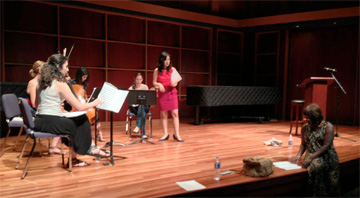 Patricia Smith, who recited and read her poetry detailing the wrath of Hurricane Katrina last week, labored on the afternoon of the performance for four hours with four musicians.
The five of them collaborated on a performance that brought tears to the eyes of the audience. Smith even wrote extra lines – just a few moments before the performance – to make her poem better fit the musical score.
In four hours, having never met before, the poet and the musicians meshed their work into a tightly woven performance for HoCoPoLitSo and the Columbia Festival of the Arts called “The Sound and Fury of New Orleans.”
Audience member Mike Clark said he emerged from the reading feeling “flayed,” he had been so moved by the show.
First performed in October 2012, the synthesis of music and poetry was the brainchild of Martin Farawell, director of the Geraldine R, Dodge Poetry Festival, and had not been performed since. Board member Tim Singleton saw Smith at Dodge, and decided HoCoPoLitSo just had to host her.
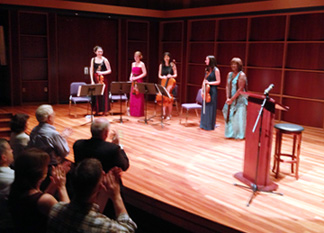
Smith performed work from her book, Blood Dazzler, a National Book Award finalist, as the Sage String Quartet played Wynton Marsalis’ “At the Octoroon Balls” for an audience that grew deeply silent.
 Violinists Arminé Graham and Laura Chang reached deep into the heart of the poems, Maggie Hummel on cello drew out the voice of Katrina during “Blue Lights on the Bayou,” and Sarah Hart and her viola flirted with the ragtime. Each note, whether quavering or raucous, seemed to speak intimately with Smith’s poems about New Orleans as lascivious flirt and nursing home residents left to drown in their beds, about a dog howling at the looming sky, about a woman with three babies and two arms, who drops her littlest one with a tiny splash.
But before it became art, there was the devil in the details. The musicians knew the music, the poet knew the poems, but in one short rehearsal on the afternoon of the performance, they had to make those two types of art speak as one.
The rehearsal started on a good note. Smith walked into the Monteabaro Recital Hall, saw the four musicians warming up onstage and chortled: “Girl party!”
The quartet laughed, the tension broken. Then, in their shorts and sundresses, the five women settled into the rehearsal.
 Smith began by explaining each poem, and reading it, as the musicians looked at the score. They talked about the silences that punctuated the piece, the times when the musicians would play “Hellbound Highball” and would have to tone down the frenzy so Smith’s words about running just ahead of Katrina’s winds could be heard.
The cellist, Maggie Hummel, took on the voice of Katrina, as Smith read poems in the hurricane’s hungry voice: “Every woman begins as weather.” Hummel’s fingers plucked insistently at the beginning of every poem in Katrina’s voice, lending an urgency to the hurricane’s approach.
Just at the end, when everyone was tired and the snacks of nuts and cherries had run out, Smith said she needed to say something about the ending.
“I’m hearing something,” she said. “Katrina’s voice.”
So Smith read the last few lines, and Hummel plucked those strings again.
“That’s it,” Smith said.
Throughout the rehearsal, if they weren’t sure how the piece would go, they just tried it.
“Let’s just do it and see what happens,” Smith said more than once. They did, then tried again. And art happened.
Susan Thornton Hobby
board member
On Homewood and Uncloaked Light — Truth Thomas Reflects on Literature, The Homewood Center, and The Legacy Project
Why does literature matter, and why should any person, governmental body, or private sector limb give funding support to reading and writing programs? Invariably, such questions come to haunt the days of all poets and writers from time to time. Whether these queries come from poetry audiences, or from friends around dinner tables; for any writer, they are about as welcome as bedbugs on a honeymoon pillow.
Certainly, HoCoPoLitSo (Howard County Poetry and Literature Society) is not immune to such a biting question in a time when the economic outlook of our days is cloudy. But every now and then literature happens that is so inspirational that it silences all interrogations about its worth. In that context, it gives me great joy to report that HoCoPoLitSo’s All-County Writing Competition represents such an inspirational event. It has come to my attention that eleven students recently won awards in our annual writing extravaganza. Among them is a student I taught in the setting of the Legacy Project Poetry Workshop Series at Homewood High School. My heart is full for all of the students who excelled in the contest, but it is especially full for Homewood and the “Lord.”
Homewood Center is the county’s alternative school, where students are sent if they do not “fit in” to mainstream—regular—Howard County schools. Wh en Bob Marley sang about “the stone that the builder refused . . . ” he could have been singing about this school. There is a police sub-station-like office at the front of the building (right across from the principal’s office), and that police presence is there for a reason. Many of the students at Homewood are in crisis, whether they are in the midst of difficult life situations or in the grip of battles to overcome profound life traumas. Many of them are there because they have suffered some kind of abuse, through no fault of their own. The staff is heroic, but make no mistake, it is not a Kumbaya-singing, marshmallow-roasting-around-the-campfire kind of place.
A friend and colleague, David Barrett, who is a former chair of HoCoPoLitSo, teaches there. He is, as are all the teachers at Homewood, fully committed to helping young people succeed. Several years ago, he invited me to Homewood to start a poetry workshop series called The Legacy Project. The point of the program, which ran for three years, was to extend avenues of hope to students whose lives were streets of trouble. Toward that end, I exposed the students to poetry—and to the power of their own creative voices—as an esteem-building exercise. Another purpose of Legacy was to teach young people that all people have something of value to offer the world—to leave behind. The program worked. It enriched the lives of many students and my life, as well. In that effort, I was privileged to work with Anne Reis, who is the media specialist at Homewood. Later, when workshop numbers grew, I was equally blessed to engage the assistance of another very talented poet, Alan King, who helped me facilitate the workshop.
It was there, in the creative frame of The Legacy Project, that I first met Lord Magloire. He was in the ninth grade then—and was gifted. His work, although in need of refinement, reflected his great love for books—particularly classic literature. Lord was a poet of promise who wrote of Homer as easily as he did TuPac Shakur. What I recall is that he needed someone to affirm his writing gifts—to push him. That we did, and Lord’s poetry blossomed. He overcame an abundance of his challenges and literature helped him to transform his life. In a poem he composed for the Howard County Library’s Word Up! Competition in 2011 called “The Cool,” Magloire wrote: “I come out of the cool like a slice of / cheesecake . . . I just am . . . through art . . . ”
This year, in HoCoPoLitSo’s annual writing contest, Lord Magloire won third place in HoCoPoLitSo’s poetry contest of all the submissions from all the high schools in Howard County, and was named by his teachers as winning a Promise and Achievement in Language Arts award. When a child is given the gift of self-esteem, it represents a fire that cannot be easily extinguished. In that uncloaked light, literature matters (and organizations that support literary enrichment matter) as instruments of that ignition. Yes, the next time someone asks me about the merit of art over a meal, I’ll just tell them a little bit about HoCoPoLitSo and a lot about the “Lord.”
The full list of creative writing winners is Jennifer Baik, Sarika Reddy, Brianna Richardson and Melanie Zheng (Centennial); Lord Magloire and Justen Williams (Homewood); Darby Dicks, Genevieve Ferris, Elizabeth George, Sarah Owoeye and Jennifer Piegols (Mt. Hebron). The honored judges were: Patricia Van Amburg, poet and professor at Howard Community College; Heidi Vornbrock Roosa, adjunct instructor at Howard Community College; and Sarah Cotner, media and resource specialist. I extend my affection to all.
Truth Thomas
Board member
Poetry, A Community College Student’s Perspective by Katy Day
We asked Howard Community College student Katy Day for her perspective of poetry on campus. Take a look at what she delighted us with:

HCC student, aspiring writer and newborn poetry fanatic Katy Day meets Billy Collins at the The Folger Shakespeare Library in Washington DC.
As I scurried through the halls of Duncan Hall at Howard Community College, on my way to Introduction to Creative Writing, I ignored the framed student poetry scattered throughout its walls, all the way up to class. After all, how good could a student’s poem be, especially to someone like me who didn’t even like poetry?
In class, I was already envisioning my name sprawled across a half dozen book covers in large font as my professor, Ryna May, informed the class that we would all be required to submit a piece of our writing to the school’s literary and arts magazine, The Muse.
I loved my Creative Writing class even more than I had anticipated. Each week I put more hours of work into my short stories than I did for any of my other three classes. Combined. I dreaded, however, the two weeks Professor May had dedicated to poetry. How would I be able to get through two entire weeks without writing a single story? More importantly, how would I be able to write poetry if I couldn’t even understand it?
I don’t think I was the only person in the class with these concerns and Professor May was already on top of that. She gave us all copies of the previous edition of The Muse and asked us to find a poem that we liked. I read through all of them and was shocked by how much I actually liked some of them. I realized it wasn’t that couldn’t understand poetry; I just hadn’t come into contact with it at any point during my adult life. I was blown away by the seemingly endless possibilities offered by a single page of words. I didn’t have a favorite. I had a list.
May showed us videos of current poets like Billy Collins and Taylor Mali; genius on her part. I will never be able to thank her enough for that. She sat back as we watched, casting her line out into the sea of non-poetry believers and patiently waited. She didn’t give us an opportunity to ignore poetry. She captivated us through sight, sound and pleasure as we all soaked in these universal, current poets. So this is what poetry is today, I thought. By the end of the videos, we were all swarming around the bait, snapping wildly at it. She had us hooked.
Of course, once the door to poetry is opened, there are endless other doors and hallways to get lost in. Like a mouse venturing through the walls of an old colonial house for the first time, many paths in poetry can lead to a dead end. People are easily scared off by it, but May was always there, pointing us in a promising direction.
At the end of the course, she encouraged me to submit my work to The Muse. After waiting three excruciatingly long months, I finally heard that they’d be publishing one of my short stories and one of my poems. I was ecstatic.
Professor May also invited me to read a poem at the Blackbird Poetry Festival, an event organized by both Howard Community College and HoCoPoLitSo. At the festival, I knew that a lot of students were being exposed to poetry in their adult lives for the first time, and I loved being a part of that. I was nervous, of course. Who wouldn’t be nervous doing their first poetry reading in front of their teachers, classmates, their mother, and RIVES, who was front and center, chanting my name as I walked to the podium.
Despite the fact that I was trembling with fear on the inside, I made it through the reading and was immediately praised by Tim Singleton, Board Co-Chair of HoCoPoLitSo, who announced after my performance that he liked it so much he would have liked to hear it twice. Professor May said I did great and assured me that I didn’t look nervous at all. One student told me after the event that my poem was his favorite. Rives even said that he loved my poem and I had excellent stage presence. Reading my poetry was like a rollercoaster ride. I was scared out of my mind but so high off of the adrenaline afterwards that I couldn’t wait to do it again.
Luckily I didn’t have to wait long because The Muse reading was only a couple of weeks later. That was a whole different experience of elation, as I picked up the first publication that contained my own work. I can’t express how lovely instructing the audience to turn to page 47 in their book to find MY POEM felt.
Howard Community College didn’t just introduce me to poetry. It provided me with all of the assurance and reassurance I needed as a writer. It gave me door-opening experiences that have fueled me to continue my journey as a poet. The dedicated and passionate English Literature professors gave me an outstanding jumpstart into poetry. Now when I’m strolling around in Duncan Hall and I come to a framed poem on the wall, I take a few moments to read it, and I’m always pleasantly surprised.
Katy Day
HCC Student
The Event of the Season: Patricia Smith & Sage String Quartet
The Sound and Fury of New Orleans
Thursday, June 27, 7:30 p.m. Monteabaro Recital Hall, The Horowitz Center
at Howard Community College
A look at Katrina New Orleans through a selection of Smith’s Blood Dazzler poems set to the music of Wynton Marsalis’ Octoroon Balls.
“Reading poems like these, overflowing with life but
contained by art, makes us all feel a little bit helpless.
These poems are blessings that will move like white
light through your veins.” – American Book Review
Straight from its  world premiere at the Geraldine R. Dodge Poetry Festival, this powerful blend of poetry and music is “breath-taking” and “not-to-be-missed.” Patricia Smith recites poems from her collection Blood Dazzler in the voices of the people lost in the floods and fury of Hurricane Katrinia accompanied by the rich, spicy music of Wynton Marsalis played by Washington D.C.’s Sage String Quartet. Marsalis’ At the Octoroon Balls is a dramatic gumbo of jazz, blues, Americana and European classical music. This performance was conceived and premiered at the 2012 Dodge Poetry Festival and has never been performed elsewhere.
Tickets available through the Columbia Festival of the Arts website.

Presented in partnership with the Columbia Festival of the Arts and Howard Community College.
Poetry Shades in the Geometry of Students’ Lives — a Guest Post by David Barrett
The latest installment in our occasional series of blog posts from members of the HoCoPoLitSo board...
 One day, I am in class alone with one of my students because her classmates are on a field trip. She has been a member of a poetry workshop that has been in place for five years at Homewood Center, Howard County’s only alternative school. It was organized by our media center specialist, inaugurated by poet Truth Thomas, and made possible from the Horizon Foundation’s contribution.
On this day, the student asks if I would listen to a poem she has been working on. I said I would and she began to read a plaintive poem about her scarred relationship with her mother. While she is reading, a second student enters the room and asks what is going on. Before I can answer, she joins us and says “This is a poem!” and starts to cry as she realizes it’s about a mother-daughter relationship. She states that she wants to say some things to her own mother (with whom she has never lived) but does not know how she would do it. After hearing her classmate’s poem, she wants to try it in a poem. With excitement in her voice, she asks if I would review it once she has completed the first draft. She is completely animated.
This is yet one more story of how poetry, serving as a vehicle to work through complex issues, is positively affecting the lives of students at our school.
Oh, I failed to mention that both girls are in my geometry class, not an English class.
By David Barrett
Ex-Officio, HoCoPoLitSo Board
Lucille Clifton & Carolyn Kizer Talk Writing
Now available for worldwide viewing on HoCoPoLitSo’s YouTube Channel, Lucille Clifton and Carolyn Kizer talking about writing.
Lucille Clifton and Carolyn Kizer:
In this first ever edition of HoCoPoLitSo’s “The Writing Life,” taped in 1985, Pulitzer Prize-winning poet Carolyn Kizer and National Book Award-winning poet Lucille Clifton interview each other and read their work. Clifton, who died in 2010, and Kizer speak about the way a place affects writing poetry, about the death of Clifton’s husband from cancer, about the restrictions on women and women poets. Clifton reads “Atlantic is a sea of bones,” a poem about the women of South Africa called “there,” and “sorrow song,” about violence and responsibility in the world. Clifton also reads “blooming,” “I’m going back to my true identity,” and “album.” Kizer reads “Bitch,” “To an Unknown Poet,” “Exodus” and talks about the structure and form of poetry, especially in her poem “Afternoon Happiness.”
“All of our writing is a trying to say,” Clifton says. “We make a mistake if we start saying that our writing is a saying, because it is at best a trying to say.”
Shakespeare on My Mind — a Guest Post by Lisa Wilde
The latest installment in our occasional series of blog posts from friends of HoCoPoLitSo. Today Lisa Wilde, director of theatre at Howard Community College and resident dramaturg at Rep Stage, has Shakespeare on her mind:
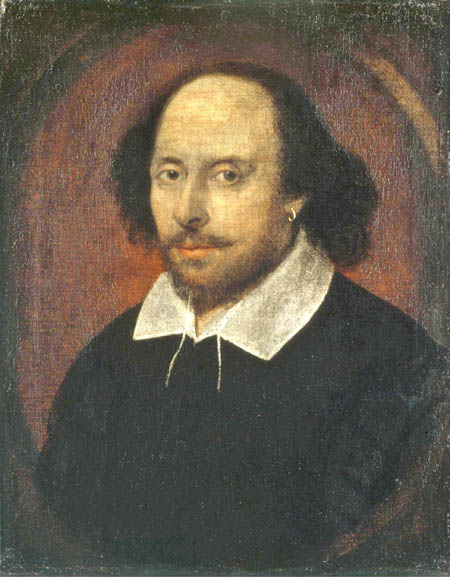 I am standing in a high school English classroom. It is 1980. I am no doubt wearing a Fair Isle sweater and a denim skirt and my hair is pulled back by tortoise shell combs. Our assignment was to memorize and deliver two Shakespearean sonnets – in my case: “Let me not to the marriage of true minds” and “Shall I compare thee to a summer’s day.” I stumble through, gently, and hopefully without anyone noticing, tapping my wooden clogs to beat out the iambs– the lub/dub or unstressed/stressed pairing so like — some have said — our most essential rhythm, our heartbeat. In my head, I am counting the ten syllables I need in each line, probably the very crutch Shakespeare’s actors used to speak their lines after a night spent with too many pints in the local pub.
Other less, shall we say, conscientious students needed more propping up to get through. Perhaps their previous evening had included activities more contemporary than me sitting at my Ethan Allen white painted desk struggling to put two lines together and then another half line, until I had gotten all fourteen– the Elizabethan sonnet as a square, rhyme scheme ABAB, CDCD, EFEF, GG.
Antiquated, huh? This notion of rote memorization and declamation. Who needs to have poems memorized and ready for the moment you are called upon to make a toast or speak in memory of someone, or you struggle to find language to provide comfort to yourself or another when you cannot find the words yourself, or to express your depth of feeling in a sparkling April or melancholy October day? Surely there’s an app for that.
Of course, we speak Shakespeare all the time. Probably you’ve seen the poster about “quoting Shakespeare”: If you speak of the “green-eyed monster” or suggest “neither a borrower nor a lender be” and “to thine own self be true” and refuse “to budge an inch” “stood on ceremony,” “danced attendance” “had short shrift,” “cold comfort” or “too much of a good thing,” you have already memorized some Shakespeare. What would it take to learn fourteen lines?
My son, looking for his buddy said “Where is Hannah?” and I responded “Who is Sylvia, fairest of the fair?” I hope to aggravate him similarly throughout his life. I have on more than one occasion suggested to a friend or sibling that they should “Sell when you can, -you are not for all markets” or wondered out loud “How will this fadge?”Am I merely pedantic? Is this a snobbish tic? Probably.
A poem in your pocket is good for the day. A poem in your mind is what remains. President Obama has called for an initiative to map the human brain. I hope they find a few dozen lines of iambic pentameter in mine.
Lisa A. Wilde
Director of Theatre, Howard Community College
Resident Dramaturg, Rep Stage
The Blackbird Poetry Festival Presents Poetry Seen, Celebrating Poetry and the Visual Arts — Tuesday, April 23rd
 This Tuesday, the 2013 Blackbird Poetry Festival invites you to be a part of Poetry Seen, exploring the intersections of poetry and the visual arts. The day-long festival on the campus of Howard Community College features writers Rives, Rachel Eliza Griffiths, and Kendra Kopelke in readings and workshops through the afternoon, the return of the Poetry Police, as well as readings by faculty and students. The festival concludes with the evening Nightbird event where Rives and Rachel Eliza Griffiths will be joined by music group Rocket Sled in a coffeehouse-style reading (see below for details).

Rives: A performance poet, storyteller and frequent speaker at TED Talks, Rives has also appeared on HBO’s Def Poetry Jam and was the co-host of Tommy Hilfiger’s Ironic Iconic America, a Bravo TV series on pop culture.
Rachel Eliza Griffiths: a poet and photographer who was awarded the 2012 Inaugural Poetry Award by the Black Caucus of the American Library Association for her most recent poetry book, Mule & Pear. In 2011, Oprah’s O Magazine featured Griffiths as an emerging poet in its first poetry issue. Griffiths’ photographs will be on display during the Blackbird Festival.
Kendra Kopelke: widely acclaimed poet and powerful voice on the Baltimore literary scene was named 2001’s “Best Poet” by BaltimoreMagazine and is the author of many books of poetry, including Hopper’s Women (inspired by the paintings of Edward Hopper).
Rocket Sled: an alternative country-rock music duo with Ed Tetreault, the engineer for several Grammy-nominated releases, and musician and Baltimore music promoter Will Hill.
Festival Schedule:
| 10:00AM | Poetry Police start to patrol HCC campus looking for National Poem in Your Pocket Day violations |
| 11:00–12:20PM | Rachel Eliza Griffiths meets with HCC’s student writers (closed) |
| 11:00-12:20PM (Burrill Galleria) | Rives meets with students and community (open and free) |
| 2:30–4:30PM DH-100 (Kittleman Room) |
Main Stage Reading in Duncan Hall (Kittleman Room 100): Kendra Kopelke, Rachel Eliza Griffiths, and Rives along with regional poets, HCC students, and faculty (open and free) |
| 7:30–9:30PM DH-100 (Kittleman Room) |
Nightbird Reading with Rives and Rachel Eliza Griffiths and a performance by musical group Rocket Sled.
Tickets: $15, $10 for seniors and for students with an id. Purchase tickets online or at the door. |
The Nightbird: a coffee house reading with poets Rives and Rachel Eliza Griffiths and music by country-rock music duo Rocket Sled, on Tuesday, April 23, 2013, at 7:30 p.m. in the Kittleman Room of Duncan Hall on the campus of Howard Community College. The theme of this year’s Blackbird Festival is “Poetry Seen,” exploring the intersections of poetry and the visual arts.
Audience members will be seated at tables during the Nightbird reading; coffee and tea will be served. Books will be sold, and authors will be available for signings. Tickets are general admission – cost $15 ($10 for students and seniors). Tickets will be available at the door or online at http://www.brownpapertickets.com/event/353577.

All events are at Howard Community College, 10901 Little Patuxent Parkway, Columbia, MD 21044; Parking available in Lot A & West Parking Garage.
The Blackbird Poetry Festival is sponsored by HoCoPoLitSo (Howard County Poetry & Literature Society) in partnership with the Howard Community College Division of English and World Languages and the Office of Student Life. Proceeds from the Nightbird reading benefit HoCoPoLitSo’s live literary programs.
Writer Traveling: Susan Thornton Hobby Returns with News of Puerto Rico’s Poet’s Passage

Photo by David Hobby.
The Poet’s Passage is a spot every community should have. Darned if it isn’t in Puerto Rico.
The shop, part coffee shop, part art store, part living room for the little old city, sits beside the little old supermarket on Calle de la Cruz in Old San Juan. All the streets in Old San Juan are cobbled in bluish stone called adoquine that arrived in Puerto Rico as ballast on Spanish ships in the 1500s. The light from shop windows makes the streets glow indigo in the frequent rain at night. One half of The Poet’s Passage is a coffee shop, with drinks like the Metaphor café latte, or the espresso (of course, called a Haiku), or the Rhyme, a latte with vanilla, almond and caramel. There are comfy chairs, a wide window to look out on the plaza, and pastries.

Photo by David Hobby.
Across a hall is the poetry shop, with paintings, poetry in calligraphy and on ceramic tiles, poetry books and sculpture for sale. There’s also a chatty parrot named Neruda who sometimes nips.
Every Tuesday night, the shop hosts an open mic poetry reading, usually with music, and sometimes the event spills out into the plaza across the street. One reading in March drew almost 2,000 people, then they had to move it indoors at midnight and it stretched on until 3 a.m.
Just beside the main, but tiny, supermarket in Old San Juan, The Poet’s Passage is owned by Lady Lee Andrews, a poet with three books published (Naturally, Changing and True Love), and her husband Nicolas Thomassin, who paints lovely images of the doors, landscapes and cobbled streets of Old San Juan and sells the prints for reasonable prices. He also makes the miniature plaster doors in the rainbow sherbet colors of Puerto Rico.

Photo by David Hobby.
Andrews’ poetry is both personal and universal, with lines like: “I looked up and saw nothing there/ to cover the blue/ fresh air I was breathing in/ I think I closed my eyes twice/ before I realized I was/ dreaming like a child/ with a red kite.”
Old San Juan is the kind of place that on Easter Sunday afternoon, hundreds of people from the town turn out to fly kites on the grounds of the El Morro, the sixteenth-century Spanish citadel built to guard the Caribbean. It’s also the kind of place that values poetry enough to keep a poetry store in business. The Poet’s Passage feels like a community hub – the kind of organization that HoCoPoLitSo seeks to be. If only we had the Puerto Rican trade winds and sunshine.
Susan Thornton Hobby
Board member
A few more pictures follow:

Photo by David Hobby.

Photo by David Hobby.
Songs, a Bit of Guinness and “The Miracle of the Actual” — A Recap HoCoPoLitSo’s 35th Irish Evening

Colum McCann reads from Let the Great World Spin and TransAtlantic during HoCoPoLitSo’s35th Annual Irish Evening. (Photo: Sam Rubin.)
HoCoPoLitSo’s 35th Irish Evening started the night before, on Feb. 28, when National Book Award-winning novelist Colum McCann drove down from New York to hang out late with Gov. Martin O’Malley and the musical Winch brothers.
It just got better from there — prose that edged us to the rims of our seats, Irish sing-a-longs with O’Malley as song-leader, midnight evocations of Irish revolutionary leader Michael Collins, a lot of Guinness, and perhaps a trace of miracle.
When McCann and Terence Winch sat down around 3:30 in the afternoon – after a little nip to get them in the mood – to record an edition of the writer-to-writer talk show, The Writing Life, McCann rubbed his hands together and said, “Let’s have some fun here today.”
Winch and McCann spoke for half an hour about McCann’s books, especially Let the Great World Spin, a 2005 National Book Award-winning novel about New York City in the 1970s, with a prostitute, a monk, a mother who loses her son to Vietnam’s destruction and a man who walks on a wire between the Twin Towers. At Winch’s request, McCann read a section from that book that he had never read aloud before, a section about a group of mothers from across the city who have lost their sons in the war:
Writing, he said, is a form of adventure, for both the writer and the reader. Fiction is an exploration of the world from inside another’s skin, a constant discovery that keeps us alive, he explained.
“Without the stories,” McCann said, “we’re just dead meat.”
That evening, after Irish Ambassador Michael Collins called McCann’s writing “undeniably and indisputably Irish,” McCann took the stage and thanked the audience, and especially O’Malley, for coming.
“I have great hope for this country because we have somebody like Gov. O’Malley,” McCann said, citing his stance on gun control. “And he can sing too. I can’t. I do, but I can’t.”
McCann read stories from his books, ranging from Newfoundland to Ireland, to Park Avenue and the Bronx and back again. McCann read from Let the Great World Spin, about the prostitute Tillie and her tricks and the Park Avenue matron bidding farewell to her doomed son in his too-short Army trousers.
Then, for the first time in public, McCann read from his new novel, TransAtlantic, set to be published in June by Random House. A multi-layered novel with three main plots, TransAtlantic follows co-pilots on the first flight across the Atlantic, in an open-cockpit modified bomber, landing in Ireland in 1919, as well as travels along on the 1845 trip to Ireland that Frederick Douglass took as a slave, hoping to convince the Irish to fight slavery, and about the efforts of Sen. George Mitchell to forge a peace in Ireland in the 1990s.
What emerged from McCann’s reading was a yearning for the sort of grace and hope that I haven’t felt in an auditorium in years. McCann spoke about finding “the miracle of the actual” in the world, and writing it. During some readings, there are moments when an audience waits, their collective breath held, all focused on the words. The author speaks those words and a tiny miracle of harmony bubbles up.
“I try to write toward grace,” McCann said, and talked about the ideas of redemption and recovery in a world of pain.
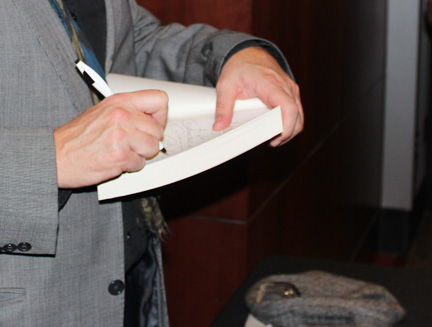
Rewriting the book. McCann signs copies of his work. (Photo: Sam Rubin.)
McCann revealed that the high school seniors of Newtown, Connecticut, have read Let the Great World Spin this winter, as a way to cope with the grief of the mass shootings at their town’s elementary school last year. This spring, he’ll be speaking with them about his book, about “grace and recovery and beauty in the face of enormous tragedy. It’s one of the best moments of my writing life.”
After the reading, the Narrowbacks, with Jesse and Terence Winch, as well as Eileen Korn Estes, Linda Hickman and Brendan Mulvihill, played and talked, until Terence called O’Malley up on stage. Dominick Murray, who played at Irish Evening for decades, but has recently become the state’s Business and Economic Development secretary, joined in on his guitar.
O’Malley grabbed a guitar and sat down to explain that he tried to protest the Winch brothers’ entreaties.
“Terry, no one wants to listen to a guy in a tie,” O’Malley told him.
“So take off your tie,” Winch replied.
He did. Then O’Malley played and sang, and lead the crowd in a sing-along to the classic Irish tune, “Jug of Punch.”
The party kept going in the gallery next door (as painter Trudy Babchak’s flamboyant women stared us down from their frames) with past HoCoPoLitSo guest and novelist Alice McDermott, along with HoCoPoLitSo’s managing director, Pam Simonson, board members and guests, band members and Estes’ blissfully sleeping baby. McCann and O’Malley invoked Michael Collins’ brave sacrifice for peace as they sipped their beers around midnight.
“Jay-sus,” McCann could occasionally be heard to mutter, as Estes’ voice drifted over the crowd and the Jameson’s whiskey flowed. What a night.
 HoCoPoLitSo