

Writers Come to see Writers.
I have a lot of HoCoPoLitSo memories. They start from way back when I was in high school and I had no idea the organization existed or what it did. All I remember was that I was on a field trip that left me wanting to be Derek Walcott once I grew up. Though a favorite HoCoPoLitSo memory, that is another story. Today I want to share a few moments of writers coming to see writers and what an honor it is to be in the midst of such occasion.
Many stories start with Irish Evening for HoCoPoLitSo. It is a landmark event. I think my awareness of other writers coming to HoCoPoLitSo events to see our headliner started one such evening. Maybe it was the Guinness, but more probably it was Colm Tóibín that brought Colum McCann down to our neck of the woods from his Manhattan apartment for the 21st annual Irish Evening. At that point in the now world famous career of Tóibín, it was a rare thing to him to this side of the Atlantic. McCann took advantage and a train to visit Columbia a year after he himself had read for Irish Evening.
I remember little of the reading that night. I seldom remember Irish Evenings and that is not for the drinking that often followed. They are labor intensive occasions to produce and I tend to be tending to that aspect. Tóibín’s voice is still in my head and bits of The Heather Blazing from that reading; I did catch some of it. What I do remember is that there were a handful of folks, me lucky enough to be among them, that headed off into the night with a number of bottles to listen to Colm and Colum talk about writing once the event was done and packed away. What an honor.
Quite recently, Colum McCann, now many books into his fame, came to another Irish Evening to read from Transatlantic, just about to be published. It was his first reading of the work to an audience and a fascinating occasion as he caught a sentence he hadn’t right and promised us he would go back to the galleys to correct it. An honest moment in the creative process.
I spotted a number of Howard County writers in attendance that evening. They were joined by none other than Alice McDermott and, I am told, George Pelicanos. The two had come from Baltimore and Washington, respectively, to take in one of the masters of prose in suburban Columbia. If we are dropping names here, I’ll add that the Governor came from Annapolis and even joined in to play with the band. After the evening at the green room party, McCann himself joined in the singing of songs.
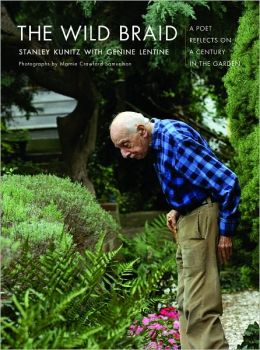
Stanley Kunitz in his garden on the cover of his book The Wild Braid.
Perhaps my favorite coming together of writers to see a particularly treasured writer was for the poet Stanley Kunitz in 1993. We all knew Mr. Kunitz was old old, 88, and that this would be the last opportunity we would have to see him. In a space that no longer exists as a venue for readings – the lower Nursing Lounge on the campus of Howard Community College – Kunitz read to a standing room only crowd that adored each and every syllable. The audience well knew his work and you could tell that he could tell: he put on a commanding performance.
I remember crowded in that room with us were Carolyn Forché and Gregory Orr who had come up from the University of Virginia for the occasion. Afterwards at a reception, all whispered to each other in awe and confirmed how lucky we were to have shared this intimate occasion with the great Stanley Kunitz. I went on to hear him read a number of times since that occasion: our collective luck grew as he lived to be 100.
Why do writers come to see other writers? For the occasion of Kunitz, it was likely reverence and the notion of ‘this might be the last time’ and one not to miss. On other occasions, it is probably more outright a taking in of craft, an opportunity to learn and admire. I know I go see other writers to learn and affirm what common language can do in the hands of masters. Thank you for that, HoCoPoLitSo.
Tim Singleton
Co-chair, HoCoPoLitSo Board
Have a favorite HoCoPoLitSo memory? HoCoPoLitSo is currently celebrating its 4oth season and would love to hear from you. Visit the Share Your Memory page and share a favorite story or two with us. As we collect favorite memories, we’ll share them in a future blog posts.
Susan Hobby Reviews Irish Evening and the Multitudes that are Emma Donoghue
Emma Donoghue contains multitudes.

Emma Donoghue. Photo by Lee Waxman
The Irish novelist writes from the point of view of a five-year-old imprisoned with his mother (Room), a French erotic dancer in 1870s San Francisco (Frog Music), a Victorian spinster enmeshed in a friend’s nasty divorce (The Sealed Letter), and a formerly destitute prostitute and fashion fiend of the eighteenth century (Slammerkin).
On Feb. 6, HoCoPoLitSo’s 37th Annual Irish Evening of Music and Poetry featured Donoghue and her various voices. The Dublin-born novelist read from two books, her blockbuster Room and her latest, Frog Music.
The audience ate it up. Donoghue’s voice flipped from character to character as she read from Frog Music. During the dialogue, Donoghue’s voice changed from the rough Irish of the spreading Irish-American family MacNamara — the youngest boy to the frazzled mother and the slightly drunken father — to the accented lilt of a French-born erotic dancer Blanche, to the husky farmer bartender next door.
And when she read from Room, Donoghue mimicked the open-faced innocence and twisted grammar of a five-year-old. As the screenwriter for the independent film of her novel, due out in the fall of 2015, Donoghue said she thoroughly enjoyed sitting on set, keeping her mouth shut, as the actors brought her novel to life.
In her first introduction for HoCoPoLitSo’s Irish Evening, new Irish Ambassador Anne Anderson explained that a recent gala theme, “Ireland: Legendary and Contemporary,” made her think of Emma Donoghue. “Emma is a natural cosmopolitan. She moves easily in time and space and between historic and contemporary space. … She is a vivid narrator for our time.”
Earlier in the day, that vivid narrator sat down with D.C. novelist Mary Kay Zuravleff to film an edition of The Writing Life, HoCoPoLitSo’s writer-to-writer talk show (www.youtube.com/hocopolitso). The two writers laughed and talked about Donoghue’s work, which includes a dozen books of fiction, literary criticism, numerous short stories, plus several plays and radio dramas.
Donoghue spent her first 20 years in Dublin, “that early marinating leaves a mark,” she laughed, as the youngest of eight children.
“It made us competitive and loquacious,” she said. “It was a big and noisy, bookish house. My dad is a literary critic (Denis Donoghue, the Henry James professor at New York University).”
Her books, Donoghue explained, are “fiction that walks arm in arm with fact.”
Frog Music tells the story of a real unsolved murder from the point of view of Blanche, the “burlesque (to put it generously) dancer,” Donoghue says, a woman who is a new friend to the murder victim, Jenny Bonnet. Bonnet was, Donoghue says, “the ideal murder victim; she was born trouble.” The victim, a cross-dressing frog-catcher for San Francisco’s restaurants in the 1870s, and most of the characters in this novel, are based in a history that Donoghue meticulously researched.

Laura Yoo gets her book signed by Emma Donoghue. Photo by Lee Waxman
Room is the least fact-based of her novels, Donoghue told the audience, but did take its premise from a real headline — a young Austrian woman kept captive by her father, Josef Fritzl, who sired seven children with her and kept three of those children imprisoned as well. Donoghue says she thinks of Room as part fairy tale, part science fiction and “a bit like a nightmare.” Five-year-old Jack tells the story — imprisoned with his mother, Jack doesn’t know there is more to the world than the room in which they are captive, thanks to the protective, magical world his mother builds with him in their small space.
Donoghue said that she doesn’t like to repeat herself, so she sets up new challenges for herself. Her next project is a book for the middle school market — “I’m far more scared of them as an audience,” she laughed. They might throw spitballs, she laughed.
Friday night’s listeners didn’t throw anything but applause Donoghue’s way. And they clapped (and some danced) through the second half of the evening, the concert of traditional Irish music and step dancing by Narrowbacks and young dancers from the Culkin School.
The Irish Evening is a long-standing tradition that helps raise money for HoCoPoLitSo’s programs for adult and student audiences. We need your support to produce these kind of events. Please consider clicking our “donate” button on this page.
Susan Thornton Hobby
Recording secretary
Howard County Poetry and Literature Society board
 HoCoPoLitSo