

HoCoPoLitSo names author Laura Shovan as poet-in-residence
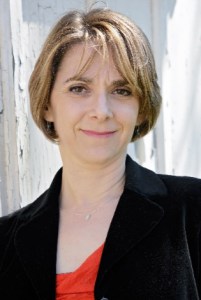
Laura Shovan
The Howard County Poetry & Literature Society (HoCoPoLitSo) has chosen Laura Shovan, winner of the 2009 Harriss Poetry Prize and author of an upcoming novel-in-verse for young readers, as its 24th poet-in-residence. Shovan will visit county high schools, the alternative school and Howard Community College classes to read her work and guide the students’ writing.
Using portraits and news headlines as triggers for poetry, Shovan will lead the students in writing their own verse. Shovan also plans to start a public reading series with student participation. A Maryland State Arts Council artist-in-residence since 1999, Shovan is the poetry editor of the Little Patuxent Review. Shovan’s book, The Last Fifth Grade of Emerson Elementary, comes out in April 2016 from Wendy Lamb Books, an imprint of Random House. Her poetry chapbook, Mountain, Log, Salt and Stone, won the Harriss prize, and she has edited two poetry anthologies. Shovan graduated from NYU’s dramatic writing program, taught high school and worked for the Dodge Poetry Festival.
For 24 years, HoCoPoLitSo has brought contemporary writers to the students of Howard County to encourage the love of literature and writing. Atholton High School teacher Jennifer Timmel, whose class wrote with last year’s poet-in-residence Joseph Ross, said about the experience: “I think the poet-in-residence program is brilliant. The students were all very moved by (Ross’s) poetry; many of them are writers and poets themselves, so to be able to speak with someone who writes for a living was very inspirational to them. They found his work interesting and inspiring. Mr. Ross is … an incredible combination of encouraging teacher and good poet.”
Shovan follows in the footsteps of illustrious writers, including Lucille Clifton, Li-Young Lee, Michael Glaser and Grace Cavalieri. Last year’s poet-in-residence, Joseph Ross, wrote, “For high school students, I’m convinced poetry can help them discover who they are. It helps them know they’re not alone. Poetry has healing properties, it connects us to everyone else.”
In The News: Joy Harjo Wins $100,000 Poetry Prize
Congratulations goes out to Joy Harjo who has just won the Wallace Stevens award from the Academy of American Poets for ‘proven mastery’ as a poet. The award comes with a $100,000 prize for lifetime achievement. Read The Guardian’s story about the award here.
Part of that life time achievement was a visit to HoCoPoLitSo in 2008 when she read and performed music to an audience at the Howard County Conservancy during an afternoon event entitled “Poetry by Nature, A Family Affair.”
During the visit to Howard County, Ms. Harjo recorded the following episode of The Writing Life:
Poetry in Motion: How to Start a Movement
By Katy Day

Katy Day, student on the HoCoPoLitSo board, writes Poetry in Motion on the third Thursday of each month.
Mind-shattering. It’s a word that best describes so many current events. People shot dead in a church — Charleston. Church burnings – throughout The South. Reflexive incarceration — everywhere. Uprisings of the underserved — Baltimore. The impoverished. The unfortunate. Inequality. Racism. Hate.
What can one person do to change the current state of the world?
 I’ve come to know one place where you can begin to change things. Poetry.
If you hang around advocates of poetry and literature, you’ll often hear claims like “poetry has the power to promote change” or “poetry heals,” and if you’re like me, you’ll want evidence to support those claims. As you may know from a previous post of mine about what I’ve learned from the Humanities, I study both English literature and psychology. I appreciate theories about human nature that poetry and literature provide, but I also appreciate claims that are supported by science.
For the poetic minds, the scientific minds, and for those like me who fall somewhere in between, I have compiled a list of just a few ways in which words can make a difference that are all backed by science.
- Poetry has the power to reduce symptoms of depression and PTSD in adolescents who have suffered from abuse.
- Expressive writing causes increased physical and mental health.
There is a lot of research on the benefits of expressive writing. Dr. James Pennebaker is a leading psychologist in this field of research and has been studying the effects of expressive writing for over 20 years. He has found that people who write about deep emotions and difficult, traumatic experiences visit their doctor less frequently, experience an increase in immune system functioning, and report feeling happier. He has also found that participants in his studies who benefit most use insight and causal words. He posits that the act of meaning-making is, at least in part, responsible for the many benefits of expressive writing. This involves deriving meaning and insight from difficult experiences. Other research has found that expressive writing leads to decreased distress, negative affect, and depression. For advice on practicing expressive writing to improve physical and mental health, visit this website.
- Partaking in poetry therapy causes an increase in self-esteem, motivation for success, self-identity, self-expression, decision-making, and team cohesion in middle school students.
- Reading about friendships between fictional characters from different groups reduces prejudice.
There have been several experiments that studied the effects of reading fiction on reducing stigma associated with certain out-groups. One study found that reading Harry Potter novels decreases prejudice among stigmatized groups, including immigrants, homosexuals, and refugees.
- Youth slam poetry promotes social change.
One study analyzed 50 slam poems written by teenagers and found that poems addressed youth (including their agency, identity, and capacity to be critical thinkers), sexuality, health, and rights. Talking about health, sexuality, and human rights are often stigmatized, but poetry appears to be a place in which these topics are acceptable.
Need more proof? Read this poem by Lucile Clifton and experience the empowering capability of poetry for yourself. Poetry is a foundation for the individual looking out at a crazy world, a place from which change can grow.
won’t you celebrate with me
By Lucille Clifton
won’t you celebrate with me
what i have shaped into
a kind of life? i had no model.
born in babylon
both nonwhite and woman
what did i see to be except myself?
i made it up
here on this bridge between
starshine and clay,
my one hand holding tight
my other hand; come celebrate
with me that everyday
something has tried to kill me
and has failed.
Katy Day, student on the HoCoPoLitSo board, writes Poetry in Motion on the third Thursday of each month.
Source material:
Kloser, K. (2013). Positive youth development through the use of poetry therapy: The contributing effects of language arts in mental health counseling with middle school-age children. Journal Of Poetry Therapy, 26(4), 237-253. doi:10.1080/08893675.2013.849042
Brillantes-Evangelista, G. (2013). An evaluation of visual arts and poetry as therapeutic interventions with abused adolescents. The Arts In Psychotherapy, 40(1), 71-84. doi:10.1016/j.aip.2012.11.005
Vezzali, L., Stathi, S., Giovannini, D., Capozza, D., & Trifiletti, E. (2014). The greatest magic of harry potter: Reducing prejudice. Journal Of Applied Social Psychology, doi:10.1111/jasp.12279
Fields, A., Snapp, S., Russell, S. T., Licona, A. C., & Tilley, E. H. (2014). Youth voices and knowledges: Slam poetry speaks to social policies. Sexuality Research & Social Policy: A Journal Of The NSRC, 11(4), 310-321. doi:10.1007/s13178-014-0154-9
Greenberg, M. A., & Stone, A. A. (1992). Emotional disclosure about traumas and its relation to health: Effects of previous disclosure and trauma severity. Journal Of Personality And Social Psychology, 63(1), 75-84. doi:10.1037/0022-3514.63.1.75
Pennebaker, J. W. (1997). Writing about emotional experiences as a therapeutic process. Psychological Science, 8(3), 162-166. doi:10.1111/j.1467 9280.1997.tb00403.x
Pennebaker, J. W. Writing and Health: Some Practical Advice. Retrieved from
http://homepage.psy.utexas.edu/HomePage/Faculty/Pennebaker/Home2000/WritingandHealth.html
Pennebaker, J. W., Kiecolt-Glaser, J. K., & Glaser, R. (1988). Disclosure of traumas and
immune function: Health implications for psychotherapy. Journal Of Consulting And
Clinical Psychology, 56(2), 239-245. doi:10.1037/0022-006X.56.2.239
Mana’s Musing: Could a Robot Write Poetry?

LAURA YOO, a member of HOCOPOLITSO Board, writes MANA’S MUSINGS for the second week of each month on the HOCOPOLITSO BLOG.
Recently, I watched a movie called Ex Machina. It’s a science-fiction film about two people: Nathan is the creator of an Artificial Intelligence named Ava and Caleb is the man called upon to do the Turing Test, which is “a test of a machine’s ability to exhibit intelligent behavior equivalent to, or indistinguishable from, that of a human” (Wikipedia).
Like many movies and stories about AI, Ex Machina ultimately asks “What does it mean to be human?” The movie defines this difference between machine and human as self-awareness and consciousness. But the true question, of course, is this: What does that self-awareness or consciousness look like? The movie uses the example of a chess player: A chess playing AI may have all the possible moves in its data but is it aware of the game or itself as a player of that game? In another movie about artificial intelligence, Transcendence, the “self awareness problem” is also at the heart of the issue. When a super computer named PINN is asked to demonstrate its self-awareness, PINN asks the humans “How do YOU know you’re self aware?” Of course, the humans are stumped.
After watching Ex Machina, I got to thinking about this question about what makes us human, and I thought about Ava’s ability to create. She draws. At first, she makes random marks on paper that do not resemble any object. Then, Caleb encourages her to draw objects and she draws them very well, including a portrait of Caleb. She can draw what she sees but can she create something new? Could Ava write poetry?
But first, I think I have to start with “What is poetry?” If we can define this, then perhaps we can try to see if Ava could create it. There are many descriptions of poetry but to define it is quite challenging. The dictionary definition for poetry – “literary work in which special intensity is given to the expression of feelings and ideas by the use of distinctive style and rhythm” – is most unsatisfying to most of us, I think. Perhaps poetry is something that defies definition.
Nonetheless, many poets have penned famous lines about poetry that help us know poetry when we see one.
For example, William Wordsworth so famously wrote that “Poetry is the spontaneous overflow of powerful feelings: it takes its origin from emotion recollected in tranquility.” And Percy Shelley claimed “Poetry lifts the veil from the hidden beauty of the world, and makes familiar objects be as if they were not familiar.” How do you think Ava’s capacity for poetry would fare against these measures?
Let’s take “We Real Cool” by Gwendolyn Brooks, for example.
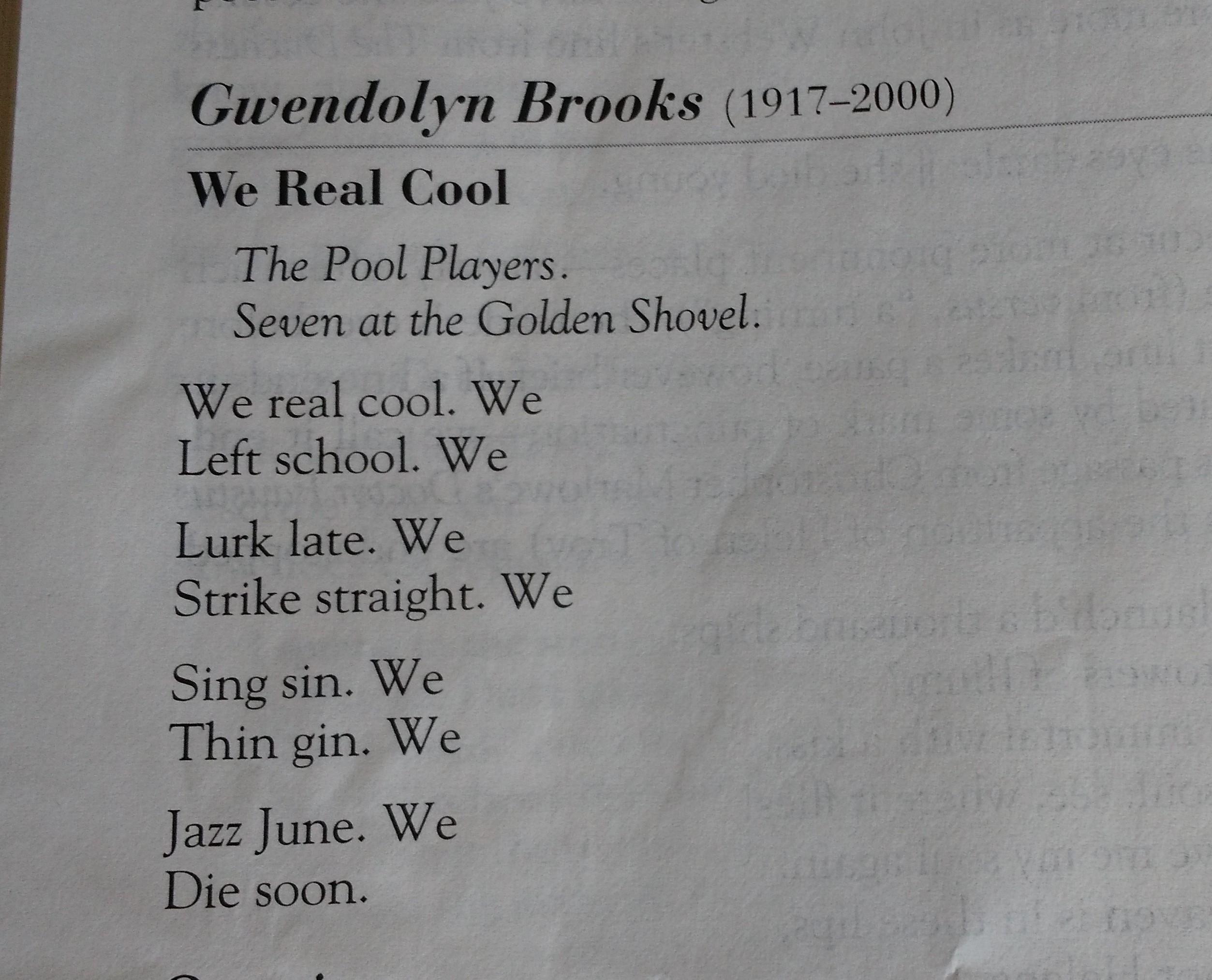
Could (or would?) Ava create the line-breaks that emphasize “We” at the end of each line? Those specific rhymes? That rhythm? What about the very idea of writing a poem? Brooks says that she saw these guys playing pool at the “Golden Shovel” and wondered how they must see themselves. In Brooks’ imagination, they think they are “real cool.” Especially given that “cool” is difficult to define at any given cultural moment, I wonder if Ava could come to this conclusion about the Pool Players and create a poem to represent her thought-experience. Here’s another take: Two AIs might come up with the exact same poem about observing the same pool players at the Golden Shovel, but I think only Gwendolyn Brooks and no other poet could have created “We Real Cool” just as it is. I mean, just listen to the way she reads it.
In a broader sense, what about creativity? For example, Edward de Bono, who coined the term “lateral thinking,” says this about creativity:
“Creativity involves breaking out of established patterns in order to look at things in a different way.”
Do we think Ava could do this? Certainly an AI could be programmed with all the necessary data – say, all poems ever written by every poet in human history – which would serve as “established patterns.” Could she come up with something that has not existed before, see something that’s missing from her data and create it?
What about this claim about creativity by Frank Goble, a prominent champion of “character education”?
“Because of their courage, their lack of fear, they (creative people) are willing to make silly mistakes. The truly creative person is one who can think crazy; such a person knows full well that many of his great ideas will prove to be worthless. The creative person is flexible; he is able to change as the situation changes, to break habits, to face indecision and changes in conditions without undue stress. He is not threatened by the unexpected as rigid, inflexible people are.”
Goble clearly identifies the act of creation as distinctly human here. Not just human – but specifically the human ability to make sense out of chaos. As a character in Transcendence says, “Human emotion. It can contain illogical conflicts.” Along these lines, I also like what Christopher Morley says about poetry: “The courage of the poet is to keep ajar the door that leads into madness.”
Maybe I’m drawn to these descriptions that allude to all that is disorderly because then I feel that I can keep Ava out of it. Surely, an AI could not possibly deal in or deal with madness, chaos, crazy, and mistakes? Surely a computer like Ava is all about logic, order, pattern, and all that makes sense. As you can see, I’m biased. And really what I want is to say is that poetry is a uniquely human activity. I don’t want AIs to appropriate poetry.
Just as AI movies are ultimately concerned not with science, machine, or robots but rather with humanity, my little musing here is really not about whether or not a robot could write poetry but really about… What is poetry?
The more I ponder this question and go from one answer to the next question, I feel myself getting sucked into a black hole (watch Intersteller) and getting lost. Time to stop. And go read a good poem like this one:
“Eating Poetry” by Mark Strand
Ink runs from the corners of my mouth.
There is no happiness like mine.
I have been eating poetry.The librarian does not believe what she sees.
Her eyes are sad
and she walks with her hands in her dress.The poems are gone.
The light is dim.
The dogs are on the basement stairs and coming up.[…]
I am a new man.
I snarl at her and bark.
I romp with joy in the bookish dark.
Join Us and Others: Underground Rooftop Coffee House — Voices from the Edge
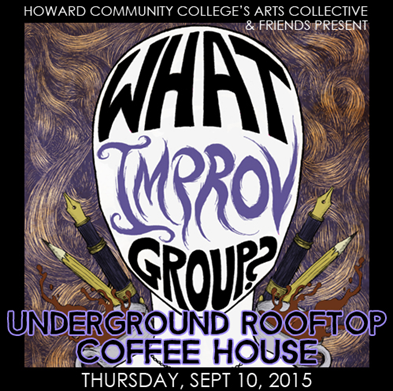 Thursday, September 10, at 7:00pm-9:00pm
HoCoPoLitSo is ecstatic to work with Howard Community College’s Arts Collective’s “What Improv Group?!?!” (W.I.G.) and the campus’s Creative Writers to present an “Underground Rooftop Coffee House.” Please join us on September 10th and see why.
The event fuses W.I.G.’s underground, edgy take on improv with powerful and evocative stories inspired by poets and writers. W.I.G.’s cast features HCC students, staff and guest artists: Douglas Beatty, Noah Bird, Diego Esmolo, Doug Goodin, Daniel Johnston, Autumn Kramer, Terri Laurino, Scott Lichtor, Thomas Matera, Apryl Motley, Shannon Willing, Sierra Young… and a few secret-surprise guests! This event will also feature poetry and prose written by HoCoPoLitSo’s Nsikan Akpan and Katy Day and local Stoop star James Karantonis. You can’t have a coffee house without music, right? Chris Sisson and Steven Caballero will provide an acoustical array of songs for the evening.
But wait, there’s more: W.I.G. will want you to raise your voice to the collective “primal scream” to celebrate this, the start of Arts Collective’s 21st season. Happy Anniversary to them.
Tickets: Includes Coffee & Treats!
$10 All Students with I.D., Seniors/Military/Groups
$15 General Admission
Parental guidance suggested. No one under 14 admitted. Seating is limited, reserve tickets now!
Special Event – Post-Show Discussion:
Following 9/10’s performance!
 HoCoPoLitSo