


On Reading: On Pool Cleaning, Poets, and iPods.

Tim Singleton, co-chair of the HoCoPoLitSo board, writes On Reading for the last week of each month on the HoCoPoLitSo blog.
One of the rites of Memorial Day Weekend is the opening of public and private pools. The weekend, while not an entrance into summer proper, does set us thinking forward to a more leisurely pace in the days ahead, the cheer of those at waterplay, and, if you are like me, of summer reading. Who doesn’t like an hour or so poolside with a good book?
 But pools aren’t just fun, games, or the odd hour with a novel in proximity. They do need their maintenance and the start of the season has me thinking back a few years where I loved being the one to volunteer for the weekly tasks of skimming and filter cleaning the communal family pool at the in-laws. I’d look forward to the Saturday morning activity, put on my shorts and bare feet, plug in the iPod headphones, and head on over to the task where I could use the forty minutes or so to catch up on poetry podcasts. I had discovered the Poetry Foundation’s Poetry Lecture series, thinking a touch of lesson with my work wouldn’t be bad, and found this opportunity for dedicated listening time. It was perfect: an outside activity, knocking off a chore, getting smarter in the process. That there is summer for me.
So, with the odd peeper, dragonfly, or spicebush swallowtail for company, I’d get at the task with Elizabeth Bishop, Kwame Dawes, Simon Oritz, or Dunya Mikhail in my head. Wow, what a joy. The work was mindless: scooping crepe myrtle blossoms, half pink, half beginning to brown, from the surface of the water, emptying the scuppers of that soup of older blossoms and twigs and maybe the bloated last bit of a frog that left its voice behind in its invisible, but ever so loud kin, and the sweeping of other debris from around the pool to keep it from becoming next week’s filter stew: I’d fill my mind with these voices and their work and what others had to say about it. That’s how I discovered the brilliant Ilya Kaminsky, who at the time orchestrated the series, often himself in conversation with the featured writers. I’d look at the lacework of light on the pool’s surface and delight in the mixture of activity and education, musing on what I was hearing. I’d be in awe of the skill and wisdom of those I was listening to: Eavan Boland, Rita Dove, Gary Snyder, Gwendolyn Brooks….
When Les Murray bubbled up in the news a few years ago, I went looking for him and found this gem and bubbled it up poolside into my ears. I loved listening to stories about Frank O’Hara — did I almost fall in? yup — and, then, there is this series of international poets in conversation that is just marvelous, a window into another part of the world that only poets and their work can seem to provide – here’s an example, and another. I might have stopped and rested my arms on the broom handle not to miss a word of some of those. There were so many treasures to discover. One of my all time favorites is when I learned that Elizabeth Bishop in her college days was picked up by the police under the suspicion of solicitation. OK. Listen for yourself in the link above.
Find yourself a pleasant chore to do, one that might last forty minutes or an hour, put on some headphones, and invite these great conversations to join you. You won’t be disappointed and you’ll find you might even be looking forward to that chore the next time it comes round. Happy listening.
Tim Singleton
Board Co-chair, HoCoPoLitSo
p.s.
If you have your own list of literary podcasts to listen to, add it below in the comments and I’ll catch up with them. Another favorite of mine is the New Yorker series where one writer introduces another writer’s short story which they then read to you.
If video is your thing, check out HoCoPoLitSo’s own work of recording writers in conversation on our YouTube Channel where you will find a growing collection of episodes of The Writing Life. Here’s E.Ethelbert Miller to tell you a little about that:

Of Stars and Hurricanes, Words and Moths
Like the moths that flit thickly around their outdoor lights in rural Virginia, the words must fly around Carrie Brown and John Gregory Brown’s house on the campus of Sweet Briar College. Because not only Carrie and John are writers, but so is their daughter Molly McCully Brown.
 Family lore holds that a tiny Molly used to wake in the middle of the night and call for her mother or father because a poem was waiting and she couldn’t yet write well enough to capture it. And she had two parental examples of how to live an adult life: Catch those words swooping around and write them down.
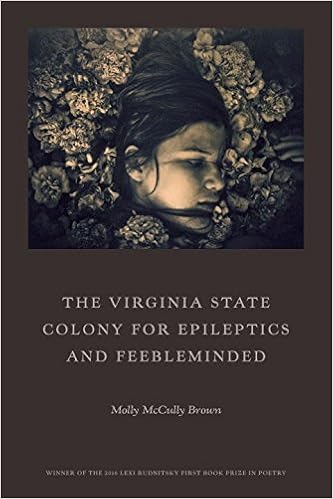
Molly’s first book of poetry won the 2016 Lexi Rudnitsky Prize, and starting in September, she’ll work as the inaugural Jeff Baskins Fellow at the Oxford American magazine.
John Gregory and Carrie Brown are returning to Columbia, the town where their family story started, for a reading to celebrate the fiftieth anniversary of the founding of this town. The pair of novelists met while working at the storied Columbia Flier, and then began their family and their careers as authors.
They’ll read together at an event June 4 at Slayton House that HoCoPoLitSo is calling “Of Stars and Hurricanes: Two Columbia Novelists Return.” Carrie Brown’s newest novel, The Stargazer’s Sister, centers on the life of eighteenth-century astronomer Caroline Herschel, while John Gregory Brown’s 2016 book A Thousand Miles from Nowhere follows a man fleeing the wreckage of his life in New Orleans after Hurricane Katrina.
Both authors’ main characters, while living in different centuries and countries, seek redemption, for a way to save themselves.
 In her opening chapter, Carrie Brown writes that Caroline thinks “a girl was not taught anything that could save her in the larger world.” Desperate to escape an abusive mother and repressive poverty, Caroline is rescued by her elder brother, William Herschel, an astronomer who, with Caroline’s help, discovers Uranus and myriad comets. Carrie explains that the relationship of the siblings – in which Caroline so closely cares for her brother that she sometimes feeds him bits of bread and cheese while he keeps both hands and his eyes on the telescopes he manufactures – was “fertile material” for a novel.
The Boston Globe writes, “Carrie Brown takes up the real life saga of the Herschels and breathes fresh life into it in her lyrical and riveting new novel … .”
“Historical fiction fills in the spaces where history is silent,” Carrie explained at a recent reading in Baltimore. Carrie tells the Herschels’ story, massaging it into the arc of fiction, to “tell the other truth of their story.”
 John Gregory Brown’s fiction is based in history – the horrible story of Hurricane Katrina – but is invented whole cloth. A former New Orleans professor loses his way, buys a store that becomes a gathering spot and exchange depot, then flees north ahead of the hurricane winds. “I am a wrecked ship,” the protagonist says in the novel. He winds up at a rural Virginia hotel owned by an East Indian widow, then discovers a community willing to lend him aid and an epic poem that might save his soul. The Boston Globe calls his book “…a tale of redemption that is both believably prosaic and incredibly, quietly moving … .”
The two novelists will read together and answer questions at this event, which also honors Ellen Conroy Kennedy, the founder and longtime executive director of HoCoPoLitSo, and her husband and longtime supporter and board member of HoCoPoLitSo, for their decades of contributions to Columbia’s cultural life.
For tickets, visit http://www.brownpapertickets.com/event/2725249.
For more information about Carrie Brown, visit http://authorcarriebrown.com/
For more information about John Gregory Brown, visit http://jgb.blog.sbc.edu/about/
For more information about Molly McCully Brown, visit https://mollymccullybrown.com/
— Susan Thornton Hobby
Recording secretary

Tyehimba Jess and W.E.B. DuBois Meet on Stage
A Guest Post by Brandt Dirmeyer
Brandt Dirmeyer is an aspiring writer and poet who wants to use language to display the ecological relationship between people and place, with a focus on revealing individuals as parts of larger wholes. You can read this poem “You’re a Mad Cow” on FIVE:2:ONE and two other poems in his blog post for the Patapsco Heritage Greenway. Below is Brandt’s reflection on Tyehimba Jess’s reading at the 2017 Blackbird Poetry Festival.

Friends Nick Stowe (left) and Brandt Dirmeyer (right) with Tyehimba Jess (middle) after the reading at the 2017 Blackbird Poetry Festival
On a warm April evening, I attended the main event of HoCoPoLitSo’s Blackbird Poetry Festival, which was a reading by the winner of the 2017 Pulitzer Prize for Poetry, Tyehimba Jess, from his newest book of poems, Olio, a collection of poems about miscellaneous African American performers who lived between the times of the Civil War and World War I. The crowd was in awe as Jess demonstrated that his poems could be read up and down, across, or in tangential patterns, which served to amplify our understanding about the personal depth of real people who played minstrel show caricatures in the 18th and 19th centuries.
As Jess read his poems about Millie and Christine, a pair of twins conjoined at the ribcage and pelvis, and Walker and Williams, famous minstrel comedians at the time, I couldn’t help but hear the voice of W.E.B. DuBois echo within my mind. During my undergraduate studies at Towson, I studied how DuBois’ concept of “double consciousness” manifested itself in Ralph Ellison’s novel, Invisible Man. In The Souls of Black Folk, DuBois wrote, “It is a peculiar sensation, this double-consciousness, this sense of always looking at one’s self through the eyes of others, of measuring one’s soul by the tape of a world that looks on in amused contempt and pity.”
Despite the hundred-plus year difference in time between when DuBois, Millie and Christine, and Walker and Williams were active, affective, and alive, I felt their connection to our current place. Listening to Jess speak, it was as if we had not only gone back in time to when Millie and Christine and Walker and Williams were heating up the stage with dance and song, but also into their minds to discover the multi-faceted exterior and interior forces that pressured them to dance and sing. I could feel DuBois’ words still alive as well, as there are similar exterior and interior forces currently at play in American society that find their origins in the time-periods of the minstrel show, the Gilded Age, and the Antebellum South.
In fact, we could go even further back in time. As soon as Captain John Smith sailed up the Chesapeake Bay looking for natural resources to exploit, these forces of subjugation, alienation, repression, misrepresentation, othering, and inequality that have been at play in human societies across the planet for thousands of years were once again amplified in the colonies of what was once called Turtle Island, now known as North America.
Millie and Christine were talented dancers and musicians who learned to harmonize with the piano and with their voices, understood five languages, and experienced the wider world while on international tours, even meeting Queen Victoria at Buckingham Palace. Walker and Williams used their minstrel show to contest cultural ownership of racial representations to white audiences.
The poems written by Jess noted the feats of each pair, but they also asked us to look past their accomplishments and see the experiences and feelings that compelled them to swim upstream in such a torrential river. Either pair could have just as easily conformed to what society expected of them, floating with the current to save energy, but instead they used the minstrel show to simultaneously conform to the expectations of their audience, while separating themselves from other minstrel show acts by putting in effort to confront said expectations.
Like DuBois’ example of a black artisan (The Souls of Black Folk) who was conflicted between producing goods that reflect his personal perspective and producing goods that are marketable to the dominant society, Millie and Christine and Walker and Williams desired to balance themselves upon the fine line between having their performances watched and having their perspectives heard.
The characters in Jess’s poems used their work to subvert societal expectations while also playing the game that they were unfairly born into. Millie and Christine were pitied and Walker and Williams were laughed at by the audience, but they also wanted to be known for who they were. In his poetry, Jess gives these performers a humanitarian redemption by showcasing their individual inner psychological conflicts.
facing the chaos of truth: Tara Hart on the Poetry of Tyehimba Jess

Tara Hart, Co-Chair of HoCoPoLitSo Board of Directors and Professor of English at Howard Community College
A blog post by Tara Hart, Co-Chair of HoCoPoLitso Board of Directors
Especially at this time, when the arts are so clearly at risk of losing national support, we are so grateful to live in a community composed of people who value what poet Marilyn Nelson calls “communal pondering” of meaning, who value spacious perspectives.
At the ninth annual Blackbird Poetry Festival, we were dazzled all day by the presence of two important master poets, E. Ethelbert Miller and Tyehimba Jess, who conducted student poetry workshops in the morning, charmed us over lunch, inspired a variety of eager new poets and poetry lovers in a free open reading of many voices, taped a TV interview for our show The Writing Life, and finally, after we squeezed them up into balls and rolled them towards overwhelming questions, we let them have a dinner break and catch their breath before Mr. Jess took the stage for the last time for the Nightbird Reading.
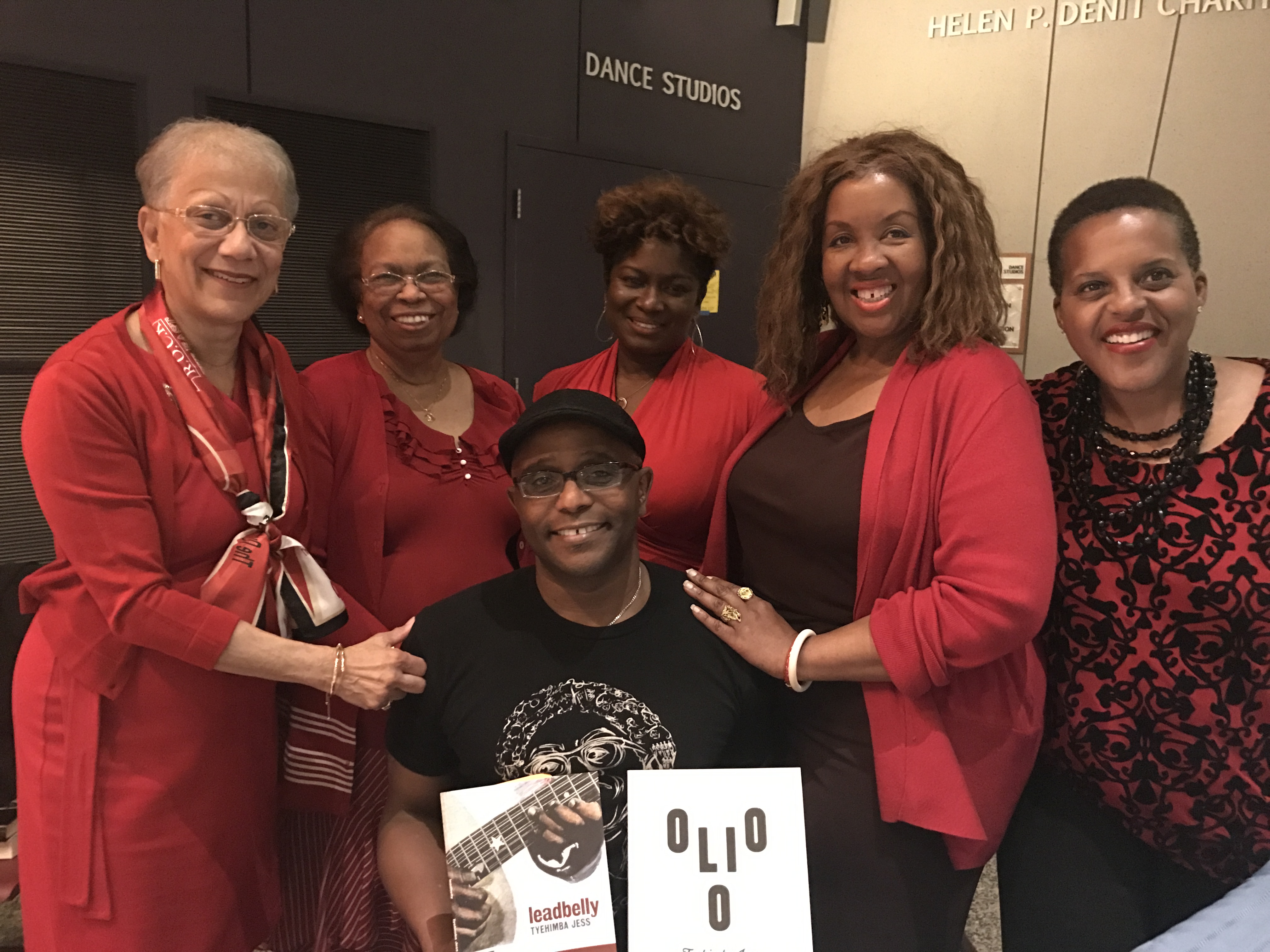
Tyehimba Jess at Blackbird Poetry Festival @ Howard Community College’s Smith Theatre
It was my honor to introduce Pulitzer Prize winning poet Tyehimba Jess to the Howard County community. Years ago, at one of the wonderful Dodge Poetry Festivals held bi-annually in New Jersey, Tim Singleton and I and several other HoCoPoLitSo board members did our usual reconnaissance to see who we thought we should invite for you. During one debriefing, I remember Tim saying, “Tyehimba Jess, Tyehimba Jess!” and I said “Yes! I saw him too, he’s amazing. And his name sounds like a song, or a prayer.” And then when we finally did connect with Mr. Jess and he accepted our invitation to come, he said, “HoCoPoLitSo! It sounds like a dance!” So I think this music Jess and HoCoPoLitSo made that evening at Nightbird Reading was meant to be.
Tyehimba Jess is the author of two award-winning books Leadbelly and Olio, and their significance and groundbreaking nature are difficult to convey sufficiently. Olio, the collection of first generation freed voices from the post-Civil War era to World War I does, as those at Found Poetry Review said, “distract you from your preconceived notions about what poetry can be, what it can do, and, ultimately, what you think you know. More than a book (and many reviewers have commented at length about what a fantastic object the book is), Olio is an extended performance, a musical score, and an epic libretto…”
Olio is made up of poems that Mr. Jess directly invites us to read in our own way and in any order (you can read the lines straight across the page, or up one side and down the other). “Weave your own chosen way among these voices,” Jess invites. There are even instructions for turning some of the pages into a sort origami that allow you to make the poems and their meanings three-dimensional. You’ll find interviews, historical documents, lists, and hymns. He faces the chaos of truth, and of our own fickle, diverse, various ways of seeing and not-seeing, and makes it all sing. Truly it is both deconstructive, giving voices back to the silenced, the misunderstood, the invisible, the abducted and it is creative – weaving them back together into patterns and inviting the reader to weave them back in ways that they choose.
There are even other ways to read the poems – I think they also tell the story of what the poet himself is achieving. Even as the poet breathes life into these people from the past, his words illuminate the impact of his own art. I’m using his words now: They “show the world the gut meaning of grace.” They are “a hurricane of back and forth notes.” They are “the sound of one mallet against history’s pale fist.” They say, “listen to how we’re bound in unison, this is our story I want you to hear.”
In his poems, boxes and trunks packed long ago are opened up, and what we find makes us question everything we thought we knew.
In the collection Leadbelly, the poems ask, “how to weed graveyard from his garden of tongue? What rainbow of prayer to pull between teeth?” They ask how we might find “a place where I can dream drought into rain, pray storm cloud out of spotless sky” or find the hope that “our wondrous oneness exists”? They speak in the voices of women as well as men, and in the voices of the objects we tie our meaning to, like guitars, or streets.
Overall, I agree with Brigit Pegeen Kelly that “It is exhilarating to be invited into a world so large and muscular, so rooted in history, a world where so much is at stake.”
And, finally I must say that the work of Mr. Jess, as well as the Poetry Out Loud program itself, are the two best arguments I know of for sustaining the National Endowment of the Arts, if these tremendous artists and their work are the result of that small investment.
WAYR Series – A Gentleman in Moscow
In this this month’s “What are you reading?” HoCoPoLitSo’s Board Member Kathy Larsen tells us about The Gentleman from Moscow by Amor Towels.
 Although The Gentleman from Moscow by Amor Towles could be a quick read, it is so beautifully written that I chose to savor it.
The novel opens in 1922 Moscow with an interrogation between Count Rostov and a Bolshevik charged with sending aristocrats to the firing squad. Expecting to die, the Count gives flippant answers. Asked if he had written a poem seen as a “call to action” prior to the Russian Revolution, the Count replies that the poem was attributed to him. Surprisingly, his life is spared. Instead, he is exiled to the Metropole Hotel and shifted from his suite above the Bolshoi to what used to be the servants’ quarters in the attic.
With the interactions among these characters working and living in the hotel, the author builds a community of hope and friendship amidst a world of fear. The Count, always charming and always observant, befriends a small girl who teaches him the terrain of the hotel. He’s kept informed by the concierge stationed at the door and kept sane by the rooftop beekeeper. He is also challenged by his nemesis, a boorish waiter who becomes the Communist enforcer.
Subtle changes in the Count’s situation reflect the changes in the greater Russian world during the 1920s and on. As Communism solidifies, the Count’s elitism and knowledge are discounted, even condemned. But when Stalin takes over and Russia returns to the world stage, the Count is asked to teach table manners to a potential ambassador.
Despite the turmoil, the love that Russians have for their homeland vibrates through the novel.
by Kathy Larsen
HoCoPoLitSo’s Board Member
 HoCoPoLitSo