

Coffee-Stained Margins: a guest post by Eunice Braimoh
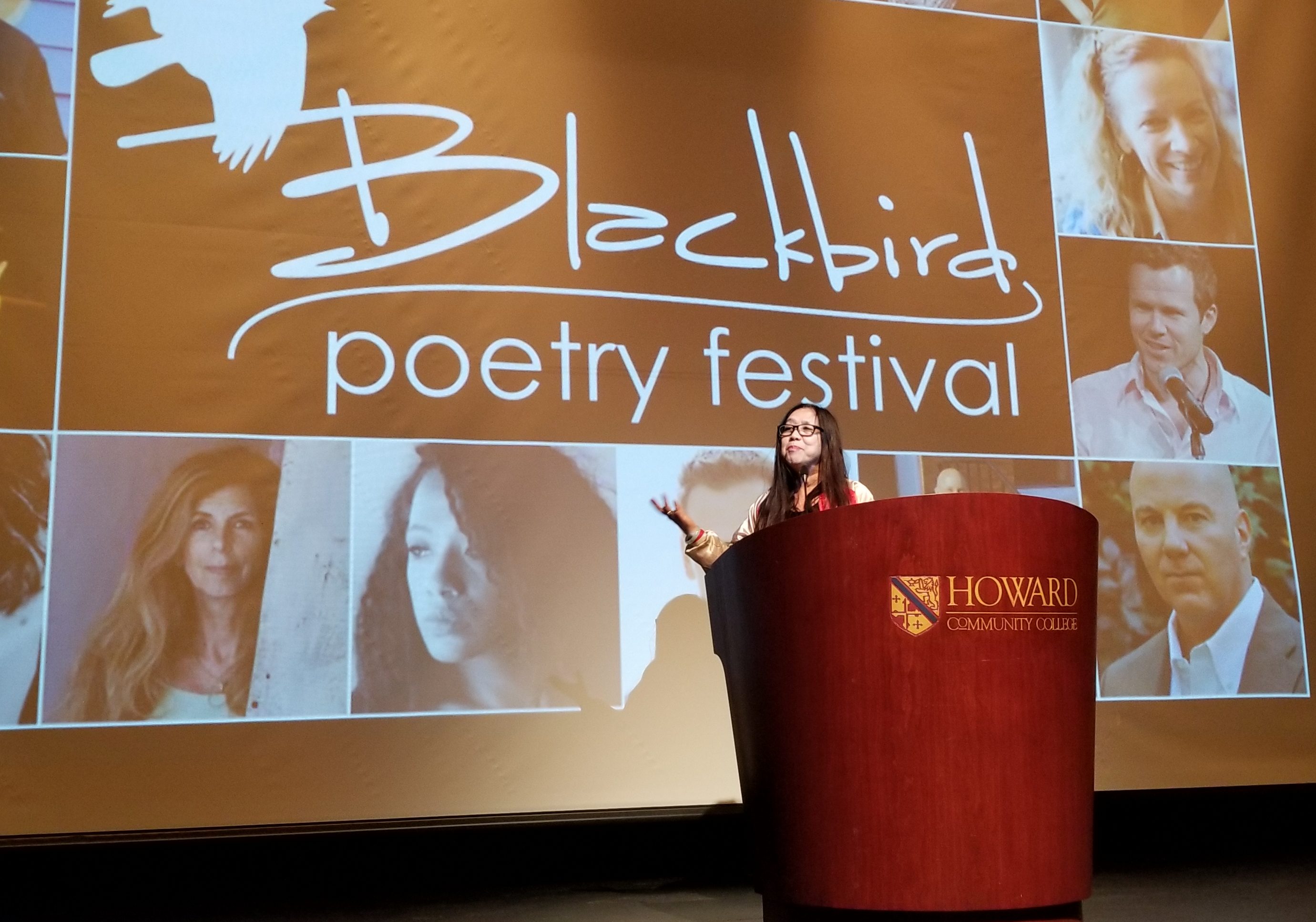
Marilyn Chin reading at the 10th Annual Blackbird Poetry Festival hosted by Howard County Poetry and Literature Society and Howard Community College on April 26, 2018
I had never heard of Marilyn Chin. But there I sat in the hazy Smith Theatre, listening to the petite, flip-flop-clad lady unfold her Chinese heritage, her voice’s rich resonance baptizing life into her words. Peppered with rhetorical questions and salted with snark, Marilyn Chin’s poetry invited the audience into conversation. As she discussed her experience with assimilation, I thought back to my years of insecurity with my Nigerian identity.
During my childhood, I tugged at my belly, my hair, my skin. I hunched in over myself. But I remember watching a spoken word from YouTube during youth group, the same lines which had echoed through my house the entire week prior because my mom, the youth leader, had been so fascinated by the video. Ears straining to keep up with the whiplash tempo, the laughing cadence, I snapped my fingers, riveted by the rain of spitfire, desperately beckoning the words barked out of the poets’ lips to be mine.
Slam poetry was alive.
A tandem of voice and pulse, spoken word went beyond sonnets and “thou”s and lofty declarations of love; it playfully teased out slant-rhymes and sidestepped the conventions of language. Poetry, I discovered, could be as unorthodox as I wished, and listening to the crowd of adroit artists (cough-SarahKay-PatrickRoche-BlytheBaird-OmarHolmon-cough) has since stirred a hunger.
For what?
Maybe I am looking for truth, naked and unholy. Maybe I write because I’m looking to sing what could be my gospel, to scream it in the shower, to spit it into the mic, to whisper it in an ear, to let it breathe ink and paper and dust.
While I write, I’ve knocked on Petrarch’s door, revisiting the poetry I once scoffed, imbibing in myself a greater appreciation for the art. Analyzing syntax and diction is what I love to do—maybe because I regularly eye my friends’ texts. (There’s a world of difference between “ok” and “Okay.”) While I am yet to be convinced that every inch of a poem is birthed from divine inspiration, I nevertheless believe that the spectrum of poetry—from spoken word to the coffee-stained margins—contains a delicateness that ought to be explored with careful hands and open eyes. As a writer, I wish to infuse electric vulnerability in my writing, inviting readers and listeners to unwind, to laugh, to have conversation.

Eunice Braimoh
As a writer exploring vulnerable curiosity, Eunice Braimoh wishes to symphonize conversation regarding race, gender, and diversity. When not effusively fangirling over slam poetry and intricate word-play, Eunice can be found writing (and rewriting) her own poetry and fiction. Previously recognized with two Regional Keys from the D.C. Metro Region, Eunice recently received a Silver Key for her poem “in which icarus does not drown”. She will be attending University of Maryland, College Park as an English major starting this fall.
Power of Poetry – a guest post by Hiram Larew
Poetry doesn’t vote. It can’t rule. It sits on no juries. It signs nothing into law. It neither runs companies or organizes houses of worship. And, it never ever wins an Academy award or Olympic Gold Medal. Or, war. On all of these fronts that matter, poetry is powerless. And for that very reason, of course, it is incredibly powerful.
Poetry is our grins, our anger, your life, my death. It’s the birds that stitch air. It’s the soul of night, the feast of day, and that ever present caution that’s careless. Poetry doesn’t decide. It doesn’t provide. If it answers at all, it does so with questions. And, to be honest, poetry doesn’t care; it cares as deeply as wells do, yes, but it never brings you water. It wants nothing from you except wanting – this is probably its most gifting power.
And it soars, when allowed to, over just about anything else we can imagine. It’s not the clouds above so much, but our need for them. Said all at once, poetry is powerful for what it cannot be, and for the dreams it wants.
If you should ever encounter a poem that makes you jump, ask yourself why. Most likely, the answer – if there is one – will be from so far-fully inside you that ancestors will wink.
Finally, poetry is really nowhere and so it’s just about everywhere around us. It lives in the corner of your eye. It watches everything from the side. Poetry is the best glancer of all. It also aches with whatever is gone. And, it cheers – even raves – for what may never be. All to say, thank goodness – and badness – for poetry, and for our never being completely sure how powerfully potent it really is.

image used with permission by Hiram Larew
Hiram Larew’s work has appeared most recently in Little Patuxent Review, FORTH, vox poetica, Poetry Super Highway, Poets & Artists, Every Day Poems, Lunaris Review (Nigeria), Amsterdam Quarterly, and The Wild Word. Author of three collections, he’s been nominated for four national Pushcart prizes, is a member of the Shakespeare Folger Library’s poetry board, and organizes several events in Prince George’s County, Maryland and beyond including Poetry X Hunger and The Poetry Poster Project. He is a global hunger specialist, and lives in Upper Marlboro, Maryland.
This piece first appeared in Echo World, and subsequently in Poets & Artists, Tales from the Forest, Miriam’s Well (blog) and Huffington Post’s Thrive Global.
 HoCoPoLitSo