

Wilde Readings Quick Six with Rissa Miller

Rissa Miller, author of Goodnight, Poet: Poems to Share at Bedtime
Occasionally, the writers who read at the Wilde Readings will answer our six burning questions about their craft and literary favorites. This month, Rissa Miller, who read at Wilde Readings on February 11th, answers our questions. Ms. Miller is hosting a free poetry workshop at the Nest in Clarksville on February 12th at 7 pm.
Who is the person in your life (past or present) that shows up most often in your writing?
I’d like to say something more honorable or romantic, but if poets seek truth, I must confess – it’s myself. All things I write, whether poetry, fiction, article, or essay have some part of me in them. Many people have influenced my writing. There are high school English teachers whose voices still echo in my mind as I write; a particularly tough professor will always be with me. She didn’t allow me to use the word “that.” Of course, my friends, family, husband, animal companions – each life that has held my heart, as well as enemies and those who hurt me, will always show up in my writing. They are the souls that formed my voice.r
Where is your favorite place to write?
Anywhere quiet. Home, work, libraries, coffee shops, laundromats. I’m not particular. I’ve written on napkins in cafes, walked out of meetings to write poems in the bathroom at jobs, and scrawled in ballpoint pen up my own arm at stoplights in the car.
Do you have any consistent pre-writing rituals?
Hot green tea. It’s more of a life ritual, I always have hot green tea, even when working out. But writing almost cannot happen without a mug besides me, gently filling the air with steam and subtle verdant aroma.
Who always gets a first read?
My husband, Nathaniel. Well, sometimes our dog, The Dude, hears me read aloud first. After them, my critique group, Ali, Melisa and Robin, see things in early stages.
What is a book you’ve read more than twice (and would read again)?
Their Eyes Were Watching God by Zora Neale Hurston; The Alchemist by Paulo Coelho; in poetry, Residence on Earth by Pablo Neruda. Each one I’ve read several times; each I am confident I will read again.
What is the most memorable reading you have attended?
Allen Ginsberg. Hearing the master himself read Kaddish, the epic poem about the life and death of his mother, literally gave me chills. At the time I was working as a journalist and had the incredible opportunity to interview him afterwards. Though I rarely get nervous and was never star struck around celebrities, Ginsberg made me break out in a cold sweat and stutter through me questions. Not just a famous personality, he was a true influence on the history poetry and writing, as well as a moment in American Society. It was such an honor.
Rissa Miller is hosting a free poetry workshop at the Nest in Clarksville, Maryland on February 12th at 7 pm. No experience required.
The next Wilde Readings is on March 10th at the Columbia Art Center and will feature authors Reuben Jackson & Edgar Silex.
on writing together
blog post by Laura Yoo
Often we portray writing as a lonely endeavor and we imagine writers cooped up in their writing rooms, alone, toiling away. This part of the writing process may well be true and writing does demand quietness and solitude. But writing also takes place in community with other writers, sometimes virtually, sometimes through conversation over the phone or email, and sometimes in real life at a coffee shop.
Laura Shovan, the author of a children’s book Last Fifth Grade of Emerson Elementary and a collection of poetry Mountain, Log, Salt, and Stone, started what she hopes will become a regular event: a write-in at the Common Kitchen in Clarksville, Maryland.
The first one took place on January 28th. In one corner of the Common Kitchen, tables were reserved for “Writers Corner.” As each person came in from the cold and joined the group, Laura introduced everyone. We sat together, each with his or her laptop or notebook, and worked quietly. Poet Patricia VanAmburg, who was at the write-in, shared with me how important it is for her to have a writing partner. She and author Ann Bracken are longtime critique partners who meet on a weekly basis to share their writings and give each other feedback. So, Patricia welcomed this new gathering of writers. Laura says 8 people attended this first write-in, including a few members of the he MD-DE-WV chapter of SCBWI (Society of Children’s Books Writers and Illustrators) and Mel Beatty who is a bookseller at the Curious Iguana bookstore in Frederick, Maryland. HoCoPoLitSo’s Tim Singleton (who worked on this piece in the session) and Susan Thornton Hobby also joined the writing fun.

Laura Shovan, Patricia VanAmburg, and Tim Singleton at the Write-In at the Common Kitchen on January 28, 2020
Laura Shovan is no stranger to “writing together.” She co-authored A Place at the Table with Saadia Faruqi, and she will be sharing that experience at the Maryland Writers Association Conference in March. Laura also brings writers together virtually through her February Poetry Project. She invites group members (usually no more than 40 people) to write a poem a day on a specific theme. For instance, last year’s theme was food and this year’s theme is is water. Group members sign up to come up with the daily prompt, and then they each write and post their drafts in a private Facebook group that same day.
Creative writing instructor and poet Tara Hart says that all students in her class at Howard Community College share their drafts in online discussion boards, but many find it daunting to provide specific feedback on each other’s writing – they may feel tentative, unqualified, or nervous of giving offense – and need a strong template to help them craft comments that are insightful and truly helpful to the writers. She encourages them to first identify what “shines” for them in a piece in order to discern a notable strength, and then to think creatively by generating a series of “what if?” questions – what if the story were told in the first person instead of the third? What if the poem ended a stanza earlier? What if the first line were the last line? In mastering peer review, they become better writers, more able to recognize the strengths to retain in their own work and to generate more possibilities for improvement, and, she hopes, more likely to seek supportive writing communities in the future.
All local writers (and anyone willing to make a drive!) are invited to the next write-in at the Common Kitchen on February 25th 9:30 am to 12:30 pm.
Writers and readers alike can also find community of lovers of writing at the next Wilde Readings With Pantea A. Tofangchi & Rissa Miller on February 11th 7 pm at the Columbia Art Center and at HoCoPoLitSo’s 42nd Annual Irish Evening with Alice McDermott on February 21st 7:30 pm at the Horowitz Visual and Performing Arts Center in Columbia.

Books And The Stories They Tell: The Bletchley Park Recreational Library.
The other day when I was visiting my dad, he handed me a book and told me to read the last paragraph aloud.
As Smith recrossed the bridge, he stopped and stood in one of the recesses to meditate on his immaturity, and to look upon the beauty of the still expanses of white moonlight and black shadow which lay before him. At last he shook his head negatively, and went home.
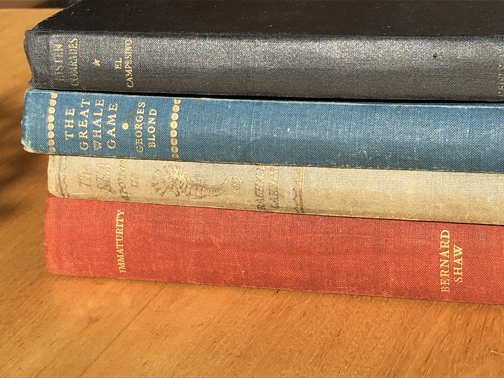
“That’s how they wrote back then,” he said, listening to the air the paragraph left behind. I admired the sentiment, and probably agreed that it was, indeed, something, the way they wrote back then. The book was a Bernard Shaw novel that I had not heard about, Immaturity. I was holding a 1931 edition. Where was this going?
It didn’t take a moment longer to realize the paragraph and the way they wrote wasn’t why I was handed the book. He started telling me a story about the inside cover, the markings there, and a bit of history I might otherwise have never come across, something called Bletchley Park.

Who knew? At the time and until the 1970s, only those that were supposed to, thanks to the Official Secrets Act. For me, a mystery was unraveling. Bletchley Park was a mansion in Buckinghamshire, England that housed a secret code-breaking operation during the second world war. I was instantly intrigued. Paraphrasing my dad, men were off fighting the war and women were tapped to translate Axis messages encoded by Enigma machines, contributing the secrets of intercepted messages to the war effort, and helping beat the Nazis ‘two years early’.
At its start, the operation at Bletchley incorporated a few hundred — you will have heard of Alan Turing and maybe Gordon Welshman and the Bombe machines that figured out the daily codes the Germans incorporated as fast as they could — and grew to an effort of thousands, all working on decoding daily messages of the Germans. The following six minute clip provides a better introduction. (While it is a video, it is more a slide show of 360 degree images that you can move around in using the tool in the top left of the frame. Have a listen and look around.)
Part of my dad’s version of the story was personal history, working in England years later, and having associates who dated back to the war. I’ll skip all the details, but so-and-so knew so-and-so-and-so and the narrative found its way to explaining the book I had in my hand. Inside the front cover was an oval stamp “B. P. Recreational Library Club”, and, on the facing page, an oddly glued-in, folded-over piece of paper with dates from the forties stamped onto it. Under that was a listing of hand-written month/day dates, all crossed out.
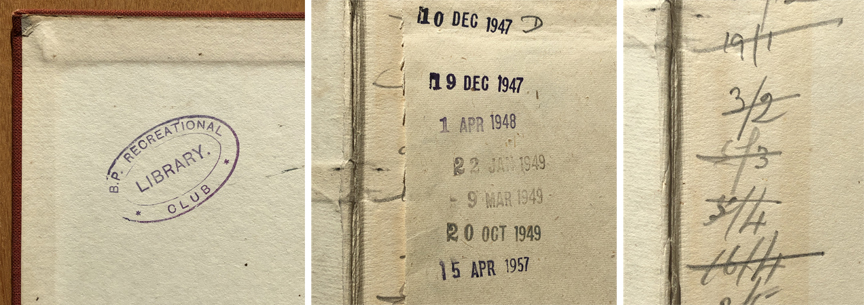
I had no idea what I was holding. He explained the book was part of a lending library created to provide recreation to workers when they weren’t putting in 15 hour days decoding.
The agency itself also tried to facilitate off-duty leisure activities for the staff in addition to amenities to provide for their general welfare. As such, the agency made buildings available for various leisure and educational activities. Hut 2 initially served as a tea room, providing hot beverages, sandwiches and lunch vouchers. The hut also contained a lending library and was the home of the Bletchley Park Recreational club from its formation in October 1940.
The Hidden History of Bletchley Park, Christopher Smith, 2015
My dad explained the book had passed into my mother’s hands from the wife of someone he had worked with. It was actually part of the Bletchley Park collection during the Second World War – WOW! (The dates suggest just after, though the style of tracking due dates on the inside pages might have started after the war?) Over the years, the library had collected more books than needed, so this was one of eight or nine that had been decommissioned and given to my mother for keeps — he wanted to make sure I knew possession was legit. The other books in the collection were from Eastgate and Cheltenham, new locations for codebreaking during the war and after as effort, capabilities, and need grew.
Unbelievable, really, that such secrecy should have prevailed.
Jane Fawcett, Veteran, Hut 6
Obviously, I grew up in the house with these books and knew nothing of their secret past, that being the way of those who can keep secrets.
Now the story is out and I hold this book in my hands in awe. What a connection to the way they did things back when. We tend to obtain a book for the story written within, but sometimes the book is the story itself, a thing to learn from as it moves from the reaches of history into our moment. Here it is today, a treasure that is monument to heroes of the past, the women of Bletchley Park.

Tim Singleton
HoCoPoLitSo, Board Co-chair
Resources:
- Bletchley Park is now a museum. Visit the webiste here online. Next time you are in England, visit the secret itself. It is on my To Do list.
- Click here for an extended documentary on Bletchley Park via YouTube.
- More on the codebreaking efforts of the Allies during World War II can be found Stephen Budiansky’s book Battle of Wits.
- Christopher Smith’s Hidden History of Bletchley Park is also fascinating.
- The Bletchley Circle — what do you do after the war if you were one of the super-smart Bletchley women? Well, back into the normal every day humdrum of ironing clothes and feeding children. This short-lived British mystery series has a few of them getting together to use their wits to solve murders, though. It is an interesting way to share the story.
 HoCoPoLitSo