

Poetry Moment: W. S. Merwin and living in the dark
This weekend, we give in to the dark. At least for the winter.
On Sunday morning, we turn our clocks back, and our evenings grow darker and darker until the shortest day of the year, the solstice, Dec. 21, 2020. It’s not just the upcoming Halloween (or election) that sends shivers in the dark.
North of Dublin, along the River Boyne in Ireland, lies a one-acre prehistoric phenomenon called Newgrange. Before Stonehenge was pushed into place, before the Egyptians built the pyramids, the Irish brought stones from all over the island to build this circular passage tomb, 90 meters in diameter. Massive carved stones ring the 39-foot-high grass-covered mound over a central stone tomb, where remains of the dead were burned and sometimes buried.
But at the entrance of the passage into Newgrange’s interior, the builders calculated carefully and constructed an open slot in the stone roof, through which at dawn on the solstice, the sun’s first light streams through and lights up the tomb’s caverns. There’s a lottery every year to celebrate the solstice inside the tomb.
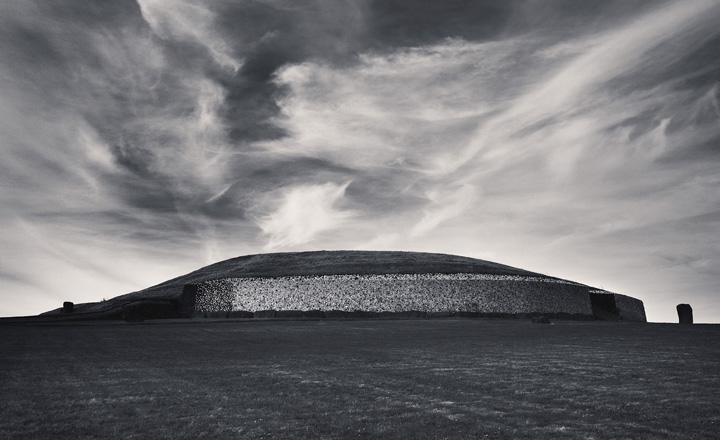
My family felt chills in that tomb when the docents doused the artificial lights, then replicated the sunrise spilling into the stone chamber. The Stone Age builders, so connected to the seasons and the land when winters were cold, long, and hungry, were determined to show that the light would return. They celebrated the turn in the season that assured their clan that spring and another planting was possible.
W. S. Merwin understood the significance of the solstice, the way people wait for a sign of hope or light in the dark winter, and the way it reminds us of the fleeting nature of life.
A practicing Buddhist and environmental activist, Merwin wrote much of his poetry after the 1970s from a rambling disused pineapple plantation in Hawaii that he carefully restored to rainforest. He watched the seasons, the plants, and the skies from his hillside house, which is now a conservancy dedicated to supporting arts and ecology.
A double Pulitzer Prize-winner, Merwin was anti-war (he donated his Pulitzer money to the Vietnam War draft resistance movement), but very much in favor of humans connecting with the natural world. Merwin visited HoCoPoLitSo audiences for a triumphant reading in 1994, just after he’d won the first annual Tanning Prize from the Academy of American Poets. He recorded the television program that same week, reading “Solstice” in his jeans and chambray shirt in the company of host poet Roland Flint. Merwin died in March 2019.
This week’s Poetry Moment verse, Merwin’s “Solstice,” addresses the ideas of light disappearing and time passing quickly, but also the comfort humans can provide one another. The final lines are, “but we are together in the whole night/ with the sun still going away/ and the year/ coming back.”
Merwin wasn’t convinced poetry could save the world. But he believed not only that he had to try, but that despair over a natural world rapidly being blighted was useless.
“The world is still here, and there are aspects of human life that are not purely destructive, and there is a need to pay attention to the things around us while they are still around us,” Merwin said. “And you know in a way, if you don’t pay that attention, the anger is just bitterness.Whether poems, human contact, the natural world, or just sheer tenacity, humans need something to pull them forward in time, to think beyond fear and anger, to see a turning point toward the light. There is much that is dark in the world today, including the coming winter. But it has been dark before and will grow light again, as Merwin and the ancients foretell.
Susan Thornton Hobby
The Writing Life producer
Poetry Moment: Marilyn Chin sends protestor a love letter
On a warm June day in 1989, the young man in the white shirt stands in front of the line of Chinese Army tanks. When they steer toward the crowds in Tiananmen Square, he again places himself in the path of the treads. He climbs onto the tank and talks into the cavity. He jumps down and blocks the tanks again. The Chinese Army had cracked down the day before and shot and killed an unnamed number of protestors. But the young man stands before the tank casually, still holding his shopping bag. Two men in blue pull him away and Tankman, as the anonymous youth was nicknamed, has never been heard from again.
Marilyn Chin, this year’s recipient of the $100,000 Ruth Lilly Poetry Prize given by the Poetry Foundation, wrote a love poem addressed to that anonymous young man, “Beijing Spring,” which we reproduce here this week’s Poetry Moment. Chin, who was given the big prize last month in a virtual ceremony [http://poetryfoundation.org/video], writes in her poem, “I believe in the passions of youth./ I believe in the eternal spring.”
Tankman’s gentle but insistent gesture reminds me of the Vietnam War protestor inserting a daisy in the barrel of a rifle during the March on the Pentagon in 1967. And of Greta Thunberg’s speech at the Climate Action Summit in 2019. And of Emma Gonzalez’s speech after the Parkland shootings during the March for Our Lives. And of the photos of the young protestors in the Arab Spring.
Young people are putting themselves at the forefront of many of the world’s movements. Just this week, thousands of pro-democracy youth are taking over the streets in Bangkok, raising the three-finger salute popularized in The Hunger Games novels to signify youth solidarity against power. In America, young people are stepping up to work as poll judges on Nov. 3 so the usual workers, the seniors, can sequester from the virus. They’re demonstrating and organizing Black Lives Matter protests, including one in Columbia that drew praise from president Barack Obama. Young people are designing signs, giving money, signing up to vote, working to make communities safe, and crushing social media. That’s the spirit Chin was channeling in “Beijing Spring.”
This kind of activism isn’t a new thing. Youth protested child labor laws in the 1900s and school segregation in the 1960s. The movements for rights for Dreamers, for Civil Rights, for Native rights, all have been invigorated by youth participation.
Chin’s poem evokes the white blossoms of a Chinese spring, but also the spirit of youth–passionate, innocent, and determined. Her poem is a loving tribute to young people who work for a better world. Follow her lead, and theirs. Vote. Young people have died for that right, including, possibly, that lithe Chinese man standing in front of the line of tanks.
Susan Thornton Hobby
The Writing Life producer
Poetry Moment: Trouble on the field with Martín Espada
Baseball is heavily and romantically played in American literature, from “Casey at the Bat” and Bernard Malamud’s The Natural through Gish Jen’s The Resisters. Martín Espada turns that beautiful green diamond on its head when he writes about brown people’s baseball experience in this week’s poem, “The Trouble Ball.”
At the moment, we are hip deep in the playoffs. The World Series starts Oct. 20, and the teams are sure to have men of many ethnic backgrounds rounding the bases. Jackie Robinson integrated the league when he started at first base for the Dodgers at Ebbets Field in April 1947, but before that day, baseball was lily white and aggressive about keeping it that way.

Espada’s poem, “The Trouble Ball,” tells the story his father told him, about going to his first American baseball game at Ebbets Field in 1941 as a new immigrant. Eleven-year-old Frank Espada had gotten off the boat from Puerto Rico not long before he and his father went to see the Brooklyn Dodgers. Little Frank wanted to be a professional baseball pitcher. In Puerto Rico, Frank and his family watched games with players from the minor leagues and the Negro leagues, and Frank idolized Satchel Paige. Paige named his pitches, one he called Bee-Ball because he said it was so fast it buzzed, and nicknames like Midnight Creeper and The Trouble Ball.

The Trouble Ball was a change-up, a pitch that looked for all the world like a fastball, but one that would stall and drop. “It makes the batter swing early and look like a fool,” Espada said on the full interview on The Writing Life. But he named his book after the pitch because “on a whole other level, it refers to other troubles. There was no greater trouble, at that time in history, and for that matter, there may not be today, than the trouble of race and the trouble of racism.”
Little Frank, sitting with his peanuts in the cheap seats at Ebbets Field in 1941, expected to see his hero Satchel Paige and the other great Negro Leaguers he’d watched in Puerto Rico. But when his father whispered to him in the stands that Black players weren’t allowed to play in the big leagues, it became a defining moment. “It was a discovery that resonated well beyond the ball field itself, and had implications for my father for the rest of his life,” Espada said.
While he did play pretty good baseball, his father instead made his living as a photographer who documented the Puerto Rican neighborhoods around him, and as a community organizer, to fight against predatory landlords, to lead marches for safer streets, to register voters. And his son, Martín, became a poet who documents trouble around the world, in hopes of changing it.
“I think memory is absolutely essential to us as a society, and poets have a role to play in restoring the collective memory and retaining the collective memory,” Espada told me in an interview.
And while many share a nostalgic fondness for baseball, Espada tells the field of dreams story from a different angle, so our collective memories also include the trouble in America.
Susan Thornton Hobby
The Writing Life producer
Watch “Why We Can’t Wait: Poetry of History and Justice by Joseph Ross”
Watch this year’s Lucille Clifton reading, “Why We Can’t Wait: Poetry of History and Justice,” featuring Joseph Ross reading from his latest book Raising King. In this event, Mr. Ross is introduced by E. Ethelbert Miller. The reading is followed by a Q&A session hosted by HoCoPoLitSo board member Susan Thornton Hobby. Ninety minutes.
Poetry Moment: Josephine Jacobsen and the lady eaten by a poem
“If I read a book and it makes my whole body so cold no fire can warm me, I know that is poetry. If I feel physically as if the top of my head were taken off, I know that is poetry. These are the only ways I know it. Is there any other way?” Emily Dickinson wrote to Thomas Wentworth Higginson in 1870.
This week’s Poetry Moment resonates with Dickinson’s famous lines about the power of literature. Read by Baltimore’s own, the very proper Josephine Jacobsen, she titled her poem “Gentle Reader.” With a sly nod to the etiquette-wise mode of address in nineteenth-century novels–think Charlotte Bronté’s Jane Eyre—Jacobsen’s lines capture the shock of reading poetry in a way that is most ungentle.
With her cap of careful curls, her pastel jackets, and her soft tones, Jacobsen looked as ladylike as she acted, polite in a way that only native-born Canadians raised in Baltimore’s Roland Park are.
“I expect that if I look in the dictionary and see the word ‘lady,’ it will be Josephine’s picture,” said poet Lucille Clifton in the 2003 memorial tribute show from which this footage is taken. “She was always such a person who valued others and understood there were a lot of ways of being a good poet.
But this lady spoke about literature, particularly in ”Gentle Reader,” like a mystic, a lover, a cult leader.
In the first stanza, Jacobsen sets up a normal evening with city and stars, reading a poem. But by the end of the stanza, the poem’s speaker has encountered a poet, “dangerous and steep” and we’re about to head off the cliff with her. The poem “juices her like a press,” and eats her “gut and marrow.” Her ear’s lust, at the end of the poem, enthusiastically agrees with James Joyce’s Molly Bloom: “yes, yes, yes, O, yes.”
That ecstasy is not often equated with poetry. Sometimes it is necessary, however, to describe a visceral response to a good poem.
Not well recognized as a poet until she was in her 70s, and with no college education, Jacobsen wrote essays, op-ed pieces, poetry, and short stories most of her life. From 1973 to 1975, Jacobsen served as the Poetry Consultant to the Library of Congress, the position later renamed as the National Poet Laureate. In 1997, the Poetry Society of America gave her the Robert Frost Medal for Lifetime Achievement in Poetry.
Both joy and terror lived in Jacobsen’s poetry, and underneath lay a kind of mystery, which is likely the same source of Dickinson’s cold and Jacobsen’s “savage sight.” Jump off that steep and dangerous cliff with Jacobsen, and with HoCoPoLitSo.
Susan Thornton Hobby
Consultant and producer of The Writing Life
Poetry Moment: Lucille Clifton’s fluttering grace
How we need this week’s poem, with its voice that calls for grace and saviors. Lucille Clifton, the Lilly Poetry Prizewinner and HoCoPoLitSo’s artistic advisor for decades, wrote “blake” and put it in her collection The Terrible Stories. But she didn’t read it to audiences very often, and HoCoPoLitSo recorded the only video of her reading this piece.
In the midst of the poems in The Terrible Stories, which address cancer, mastectomy, Biblical lust, and rage and despair over a history of slavery, this poem calls for a plume of hope.
Clifton said the poem was conceived after she had been living in the South for a while, remembering and living with its history of slavery and racist violence. She was being driven to her home in Columbia, watching out the car windows at the trees flashed by, and remembering William Blake and his visions.
Blake, a poet and artist who lived in the eighteenth and nineteenth centuries, wrote that when he was 9, he saw angels in the trees. In fact, Blake said he had visions almost daily, and angels figured heavily in those mystical experiences. He often painted angels, especially in his illustrated Songs of Innocence and of Experience. Celestial beings fluttered through his poems, guarding him, surveying the world, watching over children. The world has made famous his line: “Cherish pity, lest you drive an angel from your door.”
While Clifton didn’t often write about angels or visions directly, she always had her eyes open. In the same collection, Clifton writes about the female fox that often sat by her window, how they watched each other through the glass and acknowledged each others’ power.
“child I tell you now it was not/ the animal blood I was hiding from,/ it was the poet in her, the poet and /the terrible stories she could tell.”
“blake” is not an inspirational poem to be put on a flowery background and posted to Instagram. There are terrible stories in it, in the leaden way Clifton writes “the face/ of what we have become” and “this hunger entering our loneliness.”
But she ends the poem by coming home, “back north,” and searching the branches for poems.
Tonight, HoCoPoLitSo will host its tenth annual Lucille Clifton Reading on Friday, Oct. 2, featuring Joseph Ross reading his work based on the life of Rev. Martin Luther King, Jr.
It’s good to remember Clifton’s work this week and always. Her short lines and direct language could evoke whole other worlds, and her words both challenged and inspired readers.
Clifton’s line from “blake” about “the flutter that can save us” lingers with me. I’m watching the trees, waiting for poems or angels. Perhaps they are similar things.
Susan Thornton Hobby
The Writing Life producer
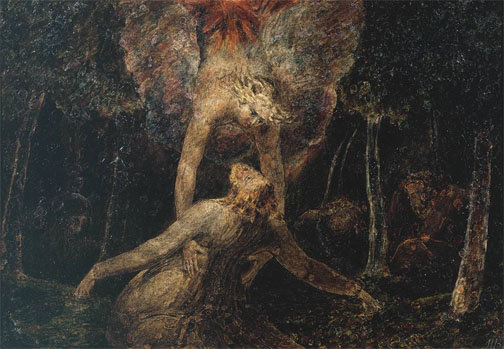
The Agony in the Garden is a small painting by William Blake, completed as part of his 1799–1800 series of Bible illustrations commissioned by his patron and friend Thomas Butts. The work illustrates a passage from the Gospel of Luke which describes Christ’s turmoil in the Garden of Gethsemane before his arrest and Crucifixion following Judas’s betrayal.[1] In Blake’s painting a brilliantly coloured and majestic angel breaks through the surrounding darkness and descends from a cloud to aid and physically support Jesus in his hour of agony.[2] The work is dominated by vertical lines, formed both from the trees and from the two arms of the angel. Two inner lines converge on Christ’s palms, evoking the nails driven through him during his crucifixion.
The Agony in the Garden was bequeathed by Blake collector Graham Robertson to the National Trust in 1948. It was acquired by the Tate Gallery the following year.[3]
 HoCoPoLitSo