

Poetry Slam Workshops with Lady Brion

Starting in February, the Howard County Library System is producing a series of four Poetry Slam workshops with social justice poet Lady Brion. HoCoPoLitSo is a supporting partner of this event.
Brion uses her poetry—focused on the black struggle, gender equality and women’s empowerment, and religious themes—to merge the space between art and activism.
Each session will focus on social justice, celebration in the midst of oppression, history, and then on March 23, the library will host an open mic. Register for each session separately.
The Anthem – February 16. Participants will explore writing celebratory unapologetic anthems about themselves, especially in the midst of an oppressive society that rarely gives space for anyone to express their fullest and truest identity. REGISTER.
Picketed – March 9. Participants will discuss the history of social movements and the way that radical demonstrations and protests can lead to change. This context will be used to have students create their own picket signs and craft a poem from it. REGISTER.
If these streets could talk – March 16. Participants will explore a social justice issue that is important to them by personifying a space, place, or object connected to their chosen social ill. REGISTER.
Open Mic – March 23. Participants will be encouraged to share poems created in one of the previous workshops or any other work that they have created. Host Lady Brion will feature sharing some of her social justice related works. REGISTER.
Lady Brion is an international spoken word artist, poetry coach, activist, organizer, and educator. Brion uses her poetry—focused on the black struggle, gender equality and women’s empowerment, and religious themes—to merge the space between art and activism. She has performed across the world including London, Ghana, Zanzibar and many of the American states. Her educational career includes teaching creative writing at the middle and elementary school level, coaching poetry teams in more than 10 institutions for the Louder Than a Bomb poetry program and residencies in more than 15 K-12 institutions. Brion is a board member for Dew More Baltimore, an art-centered nonprofit using spoken word as a tool to foster community and civic engagement.

On Reading: Reading Through a Pandemic
You would think one might plow through books during a pandemic, making the most out of quarantine and isolation. Truth be told, that’s not what this reader found to be the case. I stalled. I plodded. Mostly, I couldn’t.
While I didn’t stop reading all together, I find I have read far less books than I might have in more normal years. Hardly a day goes by where I don’t consider that, wondering what it will take to get back up to a speed to take on all the beloved unreads on my bookshelves. There’s lots of learning to do and make useful.
The way I described it early on was that I had ‘lost my metaphysics’. I couldn’t, out of habit and reflex, rely on things the way I had before. I was in a mindfog. Others described ‘languishing‘. The reliable patterns of how life was lived and days were made was gone, and something of identity and well-being along with it. Forced into the very present moment, words seem to lose their heritage, meaning and purpose. They ceased to connect. The dependable way things were failed as normal gave way to the behavior change the lethal spread of Covid demanded (and, alas, still warrants).
The very moment of quarantine shutdown, I was writing an article about an artist whose work is often commissioned for public spaces, the cover story on Katherine Tzu-Lan Mann for an issue of Little Patuxent Review. I had just finished interviewing the artist, and had the piece settled in my head. It only wanting typing out. It should have been an easy thing to do as lockdown started and I would have some time, but I started to realize that I had to write a completely different piece than what was in my mind — how does one visit and view public art when one can’t, what does that say about art and experience, what of public art and place in particular? I began to realize that the underlying foundation to what I wanted to say no longer held sway. The piece became an altogether different consideration. I was stifled and it took me a while to ‘come to terms’ and write it.

Words have definitions that come from long development and understanding (agreed upon, or not). In a sense, they are The Past, and our reliance on the past in the way we now live. They connect us in this way. Along comes the pandemic and the every day way things used to be is no longer the way things are. For me that was particularly unsettling. Pushed into the present moment, the present room, disconnected from a reliable, collective understanding/participation, I lost a structure to the way things were. I lost my metaphysics, the way I understood the world.
I balked at reading. If you know me, you know that reading has a large part to do with who I am, how I become, how I give back. That sort of stopped at the pandemic’s beginning.
Wonder-fully, it was a book on gardening that started me up again. That first summer of the pandemic, when the numbers had settled, we took a road trip to an AirBnB on the side of a Fingerlake in New York, a way to get out of our own house and the dull rigor quarantine had imposed. We picked a place we were familiar with, knew enough about to know we could keep our pandemic-safe practices, and headed out. I packed a stack of books, of course, though I probably wondered why at the time. I wasn’t reading. One of those books was Katherine White’s Onward and Upward in the Garden.
Clifftop overlooking Seneca Lake, the rustic house we stayed in had a garden, and in that a metal table surrounded by chairs. It was there I cracked open this book. I fell into its pages, its way of seeing and saying. It is a marvel. A New Yorker editor writes reviews of seed catalogues in their heyday. How could that be interesting, and why is it three hundred some pages? Every season as the catalogues came to her, Ms. White would read and review the writing, which had a literary pedigree back then. Gardeners of the world delighted; readers of the New Yorker were charmed. It is charming, bewitching, settling, especially if you look up from its pages into a garden surrounding you as you read, realizing you are in the midst of a season and its beauty and being: things are doing what they are supposed to do. Count on them. The repeating cycles of Nature. Reassuring.
Reading through the book, the years of seed catalogues, the pattern of one season after another, I shifted into a kind of Taoist appreciation of what was going on in my moment. Life from one year to the next no matter what is going on, the cliched ‘going with the flow’. Life energy moving through time, maybe not unconcerned with its particular season, but carrying on and through it, doing what life does: being and becoming. Rising to the occasion. This really was reassuring. The dread at being in the beginning of a pandemic, illness and death sweeping through, a steeped uncertainty with everything on hold, abated, and I looked to the larger patterns of Nature, the persistent force that moves through time.

It was the right book at the right time, and it helped me settle back into words, into reading, and rely on patterns of understanding that we carry along even through strife. I look to books in a know-that-you-know-nothing kind of way, hoping to learn something about being, place, and existence. This book helped me regain a sense of possible again. Odd, but there you go.
While I won’t say I am reading again at pace, I am reading more each month. I am a few books into the year already. At the moment, I am in the midst of the appropriately named Begin Again (Eddie S. Glaude Jr., 2020), what James Baldwin has to tell us about our particular time (what a book it is! but that is a different post — hoping to find the words soon to write it, but it is sending me off to read more and all of the Baldwin, and it may be a awhile).
We are still in the midst of the pandemic’s waves — they do drag on, and enough already — but we do seem to be adapting to the situation, carrying on like gardens do and remind us to do, relying on that kind of structural knowing and persistence. What a privilege reading is. While it is a frustration not to be in a mind to read for me, it is also a bit selfish and a whine to go on about it — apologies for that. Know that I am grateful for your attention. Dear reader, what books have helped you settle through these unsettling years and why?
Happy reading,
Tim Singleton
Board Co-chair, HoCoPoLitSo
I’ll point out that Onward and Upward in the Garden deserves another kind of look, one less sentimental, the privilege of property and place offering a different, more critical regard. A post for another day. I talk of words and language as connective above, but Begin Again looks at how they do quite the opposite, as well. It is one of the reasons I put these two together here — there is so much more to reading than just the book you are in, than the perspective you bring to it, all things considered.
HoCoPoLitSo Celebrates its 44th Annual Irish Evening with Former & Future Guests
Here is the program for this evening’s Irish Evening.
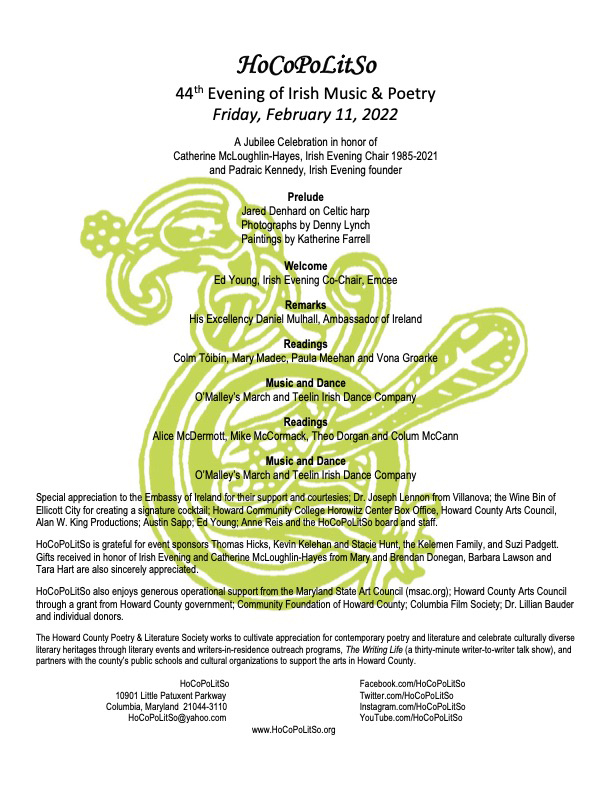


HoCoPoLitSo’s 44th annual Irish Evening of Music and Poetry on Friday, February 11, 2022 at 7:30 p.m. features an amazing roster of Irish writers sharing their memories of past visits. Colm Tóibín, Alice McDermott, Colum McCann, Mike McCormack, Vona Groarke, Theo Dorgan and Paula Meehan will virtually grace our stage, along with music by O’Malley’s March and step dancers from the Teelin Irish Dance Company. General admission is $20 and available at the Howard Community Box Office, https://ci.ovationtix.com/32275/production/1095249 or by calling 443.518.1500.
The evening program, co-chaired by Anne Reis and Ed Young and hosted on Zoom this year, begins with a pre-show at 7:20 p.m. and will pay tribute to Irish evenings of the past and introduce poet Mary Madec. The evening includes an introduction by Daniel Mulhall, Ireland’s Ambassador to the U.S, music by O’Malley’s March fronted by former MD. Governor Martin O’Malley, and award-winning dancers from the Teelin Irish Dance Company.
Six writers to have previously visited HoCoPoLitSo will share tributes to departing Irish chairperson, Catherine McLoughlin Hayes, and the founder of Irish eve, Padraic Kennedy, and read from their award-winning works. Vona Groarke, who visited in 2019, is the author of ten books of poetry and winner of numerous awards. Colum McCann, who visited both 1999 and 2013, received both the National Book Award and the Dublin Literary Award. His most recent book, Apeirogon, was longlisted for the Booker Prize. Poet and playwright Paula Meehan also visited twice, in 2000 and 2014. Theo Dorgan, who visited in 2014, is a poet, writer, lecturer, translator, and documentary screenwriter. Alice McDermott, who visited in 2020, was nominated three times for the Pulitzer Prize and was a recipient of the National Book Award. Colm Tóibín visited in 1999 and again in 2011. A winner of the Dublin Literary Prize, Tóibín received the 2021 David Cohen Prize for Literature, a lifetime achievement award. Mike McCormack visited us in 2018 and his newest novel, Solar Bones, won the Dublin Literary Award. Newcomer Mary Madec’s third poetry collection is The Egret Lands with News From Other Parts (2019).

Click here to watch a brief video on how to purchase Irish Evening tickets online.

six questions with Emily Rich and Leona Sevick

Emily Rich and Leona Sevick are the feature writers at January Wilde Readings, a monthly community open mic supported by HoCoPoLitSo. Join Emily and Leona as well as other open mic readers for a free reading on Zoom (and Facebook Live) on Tuesday, January 11 at 7 p.m. Click here to register for the free event. Click here for more details about the event.
We asked Emily and Leona our favorite six questions about their reading and writing, and here’s what they had to say.
Who is the person in your life (past or present) that shows up most often in your writing?
Emily: My parents.
Leona: While I have written about all of my family members, I suppose my mother shows up most often in my work. She was a South Korean immigrant and a complex person, and I write about her challenges with language and with the small town American culture she raised my brother and me in. I’ve also written about her struggle with illness, though I seldom name her in those poems. My mother died suddenly in late summer, and I have had some difficulty writing since then. I am working through my grief, and I’m confident the writing will come again.
Where is your favorite place to write?
Emily: I think I’m sort of antsy when I write. I have a desk that I’ll sit at for awhile, then move to a comfy chair and use a lap desk. The most important thing is to have quiet. I’m not someone who can write in a coffee shop, for instance.
Leona: My busy kitchen—at a rustic wooden island on a backless stool that keeps me alert.
Who always gets the first read?
Emily: Ideally other writers whose opinions I trust. I was most productive when I met with a regular writing group, but that’s not been possible recently. Sharing critiques with writers on line (the Writers Center in Bethesda has several on-line groups) is a pretty good substitute.
Leona: I have a close friend who is a novelist, and he is an excellent first reader. He is highly attentive to language and helps me make my words more surprising, more active. He is also painfully honest in his observations.
Do you have any consistent re-writing rituals?
Emily: The best thing I can do to get in the mindset to write is to read. I write nonfiction, so I have several essay collections, as well as lit mag subscriptions that I turn to.
Leona: Before I write I like to read a poem or two that I admire. I generally identify them days before and then revisit them for inspiration.
What is a book you’ve read more than twice (and would read again)?
Emily: William Faulkner’s The Sound and the Fury; Tim O’Brien’s The Things They Carried.
Leona: As a teacher, I’m always rereading works in preparation for classes. One book that I choose to teach again and again and enjoy rereading is Jhumpa Lahiri’s collection of stories, Unaccustomed Earth. Her ability to sensitively describe the lives of first generation immigrants and the struggles of their children is deeply moving to me.
What is the most memorable reading you have attended?
Emily: Several years ago I attended the Tin House Writers Workshop where I got to listen to fabulous readings by the likes of Maggie Nelson, Cheryl Strayed, and Anthony Doerr. What struck me was the honest way each of these very accomplished authors talked about self doubt and about how difficult the writing process can be sometimes. Beyond that, I hosted a reading for the Bay to Ocean Journal, the lit mag I manage, just a month ago. I was thrilled to have a community of writers come together, share their words, and get to know each other. We’d all come out of a long period of quarantine (which it looks like we’ll be reentering, unfortunately), and the event was joyful and full of hope.
Leona: When I was at Bread Loaf years ago, I had the honor of hearing Philip Levine read. As someone who writes also about the working class, I found his words and reading style—filled with humility and good sense—inspiring.
About Our Guests:
Emily Rich is managing editor of the Bay to Ocean Journal, published by the Eastern Shore Writers Association. She has taught memoir writing at the Bethesda Writer’s Center and through the Lighthouse Guild at Salisbury University. Her work has been published in The Pinch, Cutbank, Hippocampus, Delmarva Review, and Little Patuxent Review, among others. She’s twice been listed as a notable in Best American Essays. She lives in Trappe, MD with her husband and three hyper Labradors.
Leona Sevick is the 2017 Press 53 Poetry Award Winner for her first full-length book of poems, Lion Brothers. Her recent work appears in Orion, Birmingham Poetry Review, Water~Stone Review, The Pinch, and Blackbird. Sevick was named a 2019 Walter E. Dakin Fellow for the Sewanee Writers’ Conference, and she serves as advisory board member of the Furious Flower Black Poetry Center. She is professor of English at Bridgewater College in Virginia, where she teaches Asian American literature.
 HoCoPoLitSo