Home » Articles posted by timsingleton
Author Archives: timsingleton


Meet Jo Tyler, Second Place Winner of the 2025 Ellen Conroy Kennedy Poetry Prize
In 2021, Howard County Poetry and Literature Society launched the Ellen Conroy Kennedy Poetry Prize in honor of its founding member, Ellen Conroy Kennedy. Now in its fifth year, contest judges evaluated many submissions for mechanics and technique, clarity, style/music for our contemporary age, imagery/sensory power, and emotional resonance. Congratulations to this year’s runner up, Jo Tyler, and the poem “Ink”. Read on to learn a little about the this poet and to hear the poem recited. Congratulations to Jo!
Tell us about your poem, “Ink.” How did it come about? What sparked or inspired it?
For the last 3 years I’ve met just about every Thursday morning with a fabulous group of poet-friends for a generative writing session. We take turns hosting, sharing a poem or a piece of visual art we like and providing a small assortment of writing prompts derived from it. “Ink” got its start on one of these Thursday mornings from a series of photographs I took at The Museum of Everyday Life in Glover, Vermont, way up north. There was, among other things, an amazing collection of lists visitors had made as part of an interactive exhibition. If you haven’t ever been to the museum, I recommend it. It’s quite an experience.
What was an early experience in which you learned that language had power?
There are two experiences competing to be told here. The first one that comes to me is the first time I swore out loud. At my mother. I was six. I begged her to forgive me because I didn’t want to go to Hell. Now I don’t believe in Hell so I swear as needed, usually to get someone’s attention. The second experience is more formalized and more performative. In seventh grade I was selected to recite The Gettysburg Address from memory on Memorial Day. My English teacher coached me for weeks, teaching me how inflection and silences help words shine. On the day, the parade came to a pause at the library green, and I stood before a microphone in a new dress and patent leather shoes. The whole town was there, and the whole town was quiet. I could feel them listening. I could feel the importance of Lincoln’s language in that listening, and I also knew that in that moment the whole town was on my side, willing me not to make a mistake. And I didn’t. It was seventh-grade-glory. I think that experience accounts for my ongoing delight in sharing my work out loud, giving it a life beyond the one it has on the page
As a writer, what would you choose as your avatar / mascot / companion animal?
So many choices. I mean my dog Moxie is a faithful and favorite companion, and he’s jockeying for first place, but that seems too easy. I’m going to go with a snake, maybe a friendly one like a corn snake. I’m choosing a snake because they brumate. They slow down their metabolism, like mammals in hibernation, but their sleep isn’t as deep, and they have more options to wake up, drink, stretch, when there’s a warm spell. I like that. Sometimes my poems need to hibernate, but mostly they I think they benefit from brumation. If I encounter something in the world that makes me think of a poem I’ve set aside for a time, I might gently shake that poem awake, do some revising in the moment, give it a sip of water and then let it rest some more. I think too, that snakes are a good metaphor for poetry, because of the ways that they can slip around so smoothly, curl, elongate, contract, surprise. Corn snakes aren’t inclined to bite, but they can if they need to. I think some of my poems are like that.
Tell us about a writer or book that you return to over and over for inspiration.
I’d say Mary Oliver for sure. I know she’s not everyone’s cup of tea, but she lowers my heart rate and her simplicity in conveying complexity feels so masterful to me. She can do it all, form, free verse, long, short, and always perfectly pared down. Her imagery is so clear, stark, fearless and heartbreaking in the face of mystery. There’s something magical about how she fully welcomes her reader to the poem, how she invites us directly into her experience, engages us in it. Mary Oliver doesn’t make her reader contort, lean, peer in, surmise from an angle. Rather we encounter her experience at her side, joining with her in the delight, the sadness, and the surprise not as an outsider, but as a friend. I want my readers to feel this way – welcome, with no distance between us
What are you working on next and where can we find you?
I’m finishing up a collection that I’m going to let brumate for the rest of winter, and revise over the summer with a goal of submitting it in the fall 2026 “season” of contests and calls. I have a chapbook called Rooms for Love from Bottlecap Press available at this link: https://bottlecap.press/products/roomjt and I’m working on two others. You’ll find some of my individual poems in Yellow Arrow Journal, Maryland Literary Review, MacQueen’s Quinterly and Pen in Hand. And if you ever want to hear my work, I’m pretty much a regular at some of the open mics in the Baltimore area, like The Hot L, Manor Mill, Maryland Writer’s Association and of course the Wilde Reading Series! We’re so lucky to have such great venues in Maryland, and such great writers. I hope to see you out and about sometime soon!
Meet Chrissy Stegman, Winner of the 2025 Ellen Conroy Kennedy Poetry Prize.
In 2021, Howard County Poetry and Literature Society launched the Ellen Conroy Kennedy Poetry Prize in honor of its founding member, Ellen Conroy Kennedy. Now in its fifth year, contest judges evaluated many submissions for mechanics and technique, clarity, style/music for our contemporary age, imagery/sensory power, and emotional resonance. Congratulations to first place winner this year, Chrissy Stegman, and the poem “Please Be Kind, Rewind”. Read on to learn a little about the this poet and to hear the poem recited. Stegman was runner up for the 2022 Ellen Conroy Kennedy Poetry Prize. Congratulations to the poet!
Tell us about your poem, “Please Be Kind, Rewind.” How did you balance the gravitas of its content with its formal charm?
The formal constraints of “Please Be Kind, Rewind” are not ornamental, more they function as a kind of psychic architecture. The poem’s reversals, repetitions, and palindromic logic enact the speaker’s denial of the loss event itself. By fracturing the experience into segments, into units that can be read forward, backward, or laterally, my poem resists narrative finality. There is no single, forward-moving version of what happens. The loss is broken into parts small enough to be handled, rearranged, yet almost disguised.
Because the poem is designed to be read in reverse at its close, the reality the speaker gestures toward never fully arrives. The catastrophe is perpetually deferred. In this sense, the form becomes a strategy of hiding: the speaker is always just before the moment of recognition, always rewinding to the last place where hope still exists. The music and symmetry create a kind of inertia where transformation does not lead to release but to suspension. Grief is present everywhere, but it is never allowed to complete itself.
Talk a little bit about your process. How does the spark find you and then make its way into a poem?
The spark usually comes through language before the meaning, like in an image, a sound, a misreading, a word that tilts and becomes something else. I’m interested in what happens when words collide or misbehave, when sound begins to generate sense rather than merely accompany it. A phrase will catch because of its music or its pressure, and I’ll carry it around, letting it accrue associations. Like most poets, I’m obsessive about words, their textures, their echoes, the way one word calls another into the room.
So I play in that space. I rarely sit down determined to write a particular poem. Sometimes there’s a memory I’m curious about, but I rarely begin thinking, I need to write about this. I also write a lot of ekphrastic poetry because I’m drawn to color and to art as a medium. It’s easy to imagine a different story from a painting. I enjoy casting old scenes into new landscapes. I often think, while writing: why not? I am fascinated by transformation.
If you could turn yourself into a metaphor, what would it be and why?
This was such a fun question! I’d probably be a VHS tape that’s been recorded over too many times, weddings, footage of a farm, home movie of a dog, emergency broadcast, all bleeding into one another. A little warped for sure, a little ghost-y, but still functional. Still holding.
Tell us about a new poet or book of poems that you’ve come across that stopped you in your tracks.
Susan Leary’s Dressing the Bear stopped me immediately. The poems are intimate without being precious, emotionally astute without over-explaining themselves. What struck me first was her lyric precision and sonic control. What she does with sound is impressive work. The lines are attentive to cadence and pressure, to what repetition can hold, to how music can sharpen rather than soften emotional impact.
The book also landed with particular force for me because of its attention to loving someone who is struggling, especially when that struggle is shaped by addiction and unfolds within a family system. There is a deep, aching intelligence in the way the poems hold love alongside harm and responsibility alongside helplessness.
What are you working on next and where can we find you now?
I’m finishing a full-length manuscript while staying open to the world around me, or at least I hope! Working, looking, paying attention. Alongside that, I’ve completed a second chapbook and am currently looking for the right publisher for it. You can also find me at my website: www.chrissystegman.com
I’ve also begun exploring a 1940s Purma camera, a British camera designed to relinquish control: it rotates internally, making each exposure dependent on chance and gravity rather than intention. I’m drawn to it as a practice I’m still learning, a way of seeing that resists mastery. I’m curious about how its unpredictability might begin to inform my poems rather than simply accompany them.
In addition, I’m experimenting with stop-motion animation and linocut, interested in what happens when poems leave the page!
I’m also very aware that my creative life is inseparable from my domestic one. I’m the mother of five children, which means my days are structured around attention, interruption, negotiation, and wondering why I came into a room. Somewhere between packing lunches, locating lost shoes, and refereeing minor domestic epics, the poetry work continues.
Chrissy Stegman is a three-time Best of the Net and Pushcart-nominated poet and writer from Baltimore, Maryland. Recent work has appeared in Rattle, River Heron Review, Jake, UCity Review, Gone Lawn, Gargoyle Magazine, Stone Circle Review, Fictive Dream, Inkfish, 5 Minutes, Libre, and BULL. Her chapbook, Somewhere, Someone Is Forgetting You, was published by Alien Buddha Press. She is a 2025 MVCWI Fellow and recipient of the Idyllwyld Arts Scholarship for Poetry and a finalist in the 2025 Wergle Flomp Humor Poetry Contest.
Meet Kari Martindale – Honorable Mention Winner of the Ellen Conroy Kennedy Poetry Prize
In 2021, Howard County Poetry and Literature Society launched the Ellen Conroy Kennedy Poetry Prize in honor of its founding member, Ellen Conroy Kennedy. Now in its forth year, contest judges evaluated many submissions for mechanics and technique, clarity, style/music for our contemporary age, imagery/sensory power, and emotional resonance. Congratulations to honorable mention winner, Kari Martindale, and the poem “The Beaches of Normandie”. Read on to learn a little about the this poet and to hear the poem recited.
How did the poem come about? What sparked or inspired it?
The inspiration for “The Beaches of Normandie” is two-fold. The obvious inspiration is the subject of the poem, Angelo, my grandfather who served in Normandy on D-Day. But what sparked the poem was a post by the literary journal Collateral, which I’ve followed on Instagram since they published a poem of mine.
When they posted a screenshot of spam that they’d received from someone wanting to collaborate on a bikini ad, I commented joking that now I was going to write a poem in a bikini. Their reply, as a journal that publishes work “concerned with the impact of violent conflict and military service beyond the combat zone,” was, “impact of violent conflict = beach vibes? 🤔” and it clicked: that’s Normandie—a place of horror for my grandfather, but beauty for me during my travels.
My own experience of being in a war zone further informs the poem.

What was an early experience where you learned that language had power?
I can’t pinpoint an early experience, but I can tell you the most meaningful.
I wrote a poem, “The List”, about my experiences as an interpreter in Iraq. It was unintentionally, subconsciously infused with a feminine perspective that came naturally to me as a woman. When I perform it, women often come up to me to thank me. Most recently, a woman who was clearly affected by my reading told me, “You said things up there that I’ve never said aloud to anyone.”
Harnessing my experiences into words is helping other women to heal. That’s the power of language.
As a writer, what would you choose as your mascot/avatar/spirit animal?
I would never appropriate a spirit animal because I’m not Native American. However, if I were likening an animal to myself, it might be a goose. They’re loud and they stand their ground, and a lot of people don’t like them for those reasons. I’m here, and I’m honking.
Tell us about a writer or a book that you return to over and over for inspiration.
I often return to Dr. Martin Luther King’s writings that are critical of the white moderate, as motivation to do better, be better.
What are you working on next and where can we find you?
I’m starting to submit two poetry collections: Demolishing Whiteness and When Life Was Someone Else’s: poems from a woman who’s been to war. The second features “The Beaches of Normandie“.
I’m finishing up a collection of haiku for all fifty states, which I’ve visited, and I’m turning my poem “Suburban Lies” into a hybrid chapbook/nonfiction.
You can find me on Instagram @karilogue or online at kariannmartindale.com.
Kari Martindale is a poet, spoken word artist, and teaching artist who has read at Arts guilds across Maryland and performed at the White House. She has been published in a number of literary journals and anthologies, has been nominated for a Pushcart Prize and Best of the Net, and received honorable mention in the 2024 annual Writer’s Digest Writing Competition. Kari sits on the Board of Maryland Writers’ Association and the management team of EC Poetry & Prose. She has visited all 50 States and over 40 countries, is multi-lingual, and holds an M.A. in Linguistics from George Mason University.
Meet Lauren Benoit – Honorable Mention Winner of the Ellen Conroy Kennedy Poetry Prize
In 2021, Howard County Poetry and Literature Society launched the Ellen Conroy Kennedy Poetry Prize in honor of its founding member, Ellen Conroy Kennedy. Now in its forth year, contest judges evaluated many submissions for mechanics and technique, clarity, style/music for our contemporary age, imagery/sensory power, and emotional resonance. Congratulations to honorable mention winner, Lauren Benoit, and the poem “A Poem for Robert Bly”. Read on to learn a little about the this poet and to hear the poem recited.
Tell us about your poem “A Poem for Robert Bly”. How did it come about? What sparked or inspired it?
I wrote this poem as I was coming off an eight-month long writing drought. At the time, I was hyper focused on editing my chapbook while simultaneously experiencing intense physical and mental burnout. I hadn’t written anything I liked in almost a year. Everything in my life felt dull and uninspired. I didn’t have any ideas, and I was feeling dried up creatively. Eventually I realized that I couldn’t just sit around waiting to be inspired. I had to go out and look for something to start a spark. That’s when I picked up a copy of Robert Bly’s collection My Sentence Was a Thousand Years of Joy, hoping to find some inspiration in its pages. I was not disappointed. I was inspired the very moment I read “A Poem for Andrew Marvell.” The line “People who adore literature often say that fall / Is the best of all seasons” struck me. I found it intriguing and etched with truth, but I wanted to know more. I wanted to know why people who adore literature often say that fall is the best of all seasons. Then I thought, I’m a person who adores literature, and I also think that fall is the best of all seasons – so, why do I think that? “A Poem for Robert Bly” is an attempt to answer that question while paying homage to the poet who inspired it.

What was an early experience where you learned that language had power
I remember watching Gone with the Wind as a child and being rocked to my core when Gerald O’Hara says to Scarlett, “Do you mean to tell me, Katie Scarlett O’Hara, that Tara, that land doesn’t mean anything to you? Why, land is the only thing in the world worth workin’ for, worth fightin’ for, worth dyin’ for, because it’s the only thing that lasts.” Even as a small child I understood the power of those words and what they ultimately caused Scarlett to do and to become—for better or worse.
As a writer, what would you choose as your mascot/avatar/spirit animal?
I am going to have to go with a kitten. Not just any kitten, but a very specific kitten. Last year my husband bought me the ‘Hair Raising Tail’ greeting card by Shawn Braley. On the front of the card there is a grey and white kitten reading a book and in a thought bubble above the kitten’s head there is a scene depicting a lion fighting a green dragon in front of a castle. To me, the image not only highlights the power of reading, but it also encourages readers to dream big dreams. It’s fitting because I often feel that I am just a small kitten, dreaming of being a lion.
Tell us about a writer or a book that you return to over and over for inspiration.
I have been greatly inspired by Anders Carlson-Wee and Kai Carlson-Wee, specifically, their collections Disease of Kings and Rail, respectively. I have repeatedly turned to these works for inspiration and craft study. I find their work accessible, yet innovative and fascinating. I am also a big fan of Ilya Kaminsky. Deaf Republic was indispensable to me when I was working on my first chapbook. I love works that tell stories on both the micro and macro levels. There is so much to admire and aspire to in each of these collections.
HoCoPoLitSo: What are you working on next and where can we find you.
I am currently working on a second chapbook and conducting research for my first full-length poetry collection which is sort of a historical fictionesque journey back to the seventeenth century. It’s heavily narrative, so it’s pushing me outside my creative comfort zone, but I’m up for the challenge and looking forward to the growth that will undoubtedly come from wrestling with narrative craft study. I can be found at gone.galt on Instagram.
Biography:
Lauren Benoit is a writer and artist. She holds a Bachelor of Arts in English from the University at Albany. She lives in Western New England with her husband, her son, and their cat Ronan Harkonnen.
Meet Jared Smith — Honorable Mention Winner in the 2024 Ellen Conroy Kennedy Poetry Prize
In 2021, Howard County Poetry and Literature Society launched the Ellen Conroy Kennedy Poetry Prize in honor of its founding member, Ellen Conroy Kennedy. Now in its forth year, contest judges evaluated many submissions for mechanics and technique, clarity, style/music for our contemporary age, imagery/sensory power, and emotional resonance. Congratulations to honorable mention winner, Jared Smith, and the poem “Reaching Into Rivers”. Read on to learn a little about the winning poet and to hear the poem recited.
Tell us about your poem “Reaching Into Rivers”. How did it come about? What sparked or inspired it
“Reaching Into the Rivers” was written after spending a day at the Conowingo Dam and witnessing the incredible power of the waters behind it, how the waters have been held back in the name of progress. I meditated about the miles of watershed above that dam, and the miles ahead before it enters into the Chesapeake. My musings about that combined with my readings in The New York Times and The Washington Post about the volume of water and pollutants that were carried in an average thundercloud as it moves across America, the volume of dust and pollution and industrial waste that sustains our society contained within that average thundercloud, the source of all our waters. I thought of how many rivers have been covered over in our search for progress by urban highways and other infrastructure as they move toward Chesapeake Bay and the oceans in general. Those rivers, I came to visualize, carry the pollution and hopes and rags of infrastructure development from all across our nation deep into the earth beneath Baltimore and our other cities as they move to the ocean. They carry our dreams, our efforts, and our history deep beneath the roads and buildings we move among and are aware of in our day-to-day lives, and without them our cities and our way of life would not exist. It is necessary to understand all that they carry within their life-giving waters in order to understand who and what we are. And this is doubly true because their presence is hidden from us. We do not see what they carve away from our foundations, nor what they add. Poetry is like this too, I think, in that it moves with tremendous force beneath the fabric of society and shapes the society, yet for many is largely hidden.
What was an early experience where you learned that language had power?
I first began to learn about the power of language when I was eight years old and attended a reading by Galway Kinnell from his first book, What A Kingdom It Was. That hooked me on poetry. I later developed a love for the epic poetry of Homer, and the lyric poetry of A.E. Housman and Robert Frost, followed by the formal intellectual poetry of Auden and the imagistic poetry of the young T. S. Eliot. The poetry and essays of Robert Bly then captivated me with the power and insights he illumined in nonlinear contemporary poetry. Ginsberg, Levertov, Sexton, Merwin, and their contemporaries set me free, with their devotion to the struggles and concerns of the common citizen. All of these poets have helped shape the culture of their time and ours through the power of their words and visions. I think of them as engaging in an eternal discussion across time contributing to an understanding of our place in the cosmos, and the dignity of the common man.

As a writer, what would you choose as your mascot/avatar/spirit animal?
My spirit animal is a wolf…a spirit that roams across the width of the American wilderness, demanding respect but making do with what it can.
Tell us about a writer or a book that you return to over and over for inspiration.
Poetic sources I reach back into most frequently include Walt Whitman, Bob Dylan, Ralph Waldo Emerson, and the Germanic epic The Neibelungenlied. These are diverse sources to bring to bear upon current contemporary poetry, but I think that the masters of the past give enhanced perspective to the works of our current poets and visionaries.
What are you working on next and where can we find you?
My vision and writing is generally driven by natural landscapes, though I have lived in both urban and rural settings. Although I started out as a poet in Greenwich Village, every book I have written draws on wilderness imagery and insights from a remote and primitive cabin I maintain in Colorado’s Roosevelt National Forest. My current home in Ellicott City, MD, backs onto a stretch of woodland populated by deer and foxes, and with a pond that is filled with frogs and all other manner of aquatic life. I walk the rivers and the seashore and the mountains. Through studying nature and meditating on it, I am better able in my writing to reach a better understanding of mankind, how we shape nature to our institutions, our struggle for simple human dignity, and our place in the cosmos. I will continue writing as long as it expands my knowledge. My website is at www.jaredsmith.info.
Jared Smith is the author of 17 books of poetry, two multi-media plays, and two spoken word CDs. His work has appeared in hundreds of domestic and international journals and anthologies. He has served on the editorial staffs of The New York Quarterly, Home Planet News, The Pedestal Magazine, and Turtle Island Quarterly, as well as on the boards of literary and arts non-profits in New York, Illinois, and Colorado. He has served on the faculty of LaGuardia Community College (CCNY), as Vice President of an energy and environmental consulting company, as technical and policy advisor to several White House Commissions under President Clinton, and Special Advisor to Argonne National Laboratory. He currently lives in Ellicott City, MD. His website is www.jaredsmith.info
HoCoPoLitSo Announces Winners of 2024 Ellen Conroy Kennedy Poetry Prize
The Howard County Poetry and Literature Society (HoCoPoLitSo) is pleased to announce that Mickie Kennedy of the Baltimore area has been awarded first prize in the 2024 Ellen Conroy Kennedy Poetry Contest for the poem “Aubade With Peaches, Eggs, and Hissing Garlic.” Judges shared they appreciated the rich, incisive sensory language; skilled technical precision and powerful restraint within the form; and deep emotional resonance of this both contemporary and timeless love poem. A $500 cash prize was awarded, and the poem was published in the Winter 2025 edition of The Little Patuxent Review.
Neha Misra of Silver Spring was awarded second place with a $100 cash prize for the poem “Vanishing Gardens Return,” in recognition of the poem’s skillful use of form, vivid and original imagery, and compact storytelling. Judges noted their appreciation for the work’s familial, social, and cultural resonance.
Judges selected an additional three poets’ entries for honorable mention: Lauren Benoit of Russell, Massachusetts for “A Poem for Robert Bly”; Kari Martindale of Ijamsville for “The Beaches of Normandie”; and Jared Smith of Ellicott City for “Reaching Into the Rivers.”
Contest judges evaluated 46 submissions from poets residing across six states for mechanics and technique, clarity, style/music for our contemporary age, imagery/sensory power, and emotional resonance. Each author receiving an award was invited to be interviewed for a blog post hosted at hocopolitso.org.
The Ellen Conroy Kennedy Poetry Prize was established to honor HoCoPoLitSo co-founder Ellen Conroy Kennedy, who passed away in 2020. Ms. Kennedy, who was nominated for the National Book Award in Translation in 1969, translated Francophone African and Caribbean poets, and published her landmark work, The Negritude Poets, in 1975.
Kennedy founded HoCoPoLitSo in 1974, a nationally recognized, community-based nonprofits arts organization that has brought hundreds of writers to Howard County, Maryland, and this year celebrates its 50th anniversary. She served as president and CEO for 30 years, opening her home and sharing her table with an array of literary icons. She also developed and produced The Writing Life, originally a cable television series, featuring conversations with writers, now available free on HoCoPoLitSo’s YouTube channel where it has been seen by more over a million lovers of literature from around the world. In 2019, the Kennedys donated more than 1,500 books, most of which featured authors who read for HoCoPoLitSo audiences, to the Howard Community College library; the Kennedy Collection is housed in a reading room open to the public during normal business hours.
HoCoPoLitSo works to cultivate appreciation for contemporary poetry and literature and celebrate culturally diverse literary heritages. The society sponsors literary readings; the Bauder Writer-in-Residence outreach program to local schools; produces The Writing Life; and partners with the public schools and cultural organizations to support the arts in Howard County, Maryland. For more information, visit http://www.hocopolitso.org.
Meet Mickie Kennedy – 2024 First Place Winner of the Ellen Conroy Kennedy Poetry Contest
In 2021, Howard County Poetry and Literature Society launched the Ellen Conroy Kennedy Poetry Prize in honor of its founding member, Ellen Conroy Kennedy. Now in its forth year, contest judges evaluated many submissions for mechanics and technique, clarity, style/music for our contemporary age, imagery/sensory power, and emotional resonance. Congratulations to this year’s winner, Mickie Kennedy and the poem “Aubade With Peaches, Eggs, and Hissing Garlic.” Judges shared they appreciated the rich, incisive sensory language; skilled technical precision and powerful restraint within the form; and deep emotional resonance of this both contemporary and timeless love poem. Read on to learn a little about the winning poet and to hear the poem recited.
Tell us about your poem “Aubade With Peaches, Eggs, and Hissing Garlic”. How did it come about? What sparked or inspired it?

Last year, I took a virtual poetry class (“Food in Poetry”) taught by Melanie Tafejian. She offered weekly prompts, and the first draft of this poem was actually a response to a prompt where she challenged us to write about being in the kitchen with somebody else. In further drafts, the poem found its way inside its current shape: a meditation on the surprise of domesticity, as the speaker (recently out of the closet) resists an easy togetherness he never thought he’d have.
What was an early experience where you learned that language had power?
When I was five, quite new to reading, I kept encountering a mysterious phrase: off ice. On a walk through town: off ice. On drives with my Grandma: off ice. In winter and summer, night and day. I knew what ice meant. I knew what off meant. But off ice was a door I couldn’t pass through. I asked my Grandma what it meant, and she wasn’t sure. “Stay off the ice?” she guessed, but it was summer, so hot we kept the windows down. A few days later, while Grandma was gassing up the car, I saw the word again, painted on the side of a building. “There it is!” I said, pointing. Grandma looked, and then laughed and laughed. “That’s not off ice,” she said, “That’s office, a place where people work.” And just like that, language grew strange. Slippery. Opaque. A site of transformation. A place to hide.
As a writer, what would you choose as your mascot/avatar/spirit animal?
My animal avatar would have to be a tardigrade, which is an eight-legged micro-animal. They’re rugged survivalists, more prolific than roaches, and they can withstand hostile environments, under extreme conditions of lack, for literal decades by entering a death state, then springing back to life when the conditions soften. They’re also called mossy pigs. So much to love. And I channeled their resilience, moving through the hostile environment of my childhood.
Tell us about a writer or a book that you return to over and over for inspiration.
Richie Hofmann’s A Hundred Lovers. Lithe. Sensual. Brimming with crystalline images that refract the world back cleaner, somehow. And more strange. I’ll be reading this book for years.
What are you working on next and where can we find you?
“Aubade With Peaches, Eggs, and Hissing Garlic,” is from a manuscript called Worth Burning (my first book!), which is set to be published in February 2026 by Black Lawrence Press. So I’ll be promoting that project till the mossy pigs come home! You can find me on social media platforms @MickiePoet. Or visit my website: https://mickiekennedy.com.
Mickie Kennedy is a gay writer who resides in Baltimore County, Maryland. His work has appeared or is forthcoming in POETRY, The Threepenny Review, The Southern Review, The Sun and elsewhere; his first book of poetry Worth Burning will be published by Black Lawrence Press in February 2026. Follow him on social media @MickiePoet or his website mickiekennedy.com.
Howard County Executive Calvin Ball Introduces World-renowned Poet Truth Thomas, Howard County’s Inaugural Poet Laureate
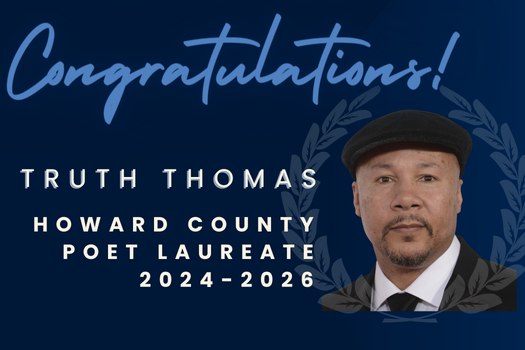
ELLICOTT CITY, MD – Howard County Executive Calvin Ball today announced Truth Thomas has been selected as Howard County’s inaugural Poet Laureate. In honor of National Poetry Month, Ball made the announcement during the Howard County Poetry and Literature Society’s (HoCoPoLitSo) Nightbird Reading at the 16th annual Blackbird Poetry Festival. Photos of the event can be seen here. Video of the event can be viewed here.
“We are incredibly fortunate to have such an active and vibrant literary arts community in Howard County. From our schools and gathering places, to our energized Downtowns and Main Streets, the arts are the heartbeat of our county, breathing life and meaning into our everyday lives,” said Ball. “I am thrilled to have the talented, terrific, transformative Truth Thomas serve as Howard County’s very first Poet Laureate. He brings a wealth of knowledge, experience, passion and creativity to this new role, and I am confident as Poet Laureate, he will elevate poetry in the consciousness of Howard County residents.”
A singer-songwriter, poet and photographer born in Knoxville, Tennessee and raised in Washington, D.C., Thomasstudied creative writing at Howard University and earned his Master of Fine Arts in poetry from New England College. The founder of Cherry Castle Publishing and creator of the “Skinny” poetry form, his collections include Party of Black, A Day of Presence, Bottle of Life, Speak Water and My TV is Not the Boss of Me. Winner of the 2013 NAACP Image Award for Outstanding Literary Work in Poetry, his poems have appeared in more than 150 publications including: Callaloo, The Newtowner, New York Quarterly, The Emerson Review, The Ringing Ear: Black Poets Lean South and The 100 Best African American Poems. His work focuses largely on matters of race and social justice, both nationally and worldwide. A former writer-in-residence for the HoCoPoLitSo, Thomas is currently a member of the Society’s Advisory Group.
“When I think about the blessing of being Howard County’s inaugural Poet Laureate, I celebrate most the opportunity to serve others through the arts–to honor the human dignity of all people. That is my literary prayer, to follow in the giant steps of great poets who have preceded me in that quest and—hopefully—leave a loving path for others to follow,” said Truth Thomas, Howard County’s Poet Laureate.
Ball first announced the launch of the County’s inaugural Poet Laureate program in partnership with the Howard County Arts Council and HoCoPoLitSo this past November. As the Howard County Poet Laureate, Thomas will serve as an ambassador for poetry, literature and the arts and contribute to Howard County’s poetic and literary legacy through public readings and participation in civic events. An honorary two-year position, Thomas will serve in this role from April 2024 through March 2026.
“I am delighted about Truth’s appointment as Howard County’s first Poet Laureate and look forward to working with him. Howard County has a proud history of influential poets and writers. Recognizing this, our inaugural Poet Laureate Review Panel emphasized the importance of the first appointee to be an exemplar for future poet laureates,” said Coleen West, Executive Director, Howard County Arts Council. “With the appointment of Truth, County Executive Ball has set the bar high. As a poet, writer, teacher and musician, Truth has already inspired so many. There is great power in his words, and he has so many stories to tell. In his new role as Howard County Poet Laureate, I am confident that Truth will have a profound impact on our community and on the next generation of aspiring poets as well.”
“HoCoPoLitSo celebrates the selection of Truth Thomas as the Inaugural Poet Laureate for Howard County and is grateful to County Executive Calvin Ball for embracing the role of the poet in public life. From its beginning, HoCoPoLitSo has sought to couple literary excellence with community engagement, to present authors whose revealing and penetrating work seeks to make a difference. Truth Thomas embodies HoCoPoLitSo’s 50th Anniversary theme, ‘Beyond Words, Beyond Borders,’ and we look forward to the many opportunities ahead for him to bring his inspiring voice to the community,” said Tara Hart, co-chair of HoCoPoLitSo Board of Directors.
Howard County Arts Council
The Howard County Arts Council was created in 1981 to serve the residents of Howard County by fostering the arts. The Arts Council is devoted to nurturing local artists and arts organizations, furthering the public’s appreciation of the arts and ensuring that the arts are accessible to all, regardless of age, ability, or economic status.
In his proposed Fiscal Year 2025 budget, Ball has included approximately $1.25 million in funding for the Arts Council to support its operations and its administration of local artist grant programs. In October, during his 2023 State of the County address, Ball announced that the Arts Council would be relocating its headquarters to the historic Circuit Courthouse located atop Historic Ellicott City. Following a full renovation and restoration of the historic building, it will be reopened as a new Center for Arts, Culture, and History in Ellicott City.
HoCoPoLitSo
Founded in 1974 by National Book Award finalist Ellen Conroy Kennedy, Prudence Barry and Jean Moon,HoCoPoLitSo engages the community with the literary arts by hosting events, offering literary workshops and producing local readings, lectures and presentations with critically acclaimed writers, including Nobel Laureates, U.S. Poets Laureate, and Pulitzer Prize and National Book Award winners.
HoCoPoLitSo also produces literary workshops for college and public school students, teachers, emerging writers and others. With support from Howard Community College’s Dragon Digital TV, HoCoPoLitSo produces The Writing Life, an award-winning writer-to-writer interview show available on YouTube and Maryland community college stations. This year marks the 50th Anniversary celebration of the organization.
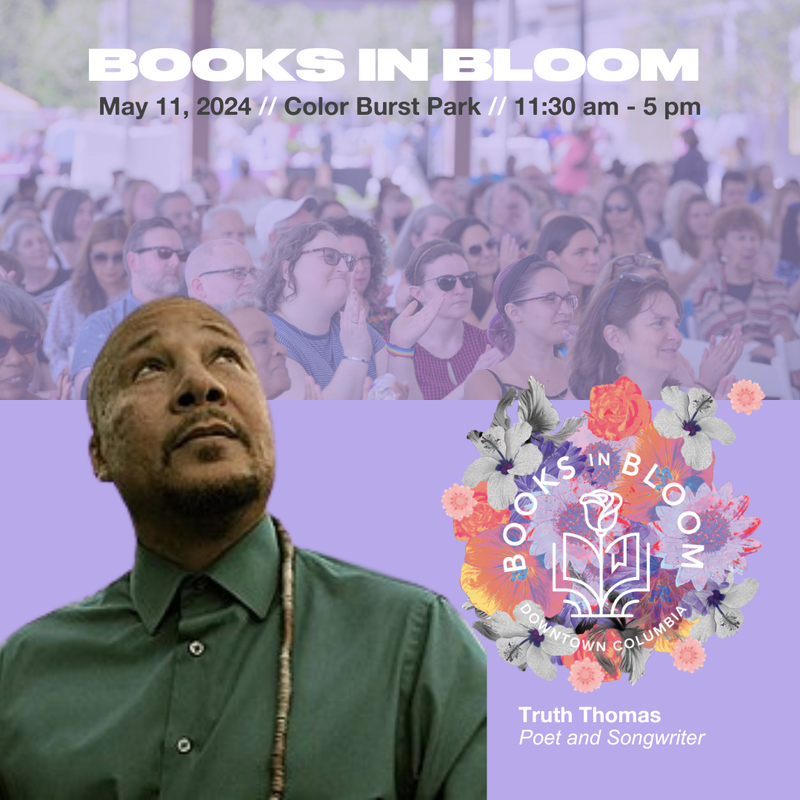
Poet Laureate Truth Thomas to read at Books In Bloom Festival
HoCoPoLitSo (Howard County Poetry and Literature Society) seeks Managing Director
About HoCoPoLitSo
Founded in 1974 by Ellen Conroy Kennedy in Columbia, Maryland, HoCoPoLitSo is an innovative, small, not-for-profit community literary arts organization devoted to fostering a love of contemporary literature, preserving the world literary heritage, and responding equitably and inclusively to the evolving needs and interests of our dynamic community.
Job Description
The managing director (MD) reports directly to the co-chairs of the Board of Directors. The MD represents and supports the organization’s day-to-day operations through dynamic project management, conscientious fiscal oversight, creative problem-solving, and highly effective communication. The MD works collaboratively with the board and the program coordinator to create, manage, and maintain a schedule of literary events that cultivate literary appreciation and provide high-quality interactive opportunities for our community to engage with great writers. The MD manages resources, produces financial and grant reports, organizes volunteers, establishes meeting agendas, and contracts with vendors, as well as documents, tracks, and maintains the organization’s financial income and expense records, including oversight of grant funding.
The ideal candidate has:
- Bookkeeping and grant management experience sufficient to manage within a limited budget and uncertain revenue stream (e.g., familiarity with QuickBooks)
- Budget and management experience (non-profit experience preferred)
- Demonstrated evidence of flexibility, resourceful problem-solving skills, and a collaborative spirit
- Strong written and verbal communication skills and interpersonal skills
- Conscientious attention to detail, follow-through, and organization
- Technical knowledge sufficient to manage communication and finances effectively, to update website content, with some social media skills
- The ability to multitask
- Evidence of ability to work effectively as a team member
- Willingness to perform other duties as necessary to accomplish the organization’s objectives
The position requires:
- Access to reliable transportation and ability to transport event materials; lives within a reasonable commuting distance
- Regular attendance and availability are requirements. Willingness to work remotely when necessary.
- Ability to meet on a regular schedule each month with the board and the program committee
- Ability to work flexible hours both in person, in the office, and online as needed, including occasional nights and weekends as needed for events
- Commitment to a safe and confidential working environment by participating in necessary training
- Ability to lift 25 pounds
Additional Information
- Hours Per Week: varies with schedule of events and deadlines; approximately 20-25
- Work Schedule: Monday – Friday, occasional nights and weekends for events
- Compensation: $18,000-$25,000/year
- FLSA Status: Exempt
- Open Until Filled
- Please apply by September 30, 2022 for best consideration
Application Instructions
Send cover letter and resume with three professional references to HoCoPoLitSo.74@gmail.com.
HoCoPoLitSo values diversity within its staff, board, and volunteer population. All qualified applicants will receive consideration for employment without regard to race, color, religion, sex, national origin, age, gender, sexual orientation, gender identity, genetic information, disability or protected veteran status.
Community Foundation of Howard County Helps HoCoPoLitSo Make Lit Happen
Columbia, MD – August 3, 2022 – The Howard County Poetry & Literature Society is delighted to receive a grant in the amount of $2,500 from the Community Foundation of Howard County (@CFHoCo on Twitter). Supported by grants and individual donors, HoCoPoLitSo cultivates the appreciation for contemporary poetry and literature, celebrates a culturally diverse literary heritage, and broadens exposure to the literary arts to foster community.
Funds from the Community Foundation of Howard County helps HoCoPoLitSo produce live, virtual and recorded literary programs accessible world-wide. Programs such as “Poetry Potluck” took the audience into the kitchens of four former writers-in-residence, who discussed their food inspired poetry and the importance of food in creating a vibrant community.
HoCoPoLitSo is a 501(c)(3) not-for-profit literary arts organization. Founded in 1974, the society has presented 5 Nobel Laureates, 31 Pulitzer Prize winners, 22 National Book Award winners, 19 National Poets Laureates, 9 Maryland Poets Laureates, and more than 300 writers to the Howard County community. Audiences can attend programs in-person, virtually or view at YouTube.com/HoCoPoLitSo twenty-four hours a day from anywhere in the world.
About the Community Foundation of Howard County – For more than 50 years, the Community Foundation of Howard County has served as a knowledgeable, trusted partner that forges connections between donors and nonprofit organizations to provide impactful investments in Howard County. Since 2020 the foundation has awarded more than $6.5 million through more than 1,000 grants to organizations delivering human service, arts and cultural, educational and civic programs. Funds to support grant programs comes primarily from income generated by the foundation’s endowment supported by more than 365 funds established by Howard County businesses, families and individuals. For more information, visit CFHoCo.org or call 410-730-7840.
HoCoPoLitSo thanks its audiences and donors, like the Community Foundation of Howard County, for supporting the literary arts in our Howard County Community!
“Your help is important. Not just to keep this local literary organization going, but to keep the positive work of words out there in the world, connecting people along the way.”
-Tim Singleton, Board Co-chair.
 HoCoPoLitSo