

Carrying a country on their backs, And telling their stories

Susan Thornton Hobby is an editor and a writer. She serves as a board member and the recording secretary for HoCoPoLitSo.
This is a guest blog post by Susan Thornton Hobby in commemoration of #ThankASoldierWeek (Dec 19-25) and sharing #veteranswritingproject
———————————————-
I’m a Quaker. I don’t believe in war. Among my many bumper stickers is this one: “War is not the answer.”
But I do believe in warriors, and in supporting those who believe differently than I do and who serve their countries.
This week is “Thank a Soldier Week,” a commemorative week made up by a marketing company. But I agree with the sentiment. Other than on Veteran’s Day, I don’t believe Americans think about the troops, much less support them enough. Fewer than one percent of Americans have participated in the recent wars in Iraq and Afghanistan. Most of us don’t have direct experience with wartime, unlike in past generations.
My Grandma Jane had five children serving in World War II at one point; her daughter Margaret joined underage and drove a transport truck.
I had three grandfathers, two by birth, one by marriage. All three were in the military. My mother’s father joined the National Guard at 17, then at age 20, when World War II broke out, he joined the Marines. He rose to the rank of sergeant major, and served in special forces in World War II, Korea, and Vietnam. He retired after 35 years in the corps. My mother stands when she hears the “Marines’ Hymn.”
My father’s father was in the Marines as well, met my grandmother at Quantico and drove supply trucks through Shanghai during World War II. Fifty years afterward, he could still describe the route he drove through the city.
My stepfather’s father served in the Canadian Army and landed on France’s beaches during D-Day. My stepfather took his father to Normandy for the fiftieth anniversary of the invasion, and for a few weeks, they visited battlefields, villages, and cemeteries together. He remembered distinctly many spots they found.
I had heard stories of war, some of my grandfathers’ tales and some from my years as a reporter. I had seen old black and white pictures of battles and movies about conflicts. But I don’t think I truly started to understand the horrors of war until I was in college, when I read Tim O’Brien’s masterpiece, “The Things They Carried.”
That’s the power of story, the power of literature, to describe something in a way that thirty years later, I can’t forget the image of a man carrying, through Vietnam’s horrors, a small, milky-white pebble found on a beach by a girl and mailed to him.
O’Brien describes the literal things these soldiers carried – canned peaches and mosquito repellent, rifles and smoke grenades, girlfriends’ pantyhose and letters from home. But he also talks about the metaphorical burdens they bore: “They carried all they could bear, and then some, including a silent awe for the terrible power of the things they carried.”
Or later, he writes, “Some things they carried in common. Taking turns, they carried the big PRC-77 scrambler radio, which weighed 30 pounds with its battery. They shared the weight of memory. They took up what others could no longer bear. Often, they carried each other, the wounded or weak. They carried infections.”
His writing humanized the soldiers and the Vietnamese people they were fighting; with the act of inventing characters and story, he told more truth than I’d ever heard about war.
I think the “Thank a Soldier Week” is meant to urge everyone to express gratitude to those who have served, and to maybe put together a care package or two. Those are good aims. But I think we need more stories, more stories about war written by people who have actually been there. I urge people to learn about and support the Veterans Writing Project, which offers free writing seminars and workshops for veterans, service people and their families. Their sister site publishes out a quarterly literary journal, O-Dark Thirty (O-Dark-Thirty).
The Veterans Writing Project describes itself as: “We approach our work with three goals in mind. The first is literary. We believe there is a new wave of great literature coming and that much of that will be written by veterans and their families. The next is social. We have in the United States right now the smallest ever proportion of our population in service during a time of war. … Our WWII veterans are dying off at a rate of nearly 900 per day. We want to put as many of these stories in front of as many readers as we can. Finally, writing is therapeutic. Returning warriors have known for centuries the healing power of narrative. We give veterans the skills they need to capture their stories and do so in an environment of mutual trust and respect.”
We should read more of their stories, so we can understand the troops who keep us safe. Literature brings me joy and solace; I can only hope it does the same for the soldiers who are carrying what most of us cannot.
#ThankASoldierWeek (Dec 19-25)
“imperfections of memory” – on not remembering books
There are so many books to read in this world and life is so short that I almost never reread a book. This week, though, I had to reread Julian Barnes’ novel, The Sense of an Ending. I had read it a couple of years ago, then I reread it to get ready for my book club discussion this week.

The thing is, though, I have this super power. Or a super weakness. It depends on how you see it, I suppose.
I have this ability to forget – almost completely – the plot of the book I’ve read or a movie I’ve seen. Sometimes, I watch a movie and half way into it – a whole hour later – I realize that maybe I’ve seen it? (Yes, with a question mark.) Sometimes I just keep watching… because I don’t remember what happens.
Although I might forget the plot – the who and the what – I often recall the feeling I had or the impression I got while reading a good book like The Sense of an Ending. And I remember loving Barnes’ effortlessly poetic (and smart) lines and being impressed with the compactness of a novel that delves pretty deeply into big questions about memory, history, regret, and “Eros and Thanatos.”
When I opened my copy of the novel this week, I was struck by how clean the pages were – no marks, no underlines, no comments. This is not usually how I read. I felt like this was a gift from my past self to this future self to come meet the novel for the first time again. This time, much was questioned (with question marks in the margins), noted (with underlines and asterisks), and commented on (with words like “how?” or “selfish”).
That old lesson I learned – the first lesson I learned as someone interested in studying literature – came back to me: look for patterns. Mr. Berkowitz at Wilde Lake High School taught us that one – look for recurring themes and patterns in imagery. Reading Macbeth, we had to write down in our “symbolism journal” every instance of different types of symbols or imagery. It was painstaking. It was beautiful.
In The Sense of an Ending, the theme of faulty memory is very clearly – almost obviously – woven into every aspect of the narrator’s telling of his story. Every few pages, he’d remind us that his telling “consists of impressions and half memories.” Recalling the letter from his friend, he says, “to be true to my own memory, as far as that’s ever possible […].” He talks about his life in terms of “the version I tell myself.”
So while reading this second time around, I complained out loud (to myself – because apparently I had forgotten), “How am I supposed to trust this guy?” And yet, I kept reading, to see what this man has to say and to find out what happened (as he’s trying to figure out what happened) and what happens. It’s like a self-punishing feat, isn’t it? Knowing that the narrator can’t be trusted, you just keep going along because he’s all you got.
And that is the beauty of this novel, of course.
For me, not remembering the plot, and only remembering the impression that it was mysterious and that it was poetic meant that I was in for a treat with The Sense of an Ending for the second time.
This is a novel I’d recommend to friends. It’s smart. It’s full of lines you’ll want to underline. Most importantly, it challenges us to question what we think we remember not only about own own lives (the plot) but also how we remember (or imagine) the ways we impacted the lives of others. In the name of “self preservation” – which Barnes’ narrator claims to be quite good at – what or whom do we save or hurt? When that “sense of an ending” approaches, what will we remember and how? And if we don’t have “corroborators” – something Barnes’ narrator is desperate to find – how will we know what we remember and don’t?
“Agains, I must stress that this is my reading now of what happened then. Or rather, my memory now of my reading then of what was happening at the time.” – Julian Barnes
An Incomplete History – LGBTQ Poetry Collection

Ryna with her wife Stephanie at the Women’s March in Washington DC in 2017
A guest post by Ryna May, Professor of English at Howard Community College:
October is LGBTQ History Month. When I think about LGBTQ history, I am of two minds and the poems included in the LGBTQ collection on Poets.org perfectly reflect that split. Some of the poems are so absolutely ordinary in their subjects, like the poem, “our happiness” by Eileen Miles, and on one hand, I think, that’s progress: the lives of LGBTQ people are written and expressed in the same way as other lives. That’s equality, right? Being a gay poet doesn’t mean that you have to write every poem about the experience of being gay.
But if we’re really talking about history, the conversation is incomplete unless we acknowledge that nothing is really the same. Some might say, hey, you won the right to get married, so what are you complaining about? That reminds me of the poem, “On Marriage” by Marilyn Hacker (1942) where the poet talks about the way in which LGBTQ people “must choose, and choose, and choose / momently, daily” to affirm their commitment to one another, “Call it anything we want” when society doesn’t quite know how to accept or handle this kind of “covenant.”
We talk a lot about “White Privilege” in cultural discourse, but we don’t talk a lot about “Mainstream Heterosexual Cisgender Privilege.” It exists. MHCP allows folks to do very ordinary things like hold hands in public without having to do a quick check of their surroundings. Put it this way: there are times when showing affection to my wife in public – just a peck on the cheek – feels like a dangerous political act.
If we’re talking about history, we have to acknowledge that being an LGBTQ person is a unique and still unequal experience in this country. There are subtle and unsubtle ways that society is set up to exclude and marginalize us. And some of the poems I browsed on Poets.org do address that fact. I find myself drawn more powerfully to these poems because I do want to acknowledge the difference that exits. A great example of this is “A Woman Is Talking to Death” by Judy Grahn. The poem was written in 1940, and the lines that jump out to me are:
this woman is a lesbian, be careful.
When I was arrested and being thrown out
of the military, the order went out: don’t anybody
speak to this woman, and for those three
long months, almost nobody did: the dayroom, when
I entered it, fell silent til I had gone; they
were afraid, they knew the wind would blow
them over the rail, the cops would come,
the water would run into their lungs.
Everything I touched
was spoiled. They were my lovers, those
women, but nobody had taught us how to swim.
I drowned, I took 3 or 4 others down
when I signed the confession of what we
had done together.
No one will ever speak to me again.
A friend of mine, Rob, hid the fact that he was gay the entire time he was in the Navy – it wasn’t just that he feared for his job, he also feared for his life, that other soldiers might threaten or harass him for being openly gay. He hid it until he completed his tour of duty, and then he came out to all of his friends. You might think that passing a law abolishing “Don’t Ask, Don’t Tell” would end this discrimination, but you would be wrong. This discrimination still exists in the military – though now the target has shifted from being gay or lesbian to being transgender. Grahn’s poem was written in 1940; it is 77 years later, and we are not there yet. And because we live in the age of vindictive executive orders, we are too afraid that the next step in the movement will be a step backward.
If we’re talking about history, we have to acknowledge that we’re still in the middle of the story right now. What started with Alan Turing, Barbara Gittings, Christine Jorgenson, Alan Ginsberg, Walt Whitman, the Stonewall riots, James Baldwin, and Harvey Milk has led us to the defeat of DOMA, Proposition 8, the victory of Edith Windsor, the success of Tammy Baldwin. But this complicated history also continues with events like the shooting in the Pulse nightclub and pronouncements that threaten the rights of transgender soldiers and that reinterpret Civil Rights laws to exclude protections for LGBTQ employees. Current events are going to write these poems, and I want to read those poems too, not just the ones that try to normalize our experience.
One of the happiest days in my life was November 6th, 2012. That was the day that voters in my home state of Maryland affirmed the right of gay and lesbian couples to marry, and I knew that I would marry my wife. Then, on June 26th, 2015, the United States Supreme Court ruled that we should be seen as equal under the law. In a stunning closing paragraph, Justice Anthony Kennedy wrote, “Their hope is not to be condemned to live in loneliness, excluded from one of civilization’s oldest institutions. They ask for equal dignity in the eyes of the law. The Constitution grants them that right.” To read that, you’d think that we are living in a new era, but in reality, it isn’t quite true.
In “Love Song for Love Songs,” Rafael Campo writes that it is “A golden age of love songs and we still / can’t get it right.” That’s what I think: If we’re going to talk about LGBTQ history and celebrate equality, we have to admit that, despite so much progress in the last few years, the last ten months have shown us that we still have so far to go. Sharpen your pencils – there is so much more to come.
what are libraries for?

Laura Yoo
HoCoPoLitSo Board member and Associate Professor of English at Howard Community College.
Many, many things.
This past week, we celebrated the National Friends of Libraries Week and these wonderful folks shared their memories of libraries and what the library means to them. Thanks to Tara, Darby, Sandra, Susan, Jocelyn, Sharon, Kristine, Ale, Liz, Annette, Trudie, Kaitlyn, and Lorraine for sharing your memories with all of us. In these stories, we see that the library is a place that offered solace, growth, independence, and of course knowledge for many.
My parents, immigrants from Korea, also found comfort at the Central Library in Columbia because they could borrow Korean books there. For them, borrowing these books allowed them to remember and connect with their homeland. For me, it was a place where I could continue my journey to becoming proficient in English. I devoured the Nancy Drew books, the Hardy Boys books, The Babysitters’ Club, and the Boxcar Children. I also borrowed many cassette tapes and later CDs of Debbie Gibson, Tiffany, Sheena Easton, and the New Kids on the Block. We borrowed movies. The library granted access to these materials – books, CDs, and movies – that were otherwise not available to me.
But it’s not just these things that the library gives us. It’s also the space it provides. When the time came for me to study for the SATs, I went to the Central Library to study. When I needed a computer, I went to the library. Many years later, when I had to study for the GREs, I went there to study in one of the study carrels on the second floor of the Central Library. Now, I take my own children there to borrow books, trying to hunt down the elusive and long-awaited copy of a Diary of a Wimpy Kid, and to sign up for summer reading programs. When we are about to go on a long road trip, we go there to borrow DVDs.
The library may have changed over the years to keep up with the changing times, especially with the changes in technology. Still, the library continues to provide space and access that many of us need and crave.
Read on to see what the library has meant for so many of us.
I have vivid memories of my small hometown library in the 1970s and can recall every section, specific places where favorite books lived, the smells of leather and hot mimeographed paper, even the words on the tiny bathroom wall.
– Tara
My love of books was born when I was a child, and to me, going into a library conjures up memories of me, twelve years old, digging through bookshelves for something new to feed my imagination. I remember the somehow comforting strain of trying to get my arms around a large stack of books, and the feeling of resting my chin on top of the stack as I hauled it to the front desk. Even today as a college student, I feel peaceful in a library, and standing between shelves, surrounded by old books, is something wonderful to me.
– Darby J.
In fifth grade summer, shortly after we immigrated to the States in the early 90s, my parents decided this summer break thing, unheard of in South Korea, was ridiculous. They dropped my younger sister and me off at the White Oak library in the morning and picked us up close to dinner time every single working days of the week for a while (around the third day or so, they decided we should have lunch and packed us something to eat). We did EVERYTHING in that children’s section in the library from eating, napping, getting to know the two very lazy hamsters we saw for the first time in our life, learning checkers from strangers to list a few. We didn’t speak or read much English at all, so when we discovered comic books, it was as if we had uncovered hidden treasures. There were two kinds, Garfield and Calvin and Hobbes. Naturally, we went with shorter plots, bigger letters, and easier expressions to guess (his eyes said it all): Garfield. I hadn’t realized then, but I was living a dream. As an English professor now, how I wish I could just roll around on the library floor without a care, rummaging through shelves after shelves and chatting away with my sister as if we were the only two in the world.
– Sandra Lee
I would visit our community public library everyday because it was the midpoint between my junior high school and my sister’s elementary school. We spent hours reading in the quiet corners of the library! I believe that my love for reading was fostered by my parents and the wonderful librarians.
– Susan Y. Williams
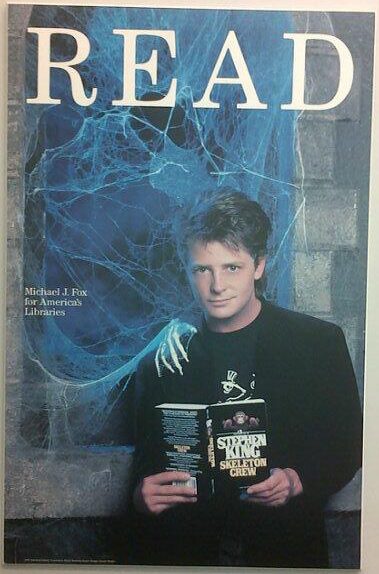 There was this feeling of a borderland for me as a young teenager in the library. I was able to be older, to be smarter somehow among the stacks. A Stephen King READ poster, a microfiche machine, a wide staircase, and low windows brushed with leaves. In the library, I was studious in wooden study carols, while the names of the Grateful Dead danced in my sight line, etched in pen years ago. In the library, I did my research with the help of those titans of knowledge behind the tall desks, their faces blooming with joy at my questions. In the library, I saw homeless men sit and read the newspapers with dignity. In the library, I saw my life stretch out before me, echoed over time, echoed under the hanging lights, layers of books and memories forever in the same borderlands of my old heart today.
– Jocelyn Hieatzman
1. My childhood library was a big stone building with stone lions guarding the front door. It made the institution impressive and important . As a child, we couldn’t borrow “adult” books, and it seemed like they must hold some secret knowledge. 2. The bookmobile came to our neighborhood every Monday afternoon. We were allowed to take 7 books, and it was air-conditioned. It was the 1960’s.
– Sharon O’Neill
I love the library. It’s a quiet place to work or explore new authors! I love the creativity with displays.
– Kristine
I moved to the United States when I was 13 years old. In Mexico libraries were not an everyday thing for me. If we went, they were usually surrounded by homeless people or too far from our home. However, once I moved to the U.S, libraries became my escape from a place I did not understand. At first I hated the library. Mostly because of my limited English and low reading level. I felt embarrassed when my teacher told me all I could read were elementary level books. It wasn’t until a lunch monitor saw me with one these books, The Ugly Duckling, that I learned the value of reading. She told me that the fastest and best way to improve my pronunciation and understanding was by reading out-loud to myself. After that day, I visited the public library and read as much as I could. I read through all the R.L Stine, Goosebumps, romances, mysteries, and many others until I was finally able to challenge myself and read the Harry Potter series. Thanks to the welcoming environment of my public and school libraries, I went from reading picture books at the age of 13 to 1000 pg Stephen King books by the time I was 16.
– Ale M.
I grew up in Ellicott City, MD, so I went to the (old) Miller Branch library when I was young quite often. My first memories are borrowing toys from the kids’ section, which was directly to your right when you entered the library. My mom loved that she could borrow toys for my sister and me since kids can be so fickle; I’m sure my family saved a lot of money by not having to buy us as many toys! In elementary school, I remember creating my own fantasy story about the small enclosed garden area directly across from the circulation desk (although I don’t remember what the story was now). In middle school, R.L. Stine novels engrossed me. I remember spending many weekends searching through the R.L. Stine books directly to the left when you entered the library, at the back. I also bought some of his books from the area to the left of the circulation desk at something like 25 or 50 cents per book. I loved that I had enough money to buy my own books! I didn’t care that they had clearly been read many times before. Finally, I remember doing a couple of research projects at Miller Branch and Central Branch. Unfortunately, I moved to another state before high school started and didn’t have such a fabulous library nearby anymore. I’m so glad to be back in Howard County with a renovated Miller Branch and an almost-ready renovated Elkridge branch within walking distance of my new house!
– Liz Campbell

the old Miller Branch library in Ellicott City, MD
Every Saturday when I was growing up, my dad and I would drop my mother off at the grocery store and walk over to the Randallstown Branch of BCPL which was in the same parking lot. While she shopped, my father and I would return the books we signed out the week before and take out new ones. We would walk back to the store and find my mom in one of the aisles and help her finish up. This is one of the fondest memories of my childhood and I remember many wonderful chats with my dad before curling up in an easy chair to read my newest treasures!
– Annette Kuperman
When I was a little girl, I lived in a small blue collar town just north (on the mainland) of Galveston, Texas. Hitchcock had a grocery store, a small bank, a doughnut shop, Mr. Charburger, a drug store and some other small local businesses! We also had a book mobile every three weeks or so, that parked in the bank’s parking lot. A large trailer with books, books and more books! I didn’t even know “libraries” existed, until one day Mother took all of us four little girls to Galveston Island to THE library. It was beautiful; with what I remember to be massive, dark-stained, ornate rails leading up the many steps to the magnificent entryway of the building. And books! Who knew there were that many books in the world? What pure, giddy joy I felt that day.
– Trudie Myers
When I was in late elementary school, I loved going to the Central Library with my mom. I loved the weird shape of the building and the nooks and crannies of the library. The library was also the first space I was allowed to be “alone” in a public space. I would look for my books while my mom would look for hers. We would meet at the check out line, her with her reasonable amount of books and me struggling to balance a stack that piled to my nose.
– Kaitlyn Curtis
I remember the Book Mobile routinely coming through our military Navy Housing in Bremerton, WA when I was in 6th grade. My two younger brothers and I so looked forward to the Book Mobile! It was such a different experience to walk-in to a library on wheels. It was a pleasurable experience I will not forget.
– Lorraine
favorite banned books, according to educators and librarians
The week of September 25th, we celebrate our RIGHT TO READ! In celebration of Banned Books Week 2017, we asked several educators and librarians about their favorite banned books. Here’s what they said.
——————————————-
To Kill a Mockingbird has influenced me as a reader and a teacher. As a young reader it brought me into a world I knew nothing about. As a teacher it has opened the same door for hundreds of students. It is only controversial because it depicts an ugly truth- which is also its value. – (a Howard County high school English teacher)
“It depicts an ugly truth – which is also its value.” Agreed. For my own part, Adventures of Huckleberry Finn has had a similar impact for me, both as a teacher and as a reader. Our literature is our history. Regardless of genre, our literature reflects who we were, are, and could be. I have always found myself drawn to those authors who have been willing to paint in honest brushstrokes, an image of humanity that requires taking stock in the complexities and contradictions, pressing us to face the mirror. Often lost in the controversy surrounding “Huck” is the wink of hopefulness gained from the novel’s final passage. – (a Howard County middle school English teacher)
My daughter read Al Capone Does My Shirts last year as a 5th grader and it was her first experience of being “hooked” by a book and rushing to read the next book and the next in the series. It totally changed her from being a reluctant reader to being someone who devours books! Having taught it in the past I do not see why it would be controversial. Many books have characters with huge flaws. But having characters that possess both positive and negative qualities is what makes them multi-dimensional, interesting, and realistic. – (Howard County secondary literacy coach)
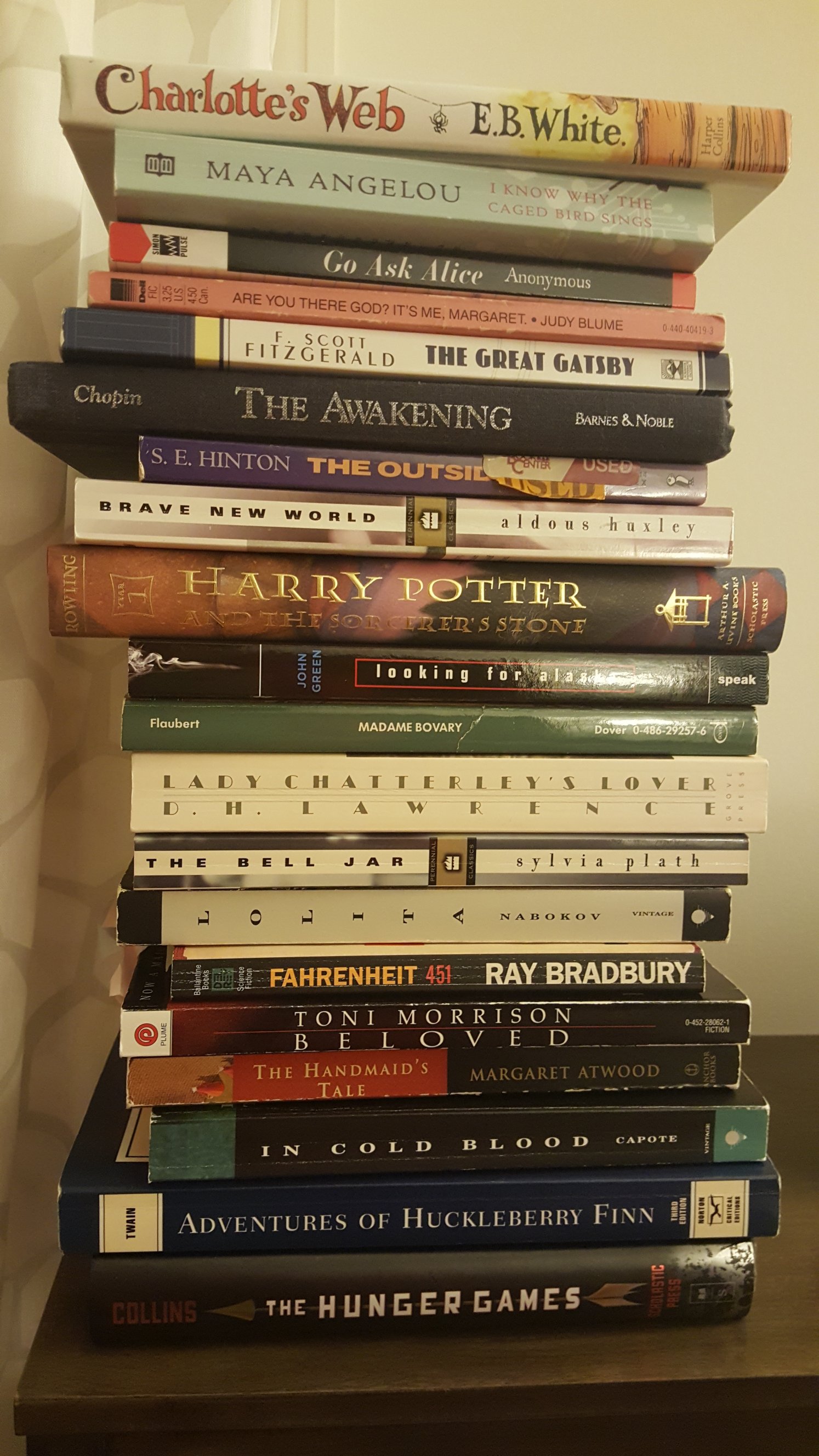
As a middle school teacher, I would have to choose The Giver and The Outsiders, two books that really touched kids and elicited deep and honest discussions. I loved teaching those books. – Beth S. (Howard County middle school English teacher)
Favorites to teach and/or read: Hunger Games, To Kill a Mockingbird, Fahrenheit 451, In Cold Blood, Leaves of Grass. Favorites to read to my kids: And Tango Makes Three, The Paper Bag Princess, The Lorax, Where the Wild Things Are. – Amy P. (High School English teacher in Hudson, MA)
Johnny Got His Gun by Dalton Trumbo and All Quiet on the Western Front by Erich Maria Remarque. Both novels are stories of the horror and dehumanizing effects of war (WWI, to be precise), and the relentless pursuit of an ill-defined victory at all costs. Reading these books in high school caused me to question a lot of the assumptions I had about politics, war, religion, and conflict more broadly defined than I had before. Or since, for that matter. They literally changed my outlook on life in a span of a few weeks, and I continue to wrestle with these ideas to this day. – Jeffrey M. (English Professor at Howard Community College)
And Tango Makes Three. My two children enjoyed this book when they were just 3-4 years old. It’s a book about penguins! But here’s the thing – now that my older son is 8 year old I am wondering how he might experience and “hear” the book today. That’s the thing about books (good books), right? They challenge us to these questions – and this book forces me to be thoughtful about how I would teach my children about family diversity and help them become accepting, welcoming people in the world. In the Night Kitchen was a gift from our friend and neighbor (Tim!) – of course the children just love that Mickey is naked – butt and penis and all – in the illustration and they giggle and laugh. But they also enjoy Mickey’s adventure. It’s fun. For my kids – who like to tell fart jokes all day long – this book delights them. And I’m really, really good with that. – Laura Y. (English Professor at Howard Community College)
Strega Nona is one of my favorite books of all times. This book has been challenged and banned due to the magical or witch-like abilities of a magic pasta pot. Strega Nona’s objective is not to be a book about witchcraft, rather a book that is full of whimsy, allowing children to engage their imagination. Challenging or banning books can stifle creativity and imagination. When a book is challenged or banned because one person feels that it is against their morals, it can lead to an entire community of readers having restricted or no access to a book. – Christina P. (Librarian at Howard Community College)
The Things They Carried: it challenges ideas of morality, truth, courage, and patriotism. I come from a military family (going back generations), so this really resonates with me. The narratives never stop feeling relevant. O’Brien creates a web of fiction, memoir, history, and memory that always ensnares us us readers, leaving us in the best possible state: uncertainty. That is where all good inquiry comes from. – Ryna M. (English Professor at Howard Community College)
It was much more banned in the past, but definitely The Handmaid’s Tale! Even when I read it in the 8th grade (?), I remember being shocked at the story–not because of content, but because of so many similarities and so much truth. I thought how not so unrealistic this society was, and I still think that now. – Sylvia L. (English Professor at Howard Community College)
For my kids… Hop on Pop!! This is such a great book to start children reading on their own. The simple rhyming text is perfect.
For me one of my favorite books growing up was Are you There God, It’s me Margaret. It’s one of the first books I could relate too. – Melissa P. (Preschool teacher at the Children’s Learning Center)
#BannedBooksWeek #RightToRead
what to read this Hispanic and Latin Heritage Month (9/15-10/15)
Associate Professor of Spanish at Howard Community College
A guest blog by Claudia Dugan
————————————
Sipping coffee at my desk last week, I tried to gather a list of favorite Latin American or Spanish books and I felt raptured into a labyrinth.
Should I go this way, or that? Which of the intricate paths should I take first? Should I do it in chronological order? But then again, the themes, like the paths in a maze, seem to meet each other, reoccur, and from time to time, give an opportunity to skip to another side… Chale! Is there an actual exit to this? Is it the task or is it me who, in an attempt to reflect about the books I love, often enter an identity labyrinth, similar to the one Octavio Paz describes?
I thought about The Broken Spears which invites the reader to be immersed into those ancient stories on the cosmology of the Aztecs, and to understand how ancient philosophies played an important role in the Spanish occupation of México, and in its current syncretism. Then, I thought that maybe Malinche by Laura Esquivel could be a better choice since it is written more like a love story, and who doesn’t love love.
But a different title kept knocking at the door of my thoughts. The one that most of us who have taken a class that requires Latin American Literature had to read: Gabriel García Márquez’s Cien Años de Soledad.
 The first time I read it in high school, it almost took me cien años to finish reading it, but the magic was worth it. You see, my classmates and I had transformed the book into a scavenger hunt. Our whiskers were wet. We looked for clues inside the book that would lead us to the next book to read. How excited I was to discover Artemio Cruz in Cien Años de Soledad, and I shared it with my friends. That served as a launching point to the next author, Carlos Fuentes, who believed that history would always provide revolutionary characters like Artemio Cruz.
But if you think such findings sparked enthusiasm and idealism inside us, you have not read much of Latin American literature. My goodness, just when your hopes get high, it begins to rain – in almost every single darn book. Fuentes, who introduced us to Artemio Cruz, reminded us in “Old Gringo” to be aware of the ugly-self-interest-seeking-human that lurks inside of each one of us, idealistic or not.
Another of my favorite on the subject of revolution is Mariano Azuela’s Los de Abajo written in the early 1900’s and centered in the Mexican Civil War. In English, the title is The Underdogs but it really does not evoke the same images that the Spanish title Los de Abajo does. Los de Abajo refers to “those who are at the bottom of the pyramidal structure of so many human social configurations throughout history.
When reading Latin American literature, you will always find those comedic chapters on the absurd, such as Capitan Pantoja and the Special Service by Mario Vargas Llosa, which provide much needed relief during raining seasons.
And of course in reading Latin American literature, there is the important question of language and translation. When I read the book Malinche in English, I noted that the culturally-rich word “temazcal” was merely translated as “hot-bath” (jacuzzi). If you knew what a Temazcal represented for Mezoamerican cultures, and its role in new-births, in healing, in cathartic ceremonies, then you would understand its significance in that chapter in which Malinali and Cortez bathe their fusing souls in it. I am sure you would be able to smell the copal and other aromatic fresh herbs when reading about it. Or, if you have studied Latin American history, you would notice the weaving of the threads that joined the voice of Oscar to the authors’ footnotes in The Brief Wondrous Life of Oscar Wao, by Junot Diaz, or the universe in the word Quetzalcóatl, in Juan Felipe Herrera’s Half of the World in Light.
So, during this Hispanic/Latino Heritage Month, connect with a book by a Latin American writer, maybe one from my list.
But more importantly, connect with a person of Hispanic or Latin heritage. What you might learn from them about the cultural values and practices, history, and character will enrich your reading experience. And of course that could lead to enriched relationships with your neighbors of Hispanic or Latin heritage as you hear their stories. After all, as Jonathan Gottschall points out in The Storytelling Animal, it is stories that make us human.
~ Claudia Dugan is an Associate Professor of Spanish at Howard Community College in Columbia, Maryland.
mana’s musings: national read a book day 2017

Laura Yoo
HoCoPoLitSo Board member and Professor of English at Howard Community College.
Today – September 6th – is National Read a Book Day. And on this occasion, I’m sharing with you 30 books that changed me.
These are the books that exposed me to new things (like about racial passing in Nella Larsen’s Passing), changed the way I felt about a subject or what I knew about the subject (like about death and dying in Ann Lamott’s Hard Laughter), or seemed to push the conventions of literature (like the way Laurence Stern’s Tristram Shandy experiments with structure and narrative voice). These are the books that made me say, “What? A book a can do THAT?!?!”
For most of these works, though, I don’t remember the exact plot or the details that made them so impressive. For some of these books, I bet the timing was what mattered. When I read Crime and Punishment, for example, it was right after high school. And I read it for fun. I think I was pretty proud of myself for reading a Dostoevsky for leisure. That made me an official adult.
Though I don’t remember the details, I remember the sensation. I remember the sense of awe inspired by Waiting for Godot and The Unbearable Lightness of Being. These books blew me away with their deep investigations of humans – about who we are, what we want, what we believe, what we lack, and what we could be (both beautiful and hideous).
I remember feeling very grown up after reading books like The Laramie Project and Middlesex. These books introduced me to the things that happen in the world to real people that I might otherwise have been shielded from.
I remember feeling envious when reading works like Playing in the Dark and Between the World and Me. These are the books that showed me what a human mind can think through and what a human mind can then articulate into language. The envy comes from recognizing these writers’ genius as well as the fact that I will never achieve that.
I remember the labor that went into studying Paradise Lost and Macbeth. So much to excavate and discover – again and again – in pouring over works like those. And the sense of accomplishment that comes from cracking the code in some small way to understand the text.
I also remember specific lines from these books that stay with me. Like “There is no story that is not true” from Thing Fall Apart. Like “A true war story, if truly told, makes the stomach believe” from The Things They Carried. And these unforgettable words: “Let me imagine … what would have happened had Shakespeare had a wonderfully gifted sister, called Judith, let us say” from A Room of One’s Own – and I never forgot about Judith Shakespeare.
Oh, and of course – I remember the laughing and the crying. Really laughing out loud while reading Me Talk Pretty One Day. And really sobbing while reading The Kite Runner.
My literature students are writing this week about why we read and study literature. As for me, I read because I want to be changed. Even in some small way. By the time I read the last page of the book I want to feel a little different and be a little better than when I started the book.
Why do you read?
A slap upside the head from a favorite author
Susan Hobby’s guest post for HoCoPoLitSo’s What Are You Reading series
Margaret Atwood was hitting me over the head.
Well, not really hitting, like in her cameo in “The Handmaid’s Tale” television series, in which she smacks Elizabeth Moss in the head.
No, the subject of Margaret Atwood – not the actual Margaret Atwood — has been clubbing me for the last seven months. Here’s why:
- In January, the sign from the Women’s March: “Make Margaret Atwood Fiction Again.”
- The profile in The New Yorker, describing Atwood as a “buoyant doomsayer,” recounting her penchant for reading palms, and explaining how, since she doesn’t drive, she often drags a cart loaded with used books through Toronto to donate to the library.
- The aforementioned, terrifying television series based on The Handmaid’s Tale.
- The copy of her Booker Prize-winning novel, The Blind Assassin, which was balanced on top of the growing pile on my nightstand, then cascaded onto the mound under my bed. I heard the Canadian novelist calling me through the mattress.
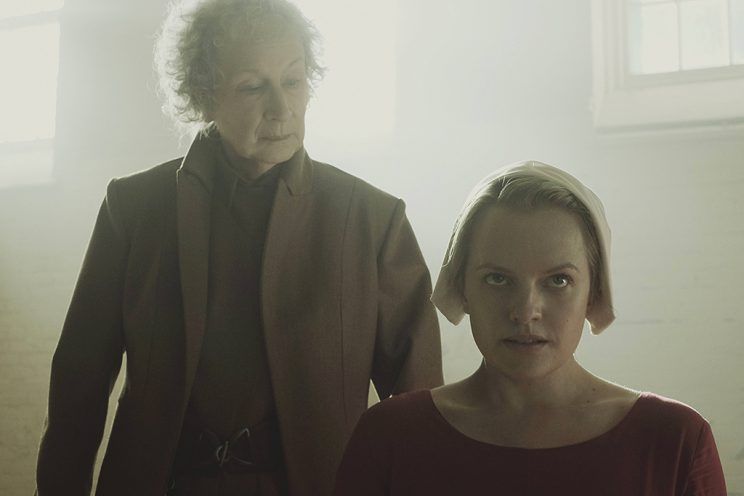
Margaret Atwood and Elizabeth Moss in The Handmaid’s Tale – Photo by George Kraychyk/Hulu
So when I went on vacation this summer, I took Atwood with me.
I started reading The Blind Assassin on my last day in Colorado, and it delayed our hike a bit because I had to finish a chapter. The story starts with the suicide of the protagonist’s sister, who drives off a bridge without slowing down, her white-gloved hands gripping the steering wheel. What would be a climax for any other writer is just the beginning for Atwood.
Since I’m trying to write fiction, after years of telling the truth as a journalist, I’m having to make stuff up. It’s hard going – I can turn a phrase and describe a scene, but plot? It proves elusive. Atwood is teaching me to read like a writer, and, I hope, write like a reader. Her plots – the hateful girls and their tormented protagonist in The Cat’s Eye, the dystopian, reproductively challenged theocracy in The Handmaid’s Tale, the nineteenth-century murder tale in Alias Grace – are masterful.
The Blind Assassin sounds complicated, but in Atwood’s deft hands, the reader spins along quickly in the book, flashing back and forth in time, into and out of the world of the science fiction novel within a novel. Iris, whose sister, husband and daughter all die untimely deaths, tells the story from her silver years, writing herself back in time to her privileged childhood and her young marriage to her father’s competitor to save the family fortune. But interspersed in Iris’s tale is her sister’s novel, about an illicit affair in which the man, to entertain the woman in bed with him, tells a story about a blind assassin and his lover, on a faraway, violence-torn planet.
About halfway through, this reader thought she had it figured out. Then, by two-thirds through, I had it figured out a different way. By the end, though, Margaret had blindsided me again, her plotting twists and turns slapping me around like I was the punk in the fight.
I marvel at her imagination, her structuring, the control that Ms. Atwood had over me. The Blind Assassin’s protagonist and narrator – writing her own story – explains:
The only way you can write the truth is to assume that what you set down will never be read. Not by any other person, and not even by yourself at some later date. Otherwise you begin excusing yourself. You must see the writing as emerging like a long scroll of ink from the index finger of your right hand; you must see your left hand erasing it.
Impossible of course.
I pay out my line, I pay out my line, this black thread I’m spinning across the page.
All the while the protagonist is teasing us, telling us half-truths and outright lies mixed in with reality. The voice, the plot, the book, they hit you like a ton of bricks.Thanks for schooling me, Professor Atwood. This writer – slightly more black and blue – will get back to work now.
Who to Read: Daniel Woodrell
A guest post by Kathy Stowe (HoCoPoLitSo’s Program Coordinator)
Searching for authors to take me through the rabbit hole into a new world has been an unending but rewarding task since I was old enough to walk the mile to the local library, the summer after third grade. When I saw the movie Winter’s Bone, I knew I had to seek out Daniel Woodrell. Rarely have I been so rewarded. Woodrell conveys in just a sentence an entire world, an unfamiliar but believable territory that exists somewhere frighteningly close. It’s Neil Gaiman without the alternative universe.
William Boyle, in a review of the recently released movie Tomato Red, also based on one of his novels, called Woodrell “the battle-hardened bard of meth county.” An apt description for a man described as a “lady stinger of a writer” by E. Annie Proulx on the book jacket review of Woodrell’s 1996 Give Us a Kiss: A Country Noir. Even the book’s title gives you a little shiver, conjuring up images of a perverted uncle. The lady stinger, a “little black thirty-two” tucked into a blue pillowcase that held his traveling clothes, accompanies Doyle Redmond on his family errand into the Ozarks to convince his older brother, Smokes, to turn himself into the law even though “us Redmonds have never been the sort of bloodline who’ll give up our kin easy to the penitentiary.”
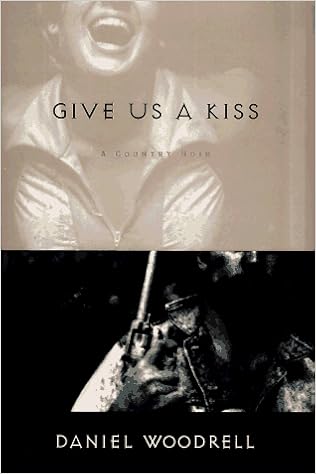 In Give Us a Kiss, this particular Redmond, Doyle, has just one true love, “following his fantasies out and scribbling them down … telling stories … big wet whoppers” that “ … eventually … shade toward truth.” Having escaped the academic world in a stagnant pond-green Volvo listed on the hot sheets as yellow, Doyle has left behind the world of four published novels nobody much had read. He’s also left behind the Volvo’s owner, his two-timing wife who had “been in a frenzy to be a poet both revered and lusted after … . A hybrid of Edna St. Vincent Millay, Carolyn Forché, and Gypsy Rose Lee.”
A quick check reveals Woodrell lists four published novels, meaning another tendency of mine, rummaging about in favored authors’ lives, might get a satisfying scratch. Lists of books carried in a box along with the pillowcase of clothes and the lady stinger, and references to authors, music and Doyle’s own writing process offer possibly slightly veiled autobiographical insight into the rather reclusive, fascinating mind of Daniel Woodrell. I too take great joy in looking under rocks to imagine, examine and describe the “dashingly scuzzy dudes,” just for the joyride of it.
Oh, and as in other Woodrell novels, sex and the Dollys are involved. The newest novel released as a film, Tomato Red (2017), and Winter’s Bone (2010) also feature the Dollys, a legendary clan of criminal persuasion, another backwoods family tribe who aren’t nearest and dearest to the Redmonds. Sex in the form of Doyle’s attraction to Niagra, Smokes’ girlfriend’s (Big Annie) 19-year-old daughter who tells him, “I believe we got the makings of a dream that’ll burn mighty hot, Doyle, you’n me.”
Woodrell’s ability to transport the reader to another world includes transforming words to smells and taste. Squirrel meat soaked in buttermilk doesn’t make my mouth water until he describes the old Folger’s can of bacon grease, burger leavings and whatever “from a United Nations of edible critters” that Big Annie cooks it in.
Woodrell, an author who is “…not the type who can exclude people socially just because they operate under some bad habits,” creates a world of memorable characters. He describes a neighborhood where “Some old boy across the road and down a few houses kept up a racket trying to cut the grass of his entire yard with a Weedwhacker. He stopped and dragged an ice chest along behind him after every five or six paces of whacking.” His evokes a believable world with unbelievable skill. This post aimed to give the reader enough of a taste to want to check out one of our best American writers. Start with Give Us A Kiss … .
Tyehimba Jess and W.E.B. DuBois Meet on Stage
A Guest Post by Brandt Dirmeyer
Brandt Dirmeyer is an aspiring writer and poet who wants to use language to display the ecological relationship between people and place, with a focus on revealing individuals as parts of larger wholes. You can read this poem “You’re a Mad Cow” on FIVE:2:ONE and two other poems in his blog post for the Patapsco Heritage Greenway. Below is Brandt’s reflection on Tyehimba Jess’s reading at the 2017 Blackbird Poetry Festival.

Friends Nick Stowe (left) and Brandt Dirmeyer (right) with Tyehimba Jess (middle) after the reading at the 2017 Blackbird Poetry Festival
On a warm April evening, I attended the main event of HoCoPoLitSo’s Blackbird Poetry Festival, which was a reading by the winner of the 2017 Pulitzer Prize for Poetry, Tyehimba Jess, from his newest book of poems, Olio, a collection of poems about miscellaneous African American performers who lived between the times of the Civil War and World War I. The crowd was in awe as Jess demonstrated that his poems could be read up and down, across, or in tangential patterns, which served to amplify our understanding about the personal depth of real people who played minstrel show caricatures in the 18th and 19th centuries.
As Jess read his poems about Millie and Christine, a pair of twins conjoined at the ribcage and pelvis, and Walker and Williams, famous minstrel comedians at the time, I couldn’t help but hear the voice of W.E.B. DuBois echo within my mind. During my undergraduate studies at Towson, I studied how DuBois’ concept of “double consciousness” manifested itself in Ralph Ellison’s novel, Invisible Man. In The Souls of Black Folk, DuBois wrote, “It is a peculiar sensation, this double-consciousness, this sense of always looking at one’s self through the eyes of others, of measuring one’s soul by the tape of a world that looks on in amused contempt and pity.”
Despite the hundred-plus year difference in time between when DuBois, Millie and Christine, and Walker and Williams were active, affective, and alive, I felt their connection to our current place. Listening to Jess speak, it was as if we had not only gone back in time to when Millie and Christine and Walker and Williams were heating up the stage with dance and song, but also into their minds to discover the multi-faceted exterior and interior forces that pressured them to dance and sing. I could feel DuBois’ words still alive as well, as there are similar exterior and interior forces currently at play in American society that find their origins in the time-periods of the minstrel show, the Gilded Age, and the Antebellum South.
In fact, we could go even further back in time. As soon as Captain John Smith sailed up the Chesapeake Bay looking for natural resources to exploit, these forces of subjugation, alienation, repression, misrepresentation, othering, and inequality that have been at play in human societies across the planet for thousands of years were once again amplified in the colonies of what was once called Turtle Island, now known as North America.
Millie and Christine were talented dancers and musicians who learned to harmonize with the piano and with their voices, understood five languages, and experienced the wider world while on international tours, even meeting Queen Victoria at Buckingham Palace. Walker and Williams used their minstrel show to contest cultural ownership of racial representations to white audiences.
The poems written by Jess noted the feats of each pair, but they also asked us to look past their accomplishments and see the experiences and feelings that compelled them to swim upstream in such a torrential river. Either pair could have just as easily conformed to what society expected of them, floating with the current to save energy, but instead they used the minstrel show to simultaneously conform to the expectations of their audience, while separating themselves from other minstrel show acts by putting in effort to confront said expectations.
Like DuBois’ example of a black artisan (The Souls of Black Folk) who was conflicted between producing goods that reflect his personal perspective and producing goods that are marketable to the dominant society, Millie and Christine and Walker and Williams desired to balance themselves upon the fine line between having their performances watched and having their perspectives heard.
The characters in Jess’s poems used their work to subvert societal expectations while also playing the game that they were unfairly born into. Millie and Christine were pitied and Walker and Williams were laughed at by the audience, but they also wanted to be known for who they were. In his poetry, Jess gives these performers a humanitarian redemption by showcasing their individual inner psychological conflicts.
 HoCoPoLitSo