Home » ECK Poetry Prize
Category Archives: ECK Poetry Prize


The 2025 Ellen Conroy Kennedy Poetry Prize

Held annually in loving memory of HoCoPoLitSo’s co-founder, the 2025 Ellen Conroy Kennedy Poetry Prize is now open to all entrants! Whether you are a life-time poet or have never written a line before, we invite you to share with us whatever moves you to poetry.
The author of the poem selected for first place will be awarded a cash prize of $500, celebrated on HoCoPoLitSo’s website, social media, and in our annual report— and have their winning poem published in The Little Patuxent Review and right here on HoCoPoLitSo’s front page.
To enter, click here, or visit the contest’s page to learn more or to read past winners’ poems. A reading fee of $10 per entrant supports a panel of fair and balanced judges.

Meet Neha Misra — Second Place Winner of the Ellen Conroy Kennedy Poetry Contest
In 2021, Howard County Poetry and Literature Society launched the Ellen Conroy Kennedy Poetry Prize in honor of its founding member, Ellen Conroy Kennedy. Now in its forth year, contest judges evaluated many submissions for mechanics and technique, clarity, style/music for our contemporary age, imagery/sensory power, and emotional resonance. Congratulations to this year’s second place winner, Neha Misra and the poem, “Vanishing Gardens Return”. The judges appreciated the skillful use of form; vivid and original imagery; compact storytelling; familial, social, and cultural resonance. Read on (below the video) to learn a little about our second place poet and to hear the poem recited.
Tell us about your poem “Vanishing Gardens Return”. How did it come about? What sparked or inspired it?
“Vanishing Gardens Return” is a poetic contemplation on the loss of metaphorical and physical gardens in the Anthropocene age of disconnection from Mother Earth, of which we human beings are a fractal part. We are living through a global climate emergency whose disproportionate impacts are all around us. 2024 was the hottest year in the entire recorded history of our planet. “Vanishing Gardens Return” is inspired by the personal, collective, planetary context of this reality. The poem ponders the inter-generational seduction of relentless industrialization that took me and so many farther and farther away from mother tree. The poem is a ritual of grief. By recognizing and honoring this grief, I plant the seeds of possibilities where vanishing gardens return and healing is possible.

What was an early experience where you learned that language had power?
I am a first-generation immigrant poet rooted in my Global Majority lineage as a multi-lingual Indian American woman. Embodying the power of language is an inheritance from my elders, culture, and migratory life experiences. My parents — an engineer and a doctor, are avid poetry lovers so my whole life has been soaked in poetry as an integral part of life. From my first waking memory, I remember being enveloped in songs, lullaby’s, poems that are a part of family’s fabric. From dinner tables to traffic jams to daily triumphs and aches, I have been lucky that have this inheritance of poetry in the most ordinary and extraordinary ways.
As a writer, what would you choose as your mascot/avatar/spirit animal?
I would not choose the word “spirit animal” out of a deep respect for what is very specific sacred cultural term for the Indigenous traditions of Turtle Island that is my adopted home.
As a writer rooted in the spiritually ecology traditions of my South Asian culture, I feel a multi-species kinship with flora and fauna across Asia, where I was born; Africa, where I spent a considerable time working on grassroots women-led climate solutions, and North America – my adopted immigrant home. Trees and birds are especially abundant across my poetics.
Tell us about a writer or a book that you return to over and over for inspiration.
Nikki Giovanni, who we lost last year, is one of my favorite poetry elders. I return to her book “A Good Cry” time and again. My much loved and annotated copy of her book feels like an old friend with whom I have cried and giggled through many time travels.
What are you working on next and where can we find you?
I am working on finding a values-aligned, community driven publisher for my debut poetry collection inspired by my migratory life and dreams. I curate, perform, share poetry and art in many forms across the Washington, metro region and online. The best way to find about these offerings is through my monthly newsletter “Color Portals”. Learn more at nehamisrastudio.com or follow me on Instagram @nehamisrastudio
Neha Misra नेहा मिश्रा (she/her) is an award-winning immigrant poet, contemporary eco-folk artist, and climate justice advocate. Her interdisciplinary practice builds bridges between private, collective, planetary healing and justice. Neha is a Public Voices Fellow on the Climate Crisis — an initiative of the OpEd Project and the Yale Program on Climate Change Communication to change who writes history. She is the Global Ambassador of non-profit Remote Energy, making solar training more accessible for women of color. Learn more at nehamisrastudio.com
The 2024 Ellen Conroy Kennedy Poetry Prize
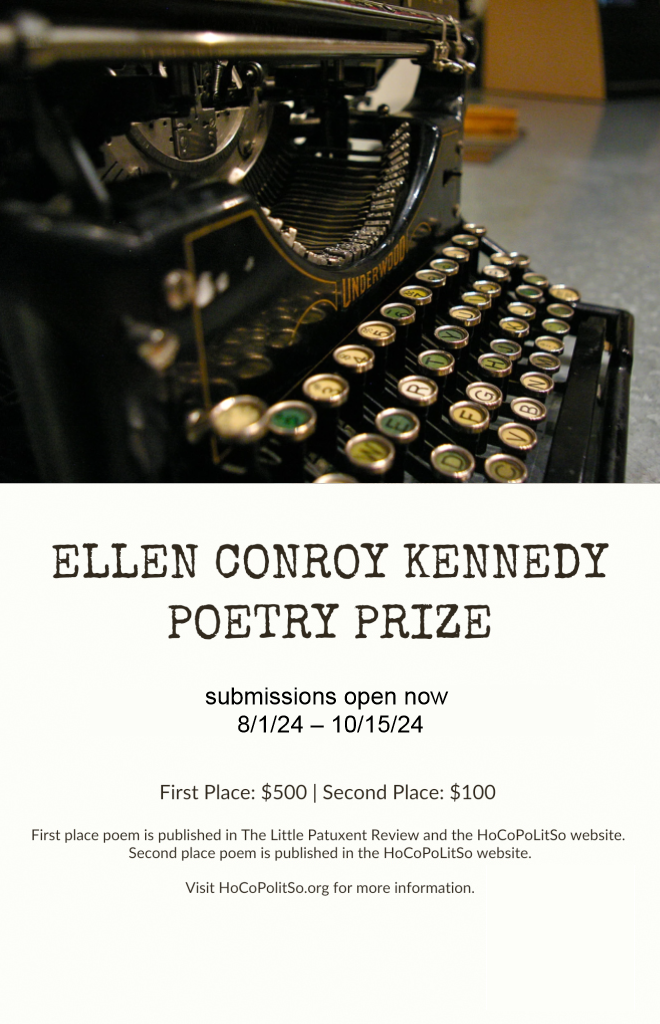
Held annually in loving memory of HoCoPoLitSo’s co-founder, the 2024 Ellen Conroy Kennedy Poetry Prize is now open to all entrants! Whether you are a life-time poet or have never written a line before, we invite you to share with us whatever moves you to poetry.
The author of the poem selected for first place will be awarded a cash prize of $500, celebrated on HoCoPoLitSo’s website, social media, and in our annual report— and have their winning poem published in The Little Patuxent Review and right here on HoCoPoLitSo’s front page.
To enter, click here, or visit the contest’s page to learn more or to read past winners’ poems. A reading fee of $10 per entrant supports a panel of fair and balanced judges.
Meet Larraine Denakpo — 2023 Second Place Winner of the Ellen Conroy Kennedy Poetry Contest
1n 2021, Howard County Poetry and Literature Society launched the Ellen Conroy Kennedy Poetry Prize in honor of its founding member, Ellen Conroy Kennedy. Now in its third year, contest judges evaluated many submissions for mechanics and technique, clarity, style/music for our contemporary age, imagery/sensory power, and emotional resonance. Here, judges noted this poem’s “restrained composition” and “universal resonance.” One said, “This neatly packed, tiny poem is so enjoyable to read.” Congratulations on the second place win.
Tell us about your poem “Lullaby for Daughters”. How did it come about? What sparked or inspired it?
The poem was written around 1988-89 when our small family was living overseas in Bujumbura, Burundi. I had written some poems in a journal with no date and left them to mull for many years. The sentiment was inspired once as I watched our two young daughters sleeping. I am white, my husband black, and I was struck by how little the girls looked like me.
What was an early experience where you learned that language had power?
The written word has always been my friend; I was an early reader and devoured books constantly, escaping boredom and looking for answers. Later the poetry of lyrics in the 60s and 70s—from Bob Dylan to Joni Mitchell to Leonard Cohen – helped me cope with the world. But I first felt the power of poetry moving me to new ways of thinking in the works of women (Nikki Giovanni, Lucille Clifton and others) when I was in college. I attended Seton Hill College in Greensburg, PA and I credit several of the faculty there (the late Sister Lois Sculco and Dr. Lynn Conroy) for encouraging me to explore and practice poetry. I was lucky to attend poetry readings in Pittsburgh when I was in college and experienced readings by powerful poets like Derek Walcott and Adrienne Rich. I even put together a collection of poems as a senior in college (1975) and won an award, but then life happened and I only wrote poems when I found some calm in the daily bustle.
As a writer, what would you choose as your mascot/avatar/spirit animal?
I feel a stronger connection to all things green than to any animal. One of my earliest poems evokes a 10-year old me sitting in a maple tree and dreaming; no longer a tree climber I get inspiration from woods and gardens and memories of the green hills of tea and bananas that I found in Burundi.
Tell us about a writer or a book that you return to over and over for inspiration.
While I was working full-time and raising a family, I didn’t find much time for poetry or books. Now I am enjoying exploring much loved poets and discovering new ones. I do go back to both the poet A.R Ammons and the writer Annie Dilliard for the way they communicate about nature.
What are you working on next and where can we find you?
I am mostly retired after working for years on education projects in Africa. I have been focusing on quilting–combining African fabrics with the calico cottons of my childhood. I also explore my new hometown, Columbia, as well and just recently learned about HoCoPoLitSo. This contest took me by surprise and I entered a few old poems on a whim. Maybe I will work on putting together a collection in the years ahead. I have a LinkedIn profile if anyone wants to connect there.
Here, Larraine Denakpo reads “Lullaby for Daughters:
Bio:
I grew up in Carlisle, PA and left after high school in 1971, rarely returning during the next fifty years. After college (BA in English), I joined the Peace Corps and taught English in a small town in Benin. There I met my husband and together we spent time in the US with me getting an MA in Linguistics from the University of Pittsburgh. Then we raised a family while working on education and health development programs in Burundi, Egypt, and Senegal. Our daughters went off to college and we continued working, often separately, for shorter assignments including stints for me in Madagascar, the Democratic Republic of Congo and Rwanda. I still work part-time at FHI 360 as an education specialist but more and more of my time is spent enjoying my grown children and grandchildren and catching up on my own creative aspirations like quilting and learning to draw. I also enjoy living in Columbia and spend time most days pondering nature on one of its pathways.
Meet Steph Sundermann-Zinger — 2023 First Place Winner of the Ellen Conroy Kennedy Poetry Contest
1n 2021, Howard County Poetry and Literature Society launched the Ellen Conroy Kennedy Poetry Prize in honor of its founding member, Ellen Conroy Kennedy. Now in its third year, contest judges evaluated many submissions for mechanics and technique, clarity, style/music for our contemporary age, imagery/sensory power, and emotional resonance. Here, judges noted the poem’s “gorgeous language” and “strong imagery, alliteration, and meter.” One said, “This poem has the strongest voice of all,” and another called it: “a mature poem that is a moment in time.” Congratulations to this year’s winner, Steph Sundermann-Zinger and the wonderful “A Dream of Solitude”.

Tell us about your poem “A Dream of Solitude” How did it come about? What sparked or inspired it?
Sometime last fall, I woke up to find the word “beekeeper” written in my bedside journal. The details of the dream that prompted my midnight scribbling were hazy even then, but I couldn’t get the word out of my mind, so I decided to dig deeper. It was a beautiful, sunny afternoon – my children were in the backyard, giggling, sword-fighting with sticks, and part of me wanted to join them. The rest of me realized that sitting down to write was remarkably like putting on a bee suit – I was choosing solitude, making room to nurture something small and new. I didn’t know anything at all about beekeeping, so I spent the next hour or so watching YouTube videos about various mid-Atlantic hives. That’s one of the things I enjoy about writing poetry – you never know where the development of a piece might take you.
What was an early experience where you learned that language had power?
I learned to talk very early; by the age of two, when my parents decided to have me baptized, I was speaking in complete sentences. I knew the priest very well, as he dined at our house regularly, so I went willingly into his arms – when he began to pour cold water from a dainty silver seashell onto the crown of my head, though, I decided enough was enough. I sat bolt upright in his arms and screamed, “Get that water off my head, Wally!” That was the first time I embarrassed my parents with my blunt, poorly-timed honesty – it was by no means the last.
As a writer, what would you choose as your mascot/avatar/spirit animal?
My study has a big window that looks out onto our backyard, and I’m lucky enough to be visited by a lot of animals while I’m writing. Families of deer, a fox or two, a stumpy-legged groundhog, and a surprising variety of birds – goldfinches, woodpeckers, red-winged blackbirds, cardinals, crows, we even have a Cooper’s hawk nesting on the back hill. They show up in my poetry regularly – so I guess I’d say regional wildlife.
Tell us about a writer or a book that you return to over and over for inspiration.
Oh, goodness. Ada Limon, Ross Gay, Mary Oliver, Ellen Bass, Louise Gluck, Lucille Clifton, Victoria Chang, Brenda Shaughnessy – I could go on. There are so many poets whose work inspires me to push the boundaries of my own, but these are the ones who come immediately to mind.
What are you working on next and where can we find you?
I’m currently completing my thesis year in the University of Baltimore’s MFA program. We’ll be holding our graduation reading and bookfair on Sunday, May 19, and copies of my thesis project will be available; you’ll also have the chance to hear my very talented classmates read their work, so I’d definitely recommend marking your calendar! You can also find me at stephwritespoems.com and on instagram @steph_writes_poems.
Here is poet Steph Sundermann-Zinger reading “A Dream of Solitude”:
Bio: Steph Sundermann-Zinger (she/they) is a queer poet living and writing in the Baltimore area. Her work explores themes of identity, relationship, and connection with the natural world, and has appeared or is forthcoming in Blue Unicorn, Lines + Stars, The Little Patuxent Review, Literary Mama, Every Day Fiction, Litbreak, and other journals.
You will find this winning poem published in the January 2024 issue of Little Patuxent Review. Thanks to LPR for their partnership in presenting the winning poem of the Ellen Conroy Kennedy Poetry Contest each year.
an invitation to your first (or 264th) poetry reading
by Laura Yoo
I know that poetry has a reputation for being “highfalutin” and hoity toity. I know that some poems are hard and they seem utterly unreadable or unknowable. As I have confessed elsewhere before, even as an English major in college, I avoided taking the required poetry class until the very last semester.
But hear me out. Not all poetry is scary. I promise. Lots of poems are very readable and knowable. Often, poems tell stories, sometime really gritty, raw, and real stories about being human. They tell stories, whether they are fictionalized or based on the poet’s life, about how people live, exist, survive, love, and die. Different people turn to poetry looking for different things, and I turn to poetry for their poignant, particular storytelling.
So, I want to invite you to HoCoPoLitSo’s Nightbird event on April 27th with poet Noah Arhm Choi, the inaugural winner of HoCoPoLitSo’s Ellen Conroy Kennedy Poetry Prize in 2021, and hear their stories.
In Cut to Bloom, Choi’s poems tell stories about family, umma (mom) and appa (dad), hurt, violence, love, language, self discovery, and names. This one about forgiveness stays with me:
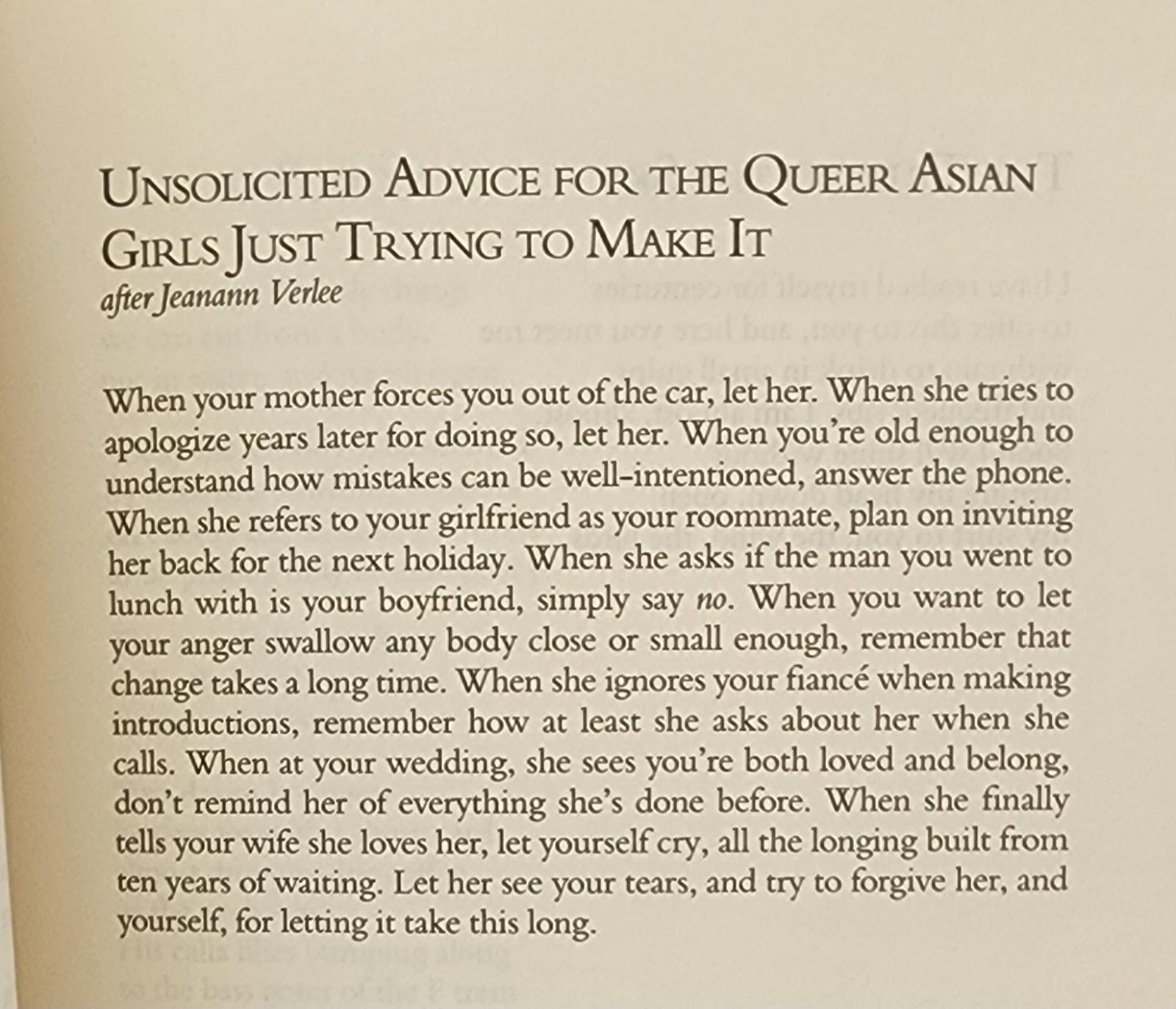
Yes, it’s a story about “queer Asian Girls” but it’s also about mothers, daughters, weddings, love, and forgiveness – all things that many of us can relate to.
How about these lines about being worthy?
Most days, it is hard to remember
I am worthy to be loved, even without
the right answer, the right joke,
the right moment.
And yet, here is my wife,
trying to tell me
a story around her toothbrush,
bragging about me to her parents,
bringing my favorite dessert home, as if
I could still be an unpredictable ending
that she wants to see unfold.
Haven’t we questioned our worthiness? Haven’t we also been loved in this way too – or have craved for such love? Is this not a story that many of us are familiar with?
When asked what they are working on after Cut to Bloom, Choi said this:
I’m working on a 2nd poetry manuscript that has been orbiting around my father’s death in 2020, my divorce, and finally coming out as transgender and beginning to transition. Sometimes I wonder what will be the thread that ties all of these subjects together. Today that thread is a look at what it means to start over and again, how grief brings out truth even if its unbearable, how much life can change in unexpected ways when one claims themself.
Are these – starting over, grief, life changing in unexpected ways, claiming oneself – not the stuff of our stories?
What I am trying to say is that you should come out to hear Noah Arhm Choi “unfold” their stories on stage on Thursday, April 27th at Monteabaro Hall at Howard Community College. Get your tickets right here. If you are a student (HCPSS high school or HCC), it’s free!
Whether this is your first poetry reading or your 264th poetry reading, you are all welcome to “poetry of belonging.”
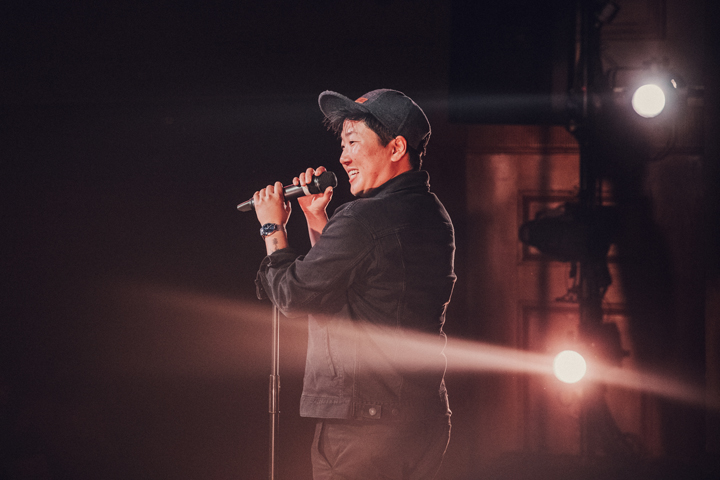
Noah Arhm Choi is the author of Cut to Bloom (Write Bloody Publishing) the winner of the 2019 Write Bloody Prize. They received a MFA in Poetry from Sarah Lawrence College and their work appears in Barrow Street, Blackbird, The Massachusetts Review, Pleiades, Split this Rock and others. Noah was shortlisted for the Poetry International Prize and received the 2021 Ellen Conroy Kennedy Poetry Prize, alongside fellowships from Kundiman, the Sewanee Writers’ Conference, and the Martha’s Vineyard Institute of Creative Writing. They work as the Director of the Progressive Teaching Institute and Associate Director of DEI at a school in New York City. Jeanann Verlee, the author of Prey, noted “Cut to Bloom is neither delicate nor tidy. This immense work both elucidates and complicates ethnic, generational, and gender violence, examining women who fight for their humanity against those who seek to silence―indeed, erase―them.”
Meet Liz Holland – second place winner of the Ellen Conroy Kennedy Poetry Prize 2021
In 2021, Howard County Poetry and Literature Society launched the Ellen Conroy Kennedy Poetry Prize in honor of its founding member, Ellen Conroy Kennedy. The contest received more than 100 submissions in its inaugural year, and the selection committee chose Liz Holland’s poem “Lifeboy Swept Away” as the second place winner. The committee cited the poem’s “intensely memorable images, elegiac tone, and vivid language that lingers with you… especially the ending: ‘The small waves/ashamed of what they hold, fold at my feet./Wading deeper, I cup my hands and take one/salted sip, carrying you as far away as you’ll go.’”

HoCoPoLitSo: Tell us about your poem “Lifeboy Swept Away.” How did it come about? What sparked or inspired it?
LH: This poem was written on the tenth anniversary of losing my friend to suicide. We grew up on the same street, celebrated holidays together (our families still do), and had much in common. He had a zest for life that I have yet to find in anyone else, though struggled desperately with his mental health. I sat down to write about something completely different and this poem pushed its way out. Travis has a way of showing up like that. I see him when I’m driving on the highway, in the local convenience store, and especially in proximity to the Chesapeake Bay. I welcome his energy when it floats in and found this piece to be a lovely way to honor him after a decade of absence.
HoCoPoLitSo: What was an early experience where you learned that language had power?
LH: I must have been around five when my mom realized my need for communication. I had such a desire to understand and to be understood. I asked a ton of questions (much to the annoyance of my mom who had four other kids to care for!) and overanalyzed everything with her throughout my teenage years. Language served a languishing purpose as I couldn’t quite express my internal world with the words available to me. I realized a certain power in language when I took my first poetry class in undergrad. I can’t tell you who I read or what my professor’s name was, but something new became available to me through writing – it truly saved my life while I, too, struggled with mental health in my twenties.
HoCoPoLitSo: As a writer, what would you choose as your mascot/avatar/spirit animal?
LH: I write a lot about the natural world (thank you Mary Oliver) and at this moment would say my avatar could be a ranunculus or peony on fire. Fire is ever present in my work as well, perhaps as a nod to me being a Leo, or from the decades of Catholic ceremony.
HoCoPoLitSo: Tell us about a writer or a book that you return to over and over for inspiration.
LH: As I’ve already mentioned, Mary Oliver’s Devotions stays on my coffee table, along with the likes of Ada Limon, Toi Derricotte, Ross Gay, Li-Young Lee, Marie Howe, and Steven Leyva. It is wildly evident as I read these works and write simultaneously, my poems move in emulation of each poet. I stay inspired by these incredible poets and return often to their books.
HoCoPoLitSo: What are you working on next and where can we find you?
LH: I am currently finalizing my first chapbook as my thesis in the MFA program at University of Baltimore. Our program culminates in a final book that is due out in May of 2022. I will be making it available on my IG and Twitter @cottonswords (same handle). I hope to continue the momentum of this publication into a full book in late 2022/2023. Thank you for publishing my work and amplifying the creative arts.
Congratulations, Liz!
Liz Holland is an MFA candidate at the University of Baltimore and 2021 nominee for ‘Best of the Net’. Her work can be found in Remington Review, Broadkill Review, Little Patuxent Review, and several other literary journals. She lives in Baltimore with her fur-son Brax.
If you or someone you know is in crisis, call the National Suicide Prevention Lifeline at 800-273-8255 or text HOME to 741741 to reach a trained counselor at the Crisis Text Line.
 HoCoPoLitSo