Home » Education (Page 3)
Category Archives: Education


Blackbird Poetry Festival Features Billy Collins, “The Most Popular Poet in America”
Date: December 20, 2013 Contact: Pam Kroll Simonson, (443) 518-4568, hocopolitso@yahoo.com
FOR IMMEDIATE RELEASE
Blackbird Poetry Festival Features Billy Collins,
“The Most Popular Poet in America”
Howard County Poetry & Literature Society (HoCoPoLitSo), in partnership with Howard Community College’s Office of Student Life, English and World Languages Division, and Arts & Humanities Division, presents the annual Blackbird Poetry Festival on Thursday, April 24, 2014, at Howard Community College. The all-day event features readings by two-term National Poet Laureate Billy Collins, called “the most popular poet in America” by The New York Times; workshops for HCC students by Bruce George, poet and co-founder of HBO’s Def Poetry Jam; readings by student poets from HCC; and on-campus patrols by the Poetry Police, who will award individuals carrying a poem in recognition of national Poem in Your Pocket Day. The theme of this year’s Blackbird Poetry Festival is “Poetry Unmasked,” exploring the bare truth of poetry.
“Billy Collins is famous for conversational, witty poems that welcome readers with humor,” writes The Poetry Foundation, an independent literary group, “but often slip into quirky, tender or profound observation on the everyday, reading and writing, and poetry itself.”
“His last three collections of poems have broken sales records for poetry,” writes the Winter Park Institute for intellectual engagement at Rollins College. “His readings are usually standing room only, and his audience–enhanced tremendously by his appearances on National Public Radio–includes people of all backgrounds and age groups.”
Collins will read and discuss his work at Nightbird, the Blackbird Poetry Festival’s evening event, at 7:30 p.m. at Smith Theatre, located in the Horowitz Visual and Performing Arts Center at HCC in Columbia. A book signing and reception will follow. Collins will give a short free reading at Smith Theater with student poets at 2:30 p.m. He will also tape an episode of The Writing Life, HoCoPoLitSo’s Bravo-TV Arts for Change Award-winning interview show seen on YouTube. George will facilitate creative writing/performance poetry workshops in morning classes at HCC.
Tickets to Nightbird are $50 for the first five rows in the center aisle and $30 for orchestra and balcony ($15 for students). Tickets can be purchased at www.brownpapertickets.com/event/523094 or www.hocopolitso.org . For more information, call HoCoPoLitSo at (443) 518-4568 or email hocopolitso@yahoo.com. Seniors in Columbia can request transportation by calling the Senior Events Shuttle at (410) 715-3087. HCC is an accessible campus. Accommodation requests should be made to HoCoPoLitSo by April 17, 2014.
HoCoPoLitSo is a nonprofit organization designed to enlarge the audience for contemporary poetry and literature and celebrate culturally diverse literary heritages. Founded in 1974 by National Book Award finalist Ellen Conroy Kennedy, HoCoPoLitSo accomplishes its mission by sponsoring readings with critically acclaimed writers; literary workshops; programs for students; and The Writing Life, a writer-to-writer interview show seen on YouTube, HCC-TV, and other local stations. HoCoPoLitSo receives funding from the Maryland State Arts Council, an agency funded by the state of Maryland and the National Endowment for the Arts; Howard County Arts Council through a grant from Howard County government; The Columbia Film Society; Community Foundation of Howard County; the Jim and Patty Rouse Charitable Foundation; and individual contributors.
For a pdf of this press release, click here: Blackbird 2014 Press Release.
Poet Laura Shovan Ignites a Creative Summer School Spark in 4th & 5th Grade Writers
The latest installment in our occasional series of blog posts from friends of HoCoPoLitSo. Today, the multi-talented — poet, blogger, teacher, editor, (the list goes on and on) — Laura Shovan shares with us her experience working with elementary school writers this summer.
It was my first, and only, time calling into a radio show. Former U.S. Poet Laureate Billy Collins was on the air with WYPR’s Dan Rodricks. I often use and recommend Collins’ website Poetry 180: A Poem a Day for American High Schools for classroom-friendly poems.
I wanted to know: Was there a Poetry 180 for younger students in the works? Collins said “No” and reasoned that elementary school children get enough poetry in their literary diet already.
Perhaps. But that poetry is often limited to work that’s easily digested. Elementary schoolers love Jack Prelutsky, yet are unfamiliar with more complex poets writing for children: Marilyn Singer, Sharon Creech, and Tony Medina. Their curriculum for poetry composition is rarely richer than limericks, haiku of the 5-7-5 variety, and cinquain. That’s why poetry educators, such as those on the Maryland State Arts Council artist-in-residence roster, are such highly valued classroom visitors. We are poetic master chefs. Give us the ingredients of poetry – form, figurative language, and voice – and we’ll turn out a dishy treat even the most reluctant writers will enjoy.
This month, I visited Lisa Johnson’s creative writing class at the Howard County Public School System’s G/T Summer Institutes. Certainly the fourth and fifth graders in a class called “Creative Writing: Ignite the Creative Spark” must like to write or they wouldn’t have been in the class. Still, many of them were unsure about writing poetry. Distaste for poetry often sets in by fifth grade, as evidenced by one student who wrote me this note: “At first, I thought you were going to be BORING!”
 As this was a group of strong writers, I brought a favorite lesson: portrait poems. To begin the workshop, we looked at a photograph of a man holding a baby. Our discussion focused on the facts of the picture. For example, we noted that “The man is wearing a baseball cap”. Once we exhausted the facts of the photograph, we let our imaginations take over. The class told stories about the man and the baby. Were the two of them related? Had the man rescued the baby from an accident? Was this a family reunion?
Next, we read a poem called “Face Poem” written in response to the photograph in question. [The poem and the related photo can be found at The Poem Farm, the online home of children’s poet Amy Ludwig VanDerwater.] We compared the class’s imaginings to the details of the poem. How did “Face Poem” work as a portrait?
After seeing the example, the students were ready to begin the writing process. Ms. Johnson and I had clipped portraits out of newspapers and magazines ahead of time. The children each chose one image to write about. They sat with their writing notebooks and the photographs and created a T-chart. On one side: the facts of the portrait. On the other: Who is this person? What is she doing? What is he thinking? What happens next?
Imagining someone else’s life through a workshop like this stretches young writers. My students often express a depth of empathy that surprises the adults in the room. The tangible details of a photograph are like a list of ingredients. How the children use those ingredients is what gives the resulting poems substance.
Here are three of the students’ responses.
The Newborn
By Aiai C.
A baby cry echoes through the room. The mother
rushes to calm her. The baby was as pale as snow,
her hair as black as the night sky, her lips
as pale pink as peaches. She would resemble
a snow maiden. She thinks she is the only one there,
but her mother is there gently whispering in her ear,
“Little one, little one, go to sleep.” The necklace
on her mother’s neck gently sweeping on her face.
her mind finally relaxes as she drifted off to dream
through the clouds of sleep.
The Hard Working Teacher
By Katelyn M.
The night was warm and bright
No noises filled the night
Her eyes sparkled like the night sky
Her chalkboard filled with white letters like the moon
Her lamp shines on her like the sun shining on the earth
That’s my teacher that teaches me
The Fisher
By Samuel C.
I stand in the lake
with a red shirt,
waiting for a fish to take
the bait on my hook.
I have a backpack
to carry fish back,
but now I just wait.
My family also waits
patiently as can be,
but they also wait
as quietly as a mime.
As soon as I catch a fish
I will go back to them,
I think to myself,
but now I just wait.
My son also waits.
On the land he stands,
as tense as a cricket
waiting for me to catch one.
The he’ll go back
and bring the fish back
for my family to eat.
Suddenly I feel a tug,
so I pull the fish ashore,
and go back to my family,
to eat that big fish.
I finally got back
to my family
at the camp
in the forest
in the depths of Quebec.
— Laura Shovan
On Homewood and Uncloaked Light — Truth Thomas Reflects on Literature, The Homewood Center, and The Legacy Project
Why does literature matter, and why should any person, governmental body, or private sector limb give funding support to reading and writing programs? Invariably, such questions come to haunt the days of all poets and writers from time to time. Whether these queries come from poetry audiences, or from friends around dinner tables; for any writer, they are about as welcome as bedbugs on a honeymoon pillow.
Certainly, HoCoPoLitSo (Howard County Poetry and Literature Society) is not immune to such a biting question in a time when the economic outlook of our days is cloudy. But every now and then literature happens that is so inspirational that it silences all interrogations about its worth. In that context, it gives me great joy to report that HoCoPoLitSo’s All-County Writing Competition represents such an inspirational event. It has come to my attention that eleven students recently won awards in our annual writing extravaganza. Among them is a student I taught in the setting of the Legacy Project Poetry Workshop Series at Homewood High School. My heart is full for all of the students who excelled in the contest, but it is especially full for Homewood and the “Lord.”
Homewood Center is the county’s alternative school, where students are sent if they do not “fit in” to mainstream—regular—Howard County schools. Wh en Bob Marley sang about “the stone that the builder refused . . . ” he could have been singing about this school. There is a police sub-station-like office at the front of the building (right across from the principal’s office), and that police presence is there for a reason. Many of the students at Homewood are in crisis, whether they are in the midst of difficult life situations or in the grip of battles to overcome profound life traumas. Many of them are there because they have suffered some kind of abuse, through no fault of their own. The staff is heroic, but make no mistake, it is not a Kumbaya-singing, marshmallow-roasting-around-the-campfire kind of place.
A friend and colleague, David Barrett, who is a former chair of HoCoPoLitSo, teaches there. He is, as are all the teachers at Homewood, fully committed to helping young people succeed. Several years ago, he invited me to Homewood to start a poetry workshop series called The Legacy Project. The point of the program, which ran for three years, was to extend avenues of hope to students whose lives were streets of trouble. Toward that end, I exposed the students to poetry—and to the power of their own creative voices—as an esteem-building exercise. Another purpose of Legacy was to teach young people that all people have something of value to offer the world—to leave behind. The program worked. It enriched the lives of many students and my life, as well. In that effort, I was privileged to work with Anne Reis, who is the media specialist at Homewood. Later, when workshop numbers grew, I was equally blessed to engage the assistance of another very talented poet, Alan King, who helped me facilitate the workshop.
It was there, in the creative frame of The Legacy Project, that I first met Lord Magloire. He was in the ninth grade then—and was gifted. His work, although in need of refinement, reflected his great love for books—particularly classic literature. Lord was a poet of promise who wrote of Homer as easily as he did TuPac Shakur. What I recall is that he needed someone to affirm his writing gifts—to push him. That we did, and Lord’s poetry blossomed. He overcame an abundance of his challenges and literature helped him to transform his life. In a poem he composed for the Howard County Library’s Word Up! Competition in 2011 called “The Cool,” Magloire wrote: “I come out of the cool like a slice of / cheesecake . . . I just am . . . through art . . . ”
This year, in HoCoPoLitSo’s annual writing contest, Lord Magloire won third place in HoCoPoLitSo’s poetry contest of all the submissions from all the high schools in Howard County, and was named by his teachers as winning a Promise and Achievement in Language Arts award. When a child is given the gift of self-esteem, it represents a fire that cannot be easily extinguished. In that uncloaked light, literature matters (and organizations that support literary enrichment matter) as instruments of that ignition. Yes, the next time someone asks me about the merit of art over a meal, I’ll just tell them a little bit about HoCoPoLitSo and a lot about the “Lord.”
The full list of creative writing winners is Jennifer Baik, Sarika Reddy, Brianna Richardson and Melanie Zheng (Centennial); Lord Magloire and Justen Williams (Homewood); Darby Dicks, Genevieve Ferris, Elizabeth George, Sarah Owoeye and Jennifer Piegols (Mt. Hebron). The honored judges were: Patricia Van Amburg, poet and professor at Howard Community College; Heidi Vornbrock Roosa, adjunct instructor at Howard Community College; and Sarah Cotner, media and resource specialist. I extend my affection to all.
Truth Thomas
Board member
Poetry Shades in the Geometry of Students’ Lives — a Guest Post by David Barrett
The latest installment in our occasional series of blog posts from members of the HoCoPoLitSo board...
 One day, I am in class alone with one of my students because her classmates are on a field trip. She has been a member of a poetry workshop that has been in place for five years at Homewood Center, Howard County’s only alternative school. It was organized by our media center specialist, inaugurated by poet Truth Thomas, and made possible from the Horizon Foundation’s contribution.
On this day, the student asks if I would listen to a poem she has been working on. I said I would and she began to read a plaintive poem about her scarred relationship with her mother. While she is reading, a second student enters the room and asks what is going on. Before I can answer, she joins us and says “This is a poem!” and starts to cry as she realizes it’s about a mother-daughter relationship. She states that she wants to say some things to her own mother (with whom she has never lived) but does not know how she would do it. After hearing her classmate’s poem, she wants to try it in a poem. With excitement in her voice, she asks if I would review it once she has completed the first draft. She is completely animated.
This is yet one more story of how poetry, serving as a vehicle to work through complex issues, is positively affecting the lives of students at our school.
Oh, I failed to mention that both girls are in my geometry class, not an English class.
By David Barrett
Ex-Officio, HoCoPoLitSo Board
Students’ Moments of ‘Quiet Potential’ with Writer-in-Residence
Sometimes the hands rise slowly. Sometimes they shoot up quickly.
Other times, hands rise up cautiously as the eyes dart around the room. I love this moment for its honesty, its quiet potential, and the way that question maps out the terrain I have to travel to at the least show each and every school in Howard County that poetry is present, possible and matters. As writer-in-residence for HoCoPoLitSo, I travel to the county high schools to read and talk poetry.
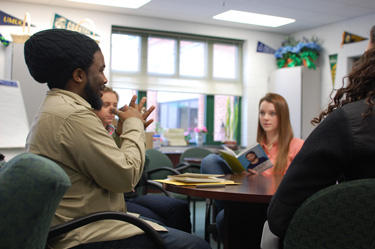
Poet Derrick Weston Brown speaks with students at Atholton High School. (Photo by Paige Feilhauer)
During the reading, I share stories behind the inspiration and origin of some of the poems and then I ask the students if they have any questions about certain poems. Many even request me to read certain poems and then give their own interpretations on them. We talk about other things as well. Ipod playlists. If Twitter is an appropriate space for poetry. Role-playing games. Favorite books. Dating. Haiku. Race. Gender. The list goes on.
If I have any sort of a complaint, I wish that perhaps my visits could extend past the usual fifty-minute class time. Usually the bell rings and the students make their way to lunch or to another class and I find myself a little melancholy that the connection we’ve built in just a short time is broken. But so much has happened within those small bubbles of time. I’ve witnessed brave students share their own poems when I’ve asked if there are any other poets in the room.
I’ve watched them deliver heartbreakingly honest and earnest poems, shaking paper and all, with the kind of sophistication and insight I truly wished I possessed at their age. I’ve stayed after my allotted time with passionate teachers and their poetry-hungry students who fire questions like pistons at me about form, meter, and content.
I enjoy this job most of all because I realize that Howard County is not as mysterious as I thought, because poetry dwells there, and anywhere poetry lives is home.
Derrick Weston Brown
HoCoPoLitSo writer-in-residence
To support HoCoPoLitSo’s Writer-In-Residence program in Howard County high schools, consider making a donation.
Students and a Writer Ask: Am I Really Here for Poetry?
When I got the news that I was tapped to be the 2012-2013 HoCoPoLitSo writer-in-residence for Howard County back in early August, I was as nervous as I was excited. The nervousness I mention first because with my own schedule that ebbs and flows with the responsibilities of being a working poet and teacher, I wondered if I could fit these visits in, and more importantly, if I could find my way around in the mysterious Howard County.
Honestly, Howard county was only familiar to me for two reasons: the city Columbia and the absolutely awesome vegan restaurant not too far from Columbia called Great Sage. But beyond the nervousness, my excitement was also sparked by the mystery of the unknown. As my imagination began its snowball’s journey down the hill of infinite possibilities, all sorts of questions were percolating around in my brain . . .
What are Howard County high schools like?

Poet Derrick Weston Brown speaks with students at Atholton High School. (Photo by Paige Feilhauer)
What will they think of my poems?
Will they care?
Will I get lost?
Will they relate to my poems?
How should I present my poems?
Should I just read?
Should I talk and then read, or read and just talk?
I carried all of these questions with me on my first school visit to Oakland Mills High School and I was pleasantly surprised and relieved to find that my first reading would be in the school’s media center. As I scanned the faces of those students that first day as they filed into the library, quietly chatting to each other while stealing looks at me, I was strangely calmed by the spectrum of expressions I saw.
There was curiosity, vague interest, teen-aged skepticism, and of course, the glazed over “Am I really here for poetry?” look. What I realized, after taking in the expressions I saw, was that I had worn each and every look displayed in front of me. I was reminded that I was a high school student once, a student who was immediately skeptical, inquisitive and up-in-arms whenever we were told we had a special guest speaker.
So I bundled up all of my nervousness and excitement, and made myself a promise in the few seconds that remained as Joyce Braga (a HoCoPoLitSo volunteer) introduced me. I wouldn’t read at the students, I wouldn’t lecture the students. To me, poetry is a conversation, a call and response; to rob the person or audience of their right to respond is a crime. So I opened my first reading that day and every day since then with a question. “Who in this room — be honest — actually likes poetry?”
To be continued …
Derrick Weston Brown
Writer-in-residence, 2012-2013
To support HoCoPoLitSo’s Writer-In-Residence program in Howard County high schools, consider making a donation.
Two Points of View on The Year’s Writer-In-Residence — Derrick Weston Brown
Guest bloggers Joyce Braga and Sam Rubin share their experiences of this year’s Writer-in-Residence in the Howard County Public School System, Derrick Weston Brown.
His poems have swagger, but the poet
remains introspective

Derrick Weston Brown
As the high school liaison for HoCoPoLitSo’s writer-in-residence, I’ve guided many poets around Howard County high schools. After I e-mailed Derrick Weston Brown, this year’s writer-in-residence. I prepared myself for our first meeting, scheduled for Nov. 12 at Oakland Mills High School, by reading his biography and his on-line interviews. I expected the usual poet—a little bit of a performer, a lot of ego and touch of swagger. I looked at the picture of Derrick Weston Brown, and knew I was right. But I was wrong, and in a good way.
I met Derrick at the school front desk. I rattled off instructions: Here’s the packet, here are your poems, sign the book, here’s the room. Oh, and please tell me how you want me to introduce you. Derrick seemed surprised, almost shy about telling me his accomplishments.
When Derrick began rather softly to read, I soon discovered why. He’s a very introspective individual. He thinks very deeply about life. He lets the students know “life’s a journey” and not always an easy one. He’s been writing since he was a child. Even with a masters’ degree in writing, getting published was a struggle for him.
As Derrick spoke, the students were fascinated, and so was I. He told the students he likes to eavesdrop on people, and I too felt a little voyeuristic in the classroom, listening to his stories. Rather than giving students his biography, Derrick uses poetry to tell his audience about himself.
As he read, I learned more about Derrick. One poem was dedicated to his father, called “Legacy.” Another was about his mother, called “Mother to Son.” And one poem, which was hard for him to read, was called “Forgiveness.” It was about him belittling a schoolmate. He told the class he’s still looking for that girl. He wants to ask forgiveness.
With each new visit I hope to discover a little bit more about Derrick Weston Brown. I now know he’s not shy, he just likes to let his poems talk for him.
Joyce Braga
volunteer liaison for
the writer-in-residence program
For Oakland Mills High students,
Brown’s words are supercalifragilisticexpialidocious
As I sat down at the November 12th Derrick Weston Brown presentation at Oakland Mills High School, I truly had no idea what to expect. Shortly after my arrival students started piling in, filling row after row. When Derrick started his presentation, he did not start with a poem or an introduction, rather he started it with a few questions to the class. “Who likes poetry?” he asked first. The audience seemed indifferent. “Who could care less about poetry?” A few went up.
“Who hates poetry?” A few more hands hit the air. “Who likes to write poetry?” A couple of hands rose tentatively.
The questions were a great way to grab the attention of the students, who perhaps did not care about this random writer they had never heard of standing in front of the room.
As the event went on, Derrick read his work, he asked and answered questions and it seemed like he, as well as the students, were having a good time. However, it was not the poetry alone that made the program so enjoyable. Derrick’s interactions with the students seemed so natural and so unplanned that it allowed the flow of the presentation to move artlessly.
One interaction in particular stuck in my mind and I believe will stick in the mind of every audience member at the reading. Derrick asked the students for ten words. After he compiled the list of words, Derrick recited a freestyle improvisation, something he might call an “off the dome” poem. It was an elegant piece, into which he somehow fit “supercalifragilisticexpialidocious.”
Just as in any class, only a select number of students raised their hands to answer and or ask questions, but perhaps a few more hands will go up next time someone asks “Who likes poetry?”
Sam Rubin
HoCoPoLitSo’s intern
Atholton High School
Let Our Kids Read
 “Children are made readers on the laps of their parents,” says author Emilie Buchwald. That’s a nice cuddly sort of sentiment, isn’t it? But she’s right. Most of us with children do read to them, almost from birth. It’s one of the best tools we have to introduce them to the vast new world around them.
We read to teach colors, shapes, letters, numbers, and textures. To teach them about animals and flowers, babies, and brothers and sisters, mommies and daddies. We read to teach them about themselves and living among others, about their world and their place in it. We read to help them learn to think. And in the process, we fervently hope – in fact it’s our duty – that we spark in them a sense of curiosity and a love of words, both so powerful that they will learn and love to read and to seek out answers on their own.
There’s an old joke about bringing up kids that goes something like this: We spend the first two years of our children’s lives teaching them to walk and talk. Then we spend the next sixteen trying to get them to sit down and shut up. Isn’t it more or less the same thing when, after we teach and encourage our children to explore the world through reading, we allow a book to be removed from a school curriculum or public library shelf because a vocal parent or small group in some way objects to its contents?
It happens more often that you might think. Every year, for the past thirty years, the American Library Association has recorded all reported challenges and bans of books in schools and public libraries in the United States. That’s hundreds of challenges every year. And those are only the reported ones. The ALA estimates that four out of five challenges go unreported. Most of the challenges come from well-intentioned parents trying to protect their children from some difficult idea or information. And that would be within their rights if they were protecting their children. The problem, however, is that challenges and bans might also deprive other children whose parents don’t share the same objections.
The challenging or banning of a book is akin to pulling the reading rug right out from under our kids. Take a look at the ALA’s list of frequently challenged books of the 21st century. You’ll see that along with the usual characters – Huckleberry Finn, The Catcher in the Rye, To Kill a Mockingbird, and so on – are a host of children’s and young adult books, the very books that we should be thrilled that our children are reading.
Reading is an active process of discovery. Our children will encounter new ideas and new ways of thinking; it’s bound to happen more and more as advances in technology continue to shrink our world and move us ever closer to true globalization. If as responsible parents we embrace such encounters as teachable moments, helping our kids “enter into a dialogue” with what they are reading, instead of saying, emphatically, “NO, you can’t read that,” we will teach our children to truly think for themselves, to consider the tough questions of our world, to make it a better and more accepting place.
In a nation that bemoans the fact that our educational system and student performances are lagging behind those of other developed nations, why would we ever even consider, if we hope to regain the intellectual edge, denying our children the opportunity to think by preventing them from exploring through reading? It may not sound quite as cuddly as what Emilie Buchwald says, but what a world of good we could do if we made our children thinking “readers on the laps of their parents,” and then let them read to their hearts’ content.
The American Library Association’s 30th Anniversary Banned Books Week observance is September 30-October 6. Join your Howard County neighbors and supporters of your First Amendment rights. Celebrate your freedom to read by reading a banned book – or by sharing one with your children.
Rick Leith
Assistant Professor of English
Howard Community College
Join HoCoPoLitSo and Howard Community College in their celebration of Banned Book Week at “Freedom to Read: The Historic Role of Grove Press in the Publication of Banned Books,” with Jeannette Seaver and Michael Dirda, Tuesday, October 2, 2-3:20 PM in Monteabaro Recital Hall in the Horowitz Visual and Performing Arts Center at Howard Community College. The event is free and open to the public.
Banned Book Profile: Naked Lunch
 Would you have published this banned book?
Book: Naked Lunch
Author: William S. Burroughs
Controversy: First published in 1959 by Olympia Press in France, Naked Lunch (initially misprinted as The Naked Lunch) was banned in the United States because of obscenity laws. The book’s subject matter deals with drug use, sexually explicit acts and obscene language.
Challenge: In 1962, Grove Press published the unedited American edition of The Naked Lunch, that is, as it was originally written for publication. It was banned in both Boston and Los Angeles, and European publishers were harrassed for printing and distributing the book. However, in 1966 the Massasschuetts Supreme Judicial Court reversed the decision finding that it did not violate obscenity laws. The book was deemed to have social value.
Impact: While his book dealt with “risque” subjects under the McCarthy Era, Burrough’s book also tackled the problems of drug addiction and protesting the death penalty. The book ‘s overall theme deals with failings of society through the exploration of the main characters encounters with the books more risque subject matter.
Burrough’s Naked Lunch was said to have influenced Thomas Pynchon, J. G. Ballard, and William Gibson.
It is included on Time magazine’s “100 Best English-language Novels from 1923-2005”.
Join HoCoPoLitSo and Howard Community College in their celebration of Banned Book Week at “Freedom to Read: The Historic Role of Grove Press in the Publication of Banned Books,” with Jeannette Seaver and Michael Dirda, Tuesday, October 2, 2-3:20 PM in Monteabaro Recital Hall in the Horowitz Visual and Performing Arts Center at Howard Community College. The event is free and open to the public.
HoCoPoLitSo, HCC Celebrate Banned Books Week – 9/30-10/6
 Co-chair of the HoCoPoLitSo board and Division Chair of English/World Languages at Howard Community College, Dr. Tara Hart previews a few upcoming Banned Book Week events in Howard County:

My New Jersey high school reading list made sure I met and never forgot Ray Bradbury’s perverse firemen, called to burn wherever books were found. Pop culture let rebellious ‘80s teens share Kevin Bacon’s Footloose character’s horror at finding that his new hometown is a place that incinerates piles of Kurt Vonnegut’s Slaughterhouse-Five in front of the public library. Much more recently, Terry Jones’s treatment of the Koran lit a global flame that continues to profane what many hold sacred. Also, “Hundreds of books [including, ironically, Fahrenheit 451] have been either removed or challenged in schools and libraries in the United States every year. According to the American Library Association (ALA), there were at least 326 in 2011. ALA estimates that 70 to 80 percent are never reported,” (www.bannedbooksweek.org). We may not understand, or feel we understand all too well, what drives those who burn or strive to hide books, but the good news is that the drive to protest such destruction and suppression is loud and sustained.
The Howard County Poetry and Literature Society (HoCoPoLitSo) celebrates National Banned Books Week (September 30 – October 6, 2012) and our freedom to read by partnering with Howard Community College to present an important conversation between Jeannette Seaver, widow of publishing giant Richard Seaver, and Michael Dirda, Pulitzer-Prize-winning critic for the Washington Post, about the historic role of Grove Press in the publication of banned books through discussion of Richard Seaver’s extraordinary memoir, entitled The Tender Hour of Twilight: Paris in the 50s, New York in the 60s: A Memoir of Publishing’s Golden Age (Farrar, Straus and Giroux, 2012).
“Dick” Seaver had a unique gift for recognizing, appreciating, and advocating for the translation and publication of previously unknown authors, especially Samuel Beckett, and was a unique presence in the publishing age that ultimately delivered to American readers, triumphing through much literal trial and other’s error, essential titles that continue to be challenged by contemporary citizens, including Lady Chatterley’s Lover, Naked Lunch, The Story of O, The Tropic of Cancer, Last Exit to Brooklyn, and The Autobiography of Malcolm X. The memoir resonates, in spite of his modesty, with a spirit of highly intelligent discernment and sense of vocation that played an enormous role in revolutionizing the American literary landscape, leading it from priggishness to possibility.
Michael Dirda is a well-versed expert on such landscapes and an ideal conversational host for Ms. Seaver, who is fascinating in her own right as an accomplished musician and later publisher who shared her husband’s intellectual and professional life and has her own opinions of and experiences with many of the literati mentioned in the book. It promises to be an engrossing, important, provocative, and academically enriching event, so come join today’s literati at “Freedom to Read: The Historic Role of Grove Press in the Publication of Banned Books,” with Jeannette Seaver and Michael Dirda, Tuesday, October 2, 2-3:20 PM in Monteabaro Recital Hall in the Horowitz Visual and Performing Arts Center at Howard Community College. The event is free and open to the public. Also check out HCC’s “parade” of banned books and the media clip festival that week.
Dr. Tara Hart
Board co-chair, HoCoPoLitSo
For more information, see
For event details, visit
 HoCoPoLitSo