Home » Guest post » Mana’s Musings (Page 3)
Category Archives: Mana’s Musings


mana’s musing: what is work? and what do poets make?

Laura Yoo, HoCoPoLitSo Board Member and Associate Professor of English at Howard Community College
One of my favorite poems is Marge Piercy’s “To be of Use”. It’s a poem that reminds us to make ourselves useful, and its last stanza includes one of my favorite lines from poetry.
The work of the world is common as mud.Botched, it smears the hands, crumbles to dust.But the thing worth doing well donehas a shape that satisfies, clean and evident.Greek amphoras for wine or oil,Hopi vases that held corn, are put in museumsbut you know they were made to be used.The pitcher cries for water to carryand a person for work that is real.
Piercy’s emphasis on “work that is real” reminds me of a magazine clipping that I see on the refrigerator door at work. It’s a photo of a child with a teacher and the caption reads: “Far and away the best prize that life offers is the chance to work hard at work worth doing.” These are words by Theodore Roosevelt in a 1903 speech. I am comforted by this because clearly I am doing “work worth doing.”

But if you’re not a teacher, how might you define “work that is real”? What is “thing worth doing”? What does “work worth doing” do? And what does it look like? How does one find such work? How we value or devalue (or over value or undervalue) different types of work? And, really, how much do we pay for such work?
About the poet’s work, Lorine Niedecker says this in her poem “Poet’s Work”:
Grandfatheradvised me:Learn a tradeI learnedto sit at deskand condenseNo layofffrom thiscondensery
$460 for a 36-line poem: The New Yorker
$75 a poem: The Paris Review
$25 a page: Plough-shares
$10 a line: Poetry Magazine
I never knew the number of lines had anything to do with being paid for working in poetry. That’s another “unit of measure” that I had not considered.
What about the book sales? Billy Collins sold more than 18,000 copies of his book which paid him a little over $44,000 in 2011. We’re talking about Billy Collins here; he’s a bestselling poet, if not THE bestselling poet, in America. I’d imagine that Billy Collins’ speaking/reading fees are pretty high, but most poets do not command such fees. So, according to New York Magazine, basically there is one way to really be paid for poetry:
WINNING THE NOBEL LOTTERY
Approximate number of books sold by Tranströmer in America in the ten years before he won the Nobel: 12,300.
Number of copies of Tranströmer books that have been scheduled for printing since he won the prize: at least 50,000.
Monetary reward for winning Nobel Prize: $1,480,000
No wonder. In a recent class discussion about work in my composition class, we were talking about how we categorize work into blue collar, pink collar, and white collar. One student asked, “Where do musicians or writers and other artists fit in?” One student responded, “No collar.” Another student said, “Unemployed.” The class laughed and I laughed along but it’s not too far from the truth for many people who want to do work in the arts. I meet many young people in my classrooms who dream of being musicians, artists, DJs, and chefs but give it up for more “practical” and “marketable” jobs. I have also seen people find their way back to their dream after many “practical” detours. And that’s a tough road.
Too many artists, including poets, cannot make a living doing their work, and for this reason some even give it up. Many poets work various jobs during the day and write at night (or vice versa). They ought to live like Piercy’s Greek amphora carrying wine or Hopi vase carrying corn – doing what they were made to do – but often they have to work as a purchasing associate at a Japanese tool company (if you’re Naoko Fujimoto). Of course, poets can do other jobs that are meaningful and fulfilling to them; I don’t mean they should only sit in a chair and write 9 to 5. But I do want to talk about how we count the value of not just their work (product) but also their labor (process) that they do as poets.
There is a prevailing misconception about the work of being a poet in this world, which influences how we value (or devalue) the poet’s labor. They are assumed to get up late in the morning, drink coffee, look out their windows to connect with nature, and pour out the natural creative genius into words onto that white paper. Boom. Done. Poetry. No labor. Just product in the form of a beautiful work of art.
I’m a little bit offended by the tone of an article called “How Much Money Do Poets Make.” It refers to the New York Magazine article that I mention above and says in a tone that is somewhere between encouraging and condescending,
Still, keep at it, poets. After all, money isn’t the reason you’re writing. But who knows? Maybe one day you, too, can win what New York Magazine refers to in its piece as the Nobel Lottery.
Poets, I’d like to know: What IS the reason you’re writing? [Maybe that’s the next blog post.]
Well, it’s not like they sell Nobel Lottery tickets at your neighborhood liquor store or gas station, so the internet is full of money-making opportunities for poets. A website called Writer’s Relief suggests 5 ways to make money as a poet: write greeting cards, teach, start your own business, write songs, and look for “appropriate spin-offs of the poetry publishing biz” (like arts organizations). I’m not sure how I feel about this. Why shouldn’t poets make a living doing their craft, their trade, their “real work” (Piercy) and “work worth doing” (Roosevelt)?
How do we count the worth of any work in a capitalist society? How do we know that one work deserves $7.25 an hour (federal minimum wage) while another deserves $75 (per poem for The Paris Review) and yet another deserves $725 an hour (hourly billing rate for top lawyers and advertising creatives)?
If not by dollars, by what other measure do we count the worth of our work?
mana’s musing: how to celebrate world poetry day – with friends
Laura Yoo, HoCoPoLitSo Board Member and Associate Professor of English at Howard Community College
March 21st is United Nation’s World Poetry Day.
Poetry reaffirms our common humanity by revealing to us that individuals, everywhere in the world, share the same questions and feelings. Poetry is the mainstay of oral tradition and, over centuries, can communicate the innermost values of diverse cultures. In celebrating World Poetry Day, March 21, UNESCO recognizes the unique ability of poetry to capture the creative spirit of the human mind.
Maya Angelou wrote and read “Brave and Startling Truth” to commemorate UN’s 50th anniversary in 1995. She says she wrote this poem “for every human being on this earth” – “We, this people,” she says.
So, to celebrate World Poetry Day on March 21st, I shared my favorite poem, “The Lake Isle of Innisfree” by William Butler Yeats on Facebook.
I will arise and go now, for always night and day
I hear lake water lapping with low sounds by the shore;
While I stand on the roadway, or on the pavements grey,
I hear it in the deep heart’s core.
I also asked friends to share a poem, and the response was overwhelming. This anthology of poetry created by my friends was too good to just sit on my Facebook page. It had to be shared with more people. So here it is. [Friends, I hope you don’t mind my sharing.]
Please enjoy my friends’ favorite poems – and go on a poem-hunt and discoveries of your own.
And if you’re inspired, come and experience poetry in real life with Marie Howe at 7th Annual Blackbird Poetry Festival on April 28th at Howard Community College.
==========
And with my pen I wrote the same
I wrote in both hast and speed
and left it here for fools to read
–Abraham Lincoln’s poem (didn’t know Lincoln write poems!)
Sama
==========
Here is a breathing body and a beating heart,
strong legs, bones and teeth,
and two clear eyes to read the world, she whispered,
and here, I said, is the lanyard I made at camp.
– Billy Collins’ “The Lanyard”
Liz
==========
I say drop a mouse into a poem
and watch him probe his way out,
or walk inside the poem’s room
and feel the walls for a light switch.
–Billy Collins’ “Introduction to Poetry”
Sarah
==========
I bathed int he Euphrates when dawns were young.
I bathed in the Euphrates when dawns were young.
I built my hut near the Congo and it lulled me to sleep.
I looked upon the Nile and raised the pyramids above it.
I heard the singing of the Mississippi when Abe Lincoln
went down to New Orleans, and I’ve seen its muddy
bosom turn all golden in the sunset.
–Langston Hughes’ “The Negro Speaks of Rivers”
Michelle
==========
O you whom I often and silently come where you are, that I may be with you;
As I walk by your side, or sit near, or remain in the same room with you,
Little you know the subtle electric fire that for your sake is playing within me.
Juliette
==========
==========
Away from me so hurriedly my reason must allow
That I have wooed not as I should a creature made of clay –
When the angel woos the clay he’d lose his wings at the dawn of day.
==========
they need space to
move around in.
they don’t fit into little
petty places. these hips
are free hips.
==========
Let it be the dream it used to be.
Let it be the pioneer on the plain
Seeking a home where he himself is free.
==========
yet a part of me, as I am a part of you.
That’s American.
Sometimes perhaps you don’t want to be a part of me.
Nor do I often want to be a part of you.
But we are, that’s true!
==========
I rise
Up from a past that’s rooted in pain
I rise
I’m a black ocean, leaping and wide,
Welling and swelling I bear in the tide.
Leaving behind nights of terror and fear
I rise
Into a daybreak that’s wondrously clear
I rise
Bringing the gifts that my ancestors gave,
I am the dream and the hope of the slave.
I rise
I rise
I rise
==========
How soon my Lucy’s race was run!
She died, and left to me
This heath, this calm and quiet scene;
The memory of what has been,
And never more will be.
==========
it has taken me
all of sixty years
to understand
that water is the finest drink,
and bread the most delicious food,
and that art is worthless
unless it plants
a measure of splendor in people’s hearts.
==========
He would do it by gently stroking my forehead, not
by tearing away the blanket.
==========
and silence settles forever
the vacancy of this cheap city room.
In the wine darkness my cigarette coal
tints my face with Geronimo’s rage
and I’m in the dry hills with a Winchester
waiting to shoot the lean, learned fools
who taught me to live-think in English.
==========
Make collections of both, and observe the battles and songs of birds.
Watch for the eggs of Phoebe about the middle of the month.
Study the circulation of the blood in a frogs’s foot.
Take up mental hygiene;
because it is much needed now.
==========
now
I can see the moon.
==========
takes us together like a violin’s bow,
which draws one voice out of two separate strings.
==========
And in the morning glow,
You walked a way beside me
To make me sad to go.
Do you know me in the gloaming,
Gaunt and dusty grey with roaming?
Are you dumb because you know me not,
Or dumb because you know?
==========
Lilacs out of the dead land, mixing
Memory and desire, stirring
Dull roots with spring rain.
Winter kept us warm, covering
Earth in forgetful snow, feeding
A little life with dried tubers.
mana’s musing: opening a time capsule and finding no women – Britannica Great Books
Laura Yoo, HoCoPoLitSo Board Member and Associate Professor of English at Howard Community College, is a monthly contributor to this blog
I own a strange collection of books that were handed down to me from my aunt and uncle many years ago. They had bought the set for their children, but the books appear untouched, unopened – like a well-preserved archaeological artifact. They are big, bulky, heavy books that take up precious real estate on the bookshelf. Finally, this week, I pulled a few off the shelf to study them – and boy am I glad I did not give into my usual Marie Kondo-tendency to chuck and declutter.
This 54 book collection, which includes 443 works by 74 authors, is called Great Books and was published by Britannica in 1952. Mine is a 1980 print. The first volume in the collection is called The Great Conversation: The Substance of a Liberal Education by Robert M. Hutchins, and it explains the origin and the purpose of the collection. The tone of the Preface is notable.
[T]he disappearance of great books from education and from reading of adults constitutes a calamity. In this view education in the West has been steadily deteriorating; the rising generation has been deprived of its birthright; the mess of pottage it has received in exchange has not been nutritious; adults have come to lead lives comparatively rich in materials comforts and very poor in moral, intellectual, and spiritual tone.
And since we’re in the middle of what has now become a never-ending election season (like Macy’s one-day-sales), allow me to also include this long excerpt.
We believe that the reduction of the citizen to an object of propaganda, private and public, is one of the greatest dangers to democracy. A prevalent notion is that the great mass of the people cannot understand and cannot form an independent judgment upon any matter; they cannot be educated, in the sense of the developing their intellectual powers, but they can be bamboozled. The reiteration of slogans, the distortion of the news, the great storm of propaganda that beats upon the citizen twenty-four hours a day all his life long means either that democracy must fall a pretty to the loudest and most persistent propagandists or that the people must save themselves by strengthening their minds so that they can appraise the issues for themselves.
It is true that every generation has words of warning for the “rising generation.” And these words of warning ring true today, two “rising generation[s]” later.
The rest of this volume contains essays with titles like “Education and Economics” and “The Disappearance of Liberal Education”. In “A Letter to the Reader,” Hutchins reminds us that the editors are “not interested in general propositions about the desirability of reading the books; they want them read. They did not produce them as furniture for public or private libraries.” [see footnote] They see this as being near-panacea to alleviating the deteriorating condition of the modern mind.
The real bibliographic achievement of this collection of books, though, is The Great Ideas: A Syntopicon, which are volumes 2 and 3 in the set (written by Mortimer J. Adler, also a philosopher). “Syntopicon” is a word that was invented to describe the indexing of big ideas and themes that are discussed in Great Books. Take “Citizen” for example. There is an overview/introduction essay which is followed by an outline of subtopics and the comprehensive listing of all “citizen” references from all of the works in the Great Books. [See photos in the gallery below.] So, truly, this is quite a feat. There is no doubt about that.
When I sat down to write about this Great Books collection, though, my intention was not to celebrate the work of Hutchins and team. What I really wanted to do was complain about the lack of women in the collection. What – women didn’t write great books? In Great Books, there are no women. None. Nada. Nesunna. Aucun. Keiner. Not. A. Single. One. Nope.
You see, I’ve been culturally conditioned to celebrate women’s history and achievements during the month of March so this was on my mind when I approached the collection on my shelf. (Had this been February, I might have been thinking about the lack of racial diversity in the collection.) Thankfully, the second edition of Great Books which was published in 1980s added 59 writers, bringing the total number of women represented in the collection to – drum roll, please! – 4: Jane Austen, George Eliot, Virginia Woolf, and Willa Cather. This collection was made by men for men.
So, before I start hyperventilating, I remind myself that this collection is a cultural and historical artifact – that it represents a specific time of a particular place among a particular group of people with specific values. Sure, I get that. And, to be fair, Britannica continued to edit and add more works to each subsequent printings, by including more works not just from the twentieth century but also from earlier periods.
As a snapshot in history, the original collection by Hutchins and Adler (two philosophers) tells an important story about inclusion and exclusion. Hutchins writes a detailed explanation about the selection process. For instance, he explains why the Bible was not included (it’s already in every American home), why the collection ends with Freud (did “great conversation” stop after 1900?), and how each epoch or nation/language was represented (or not). I can’t help but to pause at these words: “I omitted Emerson, Whitman, Thoreau, and Mark Twain, all very great writers, because I felt that, important as they were, they did not measure up to the other books in the set.” What a strange thing to say about Emerson, Whitman, Thoreau, and Mark Twain. What would a debate about the merits of Emerson versus Pascal sound like? Mark Twain against Tolstoy?
The Great Books is a celebration of Western thought. For sure. Yet, the sturdy binds of these 54 heavy-duty, pristine books from 1952 (via 1980) seem so permanent and inflexible, the opposite of what these Great Books teach us to do with our minds. It has not escaped me that my reaction reflects my own cultural experiences in an age of digital books and “knowledge” that is constantly edited and updated, not to mention knowledge that has become democratized so there is no clear line between producers and consumers of knowledge. I get it.
I am completely fascinated by what Hutchins and team achieved in hopes of encouraging a strong liberal education in America. I have learned just a little bit about Great Books here, and I’m eager to dig deeper and learn more about Hutchins and team’s project. I might even go ahead and read their collection! What intellectual work and discussions must have gone on among the faculty of University of Chicago who put this collection together! Oh to have been a fly on the wall! And as a fly, I might have buzzed about their ears and whispered,
How about something from Hypathia the mathematician and philosopher? The letters of Heloise to Abelard? Julian of Norwich – presumed to be the first book written in English by a woman? Queen Elizabeth? Some of those letters and speeches she gave are worth noting, no? Christina Rossetti? No poetry? Okay, fine. How about a bit of Aphra Behn? Oroonoko is a very short novel. Mary Wollstonecraft? What about her daughter, Mary Shelley? No? Not even Frankenstein? Wow. Okay. Then, Kate Chopin? I guess it’s still 1952 and The Awakening has not made its comeback yet. Never mind.
But here comes the fly swatter –
Footnote
[1] Speaking of furniture… Given the nature of information-creation and -exchange today, folks like Farhad Manjoo think Britannica was “exploitative.” And today in the age of Google, Siri, and Wikipedia, the Britannica seems completely irrelevant. Even back then, in the 50s or the 80s, I wonder if these books were ever really used. And even as I’m writing this, I can’t help but to look up “Great Books Britannica” in Wikipedia. There, I find that Hutchins started the project with a 2 million dollar budget but when the books didn’t sell, the company turned to door-to-door sales, which Hutchins had feared. Wikipedia also informed me that the Federal Trade Commission found Encyclopedia Britannica guilty of deceptive advertising and sales tactics. So not only were they exploitative but also deceptive and guilty of breaking the law.
mana’s musing: about crying at poetry readings
There is a sacredness in tears. They are not the mark of weakness, but of power. They speak more eloquently than ten thousand tongues. They are the messengers of overwhelming grief, of deep contrition, and of unspeakable love. – Washington Irving
Thank you, Washington Irving.
I cry. A lot. Often. I am a crier. I have no problem crying in front of people. I do an impressive ugly cry, too.
Sometimes I cry because I’m overwhelmed or happy or sad or angry. But often I’m crying for other people, real and fictional. Any time an emotional scene unfolds on the screen, for instance, my husband and my son automatically turn to look at me with “Are you crying?” The old Folgers Coffee commercial with the brother and the sister and Christmas morning – I can’t even. Also, any stories of under-privileged or disenfranchised people getting hard-earned scholarships to go to college – hands down, those just destroy me.
Laura Yoo, Board Member of HoCoPoLitSo and Associate Professor of English at Howard Community College
Poetry readings are no exception since poems are often charged with emotions. I will admit, though, sometimes all the crying is a bit embarrassing. It feels like a shortcoming to not be able to experience poetry with just a meaningful nod or a thoughtful “hmm.” Such responses seem more intellectual and sophisticated. For me, it’s almost as if my body reacts to the poetry by immediately turning on the faucet, and I feel betrayed by the body.
For example, at a recent poetry event with Steven Leyva and Josh Soto (“Beans with No Salt” hosted by HoCoPoLitSo for the Columbia Festival of Arts), just one word set me off. One tiny, little 4-letter word had me bawling. So embarrassing.
Leyva read a poem called “Tsunade, I’m afraid” and his performance was a brilliant illustration of how the “white space,” the silence, the pauses, and the breaks are crucial to the task of the poem. I held my breath during his short pause. Then, when he finally uttered the word, immediately my eyes watered. That was not the word I expected to hear. Then, the poem ended. On that word. I won’t tell you the magic word. You’ll have to wait ’til Leyva’s next book is published. And it will destroy you, too.

The cover of LPR’s Myth issue: Frame of Mind (G) Minas Konsolas Acrylic and ink on canvas, 2015 30 × 24 in.
At the January 30th launch reading of Little Patuxent Review (Myth) at Oliver Carriage House, however, I wasn’t the only one crying.
Amanda Miska came from Philadelphia to read her poem, “Missed Connections for My Self.” Her poem follows the conventions of a Craigslist section called “Missed Connections” where people post messages looking for strangers they almost met and now want to find to re-connect. In her introduction, Miska explained that she had been struggling to re-connect with her self and her new, different body after becoming a mother. There are 6 sections to the poem, which she says she wrote on her iPhone, with titles like “I Know You Were Doing the Best You Could – w4w (XSport Fitness)” and “I Want to Show you the Delicious Side of Life – w4w (Dunkin’ Donuts).”
Miska couldn’t help but cry a little as she read her poem. The poems were deeply personal. And needless to say, I cried. Like a baby. No, that’s not true. I cried like a grown woman who knew exactly what Miska was talking about, who could feel her words, who lived (and still lives) those emotions.
Later on in the reading, Edgar Gabriel Silex read several poems, but it was “Demeter” that made the poet himself fight back the tears. The last stanza of the poem reads, “and saints and angels were all gone he came into my room / one day trying to harm me and I hit my father threw him down / and stood over him crying […]” Well, when the poet chokes up, what chance do I have? None. Out poured the tears.
As Robert Frost said, “No tears in the writer, no tears in the reader. No surprise in the writer, no surprise in the reader.”
In school, we are taught to differentiate the poet from the speaker of the poem. Of course many poems speak in the voice of persona or character created by the poet. But sometimes poems speak for the poet, the poet’s experiences, the poet’s life, the poet’s memories, and the poet’s knowledge – sometimes directly and other times indirectly. Whatever “Demeter” is as a work of literary art – fiction or nonfiction – it’s one of what Silex calls “the ninety-plus essential human stories” that are believed to be out there. He says, “our libraries are filled with variations of these stories, told over and over through history, culture, and time. What changes in them, of course, is the Time-the-Teller.”
Perhaps this is why we cry. We know these stories. We know all of these stories, that is. But instead of making us dull or our lives mundane, they make us understand one another, draw us closer.
In the words of James Baldwin…
You think your pain and your heartbreak are unprecedented in the history of the world, but then you read. It was books that taught me that the things that tormented me most were the very things that connected me with all the people who were alive, or who had ever been alive.
It’s not the intellectual understanding or the cognitive awareness of the feeling – like pain, hunger, fear, hurt and so on – but the ability to imagine how someone felt it – that’s what triggers my empathy. Empathy requires imagination. Without imagination, we cannot put ourselves in the shoes of another.
I can imagine, for example, the shame that the speaker of Miska’s poem must have felt when she almost fell while trying to walk inconspicuously out of Dunkin’ Donuts. I can imagine, again, the anger (fear? hope? triumph? sadness? regret?) that the speaker in “Demeter” must have felt as he fought back his father and ran away. And when he says, “I ran / and still run from anything stinking of heaven or hell” I can picture this person who is haunted and even hunted by these memories and emotional bruises. Maybe Paulo Coelho is right – “tears are words waiting to be written.”
So, the next time you see me crying at a poetry reading (most likely at Irish Evening on February 19th), pass me a Kleenex and join me in the crying.
mana’s musing: watch less, read more (and buy less)
Laura Yoo HoCoPoLitSo Board Member
2015 was the year of binge-watching TV shows on Netflix. I’m ashamed to reveal the actual number of hours I’ve spent watching shows like House of Cards, Orange is the New Black, Sherlock, Dexter, and so on. All good shows. Still. Shame on me.
When I look over my bookshelves, the night stand, the coffee tables, and really everywhere around the house I see many books that I haven’t read yet. This is because despite the fact that I was watching more than I was reading, I continued to purchase books. I am a avid shopper of books. I enjoy Amazon and second-hand book stores (online ones like Thrift Books and real ones like Second Edition Books and Music). My favorite is browsing yard sales, garage sales, antique shops, flea markets for books. I love shopping for books (almost?) as much as I love reading them. Remember my post about the physical life of books or the one about the journey of books?

Image from Modern Mrs. Darcy
I love going to the local library, especially with the kids, but I haven’t borrowed books in many years. The last time my kids borrowed a few books from the local library I ended up owing 20 bucks in late fees. For someone who is fairly organized, I can’t seem to return books to the library on time. Maybe I’ll give it a go again this year. There is another resolution.
So without buying any new books this year (although this excludes buying books at or for author readings), I am committing to reading at least 12 books, mostly from my own bookshelf and maybe a few from the library. This goal seems so wimpy given that Amy McLay Paterson read 164 books in 2015. But I gotta start where I can.
A friend tagged me in a 2016 Reading Challenge, and this may be a good way to get to my 12 books for the year. So, here’s the plan.
- new release: I’ll have to decide on a new release – but I won’t buy it – I’ll wait to get it at the library
- finish in a day: Blue Shoes and Happiness OR The Sunday Philosophy Club by Alexander McCall Smith – Thanks Tim!
- meaning to read: The Brief Wondrous Life of Oscar Wao by Junot Diaz
- recommended by librarian: I don’t know yet! I haven’t been to the library in ages!
- should have read in school: Black Boy by Richard Wright
- chosen by a BFF: The End of the Point by Elizabeth Graver – Thanks Sarah!
- published before born: The Confessions of Nat Turner by William Styron
- banned at some point: Breakfast of Champions by Kurt Vonnegut
- previously abandoned: Kings of Infinite Space by James Hynes – Thanks Ryna for the recommendation!
- own but never read: The Plot Against America by Philip Roth
- a book that intimidates: Fates and Furies by Lauren Groff – Thanks President Obama for the recommendation!
- a book I’ve already read: this one, I will leave blank for now – as a treat for myself later…
If you’re looking for some inspiration, a list of what to look for in 2016, here are some articles that will guide your reading journey this year.
- In a Dark Time The Eye Begins to See: A 2016 Poetry Preview (NPR)
- Books in 2016: A Literary Calendar (The Guardian)
- Book Releases in 2016 (International Business Times)
- Most Anticipated: The Great 2016 Book Previews (Millions)
- 12 Books You Need to Read Before They Become Movies in 2016 (MTV)
- Book SF/F Editors Want You To Read in 2016 (Barnes and Noble)
Happy new year of reading! Please let us know what you are planning to read this year!
As for me, if EVERYTHING works out, this is the year that I spend less money, read more books, and watch less TV. Oh, and become a Yogi. In other words, my new year’s resolution is to become a better human being.
Mana’s Musing: poetry for the good, the bad, and the scary

Laura Yoo – HoCoPoLitSo member of Board of Directors and Associate Professor of English at Howard Community College
Some say poetry is irrelevant. That it belongs in the ivory tower.
Listen to this:
Earlier this year, The New Yorker published an article called “Battle Lines: Want to understand the jihadis? Read their poetry” by Robyn Creswell and Bernard Haykel (June 2015). The article is a study of the function of poetry in Arabic cultural history as well as in contemporary jihadist poetry. The authors write that, “For the jihadist, poetry is a mode of manifesto, or of bearing witness.” Creswell and Haykel remind us of the important role of poetry in shaping and propagating a culture. But that influence can go in the direction of “good” or in the direction of violence and hatred.
Analysts have generally ignored these texts, as if poetry were a colorful but ultimately distracting by-product of jihad. But this is a mistake. It is impossible to understand jihadism—its objectives, its appeal for new recruits, and its durability—without examining its culture. This culture finds expression in a number of forms, including anthems and documentary videos, but poetry is its heart. And, unlike the videos of beheadings and burnings, which are made primarily for foreign consumption, poetry provides a window onto the movement talking to itself. It is in verse that militants most clearly articulate the fantasy life of jihad.
The article gives many examples of the prominent role that poetry is given by some militant jihadist leaders, but the most shocking one is this:
Bin Laden himself recited an elegy for the nineteen hijackers of 9/11: ‘Embracing death, the knights of glory found their rest. / They gripped the towers with hands of rage and ripped through them like a torrent.”
What we must recognize in all this is that poetry is not only a tool that helps us see the world in all its beauty, but is also a tool that can aid the world in its ugliness. Sure, some poems are about roses and rainbows, about love forever and love unrequited. And those are beautiful and absolutely necessary to our humanness. However, we must not assume for a second that poetry is fluffy or inconsequential. It is a powerful mirror for the human condition – the good, the bad, and the scary.
I am thinking of Martin Espada – a lawyer turned poet – and his poem, “Imagine the Angels of Bread.” He says, “This is the year” the meek will rise and the powerful will fall because justice will be served cold and raw on a silver platter. Well, no, he doesn’t say that – but that’s how I hear it. (And that’s how I heard it when Mr. Espada read this poem on the Smith Theatre stage at Howard Community College for the Blackbird Poetry Festival in 2013). In this poem, we sense the urgency for change. And we see how we might change the world for the better.
We also look to poetry to react to events that shock and frighten us. Like when Billy Collins‘ poem “Names” honoring the 9/11 victims broke our hearts – in a way, a powerful answer to Bin Laden’s elegy of the hijackers. But we also look to poetry to challenge our own thinking, like when E. Ethelbert Miller wrote “Looking for Omar” in reflection of 9/11 and the growing anti-Muslim feelings and actions in our country. We might do well to read this poem once more today.
In November this year, a group of terrorists bombed Paris. I saw many friends turn to poetry to understand fear, tragedy, violence, and hatred as well as peace, comfort, and compassion. One of the favorites circulating social media platforms was Wendell Barry‘s “Peace of Wild Things.” It begins, “When despair for the world grows in me” – and you just know you have to read the rest. In it, you find sadness but also hope.
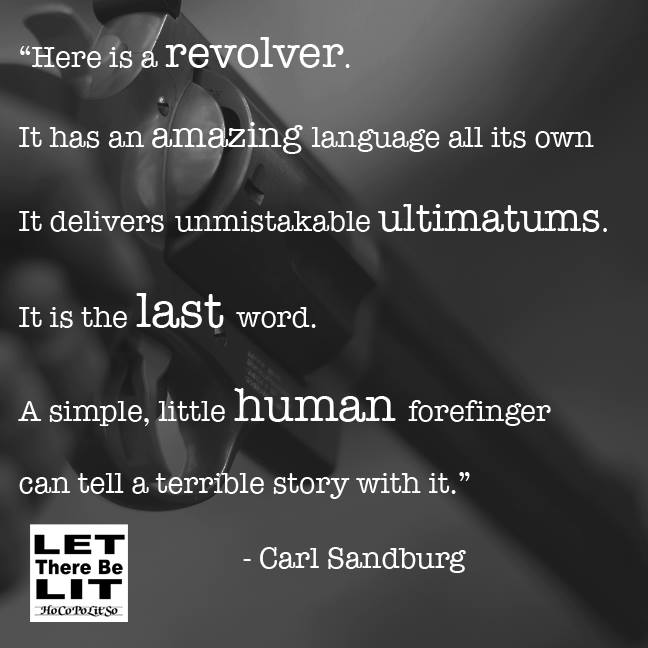 In January of 2013, a professor at University of Illinois discovered a poem by Carl Sandburg called “The Revolver.” It begins with “Here is a revolver,” and after comparing the revolver to the court of law, the poem ends with, “And nothing in human philosophy persists more strangely than the old belief that God is always on the side of those who have the most revolvers.”
The poem was discovered a few weeks after the Sandy Hook Elementary School shooting took place in Newtown, Connecticut (December 14, 2013). Now almost three years later, we again turn to this poem as we are angered and frightened by the two mass shootings in one day in Georgia and California on December 2nd.
In Claudia Rankin‘s Citizen (2014) we see the world through yet another lens.
Dean Rader of Huffington Post says, “Citizen has changed how we imagine a book of American poetry interacting with and commenting on the world we live in. It reminds us that the poet is first and foremost a citizen. It reminds us that American poetry can be both urgent and vital.” Holly Bass, writing for the New York Times, says, “Citizen throws a Molotov cocktail at the notion that a reduction of injustice is the same as freedom.”
As The New Yorker article on jihadist poetry reminds us, through poetry we can possibly know one another, about what propels our actions and shapes our beliefs. We must allow poetry to bring to light the violence and the injustices we commit against one another. We must recognize also the potential power of poetry – like many other forms of art – to comfort our sadness, calm our fears, expose our frailties, shape our vision, and even change our thinking.
Mana’s Musing: Lost and Gained in Translation
Laura Yoo – HoCoPoLitSo member of Board of Directors and Associate Professor of English at Howard Community College
While writing the last musing on “Multiple Writing Personalities” I began to pull at another thread – the art of translations.
There are many words that are not really translatable from Korean to English, and this is the case for many (if not all) languages. One example is the Korean word 한 (pronounced “hahn” and sort of means grievance) which comes from 원한 (pronounced “won-hahn” and sort of means grudge). Usually this word is used to describe the kind of deep grievance or regret that awakens a dead person’s body and spirit. Like Jason in Friday the 13th or the scary girls in The Ring or Grudge. But none of these words – hatred, resentment, grievance, regret – captures quite wholly the meaning that Koreans put in that word when they use it.
Language is cultural. Words communicate values, beliefs, cultural experiences, and history. Sometimes a single one-syllable word like 한 means a whole lot. This complexity is what makes a translation – especially a poetic translation – a work of art.
When Ko Un, one of the most well known Korean poets, read at the Dodge Poetry Festival in 2006, Richard Silberg performed the translation.
While Silberg’s translations communicate the idea of the poem, I think most would agree that it doesn’t transfer the whole meaning that is communicated in Ko Un’s reading – the audience can sense or experience the poem in the way Ko Un performs his poem that’s quite different from the way Silberg translates and performs it in English.
There is also an interesting translation of one of Ko Un’s poems by Suji Kwok Kim and Sunja Kim Kwok on Poetry Foundation’s website.
Taklamakan Desert by Ko UnWhy I’m going to the Taklamakan Desert:the emptiness there.Why I’m going to the Taklamakan Desertat seventy-five, leaving all words behind: the cryof the emptiness there.Why I’m going to the Taklamakan Desert:I can no longer standthe world’s greedor mine.There, in the Taklamakan Desert,the silence of a thousand-year-old skull.
Here is an excerpt from the translators’ notes.
With “Taklamakan Desert,” we tried to “translate” the translation towards greater spareness. […] We translated “명사도 동사도 다” (“all nouns and verbs”) as “all words,” which sounds less awkward in English, and decided not to isolate “there” (“거기”) on its own line, the way it’s isolated in the original, since it would sound overemphatic in English, especially as an ending. We added “in the Taklamakan Desert” in the penultimate line, for music, and “the silence of” in the last line, for rhythm, so that the last line becomes a line of iambic pentameter, a structural counterpoint to “the cry” in the second stanza, but only because silence is central to Ko Un’s work. (We could have rendered the last two lines more literally: “There —/ someone’s thousand-year-old skull.” — and again, may change our minds tomorrow.)
I highlight the last line above, because it shows the delicate choices one must make in translation – there is no such thing as “direct” translation, and we can see here the flexibility and creativity required in creating a work of translation.
In addition to the meaning of words, much of the art of translation has to do with the sound of words (and silences) – the intonation, the vowels, the consonants, the accents, the shapes that your mouth makes, and the way the tongue rolls to create sound. In the line “명사도 동사도 다” (“all nouns and verbs”), the Korean words for “nouns” and “verbs” rhyme: Phonetically, this line reads, “myung-sa-do dong-sa-do dah” (“do”=”too” or “and” and “dah”=”all”). So, there is a rhyme in “sa-do.” I wonder if it’s that difference in sound or the specificity of naming “verbs and nouns” instead of grouping them as “all words,” but the translation doesn’t quite… translate for me.
Still, I do not mean to argue that this translation is bad or that translations in general are inaccurate. Not at all. Ultimately, poetry translations are never about accuracy. It’s about telling and re-telling, creating and re-creating. Through the translators’ works, we share the words, the values, the thoughts, the stories, and the languages of all cultures. Works of translation open up poetry to interpretation, re-imagination, and even re-vision.
Translation itself is a work of art. It has its own creative process. It is original in its own sense of coming into creation.
Here are a few lines from Willis Barnstone’s “An ABC of Translating Poetry”:
Translation is the art of revelation.
Translation is an art between tongues, and the child born of the art lives forever between home and alien city.
Yet translation of poetry is conceivable.
A translation is never an exact copy. It is different.
A translation dwells in exile.
And so on. But “Z” is the best:
Good translation of poetry is essential to a hungry reader in a decent book store and to a global village of letters. We need it, for we still suffer under that early Babylonian God’s edict of language dispersal. Although Antigone and Lear sometimes speak in exotic tongues, subverting God’s rage against the monolingual builders of Babel writers still scrawl their words in a thousand scripts, pile them up on mounds of hope and futurity, awaiting translation. Translation is a zoo and a heavenly zion.
I love the phrase “a global village of letters.” That’s what the art of translation offers the world.
Last summer when a relative was returning from a trip to Korea, she brought back a few collections of Ko Un’s works for me. I thumbed the pages but found many of the poems too difficult for my comprehension – so my mother took the books. Having thought a little bit about translations through this little musing, though, I’m now processing my order on Amazon for several Ko Un translations by people like Richard Silberg, Brother Anthony, and Claire You – This Side of Time (2012) and Maninbo (2015).
Though my knowledge of the written Korean language is limited, having access to some of the poems in Korean and some in English (and maybe a few in both?) will give me a unique experience of Ko Un the Poet. Not necessarily fuller or more expansive experience – just different. Not only that, but it will also help me – a 1.5 generation Korean-American – become more familiar with Korean culture and history. And that is pretty awesome. Thank you, translators, for your word-art.
Mom, I need those books back please.
=========================================
“Taklamakan Desert” in Korean
타클라마칸 사막
내가 타클라마칸 사막에 가는 것은
내가 열 여섯살의 꿈속에서
타클라마칸 사막에 가는것은
거기
허허 망망 때문이다
내가 일흔다섯에 살의 대낮에
명사도 동사도 다 두고
타클라마칸 사막에 가는 것은
거기
무지무지한
허허 망망의 울음 때문이다.
내가
타클라마칸 사막에 가고 가는 것은
세상의 욕망에
내 욕망에
더 이상 견딜 수 없기 때문이다.
누구의 천년 해골
거기
Mana’s Musing: Multiple Writing Personalities
Laura Yoo, a member of HoCoPoLitSo’s Board of Directors and Associate Professor of English at Howard Community College, writes Mana’s Musings on the HoCoPoLitSo blog.
Even though I teach writing, I cannot really remember or trace the early years of my own journey of learning to write.
Thanks to my mother’s foresight and my own tendency to hold onto things, however, I do have two special artifacts from my childhood – photos below.
First is a report on Beethoven that I wrote in the 5th grade, only a few months after my family moved from Korea and I began to learn English. This is my first “writing” in English that I can find. Mostly, it seems, I copied sentences from the Britannica. And that was “writing.”
Second is a newspaper article that I wrote in the 5th grade to a Korean Catholic newspaper about my observations on adoption. In that article, I express sadness about Korean children who are adopted by families in other countries and I urge Koreans to adopt Korean children. An impassioned argument and plea from a 10 year old.
During my teenage years, I wrote a lot. Flipping through the many spiral notebooks that were my journals reveals that I wrote my “diaries” in English (even through the early years of my language acquisition) but insisted on writing my “poems” in Korean. In English, my writing was about what I did that day, what I saw, what happened to so-and-so, or what I was thinking. In Korean, on the other hand, my writing demonstrates an annoyingly dramatic teenage-angst in what appears to be verse. I can’t help but to roll my eyes at my 14 year old self. It seems that my young mind associated English with recording facts (information) and Korean with describing love, pain, betrayal, suffering, drama, and dreams in poetry.
Later on in college, the notebooks got fancier and I wrote exclusively in English – and I stopped writing poems. Probably realized how terrible they were. There was also a vague attempt at fiction-writing but I quickly learned that I was no good at it. So, instead of trying to create literature, I studied it.
The evidence of various transitions between Korean and English in my writings makes me wonder not only about my cultural identities but also my relationship to writing. You are what you write – and I guess how you write.
A recent article in The New Republic called “Multilinguals Have Multiple Personalities” cites studies that illustrate a personality difference exhibited by one person speaking in two different languages. The article summarizes one particular study:
In one session, the volunteer and experimenter spoke only French, while the other session was conducted entirely in English. […] When [Susan Ervin] compared the two sets of stories, she identified some significant topical differences. The English stories more often featured female achievement, physical aggression, verbal aggression toward parents, and attempts to escape blame, while the French stories were more likely to include domination by elders, guilt, and verbal aggression toward peers.
I find myself experiencing this kind of shift in my identity when I switch “code” between English and Korean in my day to day life. In speech, I communicate not just the words or the “thing” that I’m trying to get across but also the cultural mores, the values, the manners, and the habits deeply rooted in that language. And I dare say the language also shapes human beliefs and behaviors.
Sadly, I don’t know if the same kind of code switching applies to my writing now – mainly because I don’t write in Korean anymore. So, it seems I have lost my Korean writing personality. Or even more sadly, perhaps this means my Korean writing personality will stay trapped in that 14 year old teenager ridden with angst. Scary thought.
Mana’s Musing: Could a Robot Write Poetry?
LAURA YOO, a member of HOCOPOLITSO Board, writes MANA’S MUSINGS for the second week of each month on the HOCOPOLITSO BLOG.
Recently, I watched a movie called Ex Machina. It’s a science-fiction film about two people: Nathan is the creator of an Artificial Intelligence named Ava and Caleb is the man called upon to do the Turing Test, which is “a test of a machine’s ability to exhibit intelligent behavior equivalent to, or indistinguishable from, that of a human” (Wikipedia).
Like many movies and stories about AI, Ex Machina ultimately asks “What does it mean to be human?” The movie defines this difference between machine and human as self-awareness and consciousness. But the true question, of course, is this: What does that self-awareness or consciousness look like? The movie uses the example of a chess player: A chess playing AI may have all the possible moves in its data but is it aware of the game or itself as a player of that game? In another movie about artificial intelligence, Transcendence, the “self awareness problem” is also at the heart of the issue. When a super computer named PINN is asked to demonstrate its self-awareness, PINN asks the humans “How do YOU know you’re self aware?” Of course, the humans are stumped.
After watching Ex Machina, I got to thinking about this question about what makes us human, and I thought about Ava’s ability to create. She draws. At first, she makes random marks on paper that do not resemble any object. Then, Caleb encourages her to draw objects and she draws them very well, including a portrait of Caleb. She can draw what she sees but can she create something new? Could Ava write poetry?
But first, I think I have to start with “What is poetry?” If we can define this, then perhaps we can try to see if Ava could create it. There are many descriptions of poetry but to define it is quite challenging. The dictionary definition for poetry – “literary work in which special intensity is given to the expression of feelings and ideas by the use of distinctive style and rhythm” – is most unsatisfying to most of us, I think. Perhaps poetry is something that defies definition.
Nonetheless, many poets have penned famous lines about poetry that help us know poetry when we see one.
For example, William Wordsworth so famously wrote that “Poetry is the spontaneous overflow of powerful feelings: it takes its origin from emotion recollected in tranquility.” And Percy Shelley claimed “Poetry lifts the veil from the hidden beauty of the world, and makes familiar objects be as if they were not familiar.” How do you think Ava’s capacity for poetry would fare against these measures?
Let’s take “We Real Cool” by Gwendolyn Brooks, for example.
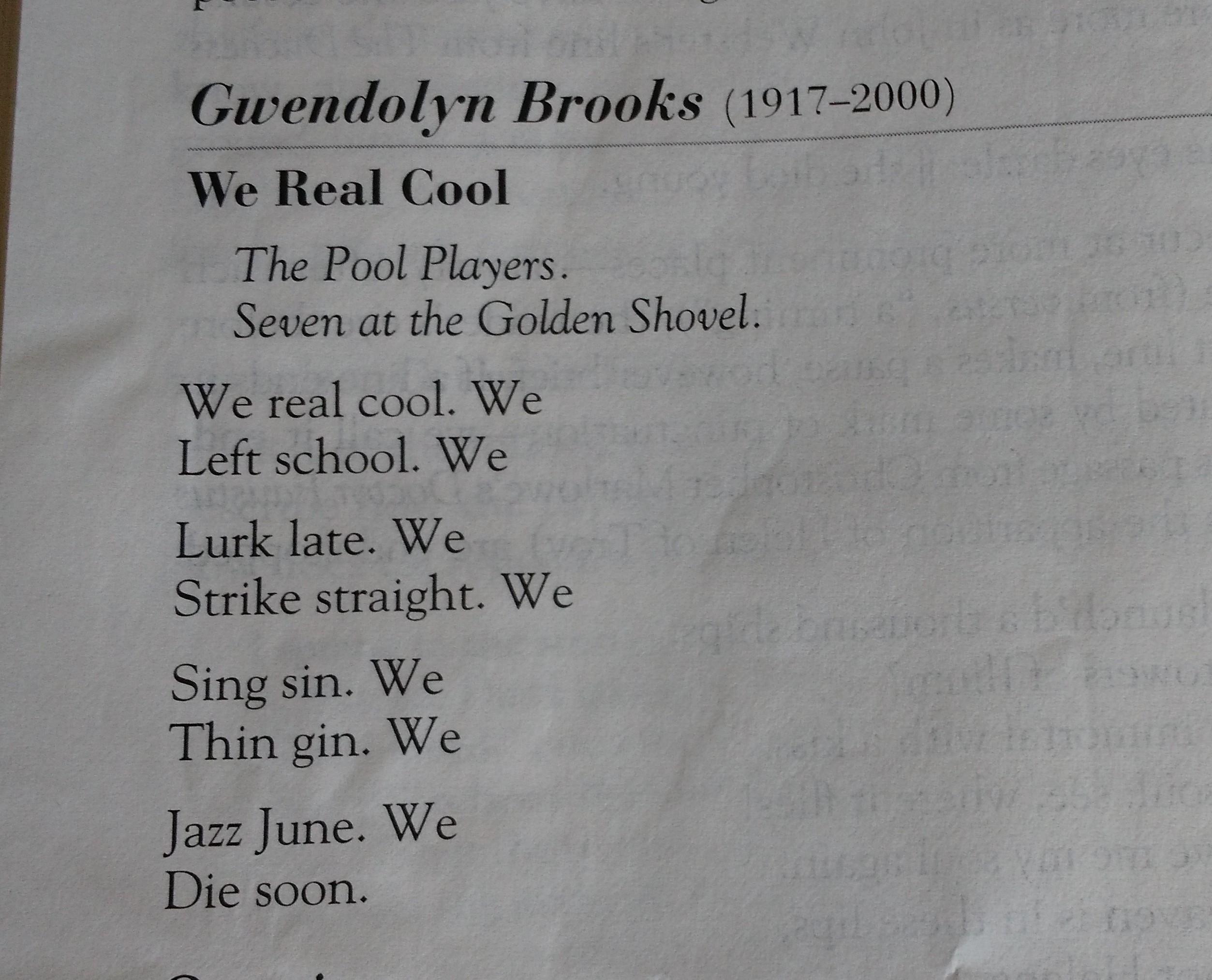
Could (or would?) Ava create the line-breaks that emphasize “We” at the end of each line? Those specific rhymes? That rhythm? What about the very idea of writing a poem? Brooks says that she saw these guys playing pool at the “Golden Shovel” and wondered how they must see themselves. In Brooks’ imagination, they think they are “real cool.” Especially given that “cool” is difficult to define at any given cultural moment, I wonder if Ava could come to this conclusion about the Pool Players and create a poem to represent her thought-experience. Here’s another take: Two AIs might come up with the exact same poem about observing the same pool players at the Golden Shovel, but I think only Gwendolyn Brooks and no other poet could have created “We Real Cool” just as it is. I mean, just listen to the way she reads it.
In a broader sense, what about creativity? For example, Edward de Bono, who coined the term “lateral thinking,” says this about creativity:
“Creativity involves breaking out of established patterns in order to look at things in a different way.”
Do we think Ava could do this? Certainly an AI could be programmed with all the necessary data – say, all poems ever written by every poet in human history – which would serve as “established patterns.” Could she come up with something that has not existed before, see something that’s missing from her data and create it?
What about this claim about creativity by Frank Goble, a prominent champion of “character education”?
“Because of their courage, their lack of fear, they (creative people) are willing to make silly mistakes. The truly creative person is one who can think crazy; such a person knows full well that many of his great ideas will prove to be worthless. The creative person is flexible; he is able to change as the situation changes, to break habits, to face indecision and changes in conditions without undue stress. He is not threatened by the unexpected as rigid, inflexible people are.”
Goble clearly identifies the act of creation as distinctly human here. Not just human – but specifically the human ability to make sense out of chaos. As a character in Transcendence says, “Human emotion. It can contain illogical conflicts.” Along these lines, I also like what Christopher Morley says about poetry: “The courage of the poet is to keep ajar the door that leads into madness.”
Maybe I’m drawn to these descriptions that allude to all that is disorderly because then I feel that I can keep Ava out of it. Surely, an AI could not possibly deal in or deal with madness, chaos, crazy, and mistakes? Surely a computer like Ava is all about logic, order, pattern, and all that makes sense. As you can see, I’m biased. And really what I want is to say is that poetry is a uniquely human activity. I don’t want AIs to appropriate poetry.
Just as AI movies are ultimately concerned not with science, machine, or robots but rather with humanity, my little musing here is really not about whether or not a robot could write poetry but really about… What is poetry?
The more I ponder this question and go from one answer to the next question, I feel myself getting sucked into a black hole (watch Intersteller) and getting lost. Time to stop. And go read a good poem like this one:
“Eating Poetry” by Mark Strand
Ink runs from the corners of my mouth.
There is no happiness like mine.
I have been eating poetry.The librarian does not believe what she sees.
Her eyes are sad
and she walks with her hands in her dress.The poems are gone.
The light is dim.
The dogs are on the basement stairs and coming up.[…]
I am a new man.
I snarl at her and bark.
I romp with joy in the bookish dark.
Mana’s Musing: The Journey of Books
Laura Yoo, a member of HoCoPoLitSo Board, writes Mana’s Musings for the second week of each month on the HoCoPoLitSo blog
Remember this from my last musing on the “thing” of the book?
Excitement is not exactly what I found in the marginalia of my Reconstructing Aphra: A Social Biography of Aphra Behn. Inside the cover I found this: “A.J. De Armond 1980- review copy”. Then a note to the future readers of this book from A.J.: “Borrowers: please don’t confuse me by adding further notes to mine.” I’m trying to hear the tone of this message – is it a polite plea or a bossy command?

A few days after this posted, I received an email from my friend Jean – subject line “OMG.” At first she thought it a coincidence that the initials I mentioned – A.J. DeArmond – was the same as her friend’s. Then we realized that she had given me that very book. How could I have forgotten?
I learned from Jean that A.J. DeArmond is Anna Janney DeArmond, her dear friend and former college professor from University of Delaware. When Professor DeArmond passed away in 2008, my friend inherited some of her books. Jean wrote in her email that Professor DeArmond “began teaching at Delaware in the 30’s when the university had a separate women’s college and when female professors could not be married and had to live in the dorms with the students.”
What really floored me was that Jean was familiar with the kind of writing that you’d find in Professor DeArmond’s books:
Finally, I am sure her inscription and notes are in pencil, not pen, in the tiniest writing imaginable. I have many of her books with those notes. And I am sure the inscription was a warning. She did a lot of book reviewing and her specialties were 18th century and American Lit. I am sure she saw that book as a teaching tool whose notes needed to be preserved for her future efforts.
This email from Jean made me smile all day long. This book, which had been read and written in by Professor DeArmond had traveled from her hands to her shelf to Jean’s to mine within the span of about 30 years. I had put it on my shelf without reading it, but the book’s life is one of resilience and patience.
An article remembering the professor after her death explained that she was the first woman to become a full professor at the University of Delaware. She went on to receive numerous awards in scholarship and teaching, and she served as a Fulbright lecturer at the University of Munich in the 50s. She also taught in England, Australia, and China. She lived a full and rich life of teaching and scholarship. Indeed she was a pioneer woman. There I was, holding this scholar’s book in my hands – all the knowledge, the history, and the experience that was in the hand that scribbled these tiny writings in pencil.
Speaking of pioneer women, Aphra Behn is often cited in English literary history as the first woman to earn a living by writing. She is part of the canon in the study of the “rise of the novel,” and her Oroonoko and The Rover are common readings in any English major’s reading list.
So the other night, I flipped through my own three books of Behn’s writings.
In the Norton edition (green cover), I came across an article written by Robert Chibka. What? Chibka? Professor Bob Chibka who was my favorite English professor at Boston College? The guy responsible for my scholarly interest in the eighteenth-century English literature? Yup. The same professor who gave me two very good pieces of life advice: 1) If you want to be an academic, marry an accountant – which I did. 2) No, your writing is not good enough to get into an MFA program in creative writing (sorry, but not sorry) – boy am I glad he gave me such brutally honest advice.

Okay, so it may seem a bit hokey to put stock in what seem like coincidences but I don’t think we can deny the connections that the material book makes simply by existing and being passed around. And the book’s journey can tell us a lot about its own material life, the lives of its previous readers and owners, and the literary work that’s inside the book.
How about one more story about a book’s travels?
A couple of weeks ago, I picked up my copy of Mitch Albom’s The Time Keeper which was among a large bulk of books I had ordered from Thriftbooks.com. I noticed the bar code sticker from the library of Camp Hovey. When I opened the book, a piece of paper fell out and it was a photocopied magazine article written in Korean. Naturally I googled “Camp Hovey” and it turns out Camp Hovey is an American military base in South Korea. And yes I am from South Korea.
Is your mind blown yet? Let the magical journey of books sink in, dear readers.

 HoCoPoLitSo