Home » Guest post (Page 10)
Category Archives: Guest post


Poet Laura Shovan Ignites a Creative Summer School Spark in 4th & 5th Grade Writers
The latest installment in our occasional series of blog posts from friends of HoCoPoLitSo. Today, the multi-talented — poet, blogger, teacher, editor, (the list goes on and on) — Laura Shovan shares with us her experience working with elementary school writers this summer.
It was my first, and only, time calling into a radio show. Former U.S. Poet Laureate Billy Collins was on the air with WYPR’s Dan Rodricks. I often use and recommend Collins’ website Poetry 180: A Poem a Day for American High Schools for classroom-friendly poems.
I wanted to know: Was there a Poetry 180 for younger students in the works? Collins said “No” and reasoned that elementary school children get enough poetry in their literary diet already.
Perhaps. But that poetry is often limited to work that’s easily digested. Elementary schoolers love Jack Prelutsky, yet are unfamiliar with more complex poets writing for children: Marilyn Singer, Sharon Creech, and Tony Medina. Their curriculum for poetry composition is rarely richer than limericks, haiku of the 5-7-5 variety, and cinquain. That’s why poetry educators, such as those on the Maryland State Arts Council artist-in-residence roster, are such highly valued classroom visitors. We are poetic master chefs. Give us the ingredients of poetry – form, figurative language, and voice – and we’ll turn out a dishy treat even the most reluctant writers will enjoy.
This month, I visited Lisa Johnson’s creative writing class at the Howard County Public School System’s G/T Summer Institutes. Certainly the fourth and fifth graders in a class called “Creative Writing: Ignite the Creative Spark” must like to write or they wouldn’t have been in the class. Still, many of them were unsure about writing poetry. Distaste for poetry often sets in by fifth grade, as evidenced by one student who wrote me this note: “At first, I thought you were going to be BORING!”
 As this was a group of strong writers, I brought a favorite lesson: portrait poems. To begin the workshop, we looked at a photograph of a man holding a baby. Our discussion focused on the facts of the picture. For example, we noted that “The man is wearing a baseball cap”. Once we exhausted the facts of the photograph, we let our imaginations take over. The class told stories about the man and the baby. Were the two of them related? Had the man rescued the baby from an accident? Was this a family reunion?
Next, we read a poem called “Face Poem” written in response to the photograph in question. [The poem and the related photo can be found at The Poem Farm, the online home of children’s poet Amy Ludwig VanDerwater.] We compared the class’s imaginings to the details of the poem. How did “Face Poem” work as a portrait?
After seeing the example, the students were ready to begin the writing process. Ms. Johnson and I had clipped portraits out of newspapers and magazines ahead of time. The children each chose one image to write about. They sat with their writing notebooks and the photographs and created a T-chart. On one side: the facts of the portrait. On the other: Who is this person? What is she doing? What is he thinking? What happens next?
Imagining someone else’s life through a workshop like this stretches young writers. My students often express a depth of empathy that surprises the adults in the room. The tangible details of a photograph are like a list of ingredients. How the children use those ingredients is what gives the resulting poems substance.
Here are three of the students’ responses.
The Newborn
By Aiai C.
A baby cry echoes through the room. The mother
rushes to calm her. The baby was as pale as snow,
her hair as black as the night sky, her lips
as pale pink as peaches. She would resemble
a snow maiden. She thinks she is the only one there,
but her mother is there gently whispering in her ear,
“Little one, little one, go to sleep.” The necklace
on her mother’s neck gently sweeping on her face.
her mind finally relaxes as she drifted off to dream
through the clouds of sleep.
The Hard Working Teacher
By Katelyn M.
The night was warm and bright
No noises filled the night
Her eyes sparkled like the night sky
Her chalkboard filled with white letters like the moon
Her lamp shines on her like the sun shining on the earth
That’s my teacher that teaches me
The Fisher
By Samuel C.
I stand in the lake
with a red shirt,
waiting for a fish to take
the bait on my hook.
I have a backpack
to carry fish back,
but now I just wait.
My family also waits
patiently as can be,
but they also wait
as quietly as a mime.
As soon as I catch a fish
I will go back to them,
I think to myself,
but now I just wait.
My son also waits.
On the land he stands,
as tense as a cricket
waiting for me to catch one.
The he’ll go back
and bring the fish back
for my family to eat.
Suddenly I feel a tug,
so I pull the fish ashore,
and go back to my family,
to eat that big fish.
I finally got back
to my family
at the camp
in the forest
in the depths of Quebec.
— Laura Shovan
Confessions of a Poetry-Phobic by Laura Yoo
The latest installment in our occasional series of blog posts from members of the HoCoPoLitSo board...
I’ve been a HoCoPoLitSo board member for several years now, but I am only now brave enough to make this confession: Poetry always scared me a bit.  As an English major in school, I avoided poetry – I took the required Introduction to Poetry class during my senior year because I put it off ‘til the very end. I was afraid.
But during the last few years, I’ve had real contact with (and real context for) poetry. What I’ve come to accept is simply that when I read or hear a poem, either I get it or I don’t get it – either I feel something or I feel nothing. And that’s good enough.
When Martín Espada came to Blackbird Poetry Festival in 2011 and read “Imagine the Angels of Bread” I definitely, most clearly, undeniably felt something. Oh yeah. When Patricia Smith performed with the Sage String Quartet just last weekend, I didn’t just feel something – my mind was blown to pieces. And when the pieces found each other again and returned to whole, it looked different. Changed.
All of this made me think about poetry and my fear of it. This thing that made me tremble in fear had been making me feel things all my life. It had introduced me to new ideas and paths, it had comforted me, it had fired me up, and it had given me peace.
My family moved to the U. S. from Korea when I was ten years old. During the first months of my life here, my fifteen-year-old cousin taught me the alphabet using the Dick and Jane primers (which are poetic in their own way). It was also this cousin who introduced me to Shel Silverstein several years later, when she thought I was finally “ready” for poetry. I remember quite clearly how I loved the repetitive sound in this particular poem, “Ations”:
If we meet and I say “Hi,”
That’s a salutation.
If you ask me how I feel,
That’s consideration.
If we stop and talk awhile,
That’s a conversation[…]
And all these ations added up
Make civilization.
Silverstein’s poems were my first introduction to the idea of playing with words to create meaning – and to make people laugh.
Next “poetry” came in the form of Macbeth in the tenth grade at Wilde Lake High School right here in Columbia. That Mr. Berkowitz was a tough teacher – he made us keep a journal documenting ALL of the imageries in the play. This arduous task illuminated all the instances of amazing things that words could do – like striking fear in the reader when Lady Macbeth speaks:
[…] Come, you spirits
That tend on mortal thoughts, unsex me here,
And fill me from the crown to the toe top-full
Of direst cruelty. Make thick my blood.
Stop up the access and passage to remorse,
That no compunctious visitings of nature
Shake my fell purpose, nor keep peace between
The effect and it! Come to my woman’s breasts,
And take my milk for gall, […]
Macbeth sealed my fate – I would study English in college.
When I was in college, I discovered “The Lake Isle of Innisfree” and it has become my favorite poem – the one that I keep in my pocket on Poem in Your Pocket Day every April. It speaks peace to me.
I will arise and go now, for always night and day
I hear lake water lapping with low sounds by the shore;
While I stand on the roadway, or on the pavements grey,
I hear it in the deep heart’s core.
When I started teaching, Taylor Mali’s “What Teachers Make” gave me a sense of justice. On those days when I felt knocked down by unreasonable students, failing students, mean students, nice but underprepared students, Mali’s poem gave me hope.
You want to know what I make?
I make kids wonder.
I make them question.
I make them criticize.
I make them apologize and mean it.
I make them write.
I make them read, read, read.[…]
I make a goddamn difference.
When a few years ago, my father died of cancer, I turned to Emily Dickinson, whose poems I had never been able to understand. Her poems seemed like words that were almost randomly strung together with dashes. But I realize now that I never “got” them because I never needed them before.
So We must meet apart –
You there – I – here –
With just the Door ajar
That Oceans are – and Prayer –
And that White Sustenance –
Despair –
I’m not a poet. And I don’t even claim to be a poetry lover. All I can say is that poetry has been in my life – it had been sneaking up on me now and then to guide me, to help me, and to change me. And guess what? It has been doing it to you, too.
Laura Yoo
HoCoPoLitSo board member
Poetry, A Community College Student’s Perspective by Katy Day
We asked Howard Community College student Katy Day for her perspective of poetry on campus. Take a look at what she delighted us with:

HCC student, aspiring writer and newborn poetry fanatic Katy Day meets Billy Collins at the The Folger Shakespeare Library in Washington DC.
As I scurried through the halls of Duncan Hall at Howard Community College, on my way to Introduction to Creative Writing, I ignored the framed student poetry scattered throughout its walls, all the way up to class. After all, how good could a student’s poem be, especially to someone like me who didn’t even like poetry?
In class, I was already envisioning my name sprawled across a half dozen book covers in large font as my professor, Ryna May, informed the class that we would all be required to submit a piece of our writing to the school’s literary and arts magazine, The Muse.
I loved my Creative Writing class even more than I had anticipated. Each week I put more hours of work into my short stories than I did for any of my other three classes. Combined. I dreaded, however, the two weeks Professor May had dedicated to poetry. How would I be able to get through two entire weeks without writing a single story? More importantly, how would I be able to write poetry if I couldn’t even understand it?
I don’t think I was the only person in the class with these concerns and Professor May was already on top of that. She gave us all copies of the previous edition of The Muse and asked us to find a poem that we liked. I read through all of them and was shocked by how much I actually liked some of them. I realized it wasn’t that couldn’t understand poetry; I just hadn’t come into contact with it at any point during my adult life. I was blown away by the seemingly endless possibilities offered by a single page of words. I didn’t have a favorite. I had a list.
May showed us videos of current poets like Billy Collins and Taylor Mali; genius on her part. I will never be able to thank her enough for that. She sat back as we watched, casting her line out into the sea of non-poetry believers and patiently waited. She didn’t give us an opportunity to ignore poetry. She captivated us through sight, sound and pleasure as we all soaked in these universal, current poets. So this is what poetry is today, I thought. By the end of the videos, we were all swarming around the bait, snapping wildly at it. She had us hooked.
Of course, once the door to poetry is opened, there are endless other doors and hallways to get lost in. Like a mouse venturing through the walls of an old colonial house for the first time, many paths in poetry can lead to a dead end. People are easily scared off by it, but May was always there, pointing us in a promising direction.
At the end of the course, she encouraged me to submit my work to The Muse. After waiting three excruciatingly long months, I finally heard that they’d be publishing one of my short stories and one of my poems. I was ecstatic.
Professor May also invited me to read a poem at the Blackbird Poetry Festival, an event organized by both Howard Community College and HoCoPoLitSo. At the festival, I knew that a lot of students were being exposed to poetry in their adult lives for the first time, and I loved being a part of that. I was nervous, of course. Who wouldn’t be nervous doing their first poetry reading in front of their teachers, classmates, their mother, and RIVES, who was front and center, chanting my name as I walked to the podium.
Despite the fact that I was trembling with fear on the inside, I made it through the reading and was immediately praised by Tim Singleton, Board Co-Chair of HoCoPoLitSo, who announced after my performance that he liked it so much he would have liked to hear it twice. Professor May said I did great and assured me that I didn’t look nervous at all. One student told me after the event that my poem was his favorite. Rives even said that he loved my poem and I had excellent stage presence. Reading my poetry was like a rollercoaster ride. I was scared out of my mind but so high off of the adrenaline afterwards that I couldn’t wait to do it again.
Luckily I didn’t have to wait long because The Muse reading was only a couple of weeks later. That was a whole different experience of elation, as I picked up the first publication that contained my own work. I can’t express how lovely instructing the audience to turn to page 47 in their book to find MY POEM felt.
Howard Community College didn’t just introduce me to poetry. It provided me with all of the assurance and reassurance I needed as a writer. It gave me door-opening experiences that have fueled me to continue my journey as a poet. The dedicated and passionate English Literature professors gave me an outstanding jumpstart into poetry. Now when I’m strolling around in Duncan Hall and I come to a framed poem on the wall, I take a few moments to read it, and I’m always pleasantly surprised.
Katy Day
HCC Student
Poetry Shades in the Geometry of Students’ Lives — a Guest Post by David Barrett
The latest installment in our occasional series of blog posts from members of the HoCoPoLitSo board...
 One day, I am in class alone with one of my students because her classmates are on a field trip. She has been a member of a poetry workshop that has been in place for five years at Homewood Center, Howard County’s only alternative school. It was organized by our media center specialist, inaugurated by poet Truth Thomas, and made possible from the Horizon Foundation’s contribution.
On this day, the student asks if I would listen to a poem she has been working on. I said I would and she began to read a plaintive poem about her scarred relationship with her mother. While she is reading, a second student enters the room and asks what is going on. Before I can answer, she joins us and says “This is a poem!” and starts to cry as she realizes it’s about a mother-daughter relationship. She states that she wants to say some things to her own mother (with whom she has never lived) but does not know how she would do it. After hearing her classmate’s poem, she wants to try it in a poem. With excitement in her voice, she asks if I would review it once she has completed the first draft. She is completely animated.
This is yet one more story of how poetry, serving as a vehicle to work through complex issues, is positively affecting the lives of students at our school.
Oh, I failed to mention that both girls are in my geometry class, not an English class.
By David Barrett
Ex-Officio, HoCoPoLitSo Board
Shakespeare on My Mind — a Guest Post by Lisa Wilde
The latest installment in our occasional series of blog posts from friends of HoCoPoLitSo. Today Lisa Wilde, director of theatre at Howard Community College and resident dramaturg at Rep Stage, has Shakespeare on her mind:
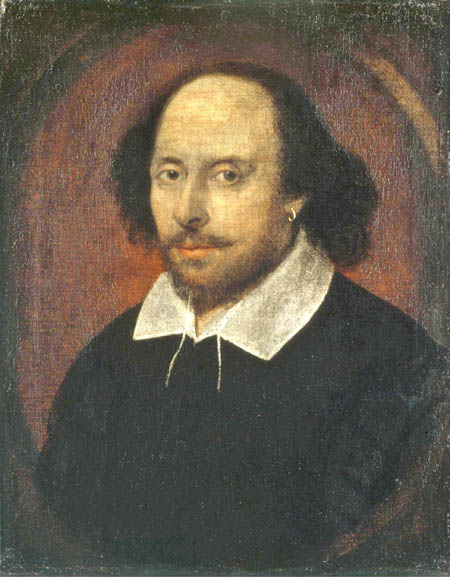 I am standing in a high school English classroom. It is 1980. I am no doubt wearing a Fair Isle sweater and a denim skirt and my hair is pulled back by tortoise shell combs. Our assignment was to memorize and deliver two Shakespearean sonnets – in my case: “Let me not to the marriage of true minds” and “Shall I compare thee to a summer’s day.” I stumble through, gently, and hopefully without anyone noticing, tapping my wooden clogs to beat out the iambs– the lub/dub or unstressed/stressed pairing so like — some have said — our most essential rhythm, our heartbeat. In my head, I am counting the ten syllables I need in each line, probably the very crutch Shakespeare’s actors used to speak their lines after a night spent with too many pints in the local pub.
Other less, shall we say, conscientious students needed more propping up to get through. Perhaps their previous evening had included activities more contemporary than me sitting at my Ethan Allen white painted desk struggling to put two lines together and then another half line, until I had gotten all fourteen– the Elizabethan sonnet as a square, rhyme scheme ABAB, CDCD, EFEF, GG.
Antiquated, huh? This notion of rote memorization and declamation. Who needs to have poems memorized and ready for the moment you are called upon to make a toast or speak in memory of someone, or you struggle to find language to provide comfort to yourself or another when you cannot find the words yourself, or to express your depth of feeling in a sparkling April or melancholy October day? Surely there’s an app for that.
Of course, we speak Shakespeare all the time. Probably you’ve seen the poster about “quoting Shakespeare”: If you speak of the “green-eyed monster” or suggest “neither a borrower nor a lender be” and “to thine own self be true” and refuse “to budge an inch” “stood on ceremony,” “danced attendance” “had short shrift,” “cold comfort” or “too much of a good thing,” you have already memorized some Shakespeare. What would it take to learn fourteen lines?
My son, looking for his buddy said “Where is Hannah?” and I responded “Who is Sylvia, fairest of the fair?” I hope to aggravate him similarly throughout his life. I have on more than one occasion suggested to a friend or sibling that they should “Sell when you can, -you are not for all markets” or wondered out loud “How will this fadge?”Am I merely pedantic? Is this a snobbish tic? Probably.
A poem in your pocket is good for the day. A poem in your mind is what remains. President Obama has called for an initiative to map the human brain. I hope they find a few dozen lines of iambic pentameter in mine.
Lisa A. Wilde
Director of Theatre, Howard Community College
Resident Dramaturg, Rep Stage
Writer Traveling: Susan Thornton Hobby Returns with News of Puerto Rico’s Poet’s Passage

Photo by David Hobby.
The Poet’s Passage is a spot every community should have. Darned if it isn’t in Puerto Rico.
The shop, part coffee shop, part art store, part living room for the little old city, sits beside the little old supermarket on Calle de la Cruz in Old San Juan. All the streets in Old San Juan are cobbled in bluish stone called adoquine that arrived in Puerto Rico as ballast on Spanish ships in the 1500s. The light from shop windows makes the streets glow indigo in the frequent rain at night. One half of The Poet’s Passage is a coffee shop, with drinks like the Metaphor café latte, or the espresso (of course, called a Haiku), or the Rhyme, a latte with vanilla, almond and caramel. There are comfy chairs, a wide window to look out on the plaza, and pastries.

Photo by David Hobby.
Across a hall is the poetry shop, with paintings, poetry in calligraphy and on ceramic tiles, poetry books and sculpture for sale. There’s also a chatty parrot named Neruda who sometimes nips.
Every Tuesday night, the shop hosts an open mic poetry reading, usually with music, and sometimes the event spills out into the plaza across the street. One reading in March drew almost 2,000 people, then they had to move it indoors at midnight and it stretched on until 3 a.m.
Just beside the main, but tiny, supermarket in Old San Juan, The Poet’s Passage is owned by Lady Lee Andrews, a poet with three books published (Naturally, Changing and True Love), and her husband Nicolas Thomassin, who paints lovely images of the doors, landscapes and cobbled streets of Old San Juan and sells the prints for reasonable prices. He also makes the miniature plaster doors in the rainbow sherbet colors of Puerto Rico.

Photo by David Hobby.
Andrews’ poetry is both personal and universal, with lines like: “I looked up and saw nothing there/ to cover the blue/ fresh air I was breathing in/ I think I closed my eyes twice/ before I realized I was/ dreaming like a child/ with a red kite.”
Old San Juan is the kind of place that on Easter Sunday afternoon, hundreds of people from the town turn out to fly kites on the grounds of the El Morro, the sixteenth-century Spanish citadel built to guard the Caribbean. It’s also the kind of place that values poetry enough to keep a poetry store in business. The Poet’s Passage feels like a community hub – the kind of organization that HoCoPoLitSo seeks to be. If only we had the Puerto Rican trade winds and sunshine.
Susan Thornton Hobby
Board member
A few more pictures follow:

Photo by David Hobby.

Photo by David Hobby.
Students’ Moments of ‘Quiet Potential’ with Writer-in-Residence
Sometimes the hands rise slowly. Sometimes they shoot up quickly.
Other times, hands rise up cautiously as the eyes dart around the room. I love this moment for its honesty, its quiet potential, and the way that question maps out the terrain I have to travel to at the least show each and every school in Howard County that poetry is present, possible and matters. As writer-in-residence for HoCoPoLitSo, I travel to the county high schools to read and talk poetry.
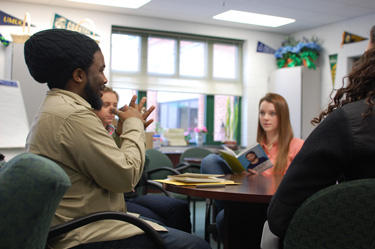
Poet Derrick Weston Brown speaks with students at Atholton High School. (Photo by Paige Feilhauer)
During the reading, I share stories behind the inspiration and origin of some of the poems and then I ask the students if they have any questions about certain poems. Many even request me to read certain poems and then give their own interpretations on them. We talk about other things as well. Ipod playlists. If Twitter is an appropriate space for poetry. Role-playing games. Favorite books. Dating. Haiku. Race. Gender. The list goes on.
If I have any sort of a complaint, I wish that perhaps my visits could extend past the usual fifty-minute class time. Usually the bell rings and the students make their way to lunch or to another class and I find myself a little melancholy that the connection we’ve built in just a short time is broken. But so much has happened within those small bubbles of time. I’ve witnessed brave students share their own poems when I’ve asked if there are any other poets in the room.
I’ve watched them deliver heartbreakingly honest and earnest poems, shaking paper and all, with the kind of sophistication and insight I truly wished I possessed at their age. I’ve stayed after my allotted time with passionate teachers and their poetry-hungry students who fire questions like pistons at me about form, meter, and content.
I enjoy this job most of all because I realize that Howard County is not as mysterious as I thought, because poetry dwells there, and anywhere poetry lives is home.
Derrick Weston Brown
HoCoPoLitSo writer-in-residence
To support HoCoPoLitSo’s Writer-In-Residence program in Howard County high schools, consider making a donation.
Against the Ruins, Her Book of Poems
These fragments I have shored against my ruins.
T.S. Eliot, “The Waste Land”
by Tara Hart
If nothing else, I am a reader. Perhaps because I always had my face in a book, my parents logically wondered when I would finally write one. As much as I love reading novels (the longer the better), I have also always been aware that I am not driven to create them. Characters do not haunt me, demanding I write their stories, as in Pirandello’s Six Characters in Search of an Author. Extended, magical narratives do not spring into my mind on the train. My few hesitant attempts at starting a story and seeing where it would go led . . . nowhere.
And then our first child died, our Tessa. And that experience was too large to hold, and I  was helpless to know where to put it. I only wanted poems. I had always loved poetry, but in the casually passionate way we love favorite foods. Now I came to poems in a state of complete surrender, starving to know I was not alone, that the world is not all just a darkling plain. Lucille Clifton. Mark Doty. W. S. Merwin. Sharon Olds. They said many things that helped. They said some things that called to other things inside me. Slowly, I found relief in getting a few words down: a line, an image, a phrase. Sometimes I could write a whole page, breaking the lines like twigs wherever they were weakest, and create what might look like poems from arm’s length, but they had no music. I kept writing a little at a time, though, grateful for tiny shards of light, and I’d throw the scraps in a box. Or I’d think of something at work – like a new fear of crocuses – and type it into a document called “bits.”
 I wondered if I would ever be able to find sustained time to shore the fragments, and after a few years, the answers were all, suddenly, yes. My angriest, saddest lines, after thirteen discordant tries, flew into place like a blackbird and won a Pushcart Prize. I applied for a sabbatical, and received it. A friend taking a graduate course in design asked if she could work with me to produce a chapbook. And so in the spring of 2012, when Tessa would have been eight, I filled our birdfeeder, said a prayer of thanks, shook out the pieces, printed the drafts, and spread everything out on a table. I looked at my notes in the margins of great poets. In the softly silent house, for six hours a day, I listened to what I remembered. I followed those fragments, my breadcrumbs, my torches, planchettes. They were tickets, too, to a prize I was finally able to claim – the gift of understanding how I and my whole here and absent family are connected to a much, much larger story of love and loss, and what comes after. So I guess I do have that blessed clamoring that leads to the work, the words, and the release. It is one of my daughter’s many gifts, to turn me into a writer, after all.
Tara Hart co-chairs the board of HoCoPoLitSo and chairs the Howard Community College Division of English and World Languages, where she teaches creative writing and literature. Her chapbook, The Colors of Absence, is available at http://www.tarajhart.com/purchase.html
Who is rescuing whom? The writers or the readers?
 The latest installment in our occasional series of blog posts from friends of HoCoPoLitSo. Today Patricia VanAmburg, poet and professor of English at Howard Community College, writes of the power of sharing in literature and asks a ‘simple’ question:
Four thousand years ago, the Sumerians immortalized their king Gilgamesh (and their civilization) by telling his story. This has been a universal phenomenon. A few years ago, I had the opportunity to work with American poet Galway Kinnel, who defined poetry as “rescue work in time.” Broadening that definition to encompass all literature, I sometimes ask students what gets “rescued” in a poem or story.
They always guess the writer first and the reader second. Innately we know the healing quality of sharing our feelings and the relief in knowing someone else has felt or struggled with some of our own issues. Finally though, students realize that something even bigger gets rescued—the microcosm of a single event—the macrocosm of human experience.
We all belong to communities whose stories are important on local and global levels. Turkish writer and Nobel prizewinner Orhan Pamuk said in his 2006 acceptance speech: “The writer who shuts himself up in a room and first goes on a journey inside himself will, over the years, discover literature’s eternal rule: he must have the artistry to tell his own stories as if they were other people’s stories, and to tell other people’s stories as if they were his own, for this is what literature is. But we must first travel through other people’s stories and books.” Through the words of other writers, I have come to visualize literature as a flowing infinity symbol—the connection between teller and listener—the connection between individual and community. What literature connects you?
Patricia VanAmburg
Poet and professor of English
Howard Community College
The HoCoPoLitSo board of directors constantly thinks of how literature connects with the community, and how we can share those words with our audiences. But we thought a few book recommendations – especially at this time of year and considering the recent tragedies in our country – would be apropos.
What follows is a quick list of some of our board members and staff and the books they’re thinking of at this time:
- Tara Hart, board co-chair, recently sent her nephew, a veteran, a copy of Tim O’Brien’s Vietnam classic, The Things They Carried.
- Tim Singleton, board co-chair, reaches for Donald Hall’s Without, elegiac poems written of the dying of his wife, Jane Kenyon, that share the idea that one can let go, hold, carry on.
- Pam Simonson, HoCoPoLitSo’s managing director, is reading Elizabeth Spires’ Now the Green Blade Rises: Poems. Spires’ poems about her mother’s death are moving and comforting, as well as full of hope, when hope feels distant, Simonson says.
- Kathy Larson, treasurer, says she has read The Secret Garden, by Frances Burnett, many times, and “come away with a renewed appreciation for fresh air and sunshine and the healing power of nature.”
- Susan Thornton Hobby, secretary of the board, loves Mary Oliver’s New and Selected Poems, with the line: “Tell me, what is it you plan to do with your one wild and precious life?” from the poem “The Summer Day.”
- Laura Yoo, board member at large, found comfort in the collected works of Emily Dickinson when she had a sudden death in the family.
We’d love to hear what literature connects you. Feel free to comment below.
The Dodge Poetry Festival Leaves One Asking, “More Bread, Please!”
The latest installment in our occasional series of blog posts from friends of HoCoPoLitSo. Today Ryna May, Associate Professor of English at Howard Community College, writes of her experience at the recent Dodge Poetry Festival.…
Poetry, like bread, is for everyone.
– Roque Dalton

Natasha Tretheway. Photo by Dodge Poetry Festival. Click on the image to view more photos from the 2012 Dodge Poetry Festival.
The Geraldine R. Dodge Poetry Festival once again transformed downtown Newark, New Jersey, into a “poetry village” for a few days in October. The bi-annual festival has been going strong since 1986, though longtime supporters have noticed a different energy since the festival left its traditional home in Waterloo Village.
But one thing has not changed: This remains the Super Bowl of Poetry. There is no other event like this festival, where the old meets the new, where high school students cheer wildly for words, and where the teeming energy of a giant hall of people morphs into a single, quiet heartbeat. Where Natasha Trethewey, the newly minted poet laureate, shares a stage with Amiri Baraka. Where Philip Levine and Dorianne Laux teach us about the lyrical nobility of work. Where aspiring poets, old and young, hang onto every word as if it is bread, as if it is life-giving manna.
 The festival is more than a poetry reading, more than an event. It is a pilgrimage to sit at the feet of poets like Taylor Mali, to hear him recite “Like Lily Like Wilson.” It is the chance to be completely surprised by a brand new poet like Emari DiGiorgio and come to your feet when she finishes “Lady Liberty.” It is the chance to be inspired by Jane Hirshfield, who tells us that poetry gives us a voice, gives us courage to face the challenges that life puts before us.
Okay, so poetry isn’t life itself, but it is a way to experience life, a way to see the world and describe it and make meaning out of it. You can only see this, can only feel this at the festival. It isn’t quite Brigadoon, but it has that quality of stepping out of one world and into another. And if you experience it, you will be changed. This event is for everyone, and everyone should experience the Geraldine R. Dodge Poetry Festival at least once. If you go once, I promise you will want more.
— Ryna May
Associate professor of English,
Howard Community College
 HoCoPoLitSo