



Read Our Annual Report
Remembering Mary Oliver in Columbia – 1996

Mary Oliver – Photo credit Rachel Giese Brown
Before the Columbia Festival of the Arts box office even opened in 1996, tickets for the reading by Mary Oliver were long sold out.
Word had spread like wildfire about her appearance, and the famous Oliver, a quiet soul who didn’t travel much from her home in Massachusetts, read once, and only once, for HoCoPoLitSo. We tried for years to lure her back, but failed. Oliver died January 17, 2019, from lymphoma.
Before that June day in 1996, ninety writers sent in poems for a workshop, which Oliver conducted in the Slayton House dance studio. If you were one of those poets, we want to hear what Oliver said about your work. We hope you kept her notes.
After the workshop, Oliver packed Slayton House’s auditorium with 250 people. The late Lucille Clifton, another poet who is now no longer with us, introduced Oliver, the Pulitzer winner, this way, “To call her a nature poet is like calling Pavarotti a singer.”
Afterwards, Oliver, who is “reclusive, but not shy,” says HoCoPoLitSo founder Ellen Kennedy, chatted over chicken salad and fruit kebabs at the Kennedy home.
“I am trying in my poems to vanish and have the reader be the experiencer. I do not want to be there. It is not even a walk we take together,” Oliver explained about her work.
She’s become an Instagrammable poet, an inspirational poet. She asked her readers, “Tell me, what is it you plan to do/ with your one wild and precious life?” (link to “The Summer Day”)
But her work reaches people because it’s authentic, it’s true. Above all, she is a masterful poet.
Her images – of the grasshopper’s jaws moving sideways to mouth the sugar that Oliver fed her, of the lights going out behind her as journeys away from her home, of the wild geese streaking the sky – remain with me. I am always hoping that I can live like she did, “from day to day from/ one golden page to another.” (link to “Forty Years”)
by Susan Thornton Hobby
HCPLS Recording secretary

Free Wilde Readings Series Continues with Winter Line-up, Open Mics.
Wilde Readings is a free monthly literary reading series that provides local writers — poets, fiction, non-fiction — a chance to share their work with the community. The format showcases featured authors, as well as an open mic for interested audience members.
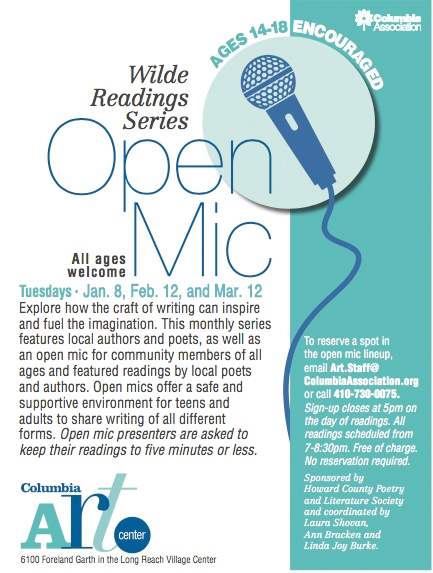
The open mic session offers a safe and supportive environment for teens and adults to share writing of all different forms. Open mic presenters are asked to keep their readings to five minutes or less. Come explore how a range of creativity can inspire and fuel the imagination and nurture one’s one craft and well-being.
Wilde Readings is sponsored by HoCoPoLitSo and coordinated by Laura Shovan, Ann Bracken, Linda Joy Burke, and Faye McCray.
Second Tuesdays at the Columbia Association Art Center in Long Reach. Starts at 7 p.m.
Featured Reader Line-up:
JANUARY 8, 2019
Danuta Hinc and Luther Jett
Host: Ann Bracken
 Danuta Hinc’s essays and short fiction have appeared in Washingtonian Magazine, Literary Hub, Popula, Consequence Magazine, The Word Riot, Litteraria, among others. She holds an M.A. in Philology from Gdansk University in Poland, and an M.F.A. in Writing and Literature from Bennington College, VT. She is the recipient of the Barry Hannah Fiction Award, and the author of the novel, To Kill the Other. Hinc is a Senior Lecturer at University of Maryland at College Park where she teaches writing.
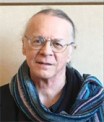
Luther Jett is a native of Montgomery County, Maryland and a retired special educator. His poetry has been published in numerous journals,as well as several anthologies. His poetry performance piece, Flying to America, debuted during the 2009 Capital Fringe Festival in Washington D.C. He is the author of two poetry chapbooks: “Not Quite: Poems Written in Search of My Father” (Finishing Line Press, 2015), and “Our Situation” (Prolific Press, 2018).
FEBRUARY 12, 2019
Dr. Dorothy Adamsnon and Gregory Luce
Host: Faye McCray
 Dr. Dorothy Adamson Holley, aka Drum Dr. Dot, is a Developmental Psychologist and a Licensed Clinical Social Worker. She is the co-founder of Nyame Nti Cultural Healing Arts Therapy, a nonprofit organization that integrates mental health and the arts to promote healing. Dr. Holley is the creator of Drumetry™, an art form that integrates two of her passions, drumming and poetry, and she is a proud member the Baltimore band, Roses n Rust.
 Gregory Luce, author of Signs of Small Grace (Pudding House Publications), Drinking Weather (Finishing Line Press), Memory and Desire (Sweatshoppe Publications), and Tile (Finishing Line Press), has published widely in print and online. He is the 2014 Larry Neal Award winner for adult poetry, given by the DC Commission on the Arts and Humanities. He is retired from National Geographic, works as a volunteer writing tutor/mentor for 826DC, and lives in Arlington, VA.
MARCH 12, 2019
Andrea Nacina Cole and Lisa Vihos
Host: Linda Joy Burke
 Andria Nacina Cole’s short stories have appeared in The Feminist Wire, Baltimore City Paper, and Ploughshares, among others. She has received multiple grants from the Maryland State Arts Council, including the organization’s top prize for fiction. She is the 2010 recipient of the Cohen Award, a Rubys Award grantee and Baltimore’s Best Storyteller (2017). She co-founded A Revolutionary Summer in 2015 in response to the murder of Freddie Carlos Gray.
 Lisa Vihos is the Poetry and Arts Editor at Stoneboat Literary Journal and an occasional guest blogger for The Best American Poetry. Along with two chapbooks, A Brief History of Mail (Pebblebrook Press, 2011) and The Accidental Present (Finishing Line Press, 2012), her poems have appeared in numerous print and online journals. She has two Pushcart Prize nominations and received first place recognition in the 2015 Wisconsin People and Ideas poetry contest for her poem, “Lesson at the Checkpoint.” She is active in the 100 Thousand Poets for Change global movement and recently returned home from the group’s first world conference in Salerno, Italy. Visit her blog at Frying the Onion.

On Reading: So You Like A Good Bookstore? You Should Like A Good Bookstore Book.
 Recently, I posted the Columbia Flier cover story about local bookstores to our Facebook page. The article post, featuring the likes of Books With A Past and the new Barnes & Noble at the Columbia Mall, got lots of attention. It is inspiring to see the love of the local store through thumbs up, hearts, and shares, and it has me thinking of the section of my own bookshelves that features books on books and bookstores, and writers on reading and writing. I thought I would share a few of the treasures there and recommend they find their way to your shelves.
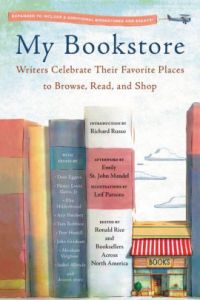
My Bookstore – edited by Ronald Rice and Booksellers Across America and with an introduction by Richard Russo – It’s hard to put this down, but then it is hard not to put it down. It is a collection of an array of writer recollections of their favorite bookstores, and features towards eighty writers (Isabel Allende, Dave Eggers, Edith Perlman, Henry Louis Gates, Jr. and so on) each providing a few pages of personal vantage and appreciation. Now, why would you want to put that down? To get in your car and head out to your own favorite local and live your own experience first hand, silly.
“I still own books that have remained alive and dear in my thoughts since I was a boy, and a part of the life of each one is my memory of the bookstore where I bought it and of the bookseller who sold it to me.” — Wendel Berry in My Bookstore
84, Charing Cross Road – Helen Hanff – I think this was the first bookstore book I ever read and, if I remember correctly, it might have been my dad or mom that gave me the copy (or maybe it was my mother-in-law, we are an extended book reading family and all love this one). Can’t quite remember. I do remember it being absolutely delightful, an epistolary tale of a dutiful reader’s cross-Atlantic relationship with a bookstore that kept her in all the titles her mind wanted to pursue, no matter the whimsy or rarity. Short and sweet and I am thinking I should read it again. So delightful the story and characters, they made a movie. Trying to remember now if there was a sequel book. Hmm.
My Reading Life and A Lowcountry Heart – Pat Conroy – These are another introduction and gift from my dad. They chronicle the writer of The Great Santini and The Prince of Tides reading and writing life. I have only come to them in the last so many years, but am very happy to not have missed either. I binged the both. If you go on a Conroy binge – recommended – make sure to add The Water is Wide to the list. It adds bio of his development as a caring teacher to the reading and writing.
Sixpence House – Paul Collins – It was my mom that gave me this treat: imagine a whole town of bookstores. It exists, and this is the book about it. Well, it is actually the story about the author moving out of his American life and into Hay-on-Wye in Wales to run a bookstore in the town of bookstores. Any sane person would wonder Hay-on-What? Wonder through the pages of this book and you’ll add to your bucket list the desire to have a wander through the place itself one day.
“It really is an APPALLING thing to think of the people who have no books…It is only by books that most men and women can lift themselves above the sordidness of life. No books! Yet for the greater part of humanity that is the common lot. We may, in fact, divide our fellow-creatures into two branches – those who read books and those who do not.” — Paul Collins in Sixpence House
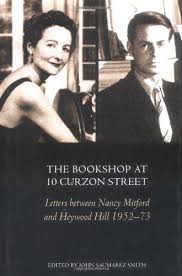 The Bookshop At 10 Curzon Street and A Spy In The Bookshop – Letters between Nancy Mitford and Heywood Hill. You shouldn’t need more of an introduction than that. I am pretty sure that is what had me pulling these two volumes off of a used bookstore shelf in Chicago a while back. I think it was Chicago. Dig in, they are delightful. (Note: in my mind all the good bookstores tend to blend into one epic thing, a sort of heaven of a place that just drifts shelf to shelf.)
Books and Literary Life – both memoirs by Larry McMurtry. Oh no. I can’t find my copy of Books. Now, would I have lent it out? Hope not. Or did I borrow a copy to read? There’s more than this that makes me mad about these memoirs from the very famous Larry McMurtry. You see, he used to run a bookstore just down the way in Washington, D.C. and I was never clued in enough to the world at the time to know, to go. I never went. I never saw/met him as he worked behind the counter, easy as it would have been. That is a thing I will always regret. Fortunately, I have these two books to stew over, and I love that.
Of course there’s more (who/what would you add to the list? – in the comments, please). But that is enough for a blog post.
Notice that I haven’t linked you to any online opportunities to track down these things? When you are done reading in a sentence or so, get yourself in a car and head out to Books With A Past, Attic Books, Gramps Attic Books, Second Edition Books, or even the new Barnes and Noble outside at The Mall (we want all the brick and mortar books sellers to be successful, stocked and ready for us) or the older one at Long Gate. If you can’t find what you are looking for on the shelves, ask. They’ll track it down for you. It’s the bookstore way.
Happy Reading,
Tim Singleton
HoCoPoLitSo Board Co-Chair
Poets Traveling Like Stars: Michael Collier, Elizabeth Spires, and David Yezzi

Tara Hart
Tara Hart is a Co-Chair of HoCoPoLitSo, and she is known for her beautiful introductions to the guest authors that we host. Below is her introduction to Michael Collier, Elizabeth Spirs, and David Yezzi. These authors read at the Lucille Clifton Reading Series on October 26, 2018 at Howard Community College’s Monteabaro Recital Hall. The introduction has been edited for the blog.
HoCoPoLitSo’s autumn reading series is named for Lucille Clifton, our late artistic advisor, distinguished master poet, and dear friend. We seek to craft a fall event each year that honors the caliber of her poetry and contributions to poetry, but also honors her spirit of connection, inquiry, and social justice, and her love for life and learning. She always let us know if HoCoPoLitSo was up to the mark and we know we would have had her fullest approval and blessing for the season opening event with three master poets Michael Collier, Elizabeth Spires, and David Yezzi.
These poets each have quite distinctive rhythms, tones, and subjects. But when I read their work in proximity to each other, fascinating connections emerge and start to tell a compelling story of the wonder of ordinary experience. When I say “wonder,” I do not mean it is all wonderful. But there is wonder in how many shades a life can hold, how many complexities and contradictions and paradoxes, and yes, how much darkness can be present yet still allow for light. In the work of these poets, you see free verse, but also elegantly structured quatrains, villanelles, and sonnets; there are some explicit references to other contemporary poets but also to King Lear, Keats, Emily Dickinson. These poets include a lot of snow in their poems, a lot of birds and flowers, dreams and ghosts, but also Instagram, humblebrags, and hashtags, anxiety medication, soap operas, game shows, videogames, even Patrick Swayze. There are terrifyingly timely poems about being a 21st century man with terrifying impulses. About guns, plagues, and tragedies in daylight. About those who abuse others’ trust and those who enable abusers. About inadequate rulers, about resistance, about the need to “stay human” amidst the news, the smartphones, and the loneliness.
These poets help us understand both the timeless and contemporary purposes of poetry, this singing and where it might come from. Using some of their own words now, we can see how poetry is “Like the weather that is never one thing.” It might be about making “bright things from shadows.” Poems might be stacks of perfectly balanced rocks or cairns, with words like roaring shells you hold up to your ear that say neither yes nor no, but to which we listen. Poets might be beggars with empty bowls peddling “poems that were never ours though we wrote them”; poets might write from bruised places or from the “place where a night/bird sings.”
All three poets’ work is full of wings (birds, ghosts, leaves, moths, bees, oars) “drumming and drumming.” They drum of ordinary regrets: our missed turns, going away for too long, getting lost, doing things that can’t be undone. Our desires, our clutter. Our “wingless feet.” Our ordinary worries: about children, about loss, about dying. “The terror of all that could befall me, you.”
These poets show us the nature of inquiry: “here in this place, there are no names on the map. There is no map.” They ask “What does it mean to be alive?” Why is “happiness so fleet”? “What is our hate made of?” “What will be left when each thing goes?” “Is it enough? To rest in this moment? To turn our faces to the sun?”
Finally, in Elizabeth Spires’ poem “Starry Night,” she gives us faith that the light of artists keeps travelling like stars, never darkening, never dying. As we stumble, they still shine, so we should keep looking up to them, working wonders.
A LONG WAY TO GO ON GUN VIOLENCE BY LAURA SHOVAN
This essay originally appeared on Nerdy Book Club and has been reposted here for HoCoPoLitSo readers with the permission of the author and Nerdy Book Club. The original posting can be found here: https://nerdybookclub.wordpress.com/2018/11/15/a-long-way-to-go-on-gun-violence-by-laura-shovan/
We woke up on Thursday morning to news of another mass shooting in America, this time at a California bar. It was college night. As the mom of two college students, I was shaken once again. It had only been eleven days since Jews were gunned down in their Pittsburgh synagogue. Twelve since a man killed two people at a grocery store after he was unable enter a predominantly black church nearby.
Writers and publishers are producing a growing number of books for children and teens about gun violence. In This Is Where It Ends, by Marieke Nijkamp, readers witness a mass school shooting through the eyes of several narrators. Marisa Reichardt’s Underwater offers a thoughtful study of a school shooting survivor who suffers from PTSD. The Hate You Give, by Angie Thomas — in which a girl witnesses the police shooting her best friend, a black teen — is now a movie.
These are important books. Kids need these stories as they struggle to understand what we are all struggling with: gun violence is impacting their generation. But what they also need are books that carefully examine our culture’s relationship to violence.

Photo credit: Yassine El Mansouri
Last weekend, a friend and I saw the John F. Kennedy Center for the Performing Arts’ production of Jason Reynold’s Long Way Down. The verse novel was adapted for the stage by Martine Kei Green-Rogers and directed by Timothy Douglas. The play follows the book’s plot: When his older brother Shawn is shot and killed, fifteen-year-old Will follows the rules handed down by the men in his family: “No crying. No snitching. Always seek revenge.” The story takes place as Will rides his building’s elevator – gun tucked into the back of his pants – down to the street, where he plans to shoot his brother’s killer. During that ride, the ghosts of past gun violence in Will’s life visit him, forcing him to look at how each loss has hardened him. He begins to question what he is about to do.
This production was, remarkably, a one-act, one-man show, with actor Justin Weaks playing not only Will, but also the people he has lost. That choice drives home an important point: Will carries each murdered friend and family member deep in his psyche. Each ghost’s visitation peels back a layer of Will’s armor, and we see him feeling emotions most boys are taught to hide: fear, grief, sadness. I won’t go into the wonders of the staging – how the coffin-like elevator was recreated, its mirrored walls reflecting the actor’s face as Will reflects on the people he’s lost.

Photo credit: Yassine El Mansouri
I am still trying to piece together my reactions to Long Way Down after reading the book, experiencing this production, and interviewing Jason Reynolds for a local television series called “The Writing Life.” What sets this book apart is that act of peeling back layers of grief. Readers connect with Will’s first-person voice straight away. We are already rooting for him to make a different choice, even as we understand his in-the-moment decision to punish the person who took his brother’s life. However, as Reynolds introduces us to the ghosts, the reader or audience member begins to understand intergenerational violence and how traumatizing it is for children, especially children of color.
I was grateful that after the standing ovation, a facilitator was on hand to help people process what we had just witnessed. As audience members shared their stories – best friends, siblings lost to gun violence – I was in denial. “Gun violence hasn’t touched me directly,” I thought. But of course, it has. My friend was at our local mall in Columbia, Maryland, during a shooting in 2014. She sheltered in place in a cramped store-room for hours before the all-clear was given. On New Year’s Day, 2017, my neighbor’s fifteen-year-old daughter – my daughter’s friend – was shot and killed by a classmate who had stolen a gun and broken into their house.
Another act of violence in our community was one of the inspirations for my recent middle grade novel, Takedown. On a winter evening in 2007, an ongoing argument between two groups of teens escalated. They went to an empty high school parking lot for a rumble. One boy, a highly-ranked wrestler in the county, brought a bat. He killed another teen that night. I remember sitting down with my son, who was ten years old at the time and part of the county’s tight-knit wrestling community. As a family, we talked about the idea that at any point that evening, the teens involved could have made another choice and walked away from the fight. In Long Way Down, Will’s elevator ride is his moment to decide whether he is going to walk away and step out of the cycle of violence.
Although I decided to tone down the violent moment in my story of a middle school girl who joins an all-boys wrestling team, writing about a traditionally male combat sport gave me an opportunity to look at this issue. And this week, I am reminded that our society is paying the price for celebrating violence among boys and men, whether we actively teach them to seek revenge, or we subtly look the other way under the guise of “boys will be boys.”
Books like Long Way Down are necessary, because they can help us talk with children and teens about the cost of violence, and what it means to walk away.
Laura Shovan’s debut middle grade novel, The Last Fifth Grade of Emerson Elementary, won several awards, including NCTE 2017 Notable Verse Novel, Arnold Adoff Poetry Award for New Voices honor book, and a Nerdy Book Club award for poetry. Laura’s second children’s novel, Takedown, is a Junior Library Guild and PJ Library selection. Look for her next book, A Place at the Table, co-written with author/activist Saadia Faruqi, in 2020. Laura is a longtime poet-in-the-schools in her home state of Maryland.

Poetry, music, cocktails at HoCoPoLitSo’s 41st Irish Evening of Music and Poetry
 HoCoPoLitSo’s guest for its annual Irish Evening on February 8, 2019, is the award-winning poet Vona Groarke, recipient of the 2017 Hennessy Hall of Fame Award for Lifetime Achievement. Groarke’s reading will be followed by a concert of Irish music and championship step dancing. During intermission, complimentary snacks and non-alcoholic beverages will be available. Irish coffee, specialty cocktails, and Guinness will be offered for sale beginning at 7 p.m. and during intermission. The program begins at 7:30 p.m. in the Smith Theatre of the Horowitz Center for Visual and Performing Arts on the campus of Howard Community College. Tickets are available on-line (starting Nov. 23) https://www.brownpapertickets.com/event/3905864, by phone or mail. To purchase by phone, call 443-518-4568 or by mail, send a check and self-addressed envelope to HoCoPoLitSo, 10901 Little Patuxent Parkway, Horowitz Center 200, Columbia, MD 21044.
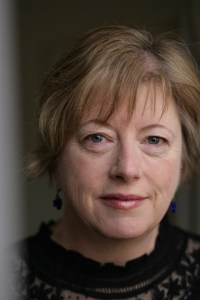 Vona Groarke’s most recent collection, Selected Poems, won the 2017 Pigott Prize for the best collection of poetry by an Irish poet. Noted as “brilliant and original” by the Irish Times, Groarke writes haunting and candidly sensual poems. At Irish Arts Center’s annual PoetryFest in New York, organizer and author Nick Laird extolled Groarke’s voice as “always modulated beautifully, assured and daring, often wry, (that) in the end keeps faith with the world.”
Groarke has published ten books, including a 2016 book-length personal essay, Four Sides Full and one translation, Lament of Art O’Leary (from an eighteenth-century Irish classic). A new collection of poems, Double Negative, is due in 2019. Her work has been recognized as one of Irish poetry’s “most consistently satisfying voices” (Agenda magazine) and “among the best Irish poets writing today” (Poetry Ireland Review). She has been the recipient of many prizes and grants, including the Brendan Behan Memorial Prize for her first collection, Shale (1994), the Michael Hartnett Award for Flight (2002), and is currently a Cullman Fellow at New York Public Library.
Groarke joins the long list of illustrious Irish authors HoCoPoLitSo has brought to Howard County audiences, including Frank McCourt, Colm Tóibín, Anne Enright, Colum McCann, and Emma Donoghue. For more than 40 years, HoCoPoLitSo’s Irish Evening has celebrated the substantial impact of Irish-born writers on the world of contemporary literature.
Performing traditional and original Irish music will be the Hedge Band: Laura Byrne on flute, Billy McComiskey on the box accordion, Donna Long on piano and Jim Eagan on fiddle, accompanied by dancers Maureen Berry, founder and Director of the Teelin School of Irish Dance, and Saoirse DeBoy, the 2016 World Solo Championship winner (girls age 16-17).

Mana’s Musings: Dodge Saw It Coming
BY LAURA YOO
All day Saturday, I was cocooned inside the warmth and protection of poetry at the 17th Biennial Dodge Poetry Festival in Newark, New Jersey. So I didn’t know what was going on out in the world and I didn’t know what would happen the next day. I didn’t know that another terrible news story was brewing. But maybe the poetry knew.
My friend and I left Columbia at 6:30 in the morning and arrived in Newark by 10:00. We planned to stay for 6 hours of poetry and head back home that night. We were ambitious.
At the very first session, Jan Beatty, Tina Chang, Cortney Lamar Charleston, Maria Mazziotti Gillan, and Danez Smith blew us away. Their poetry tore me apart with its heartache, beauty, hope, violence, and revelation. Somehow, I felt like each poem was about me or for me. How could that be? How could every poem be about fathers or about being a mother? Of course, that’s not really true. Poems are about lots of things. But what I realized is that poems touch you and maybe even hurt you where you are most vulnerable. For me, I am most vulnerable in my identity as a mother to two boys and I am most sensitive about the loss of my father who died eight years ago. Those are the two places that are the softest and yet the toughest because that’s where I hold so much fear, joy, sadness, regrets, and hope.
At a session called “Crossing Boundaries,” I heard tenderness in Joy Ladin‘s reading, defiance in Natalie Scenters-Zapico‘s, and anger in Paul Tran‘s. The discussion that followed made me think about the complexity of boundaries – about how they work both ways. They mark inclusion and exclusion. They protect but also they reject. Barriers between English and Spanish; between man and woman; between gay and straight. As if there are these solid lines of boundary that can really contain us and separate us from one another. On the other hand, the poets reminded us, there are boundaries that we need, like privacy and the inner self.
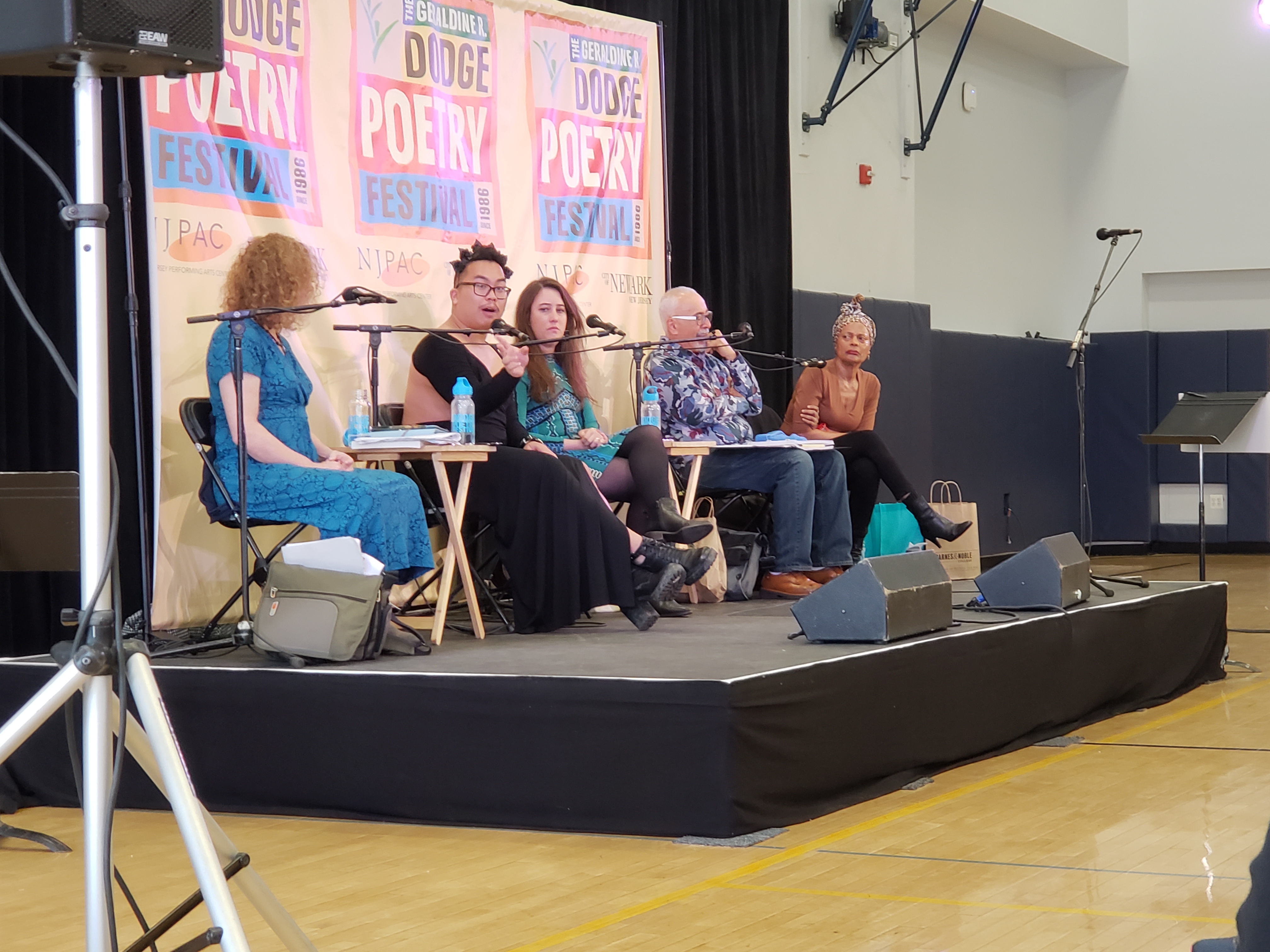
Joy Ladin, Paul Tran, Natalie Scenters-Zapico, Juan Felipe Herrera, and Sapphire (left to right)
In “Poetry and the News,” Tina Chang, Aaron Coleman, Safia Elhillo, and J.C. Todd, read their poems about how poems may be an antidote to the news even as they simultaneously speak of the news. Elhillo, who is Sudanese and Muslim, talked about being tired of being the subject of the news and of being asked to speak for “her people.” Her poems, which experiment with the form of the interview, made me think of a kind of subjugation through interrogation. Chang’s poems wove together the personal and the political, our own stories and news stories.
At the last session of the day, I got to hear Hieu Minh Nguyen, Nancy Reddy, sam sax, and J.C. Todd. And as Todd read the last line of the last poem for the session, the room went completely dark and silent – the power had gone out due to manhole covers blowing out in front of the New Jersey Performing Arts Center down the street. It seemed like a totally appropriate response to the powerful readings of these poets.
As Newark was burning below, green and black smoke oozing out from underground, and losing its power – literally but not literarily – my friend and I left and drove three hours back to Columbia. We talked nonstop during that ride about all that we had seen, heard, and felt. When we got home, we had more to say, so we continued our talk over 막걸리 (rice wine) and 부대찌개 (Korean “army stew”). There was poetry in those Korean soul foods, too.
The next day, I was still reeling from the trip when I saw many posts on Facebook and Instagram supporting the LGBTQ+ people. I thought, “What now? What’s going on?” I googled “transgender in the news” and saw the following headlines:
“Reports That the Trump Administration Plans to ‘Erase’ Transgender Definition Spark Alarm”
“The Trauma of the Trump Administration’s Attacks on Transgender People”
“Trump administration considers elimination of transgender recognition”
Dodge must have seen it coming. It was like the poets were predicting dire situations with their panels about boundaries, identities, bodies, and the news. With sessions like “Who Is It Can Tell Me Who I Am: Poetry and Identity” and “Whose Body?” Dodge Poetry Festival was preparing us, giving us the energy and the ammunition we would need to engage in the political (and emotional) fight against moves that take away rights, take away protection, and take away personhood.
And I know, too, that all the poetry in the world cannot fix what needs to be fixed if we don’t vote.
Read poetry. Vote. That’s what I will do.

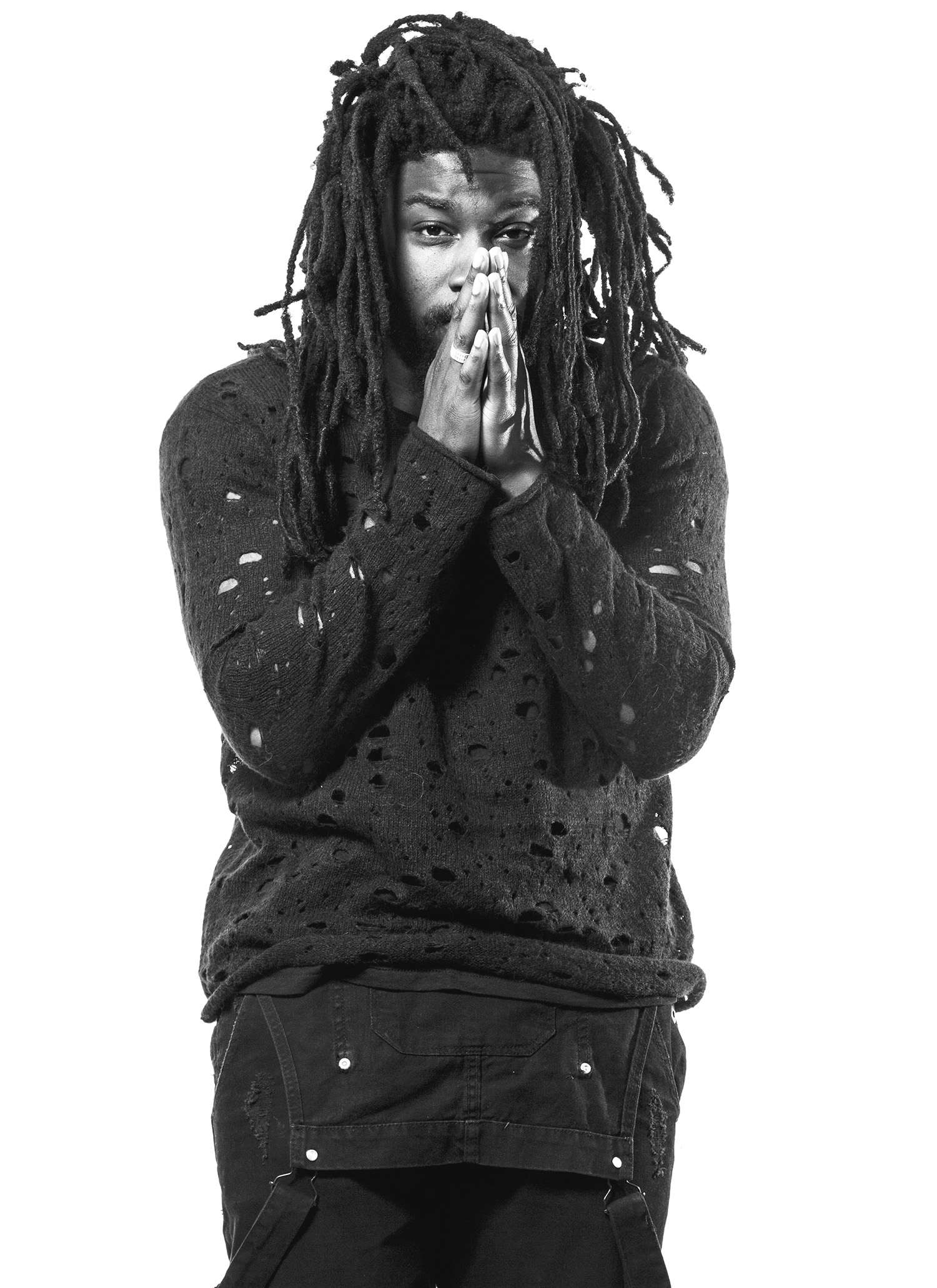
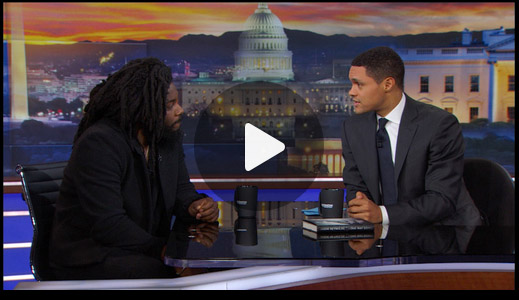
Book Challenge: Jason Reynolds
Join forces with author, library and HoCoPoLitSo to offer a book of dreams for everyone

The inside cover of Jason Reynolds’s book For Every One says it all. We’re supposed to pass it on. The book’s dedication reads, “For You. For Me.”
His book is about dreams, and how hard one must work to achieve them. He wrote about trying to focus on his ambitions:
“So I went out and bought all the books on all the ways to make dreams come true, laying out the how-to, somehow spinning life into a fantastic formula for dummies and dream chasers, written by experts and dream catchers who swear that I can one plus one and right foot left foot my way into fulfillment, never taking into consideration all this mess I got strapped to my back and my head and my legs and my heart.”
Susan Thornton Hobby
Recording secretary, HoCoPoLitSo Board
HoCoPoLitSo’s 45th Season Opens with Poetic Trio.
HoCoPoLitSo opens its literary season October 26 with “Ordinary Wonder: Three Poets on Writing and Reality,” featuring Michael Collier, Elizabeth Spires, and David Yezzi. The 2018 Lucille Clifton Reading Series highlights three Maryland poets with new, acclaimed collections. Collier, Spires and Yezzi will read and discuss their work beginning at 7:30 p.m. in the Monteabaro Recital Hall of the Horowitz Center for the Performing and Visual Arts on the campus of Howard Community College. Join us in celebration of HoCoPoLitSo’s forty-five years of literary programming at this year’s Lucille Clifton Reading Series. A book signing and wine and cheese reception will follow. The suggested donation for this event is $5.

Michael Collier, Elizabeth Spires, and David Yezzi
The three poets, in their own ways, hold up the ordinary world to the light of poetry and examine everyday mysteries, both beautiful and horrible.
Michael Collier’s most recent collection is My Bishop and Other Poems (2018). Poet and professor A. Van Jordan wrote, “My Bishop and Other Poems reminds us of the power of the observant in an age when, too often, we move too quickly to notice the world unfolding around us. These poems bring a passion, an empathy, and a way of seeing I had forgotten was possible.” Collier’s other collections include An Individual History, a finalist for the Poet’s Prize, and The Ledge, a finalist for the National Book Critics Circle Award and the Los Angeles Times Book Prize. He is the director of the Creative Writing Program at the University of Maryland, a director emeritus of the Bread Loaf Writers’ Conferences, and a former Maryland Poet Laureate.
Elizabeth Spires‘ most recent poetry collection, A Memory of The Future (2018), was influenced by Zen and Asian art. The New York Times wrote of the work, “In these lyrical verses, Spires questions the quotidian, elevating the everyday to a meditational art form.” Spires’ other collections include Worldling, Now the Green Blade Rises, and The Wave-Maker. The author of six books for children, Spires lives in Baltimore and is a professor of English at Goucher College.
David Yezzi’s newest collection of poems is Black Sea (2018). Other collections include Birds of the Air, Azores, and The Hidden Model. Reviewing Birds of the Air (2013), Farisa Khalid noted the poem Orts “does something that many poems strive for but don’t quite get at, and that’s conveying with clarity the otherness of our world—the strange beauty of what we experience and the mystery of what we can’t always understand.” Yezzi has contributed poems and criticism to The New York Times Book Review, The Times Literary Supplement, The Wall Street Journal, The Paris Review, The New Republic, Poetry, The Yale Review, Poetry Daily, and elsewhere. Yezzi, who lives in Baltimore, is the editor of The Hopkins Review and poetry editor of The New Criterion, and chair of the Writing Seminars at Johns Hopkins University.
Ordinary Wonder:
Three Poets On Writing and Reality
Michael Collier, Elizabeth Spires, and David Yezzi
Friday, October 26, 2018 – 7:30 p.m.
Monteabaro Recital Hall at the
Horowitz Center for the Performing Arts
Howard Community College
HoCoPoLitSo, a private, nonprofit literary organization, receives funding from the Maryland State Arts Council, an agency funded by the state of Maryland and the National Endowment for the Arts; Howard County Arts Council through a grant from Howard County government; The Columbia Film Society; Community Foundation of Howard County; and individual contributors.
Coffee-Stained Margins: a guest post by Eunice Braimoh
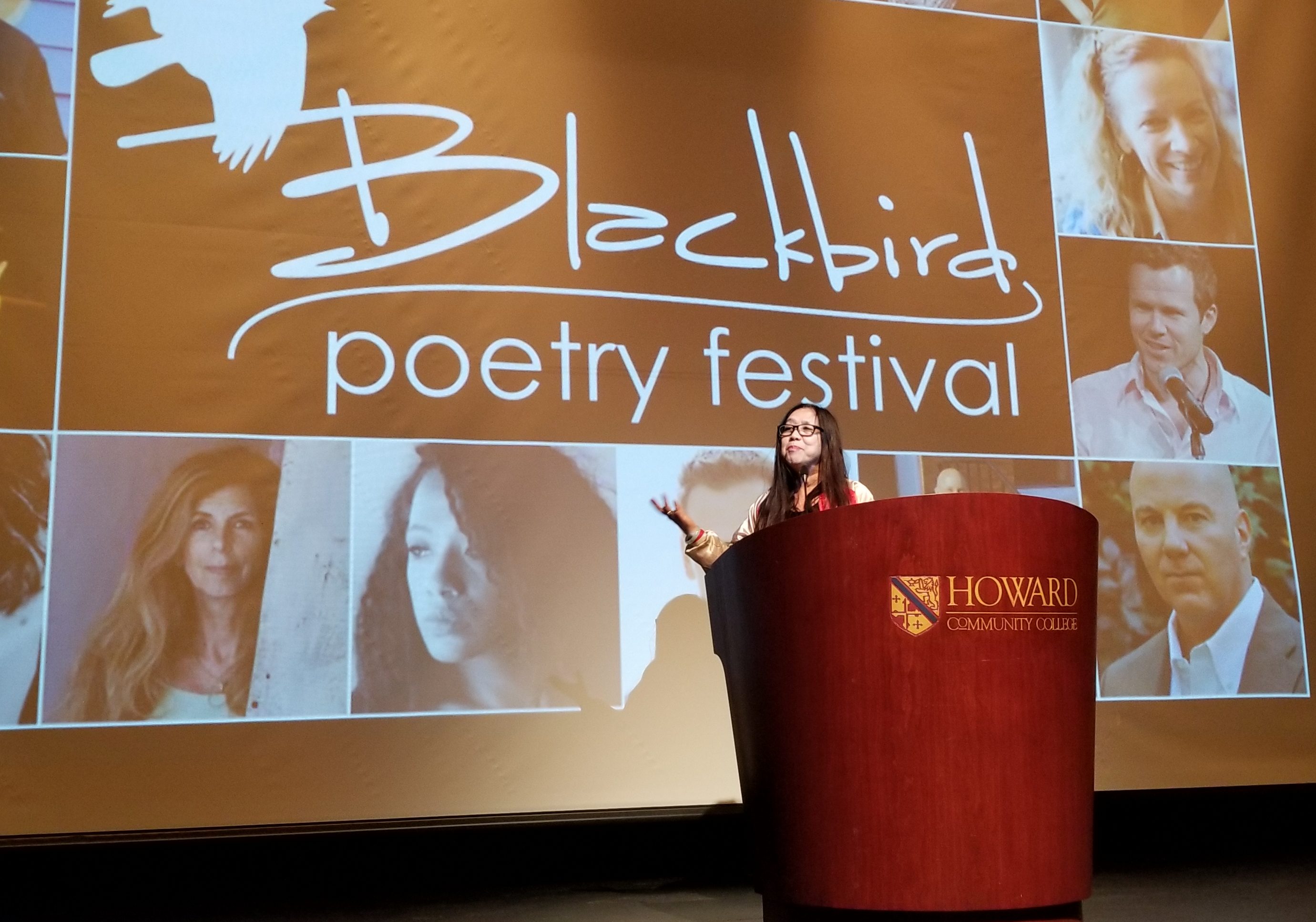
Marilyn Chin reading at the 10th Annual Blackbird Poetry Festival hosted by Howard County Poetry and Literature Society and Howard Community College on April 26, 2018
I had never heard of Marilyn Chin. But there I sat in the hazy Smith Theatre, listening to the petite, flip-flop-clad lady unfold her Chinese heritage, her voice’s rich resonance baptizing life into her words. Peppered with rhetorical questions and salted with snark, Marilyn Chin’s poetry invited the audience into conversation. As she discussed her experience with assimilation, I thought back to my years of insecurity with my Nigerian identity.
During my childhood, I tugged at my belly, my hair, my skin. I hunched in over myself. But I remember watching a spoken word from YouTube during youth group, the same lines which had echoed through my house the entire week prior because my mom, the youth leader, had been so fascinated by the video. Ears straining to keep up with the whiplash tempo, the laughing cadence, I snapped my fingers, riveted by the rain of spitfire, desperately beckoning the words barked out of the poets’ lips to be mine.
Slam poetry was alive.
A tandem of voice and pulse, spoken word went beyond sonnets and “thou”s and lofty declarations of love; it playfully teased out slant-rhymes and sidestepped the conventions of language. Poetry, I discovered, could be as unorthodox as I wished, and listening to the crowd of adroit artists (cough-SarahKay-PatrickRoche-BlytheBaird-OmarHolmon-cough) has since stirred a hunger.
For what?
Maybe I am looking for truth, naked and unholy. Maybe I write because I’m looking to sing what could be my gospel, to scream it in the shower, to spit it into the mic, to whisper it in an ear, to let it breathe ink and paper and dust.
While I write, I’ve knocked on Petrarch’s door, revisiting the poetry I once scoffed, imbibing in myself a greater appreciation for the art. Analyzing syntax and diction is what I love to do—maybe because I regularly eye my friends’ texts. (There’s a world of difference between “ok” and “Okay.”) While I am yet to be convinced that every inch of a poem is birthed from divine inspiration, I nevertheless believe that the spectrum of poetry—from spoken word to the coffee-stained margins—contains a delicateness that ought to be explored with careful hands and open eyes. As a writer, I wish to infuse electric vulnerability in my writing, inviting readers and listeners to unwind, to laugh, to have conversation.
Eunice Braimoh
As a writer exploring vulnerable curiosity, Eunice Braimoh wishes to symphonize conversation regarding race, gender, and diversity. When not effusively fangirling over slam poetry and intricate word-play, Eunice can be found writing (and rewriting) her own poetry and fiction. Previously recognized with two Regional Keys from the D.C. Metro Region, Eunice recently received a Silver Key for her poem “in which icarus does not drown”. She will be attending University of Maryland, College Park as an English major starting this fall.
 HoCoPoLitSo