



Read Our Annual Report
Poet Ann Bracken’s Visit to Patuxent Institution
Quality Poems: Offering a Window and a Voice
by Ann Bracken

Ann Bracken
So few of us ever visit a prison, yet many of us already have a vision of what it’s like, thanks to TV shows, such as the popular Orange is the New Black. On November 10, 2015, sponsored by the Howard County Poetry and Literary Society, I visited the Patuxent Institution to offer a writing and poetry workshop to some of the incarcerated men in the youth program. Pseudonyms have been used to protect the men’s identities.
The day was rainy and cool, and the gray skies nearly matched the gray walls and somber mood of the prison. Because I have worked with another writing group at the prison complexes in Jessup, I knew all I could take in were my art supplies, papers, and a book, in addition to my car keys and my license. The screening procedures are very much like going through the check-points of airport security, except that you must be patted down each time you enter the prison. I was not allowed to bring in my tote bag for the class supplies—instead, I was given a clear plastic bag.
Once I made it through security, Hillary Battle, a social worker who works with the youth program, escorted me to the education wing of the prison. I was curious about the designation of “youth program” because I knew the approximate ages of the men were between 25 and 35 years old. Ms. Battle explained the disconnect, “In order to be eligible for the Youth Program, the men must be sentenced under the age of 21. We could receive them at any time during their incarceration because the program distinction is based on when they were sentenced for their crimes.”
I’ve walked those long halls to the classrooms several times now, but I still shudder a little when I get on an elevator and the barred doors clank shut behind me. As Ms. Battle and I walk towards the classroom, many thoughts run through my head. Will the activity be beneficial for the men? What will they be like? Will they write and share? Do I have enough time for all I want to offer?
After discussing the men’s needs with Ms. Battle a few weeks earlier, we had both decided that my activity using J. Ruth Gendler’s book Quality Poems would provide a familiar starting point for the men to explore poetry. In her series of prose poems, Gendler personifies 100 character traits and invites us into their world—a world where “Commitment has kind eyes,” “Forgiveness is a strong woman,” and “Courage has roots.”
Dr. Cynthia Carter, the team leader for the youth program, greeted me with a warm smile and thanked me for coming when I arrived in the classroom. The men sat at their desks, quietly waiting for the lesson to start. As I surveyed the room, I noticed the standard furnishings: a large blackboard, several file cabinets, a few TVs, and about five computers. Nine men sat at desks arranged in rows. Because I’ve been a teacher for my whole career, the classroom felt familiar—even down to the four men who chose to sit in the back row. “We just feel safer here,” they told me and smiled. After I put my supplies on the desk, I walked up to each man, shook hands, and introduced myself. They smiled at me and thanked me for coming. In that moment I prayed that things would go well and that what I had planned would speak to their needs.
I began by reading the poem “Courage.” After a few moments of reflection, Claudio said, “Courage is quiet. He keeps to himself.” The other men chimed in, feeling more confident now that one of their friends had spoken. “Is Courage ever afraid?” Tony asked. My take? Yes, Courage is often fearful, but chooses to move ahead despite the fear. Tony shared his thoughts and said, “I like the line in the poem that goes, ‘Courage is not afraid to pray.’” I read another poem about “Forgiveness” and the men were visibly moved. As I read, they were nodding their heads. I knew they were ready to write when I heard Julio say, “Forgiveness is a gift you give yourself.”
All told, the men wrote two poems—one on a positive character trait they possessed and one on a trait they wanted to improve or change. When it was time to share their work, I invited all of them to form a circle with their desks so that we could all see and hear each other better. Here is a sample of the traits they wrote about and some lines from their poems; I found their words both powerful and beautiful.
Danny spoke up from the back row and offered to share first. He wrote about “Distrust” as if the character were a woman. “She lives within herself … I stood at the door of her heart … to let her know I understood, I called her by her name, Distrust.” For his other characteristic, Danny chose “Uncertainty”: “ … harsh forms like factory smoke … moist, unanswered questions.”
Claudio, with short-cropped hair, offered to share next. I had met Claudio during another visit, and I knew him to be a fine painter. He wrote these lines about intuition: “Like vapor in gulfless canyons, travels like a gadfly. Intuition chooses friends like a coal miner searches for diamonds.” As I listened to Claudio’s poem, I was struck by how he seemed to literally paint with words.
Armando, sitting in the front row, offered to read next. “Confidence is not arrogant. He takes responsibility. Confidence is a good trick to have.” All of us loved that last line—a real surprise.
Bernardo sat in the corner and raised his hand to share after his friends had read. He had this to say about creativity: “Creativity comes in every size. He recites rhymes for fun and lives in the forefront of my mind. Creativity has a humble hobby.”
The men’s poems were full of rhythm and memorable phrases. Even though I wanted copies of their work to share with HoCoPoLitSo, I didn’t feel right asking the men to give me the poems they had written that day. I encouraged them to keep writing more about the qualities they had chosen. I did ask them for permission to use some of their work and they all agreed, as long as I used pseudonyms to preserve their anonymity. Dr. Carter, Ms. Battle, and all of the men told me I was welcome to come again any time.
Once again, I could see that poetry had offered people two vital elements: a unique expression of their voices and a safe place to explore their lives.
Poet, certified poetry therapist, teacher
On Reading: What To Read Next?

Tim Singleton, co-chair of the HoCoPoLitSo board, writes ‘On Reading’ for the blog.
So we are at the end of one year and the beginning of another. For many, it’s the time to make a few resolutions. For me, I like to take a look back at what I have read and ponder what to read next. I don’t know which is more of a treat: looking backward at the cache or looking forward, ambitiously. Here’s a bit of both.
 Surprise of the year was Jen Grow’s book of stories My Life as a Mermaid. Not sure I have been as excited reading a collection of stories for the first time since Edith Pearlman. Get it; read it. Can’t wait for her next collection. The pressure is on, Jen, the pressure is on.
There were many things I expected to be great and they were. Pearlman’s Honeydew, Toibin’s Elizabeth Bishop, a number of works translated by Ted Hughes (magnificent), The Odyssey (Fitzgerald trans.). There were surprises, things that I wasn’t really expecting to have in my hands, but did and was thankful for them: Zachary Lazar’s first novel Aaron, Approximately, Dinaw Mengestu’s The Beautiful Things that Heaven Bears, Edmundo Paz Soldan’s The Matter of Desire, to name a few.
This was the year I finally finished Elizabeth Bishop and the New Yorker. It had been sitting bedside for dip-ins every now and then since it was published. It’s been replaced with Words In Air. Wonderful stuff. Thank goodness she was a prolific letter writer – years of joy ahead.
As you would expect for a HoCoPoLitSo-er, I do try to fill they year with a good selection of poetry. I’ll only name drop here as I tend to binge read, going through what I have on the shelf for a particular writer (if you see your name here, time to start publishing a few next books [hint hint Patricia Smith]). Patricia Smith, Bruce Ross, Saigyo, Marie Howe (she’s coming to Columbia in April), Eamon Grennan (he’s here in February), lots and lots of Maxine Kumin, Rachel Eliza Griffiths, Breyton Breytonbach, Grace Paley, a Rilke revisit… I’ll stop there or you’ll stop reading as it’s just a list of names.
On to that year ahead: Susan Sontag suggests one should read a book a day. That is a mighty goal, completely unrealistic for a mortal. In fact, I’d find two books a week and a day job to put a roof over those books unattainable. A book and a half a week: more realistic, though probably just as dreamy. (I bet I might bring books into the house some years at one a day on average — I’ll not stop to figure that out, it might get me in trouble – does that count for anything?)
There are a few things already in the pile to read next-ish. I have already started Rebecca Goldstein’s Plato at the Googleplex: Why Philosophy Won’t Go Away. A couple of years ago I started reading the works of Agatha Christie. In order. All of them. There’s always one to read next-ish. (Why? The story is for a future post.) I 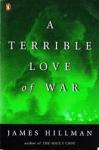 know I’ll be reading more Grennon and Howe in advance of their visits. James Hillman’s A Terrible Love of War awaits with its insights into our bellicose behavior. Julian Barnes Keeping An Eye Open was a Christmas gift that won’t be waiting long, as is Rahael Jerusalamy’s The Brotherhood of the Book Hunters. And I do aim to have Jane Kenyon’s A Hundred White Daffodils in the mind soon, long overdue to do. Sontag is also on the list.
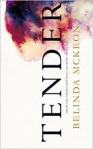 The treat I have been saving to start the year is Belinda McKeon’s Tender, though. So looking forward to it. I had wanted to read the copy that crossed the Atlantic for me as summer ended, but I started teaching a semester of Philosophy 101 and that had me reading other things. Lots and lots of other things (Helen Buss Mitchel’s textbook Roots of Wisdom is excellent). I’ll start reading the McKeon after I put down Patti Smith’s delightful M Train. I think it is time to go back to that now. Happy reading, everyone, and Happy New Year!
Tim Singleton
Co-chair, HoCoPoLitSo Board
Mana’s Musing: poetry for the good, the bad, and the scary

Laura Yoo – HoCoPoLitSo member of Board of Directors and Associate Professor of English at Howard Community College
Some say poetry is irrelevant. That it belongs in the ivory tower.
Listen to this:
Earlier this year, The New Yorker published an article called “Battle Lines: Want to understand the jihadis? Read their poetry” by Robyn Creswell and Bernard Haykel (June 2015). The article is a study of the function of poetry in Arabic cultural history as well as in contemporary jihadist poetry. The authors write that, “For the jihadist, poetry is a mode of manifesto, or of bearing witness.” Creswell and Haykel remind us of the important role of poetry in shaping and propagating a culture. But that influence can go in the direction of “good” or in the direction of violence and hatred.
Analysts have generally ignored these texts, as if poetry were a colorful but ultimately distracting by-product of jihad. But this is a mistake. It is impossible to understand jihadism—its objectives, its appeal for new recruits, and its durability—without examining its culture. This culture finds expression in a number of forms, including anthems and documentary videos, but poetry is its heart. And, unlike the videos of beheadings and burnings, which are made primarily for foreign consumption, poetry provides a window onto the movement talking to itself. It is in verse that militants most clearly articulate the fantasy life of jihad.
The article gives many examples of the prominent role that poetry is given by some militant jihadist leaders, but the most shocking one is this:
Bin Laden himself recited an elegy for the nineteen hijackers of 9/11: ‘Embracing death, the knights of glory found their rest. / They gripped the towers with hands of rage and ripped through them like a torrent.”
What we must recognize in all this is that poetry is not only a tool that helps us see the world in all its beauty, but is also a tool that can aid the world in its ugliness. Sure, some poems are about roses and rainbows, about love forever and love unrequited. And those are beautiful and absolutely necessary to our humanness. However, we must not assume for a second that poetry is fluffy or inconsequential. It is a powerful mirror for the human condition – the good, the bad, and the scary.
I am thinking of Martin Espada – a lawyer turned poet – and his poem, “Imagine the Angels of Bread.” He says, “This is the year” the meek will rise and the powerful will fall because justice will be served cold and raw on a silver platter. Well, no, he doesn’t say that – but that’s how I hear it. (And that’s how I heard it when Mr. Espada read this poem on the Smith Theatre stage at Howard Community College for the Blackbird Poetry Festival in 2013). In this poem, we sense the urgency for change. And we see how we might change the world for the better.
We also look to poetry to react to events that shock and frighten us. Like when Billy Collins‘ poem “Names” honoring the 9/11 victims broke our hearts – in a way, a powerful answer to Bin Laden’s elegy of the hijackers. But we also look to poetry to challenge our own thinking, like when E. Ethelbert Miller wrote “Looking for Omar” in reflection of 9/11 and the growing anti-Muslim feelings and actions in our country. We might do well to read this poem once more today.
In November this year, a group of terrorists bombed Paris. I saw many friends turn to poetry to understand fear, tragedy, violence, and hatred as well as peace, comfort, and compassion. One of the favorites circulating social media platforms was Wendell Barry‘s “Peace of Wild Things.” It begins, “When despair for the world grows in me” – and you just know you have to read the rest. In it, you find sadness but also hope.
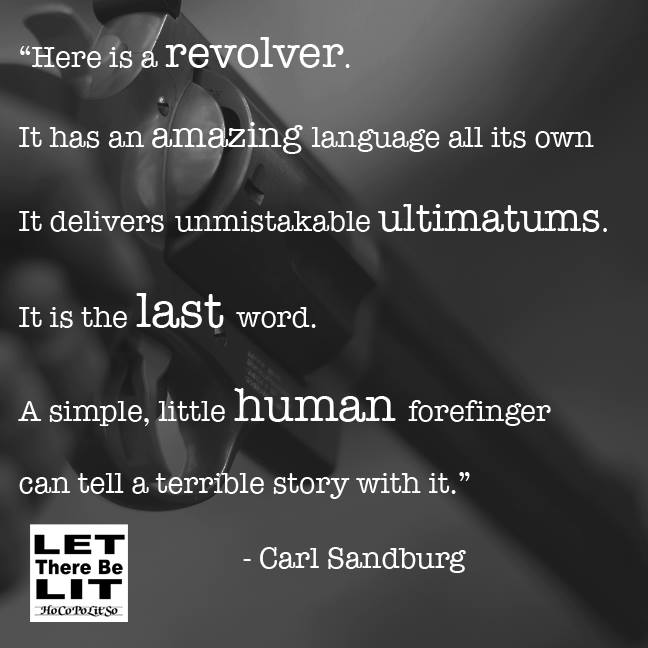 In January of 2013, a professor at University of Illinois discovered a poem by Carl Sandburg called “The Revolver.” It begins with “Here is a revolver,” and after comparing the revolver to the court of law, the poem ends with, “And nothing in human philosophy persists more strangely than the old belief that God is always on the side of those who have the most revolvers.”
The poem was discovered a few weeks after the Sandy Hook Elementary School shooting took place in Newtown, Connecticut (December 14, 2013). Now almost three years later, we again turn to this poem as we are angered and frightened by the two mass shootings in one day in Georgia and California on December 2nd.
In Claudia Rankin‘s Citizen (2014) we see the world through yet another lens.
Dean Rader of Huffington Post says, “Citizen has changed how we imagine a book of American poetry interacting with and commenting on the world we live in. It reminds us that the poet is first and foremost a citizen. It reminds us that American poetry can be both urgent and vital.” Holly Bass, writing for the New York Times, says, “Citizen throws a Molotov cocktail at the notion that a reduction of injustice is the same as freedom.”
As The New Yorker article on jihadist poetry reminds us, through poetry we can possibly know one another, about what propels our actions and shapes our beliefs. We must allow poetry to bring to light the violence and the injustices we commit against one another. We must recognize also the potential power of poetry – like many other forms of art – to comfort our sadness, calm our fears, expose our frailties, shape our vision, and even change our thinking.

Eamon Grennan to read at 38th Irish Evening of Music and Poetry
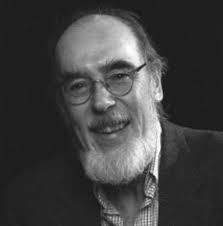 HoCoPoLitSo’s guest for its 38th Annual Irish Evening is the award-winning poet Eamon Grennan. He will read from his work starting at 7:30 p.m., February 19, 2016, at the Smith Theatre in the Horowitz Center for Visual and Performing Arts on the campus of Howard Community College. Grennan’s reading will be followed by Narrowbacks Eileen Korn Estes, Jesse Winch, Terence Winch, Linda Hickman, and Brendan Mulvihill on fiddle in a concert of traditional Irish music, with stepdancers from the Culkin School and Irish coffee and beer for sale in the lobby.
Starting with Wildly for Days in 1983, Grennan’s work has earned him much praise from the literary collective, including fellowships from the National Endowment for the Arts, the National Endowment for the Humanities, and the Guggenheim Foundation. Former U.S. Poet Laureate Billy Collins said of Grennan: “To read him is to be led on a walk through the natural world of clover and cricket and, most of all, light, and to face with an open heart the complexity of being human.”
Grennan has published more than twenty books of verse, along with translations and a collection of essays about modern Irish poetry; his latest is There Now (July 2015). His works have won the PEN Award for Poetry in Translation for Leopardi: Selected Poems (1997), the Lenore Marshall Poetry Prize from the Academy of American Poets for Still Life with Waterfall (2002), and Pushcart Prizes. His collection Out of Breath (2007) was nominated for the 2008 Poetry Now Award and he was a finalist for both the LA Times Book Prize for What Light There Is and Other Poems (1989) and So It Goes (1995) for the Paterson Poetry Prize.
Grennan follows other luminary Irish authors who have come to Howard County, including Frank McCourt, Eavan Boland, Hugo Hamilton, Paula Meehan, Colm Tóibín, Anne Enright, Colum McCann, and Emma Donoghue, to name a few. For 38 years, HoCoPoLitSo’s Irish Evening has recognized and celebrated the enormous impact of Irish-born writers on the world of contemporary literature.
General admission tickets are $35 each; available on-line at http://www.brownpapertickets.com/event/2465863 or by sending a check payable and self-addressed envelope mailed to HoCoPoLitSo, 10901 Little Patuxent Parkway, Horowitz Center 200, Columbia, MD 21044.

Creative Writing 101 with Tara Hart
Writing is a discipline and it takes discipline to write.
So how does one learn and practice to become a writer? What’s more, how does one teach others to become writers?
In the next few months, you will hear from those who teach creative writing. Consider this your mini, free Creative Writing 101.

Tara Hart, Co-Chair of HoCoPoLitSo Board of Directors and Professor of English at Howard Community College
We kick off this series with Dr. Tara. Hart. Tara is one of two Co-Chairs of HoCoPoLitSo. In addition to being a community advocate for poetry and literature, she is a scholar, a poet, and a teacher. Listen to Tara read her poem “Pine” published in TriQuarterly. She teaches poetry and creative writing at Howard Community College. Here’s what she had to share with us.
LY: How would you describe – to someone brand new to teaching creative writing – your approach to teaching creative writing?
TH: I’ve realized over the years that the greatest challenges students face in their creative writing are getting it done on time and overcoming a sense of vulnerability, and that realization has significantly impacted my course design. I set up the grade distribution to reflect the fact that in the professional world of creative writing, you might have tremendous freedom in your assignments but you must hit your marks. Students might struggle to produce creative work by a certain deadline because they haven’t consciously made time or created the right environment for their creative process and habits, or because they fear the judgment that follows sharing their work, which can be very personal. So one of our first assignments is to create an action plan that anticipates difficulties, and every assignment they do receives full credit/points if it meets the required length and deadline and is on topic; I don’t “grade” individual pieces of creative work a la A, B, C, D, F.
This design motivates them to meet their deadlines and push forward even when it’s not perfect or even close. Their final portfolio of work, containing their best pieces and a reflective essay on their own strengths and goals for improvement, is graded at the end of the semester, but it’s now a much lower percentage of their overall grade, and it’s quite remarkable how the “best” writers very often do end up with the highest grades, even though the vast majority of the final grade is really about completing work on time. It affirms my idea that strengthening the habit of writing consistently and pushing through fear to meet the challenges of writing in unfamiliar genres and on a variety of topics produces, ultimately, better quality writing.
I heard a “Moth” storyteller on NPR say that a turning point in her life when she decided to “stop being a writer” and decided to “actually write.” I think my class, with its emphasis on production and feedback, distinguishes those students who are compelled to write and to develop the habits and discipline of a writer, from those who just like the idea of writing and might otherwise use the excuse that the instructor doesn’t “like” their writing – if they don’t do well in the class, it’s because they simply didn’t produce and engage.
LY: What is the most challenging thing to teach in creative writing?
TH: I have struggled most and improved most in the area of designing valuable peer review experiences in which students consistently give, receive and respond to each other’s feedback. Peer review skills are important in composition as well, but it’s harder, in a different way, for students to critique someone’s personal memoir than an expository essay. When I gave creative writing students choices in terms of whom to review, the same strong writers would get the most feedback and others would be neglected. Now I deliver the course most often as a hybrid, so that the Canvas learning platform becomes the “workshopping” portion of the course, and I use its automatic peer review feature to make sure everyone receives equal amounts of attention.
I’ve also worked hard to teach them how to work effectively within a writing community. I give very specific guidance and requirements about how to review each other’s work, using the model of What Works? What Doesn’t Work? and What If? , and as they explicitly improve in the quality of their feedback they implicitly improve their own writing because their self-editing skills are inevitably sharpened. I have learned to come in with my comments at the end of a unit, such as writing to them about patterns and possibilities I see in their fiction or in their poetry after they’ve worked a while with that genre – this gets them in the habit of listening to each other first and for quite a while without waiting for or deferring to the “real” critique from the professor.
Students might say that the most challenging/scary part of the course is reading their work aloud, which I’ve required to greater degrees over the years. I want them to learn more about the rhythm and music of their words. Also, the literary readings we do together, in which each student gets on the stage of Monteabaro Hall and reads for two minutes, make the students feel closer to each other, often increase their self-confidence in their writing, and illustrate the power of a supportive writing community.
LY: You are a poet. What’s the best suggestion/tip/teaching that you received from your own creative writing teachers?
TH: I didn’t study towards an MFA but trained in criticism, so my best creative writing teachers have been the master poets and writers I’m fortunate to read and meet and listen to as they are interviewed about their process for The Writing Life or present in venues here on campus or at the Dodge Poetry Festival every other year. I tell and require my students to READ, and to “read like writers,” which an astonishing number do not do extensively or widely. I ask those who do not read often, “Who, then, do you think is going to read your work?”
Billy Collins has had the greatest impact on my own writing when he teaches that readers don’t really want to hear about the writer’s thoughts and feelings but are looking to find themselves in what they read; that readers need to be oriented in concrete, specific ways before you launch them into abstraction or profundity; and that as writers we need to stop hiding behind vagary or ego. I’m better at spotting the difference between self-indulgent “bravery” (in which facts and feelings are wielded as weapons) and the tender commitment to offering truth.
LY: What is the most common advice/suggestion/tip you find yourself giving to your students?
TH: Show, don’t tell! Let the reader “be there” through the use of sensory details, rather than summarizing or explaining the experience for them. I’m also (in)famous for crossing out lots of text. I can do lots of slashing because I’ve already given them full credit for doing their work – I’m free to tell them how unnecessary lots of it is. Student writers tend to over-explain and interrupt their own compelling action or images with redundant “telling” of what we’re already inferring and feeling.
Mana’s Musing: Lost and Gained in Translation
Laura Yoo – HoCoPoLitSo member of Board of Directors and Associate Professor of English at Howard Community College
While writing the last musing on “Multiple Writing Personalities” I began to pull at another thread – the art of translations.
There are many words that are not really translatable from Korean to English, and this is the case for many (if not all) languages. One example is the Korean word 한 (pronounced “hahn” and sort of means grievance) which comes from 원한 (pronounced “won-hahn” and sort of means grudge). Usually this word is used to describe the kind of deep grievance or regret that awakens a dead person’s body and spirit. Like Jason in Friday the 13th or the scary girls in The Ring or Grudge. But none of these words – hatred, resentment, grievance, regret – captures quite wholly the meaning that Koreans put in that word when they use it.
Language is cultural. Words communicate values, beliefs, cultural experiences, and history. Sometimes a single one-syllable word like 한 means a whole lot. This complexity is what makes a translation – especially a poetic translation – a work of art.
When Ko Un, one of the most well known Korean poets, read at the Dodge Poetry Festival in 2006, Richard Silberg performed the translation.
While Silberg’s translations communicate the idea of the poem, I think most would agree that it doesn’t transfer the whole meaning that is communicated in Ko Un’s reading – the audience can sense or experience the poem in the way Ko Un performs his poem that’s quite different from the way Silberg translates and performs it in English.
There is also an interesting translation of one of Ko Un’s poems by Suji Kwok Kim and Sunja Kim Kwok on Poetry Foundation’s website.
Taklamakan Desert by Ko UnWhy I’m going to the Taklamakan Desert:the emptiness there.Why I’m going to the Taklamakan Desertat seventy-five, leaving all words behind: the cryof the emptiness there.Why I’m going to the Taklamakan Desert:I can no longer standthe world’s greedor mine.There, in the Taklamakan Desert,the silence of a thousand-year-old skull.
Here is an excerpt from the translators’ notes.
With “Taklamakan Desert,” we tried to “translate” the translation towards greater spareness. […] We translated “명사도 동사도 다” (“all nouns and verbs”) as “all words,” which sounds less awkward in English, and decided not to isolate “there” (“거기”) on its own line, the way it’s isolated in the original, since it would sound overemphatic in English, especially as an ending. We added “in the Taklamakan Desert” in the penultimate line, for music, and “the silence of” in the last line, for rhythm, so that the last line becomes a line of iambic pentameter, a structural counterpoint to “the cry” in the second stanza, but only because silence is central to Ko Un’s work. (We could have rendered the last two lines more literally: “There —/ someone’s thousand-year-old skull.” — and again, may change our minds tomorrow.)
I highlight the last line above, because it shows the delicate choices one must make in translation – there is no such thing as “direct” translation, and we can see here the flexibility and creativity required in creating a work of translation.
In addition to the meaning of words, much of the art of translation has to do with the sound of words (and silences) – the intonation, the vowels, the consonants, the accents, the shapes that your mouth makes, and the way the tongue rolls to create sound. In the line “명사도 동사도 다” (“all nouns and verbs”), the Korean words for “nouns” and “verbs” rhyme: Phonetically, this line reads, “myung-sa-do dong-sa-do dah” (“do”=”too” or “and” and “dah”=”all”). So, there is a rhyme in “sa-do.” I wonder if it’s that difference in sound or the specificity of naming “verbs and nouns” instead of grouping them as “all words,” but the translation doesn’t quite… translate for me.
Still, I do not mean to argue that this translation is bad or that translations in general are inaccurate. Not at all. Ultimately, poetry translations are never about accuracy. It’s about telling and re-telling, creating and re-creating. Through the translators’ works, we share the words, the values, the thoughts, the stories, and the languages of all cultures. Works of translation open up poetry to interpretation, re-imagination, and even re-vision.
Translation itself is a work of art. It has its own creative process. It is original in its own sense of coming into creation.
Here are a few lines from Willis Barnstone’s “An ABC of Translating Poetry”:
Translation is the art of revelation.
Translation is an art between tongues, and the child born of the art lives forever between home and alien city.
Yet translation of poetry is conceivable.
A translation is never an exact copy. It is different.
A translation dwells in exile.
And so on. But “Z” is the best:
Good translation of poetry is essential to a hungry reader in a decent book store and to a global village of letters. We need it, for we still suffer under that early Babylonian God’s edict of language dispersal. Although Antigone and Lear sometimes speak in exotic tongues, subverting God’s rage against the monolingual builders of Babel writers still scrawl their words in a thousand scripts, pile them up on mounds of hope and futurity, awaiting translation. Translation is a zoo and a heavenly zion.
I love the phrase “a global village of letters.” That’s what the art of translation offers the world.
Last summer when a relative was returning from a trip to Korea, she brought back a few collections of Ko Un’s works for me. I thumbed the pages but found many of the poems too difficult for my comprehension – so my mother took the books. Having thought a little bit about translations through this little musing, though, I’m now processing my order on Amazon for several Ko Un translations by people like Richard Silberg, Brother Anthony, and Claire You – This Side of Time (2012) and Maninbo (2015).
Though my knowledge of the written Korean language is limited, having access to some of the poems in Korean and some in English (and maybe a few in both?) will give me a unique experience of Ko Un the Poet. Not necessarily fuller or more expansive experience – just different. Not only that, but it will also help me – a 1.5 generation Korean-American – become more familiar with Korean culture and history. And that is pretty awesome. Thank you, translators, for your word-art.
Mom, I need those books back please.
=========================================
“Taklamakan Desert” in Korean
타클라마칸 사막
내가 타클라마칸 사막에 가는 것은
내가 열 여섯살의 꿈속에서
타클라마칸 사막에 가는것은
거기
허허 망망 때문이다
내가 일흔다섯에 살의 대낮에
명사도 동사도 다 두고
타클라마칸 사막에 가는 것은
거기
무지무지한
허허 망망의 울음 때문이다.
내가
타클라마칸 사막에 가고 가는 것은
세상의 욕망에
내 욕망에
더 이상 견딜 수 없기 때문이다.
누구의 천년 해골
거기
Expectations for “A Technicolor Life”, on Stage at Smith Theatre
Susan Hobby is a member of the HoCoPoLitSo board. Look for her Lit Up column here on the HoCoPoLitSo blog.
A play about three generations of stress in one household sounds like a downer: a divorced workaholic mother; two sisters, one shy and slightly chubby, one an embittered vet who lost her left hand in Irag; plus a grandmother dying of cancer.
So what are Marilyn Monroe and Jane Russell doing up on stage vamping while the ladies toss back wine coolers and wear neon wigs?
I’m eager to find out. Rep Stage is producing the world premiere of Technicolor Life, by Jami Brandli, that centers around this mainly female family. Maxine, a slightly awkward freshman in high school, just wants to help her sister, Billie, who returned from Iraq with no left hand, plus the psychic wounds that come from combat and military sexual assault.
Maxine’s mother is an overworked attorney who drinks a bit too much, whose husband left her for a younger woman a few years ago. And Franny, Maxine’s grandmother, shows up afte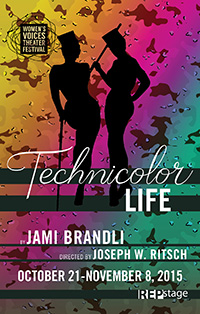 r being kicked out of the assisted living facility where she had been living. Turns out, she’s dying of cancer. But she’s also a live wire who insists the family do things together before she kicks off.
So they watch old movies — especially Gentlemen Prefer Blondes — and work makeover miracles. Billie’s not having it; she runs 10 miles a day and slurps from her “water” bottle of vodka to kill the pain. Maxine, with the help of her new imaginary Blonde friends, finds Billie a fellow vet to date, and finds her voice. Meanwhile, Franny is arranging her euthanasia with Canadian drugs and her going-away party. Throughout, high school student Maxine practices her vocabulary words (serendipity, debonair, unique) and does reports for school on amputation, assisted suicide and turret gunners. Doesn’t sound like a barrel of laughs, but the play reads tragic comedy. Things do get better.
The play captures the awkward efforts of Maxine, the rage of post-traumatic stress syndrome, the yearning for connection between family members.
An ingenious part of the text — since I haven’t seen Technicolor Life staged, I have to imagine it — is the “playing field,” a real space onstage that illustrates the imagination. The playing field becomes a dance floor, a makeover space, Iraqi combat reenactments and even Internet dating site brought to life.
Part of the Horowitz Center’s “Year of the Woman,” Technicolor Life runs Oct. 21 to Nov. 8 in Rep Stage. For tickets visit www.repstage.org.

Mana’s Musing: Multiple Writing Personalities
Laura Yoo, a member of HoCoPoLitSo’s Board of Directors and Associate Professor of English at Howard Community College, writes Mana’s Musings on the HoCoPoLitSo blog.
Even though I teach writing, I cannot really remember or trace the early years of my own journey of learning to write.
Thanks to my mother’s foresight and my own tendency to hold onto things, however, I do have two special artifacts from my childhood – photos below.
First is a report on Beethoven that I wrote in the 5th grade, only a few months after my family moved from Korea and I began to learn English. This is my first “writing” in English that I can find. Mostly, it seems, I copied sentences from the Britannica. And that was “writing.”
Second is a newspaper article that I wrote in the 5th grade to a Korean Catholic newspaper about my observations on adoption. In that article, I express sadness about Korean children who are adopted by families in other countries and I urge Koreans to adopt Korean children. An impassioned argument and plea from a 10 year old.
During my teenage years, I wrote a lot. Flipping through the many spiral notebooks that were my journals reveals that I wrote my “diaries” in English (even through the early years of my language acquisition) but insisted on writing my “poems” in Korean. In English, my writing was about what I did that day, what I saw, what happened to so-and-so, or what I was thinking. In Korean, on the other hand, my writing demonstrates an annoyingly dramatic teenage-angst in what appears to be verse. I can’t help but to roll my eyes at my 14 year old self. It seems that my young mind associated English with recording facts (information) and Korean with describing love, pain, betrayal, suffering, drama, and dreams in poetry.
Later on in college, the notebooks got fancier and I wrote exclusively in English – and I stopped writing poems. Probably realized how terrible they were. There was also a vague attempt at fiction-writing but I quickly learned that I was no good at it. So, instead of trying to create literature, I studied it.
The evidence of various transitions between Korean and English in my writings makes me wonder not only about my cultural identities but also my relationship to writing. You are what you write – and I guess how you write.
A recent article in The New Republic called “Multilinguals Have Multiple Personalities” cites studies that illustrate a personality difference exhibited by one person speaking in two different languages. The article summarizes one particular study:
In one session, the volunteer and experimenter spoke only French, while the other session was conducted entirely in English. […] When [Susan Ervin] compared the two sets of stories, she identified some significant topical differences. The English stories more often featured female achievement, physical aggression, verbal aggression toward parents, and attempts to escape blame, while the French stories were more likely to include domination by elders, guilt, and verbal aggression toward peers.
I find myself experiencing this kind of shift in my identity when I switch “code” between English and Korean in my day to day life. In speech, I communicate not just the words or the “thing” that I’m trying to get across but also the cultural mores, the values, the manners, and the habits deeply rooted in that language. And I dare say the language also shapes human beliefs and behaviors.
Sadly, I don’t know if the same kind of code switching applies to my writing now – mainly because I don’t write in Korean anymore. So, it seems I have lost my Korean writing personality. Or even more sadly, perhaps this means my Korean writing personality will stay trapped in that 14 year old teenager ridden with angst. Scary thought.
Two TWL Episodes Now On YouTube: Rita Dove and Israeli Poems of War and Peace
Rita Dove discusses a musical life in verse
In this edition of HoCoPoLitSo’s The Writing Life, Rita Dove, a Pulitzer Prize-winner and former National Poet Laureate, speaks with Maryland Poet Laureate Stanley Plumly about her latest book, Sonata Mulattico. The book tells the story, through multiple narrative poems in different voices, of George Bridgetower, an Afro-Polish child prodigy violinist who studied with Haydn. Beethoven dedicated a sonata to Bridgetower, “my crazy mulatto,” but later quarreled with him over a girl, and shunned him. Bridgetower fell into anonymity. The book is long and complex, Dove says, but “This is the only way to encompass this life and make it seem not a curiosity, but an essence of humanity.”
Israeli Poems of War and Peace
In this edition of HoCoPoLitSo’s The Writing Life, poet and professor Michael Collier talks with poets Moshe Dor and Barbara Goldberg about their 1997 book of Israeli poems and translations, After the First Rain: Israeli Poems on War and Peace. Goldberg reads her translation of Ariel Kaufman’s “How My Brother is Cain,” and Dor reads the Hebrew version. Goldberg reads six more poems from the collection, including Amir Gilboa’s “My Brother Was Silent,” with the final, haunting line, drawn from the book of Genesis, “His blood cried out from the ground.” Goldberg concludes with a poem that sums up the Israeli desire for a long-coveted peace, Yehuda Amichai’s “Wildpeace.” This program was recorded in 1999.
 HoCoPoLitSo