



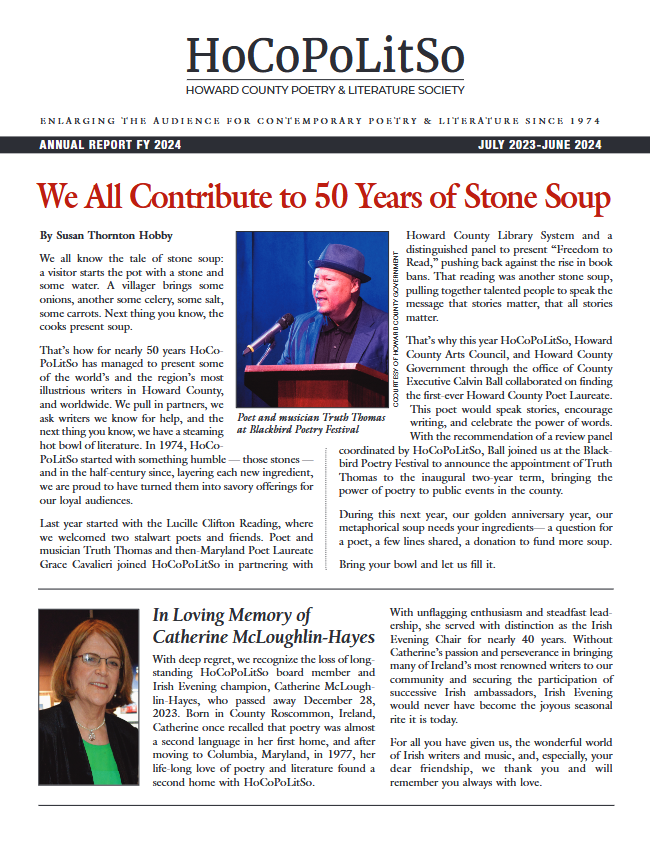
Read Our Annual Report
The Poetics of Place: an Afternoon with Jane Delury & Steven Leyva

Next week, on Tuesday, April 8th, 4:00–5:45 p.m., HoCoPoLitSo joins Howard Community College’s Department of Humanities and the Office of Student Life in welcoming authors Jane Delury and former HoCoPoLitSo writer-in-residence Steven Leyva to the college campus for an afternoon reading, discussion and Q&A, offered free to the public. We hope you will join us in the Horowitz Center’s Monteabaro Recital Hall, and in its lobby afterward for a reception with light refreshments, and book sales and signing provided by HoCoPoLitSo of the authors’ newest works, Hedge by Jane Delury and The Opposite of Cruelty by Steven Leyva.

Wilde Readers of April: Nishi Chawla & Jennifer Keith
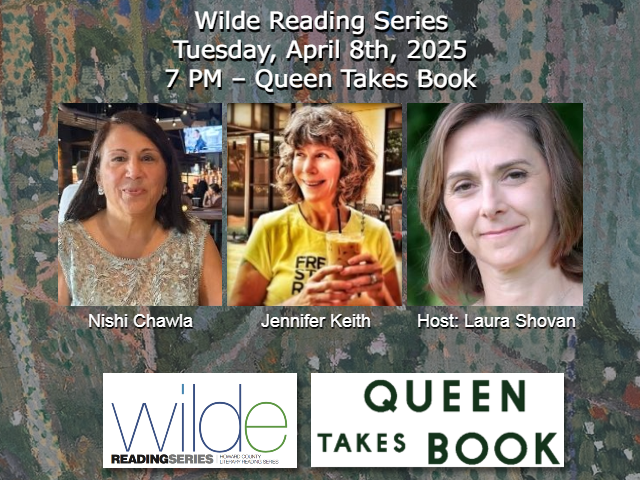
HoCoPoLitSo welcomes all to the April edition of the Wilde Reading Series, with Nishi Chawla and Jennifer Keith, hosted by Laura Shovan. Please join us at independent bookstore Queen Takes Book on Tuesday, March 11th at 7 p.m., at 6955 Oakland Mills Rd, Suite E, Columbia MD, 21045. Please spread the word— bring your friends, family and students! Light refreshments will be served and books by the readers available for sale.
An open mic follows the featured authors and we encourage you to participate. Please prepare no more than five minutes of performance time, about two poems. Sign up when you arrive, or in advance via this online form.
Below, get to know Nishi and Jenny!
Who is the person in your life (past or present) that shows up most often in your writing?
Nishi: No single person lingers in my writing, yet traces of many pass through its pages. Faces blur, voices merge, and memory bends into something else – something both familiar and unclaimed. My characters are not reflections but echoes, shaped by moments, by absences, by the weight of untold stories. If anyone appears, it is only in fragments, never whole, never fully known.
Jenny: I don’t want to embarrass them.
Where is your favorite place to write?
Nishi: For me, the act of writing is less about a fixed location and more about the atmosphere it creates, an intangible space where thought deepens and language takes shape. I find myself drawn to places that allow reflection and immersion, where the world hums in the background without overwhelming the silence I need. Sometimes, it’s a quiet study, lined with books whose spines hold centuries of voices. Other times, it’s a window seat with a view – watching the shifting light, the slow dance of trees, or the distant rhythm of life unfolding outside. And then, there are moments when movement itself fuels the writing: a train rushing past blurred landscapes, the steady motion mirroring the flow of words, stories forming like fleeting impressions on a rain-streaked window. My writing space is not defined by walls, but by a feeling, a sense of being both grounded and aloft, where ideas can unfold freely.
For me, writing is also a deeply personal act, untethered from ritual or setting. I can even write in bed, words slipping between wakefulness and dreams, taking shape in the soft hush of late hours or the first light of morning.
Jenny: My beautiful studio. Having a special place for writing is a real luxury.
Do you have any consistent pre-writing rituals?
Nishi: I wouldn’t say I have rigid pre-writing rituals, but there are rhythms, quiet gestures, that help ease me into the act of writing. Sometimes, it begins with a moment of stillness – just sitting, allowing thoughts to settle, waiting for the right thread to emerge. Other times, it’s about movement, a slow walk to let ideas breathe before they take shape on the page.
Reading something – perhaps a poem, a passage from a novel, or even an old notebook filled with half-formed ideas, often sparks a certain energy, nudging me toward the right words. A warm cup of tea, the ritual of holding it, sipping it slowly, can create a bridge between the ordinary and the creative.
And then there is the silence – necessary, but not always literal. Sometimes, it’s the hush of early morning or late night. Other times, it’s the gentle hum of instrumental music, something that doesn’t intrude but instead opens up space within the mind.
But not all writing arrives with ritual. There are days when words come unbidden, unexpected, without ceremony. And those moments are just as welcome.
Jenny: Tea. Lots of tea.
Who always gets a first read?
Nishi: It’s a bit of a moving target, really. Sometimes, the first reader is no one but myself – my eyes tracing over every word, reading and rereading, letting the work breathe before I decide to share it. But when I do share, it’s with someone I trust implicitly, someone who understands the delicate balance of offering both honesty and empathy. It could be a fellow writer, a friend who knows my voice well, or even someone who isn’t a writer at all but has a sharp, perceptive eye. The first read is always an intimate moment, a quiet exchange between the work and those who help shape its journey. It depends on what I’m writing. Sometimes, a piece feels too raw, too close, to share with anyone right away. Mostly, the first reader is just myself – stepping away and returning, letting the work reveal its own flaws and strengths before I decide it’s ready for another set of eyes.
Jenny: My husband, Chris Ciattei, AKA Batworth.
What is a book you’ve read more than twice (and would read again)?
Nishi: There are a few books I’ve returned to time and again, but one that stands out is The Master and Margarita by Mikhail Bulgakov. The layers of surrealism, satire, and spirituality never seem to lose their intrigue. Each time I read it, I find new meanings, new connections, as if the book itself evolves with me. It’s a rare story that can be revisited without ever feeling stale. It pulls me in, like a labyrinth I never quite finish exploring.
Jenny: Alcoholics Anonymous, fourth edition.
What is the most memorable reading you have attended?
Nishi: There have been many readings that have stayed with me, but the most memorable ones are those where the words didn’t just exist on the page but came alive in the air, charged with presence and emotion. It wasn’t always about the fame of the writer or the grandeur of the venue. Sometimes, it was the intimacy of a quiet room where a poet’s voice trembled with unspoken history, or a storyteller wove a world so vividly that the audience forgot to breathe.
Perhaps it was a reading where the language carried weight beyond the words themselves – where literature met lived experience, and something unnameable passed between speaker and listener. The most memorable readings, for me, are those where words linger long after the event is over, reshaping thoughts, leaving echoes that refuse to fade.
Jenny: SO many: Anthony Hecht in Georgetown, D.C., December 1996. 1998 Best of Baltimore at Pikesville Bibelot. HOT L reading in Philadelphia at AWP in 2022. Any time Joe Harrison read. (RIP)
• Dr. Nishi Chawla is a well-known Asian-American poet, playwright, novelist, independent filmmaker and a long-standing academician. She has published two novels, seven volumes of poetry and ten plays. She has co-edited two global volumes of poetry for Penguin Random House. She holds a Ph.D. in English from the George Washington University, Washington DC, and a post-doctorate from Johns Hopkins University. She has also written and directed four arthouse feature films, three of which are now streaming on Amazon Prime. She can be found online at nishichawla.com.
• Jennifer Keith‘s poems have appeared in The Free State Review, Fledgling Rag, The Baltimore Review, Best American Poetry 2015, Able Muse, and elsewhere. Keith received the 2014 John Elsberg poetry prize, and was a finalist in the 2021 Erskine J. Poetry Prize from Smartish Pace. Her first full-length book of poems, Terminarch, was chosen by David Yezzi for the 2023 Able Muse Book Award. She lives in Baltimore, Maryland. Her home page can be found at jenniferkeithwriter.com, now under development.

HoCoPoLitSo Offers Opportunities for Young Writers; Deadlines in March, April

(Photo credit: Stephen Cherry)
Howard County Poetry & Literature Society, HoCoPoLitSo, this year celebrates its 50th anniversary of presenting writers— from the internationally renowned to emerging locals— here in Howard County to audiences of all ages and backgrounds. The first step toward that achievement began on November 19th, 1974, when poets Lucille Clifton and Carolyn Kizer read from their work to students at Wilde Lake High School, and in the incredible half-century since that day, of all the many services HoCoPoLitSo is privileged to provide the community, we remain perhaps most proud of our student and youth-focused programming and close partnerships with local schools, including Howard County Public School System and Howard Community College.
In addition to welcoming student attendees at all events, HoCoPoLitSo each year provides for an active professional writer to take part in a residency in Howard County, visiting students for readings and workshops in their classrooms. More than 30 authors of diverse backgrounds have taken part in what is today the Bauder Writer-in-Residence Program; after a recent visit by Tope Folarin, the current resident, one student said:
About a third of the way into his speech, all I could think was ‘man, what an absolute badass.’ That guy was awesome, I’m super proud to have gotten to hear from someone like him. [Tope’s] statement of ‘I’ve got to open this door or die trying’ is exactly the kind of drive people need in life, and seeing someone who had a life full of that idea is absolutely amazing. It’s an aspect everyone needs in life, without a doubt. I wish we got to have more people giving talks like that at school [. . .] I hope he keeps on going like this.
To further encourage young writers, HoCoPoLitSo annually presents awards to student honorees of—
All-County Writing Competition — due March 31, 2025
Since 1981, HoCoPoLitSo hosts this annual writing contest open to current Howard County high school students, accepting entries across four categories: poetry, personal essay, short story, and short play. Students submit their own work; there is no entry fee, and students may enter in as many categories as they wish.
Submissions are open NOW, and close on March 31, 2025.
Promise & Achievement in Language Arts — due April 15, 2025
Through this annual partnership between HoCoPoLitSo and Howard County Public School System, English department Instructional Team Leaders nominate students at their schools to receive award. If you are a county educator who has not received communication on how to nominate students, please contact info@hocopolitso.org or 443-518-4568.
Nominations are open NOW, and close on April 15, 2025.
The students selected for awards receive personally-selected books tailored to their literary interests, presented by HoCoPoLitSo board members or affiliates at each school’s summer award and graduation ceremonies. A full list of the past year’s honorees is available in the HoCoPoLitSo Annual Report. In an interview with Business Monthly in 2024, Miriam Roy, a student recipient of award for Promise & Achievement in Language Arts then at Long Reach High School, said:
It was a lovely surprise to receive an award for my love of literature. I have always enjoyed reading literature and writing poetry since the beginning of middle school so receiving the award was a wonderful experience.
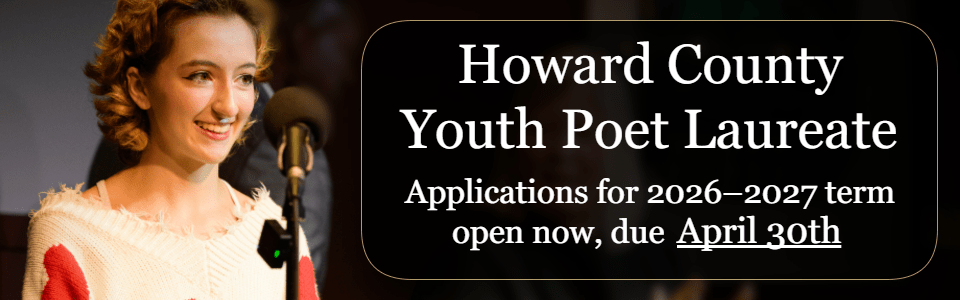
More recently, starting in fall of 2023, HoCoPoLitSo has partnered with Howard County Arts Council and Howard County Government through the office of County Executive Calvin Ball, to implement the first-ever offices of Howard County Poet Laureate and Youth Poet Laureate. Following the appointment of Mai-Anh Nguyen, then a student at Oakland Mills High School, as the inaugural Howard County Youth Poet Laureate, applications are now open for the second term of this one-year honorary position:
Howard County Youth Poet Laureate — due May 9, 2025
The role of Howard County Youth Poet Laureate is an honorary position formally appointed by the County Executive at the recommendation of a review panel coordinated by HoCoPoLitSo. Candidates submit their own application, with supporting recommendations; eligible candidates are aged 14–21, and either reside in or will be able to present at in-person events in Howard County throughout the one-year term. The next Youth Poet Laureate will serve from September 2025 to July 2026, and receives an honorarium of $500.
Applications are open NOW, and close on May 9, 2025.
The current Howard County Youth Poet Laureate, Mai-Anh Nguyen, will read at HoCoPoLitSo’s Wilde Reading Series in June.
The deadline for the 2025–2026 Youth Poet Laureate term applications has been extended to Friday, May 9th, at 11:59 p.m.
Poetry in Motion — 17th Annual Blackbird Poetry Festival
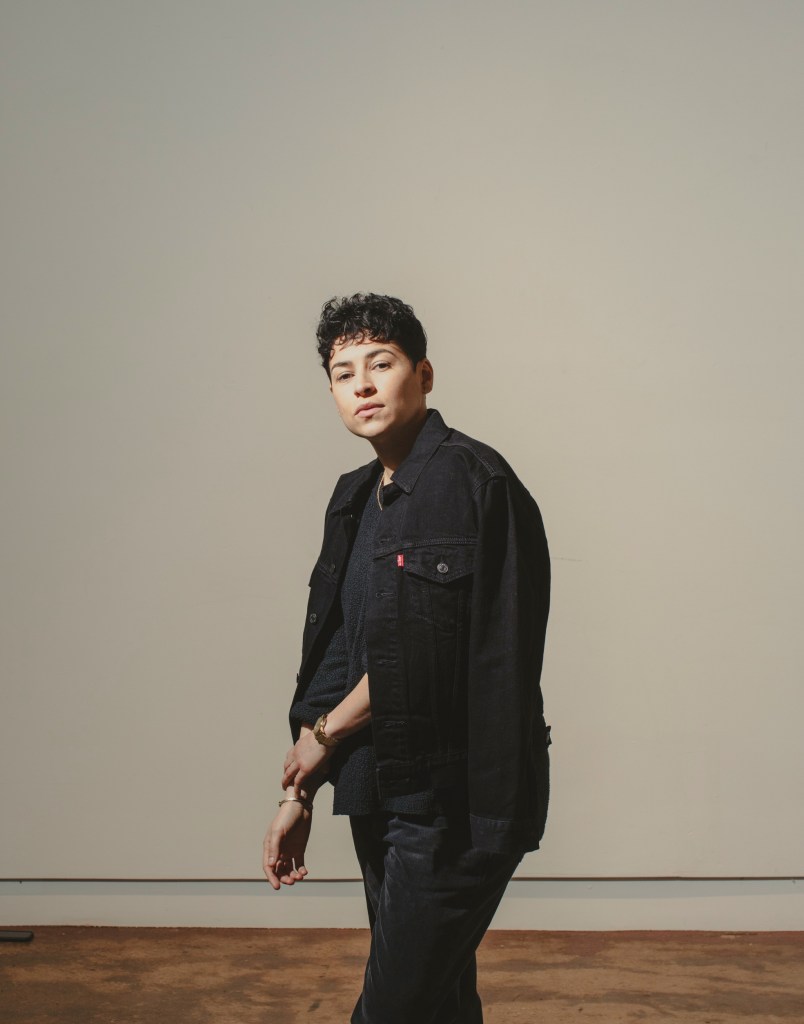
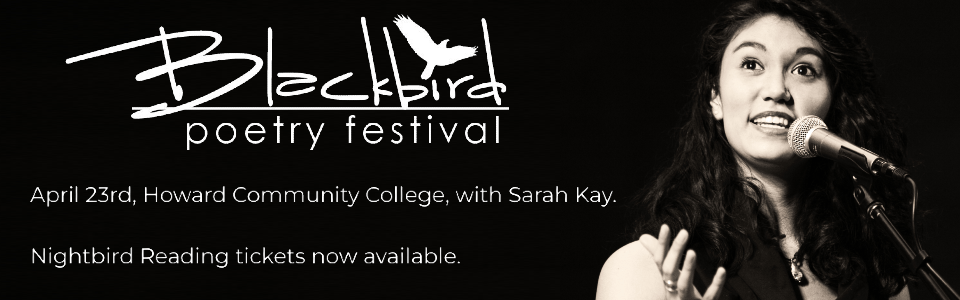
Denice Frohman headlines the Blackbird Poetry Festival to be held on April 24th, 2025, at Howard Community College (HCC). Now in its 17th consecutive year, the festival is a day devoted to verse, presented in partnership between HoCoPoLitSo and HCC’s Departments of Student Life and Humanities/World Languages, including a student workshop, multiple poetry readings, HCC’s poetry patrol, a recording session of HoCoPoLitSo’s writer-to-writer talk show The Writing Life, a reading from the Howard County Poet Laureate Truth Thomas, and much more.
The event starts moving at the 11 a.m. Morning Songs Writing Workshop in the Kittleman Room of Duncan Hall (DH-100), hosted by HoCoPoLitSo’s current Bauder Writer-in-Residence, Tope Folarin. The 2 p.m. Sunbird Reading features a reading by guest artist Denice Frohman, followed by a poetry open mic for local authors of all ages. Attendance is free and open to the public, while seating lasts; current HCC students may find college registration links on the college event page.
Finally, the festival culminates its daylong celebration of poetry with the Nightbird Reading, in the Rouse Company Foundation Student Services Hall top floor suite (RCF-400): seating starts at 6:30 p.m. for the 7 p.m. performance. Nightbird will feature Denice Frohman; Tope Folarin; and Truth Thomas, with a reception, book sale and signing to follow the reading. Nightbird this year is offered free to the public, but we ask that guests planning to attend RSVP in advance to ensure adequate seating is available.
Free general admission seating can be reserved at https://blackbird2025.eventbrite.com. If you require additional accommodations, or for questions or comment, please reach us at info@hocopolitso.org or by phone call to (443) 518-4568.

• Denice Frohman (@DeniceFrohman) is a poet and performer from New York City. She has received support from The Pew Center for the Arts, Baldwin for the Arts, CantoMundo, Headlands Center for the Arts, the National Association of Latino Arts and Cultures and the National Endowment for the Arts.
Her work has appeared in The New York Times, Poem-A-Day (The Academic of American Poets), The BreakBeat Poets: LatiNext, Nepantla: An Anthology for Queer Poets of Color and elsewhere. A former Women of the World Poetry Slam Champion, she has featured on hundreds of stages from The Apollo to the White House. Currently, she is developing her one-woman show, Esto No Tiene Nombre, which centers the oral histories of Latina lesbian elders.
• Tope Folarin is a Nigerian-American writer based in Washington, D.C., now serving as HoCoPoLitSo’s 2024–2025 academic year Bauder Writer-in-Residence. He also serves as Director of the Institute for Policy Studies and the Lannan Visiting Lecturer in Creative Writing at Georgetown University. He is the recipient of the Caine Prize for African Writing, the Whiting Award for Fiction, and a fellowship from the National Endowment for the Arts, among other awards. Tope was educated at Morehouse College and the University of Oxford, where he earned two Masters’ degrees as a Rhodes Scholar.
His reviews, essays, and cultural criticism have been featured in The Atlantic, The Baffler, BBC News, The Drift, High Country News, Lithub, Los Angeles Review of Books, The Nation, The New Republic, The New York Times Book Review, Vulture, The Washington Post, and elsewhere. His debut novel, A Particular Kind of Black Man, was published by Simon & Schuster.
The Howard County Poetry & Literature Society— HoCoPoLitSo— this year celebrates 50 joyous years of nurturing love for the diversity of contemporary literary arts in Howard County. The society sponsors numerous literary readings throughout the year; administers the Bauder Writer-in-Residence program providing for a current working author to visit Howard County students in their classrooms; produces The Writing Life talk show, now seen by more than a million viewers; and partners with many other cultural arts organizations to support the arts in Howard County, Maryland, and beyond. More information is available here at hocopolitso.org, and the tax-deductible gifts of individual donors are always welcomed, and crucial to sustaining another 50 years to come.
HoCoPoLitSo is a 501(c)(3) nonprofit organization and receives funding from Howard County Government; Howard County and Maryland State Arts Councils; Community Foundation of Howard County; Maryland Humanities; Alpha Foundation of Howard County; Dr. Lillian Bauder; and generous friends of HoCoPoLitSo. The Howard County Poet Laureate and Youth Poet Laureate programs are administered in partnership between HoCoPoLitSo, Howard County Arts Council, and the Office of the Howard County Executive. Proceeds support live and recorded literary programs produced by HoCoPoLitSo for student and general audiences.


Wilde Readers of March: Ashley Elizabeth & Sue Ellen Thompson

HoCoPoLitSo welcomes all to the March edition of the Wilde Reading Series, with Ashley Elizabeth and Sue Ellen Thompson, hosted by Jared Smith. Please join us at independent bookstore Queen Takes Book on Tuesday, March 11th at 7 p.m., at 6955 Oakland Mills Rd, Suite E, Columbia MD, 21045. Please spread the word— bring your friends, family and students! Light refreshments will be served and books by the readers available for sale.
An open mic follows the featured authors and we encourage you to participate. Please prepare no more than five minutes of performance time, about two poems. Sign up when you arrive, or in advance via this online form.
Below, get to Ashley and Sue!
Who is the person in your life (past or present) that shows up most often in your writing?
Ashley: The person that shows up the most is my grandmother. I draw a lot from the ancestors and sometimes it feels as though she’s not actually gone. It does hurt when I wake up from a work, but feels good while I am in it. Others that show up quite frequently include my partner, my parents, and my sister.
Sue: My mother—although my father shows up almost as often.
Where is your favorite place to write?
Ashley: I am not a writer that needs to be in a specific environment to write. I can write whenever, wherever as long as the ideas are coming. The most common place for me to write or at least start a draft is in my car in my voices notes app or regular notes if I’m at a stoplight, but it always gets transferred to paper for initial edits.
Sue: At home in Oxford, MD, in my studio over the garage.
Do you have any consistent pre-writing rituals?
Ashley: Not at all. I wait for ideas to come to me, and once they do, I must get to it in that moment instead of trying to reach an idea of comfortability. By then, the idea usually is long gone!
Sue: I like to get physical exercise first, so I always go to the gym before sitting down to write.
Who always gets a first read?
Ashley: This depends on the piece and when I write it. Normally, my sister, Mel Sherrer, gets a first look since I take a lot of her workshops and it’s only fair to share what I got from the workshop. Sometimes, my partner gets a first read if I drop everything to write some.
Sue: No one aside from myself.
What is a book you’ve read more than twice (and would read again)?
Ashley: There are several. Whenever I am grieving, I return to The Cruel Country by Judith Ortiz Cofer. House on Mango Street by Sandra Cisneros usually brightens my day as well. Such a colorful text. With my students, I return to our curricular texts quite often. They each bring something different and I get something different from them each time I return. Before I do re-reads I do try to read something different in between re-reads. You know, for balance.
Sue: Jane Kenyon’s Collected Poems.
What is the most memorable reading you have attended?
Ashley: As an audience member, Nikki Giovanni‘s reading will always stay with me. Out of the several readings I’ve been to, I think I took the most notes during that reading.
As a reader, I’ve been fortunate enough to take part in several events. It’s hard to pick which was most memorable, but probably my second reading with Garden Party Collective as it was to highlight my chapbook about teaching, red line. The parents of one of my students that died suddenly were there, and it was the first time I felt physically unable to continue to read but also felt like I had the most impact with.
Sue: Philip Levine‘s 2011 reading at the Bread Loaf Writers’ Conference in Vermont, right after he’d been appointed U.S. Poet Laureate.
• Ashley Elizabeth (she/her) is a Baltimore-based poet and winner of the 2024 Garden Party Collective Chapbook Contest. She is a Pushcart-nominated writer and educator whose work has appeared in SWIMM, Voicemail Poems, Rigorous, and Sage Cigarettes, among others. She is the author of four chapbooks, including red line and CHARM(ed). Her debut full-length collection, A Family Thing, is out now from ELJ Editions.
You can find Ashley on Instagram and Twitter as @ae_thepoet, or @aetheblkpoet on Bluesky, or on her personal website, aetheblkpoet.com.
• Sue Ellen Thompson is the author of six books of poetry— most recently Sea Nettles: New & Selected Poems. Before moving to the Eastern Shore in 2006, she taught at Middlebury College, Binghamton University, Wesleyan University, and Central Connecticut State University. A resident of Oxford for the past 18 years, she has been mentoring adult poets and teaching workshops at The Writer’s Center in Bethesda. In 2010, the Maryland Library Association awarded her its prestigious Maryland Author Award.
Sue’s home online is sueellenthompson.com, and she can be reached on Facebook as Sue Ellen Thompson, Poet.
Meet Kari Martindale – Honorable Mention Winner of the Ellen Conroy Kennedy Poetry Prize
In 2021, Howard County Poetry and Literature Society launched the Ellen Conroy Kennedy Poetry Prize in honor of its founding member, Ellen Conroy Kennedy. Now in its forth year, contest judges evaluated many submissions for mechanics and technique, clarity, style/music for our contemporary age, imagery/sensory power, and emotional resonance. Congratulations to honorable mention winner, Kari Martindale, and the poem “The Beaches of Normandie”. Read on to learn a little about the this poet and to hear the poem recited.
How did the poem come about? What sparked or inspired it?
The inspiration for “The Beaches of Normandie” is two-fold. The obvious inspiration is the subject of the poem, Angelo, my grandfather who served in Normandy on D-Day. But what sparked the poem was a post by the literary journal Collateral, which I’ve followed on Instagram since they published a poem of mine.
When they posted a screenshot of spam that they’d received from someone wanting to collaborate on a bikini ad, I commented joking that now I was going to write a poem in a bikini. Their reply, as a journal that publishes work “concerned with the impact of violent conflict and military service beyond the combat zone,” was, “impact of violent conflict = beach vibes? 🤔” and it clicked: that’s Normandie—a place of horror for my grandfather, but beauty for me during my travels.
My own experience of being in a war zone further informs the poem.

What was an early experience where you learned that language had power?
I can’t pinpoint an early experience, but I can tell you the most meaningful.
I wrote a poem, “The List”, about my experiences as an interpreter in Iraq. It was unintentionally, subconsciously infused with a feminine perspective that came naturally to me as a woman. When I perform it, women often come up to me to thank me. Most recently, a woman who was clearly affected by my reading told me, “You said things up there that I’ve never said aloud to anyone.”
Harnessing my experiences into words is helping other women to heal. That’s the power of language.
As a writer, what would you choose as your mascot/avatar/spirit animal?
I would never appropriate a spirit animal because I’m not Native American. However, if I were likening an animal to myself, it might be a goose. They’re loud and they stand their ground, and a lot of people don’t like them for those reasons. I’m here, and I’m honking.
Tell us about a writer or a book that you return to over and over for inspiration.
I often return to Dr. Martin Luther King’s writings that are critical of the white moderate, as motivation to do better, be better.
What are you working on next and where can we find you?
I’m starting to submit two poetry collections: Demolishing Whiteness and When Life Was Someone Else’s: poems from a woman who’s been to war. The second features “The Beaches of Normandie“.
I’m finishing up a collection of haiku for all fifty states, which I’ve visited, and I’m turning my poem “Suburban Lies” into a hybrid chapbook/nonfiction.
You can find me on Instagram @karilogue or online at kariannmartindale.com.
Kari Martindale is a poet, spoken word artist, and teaching artist who has read at Arts guilds across Maryland and performed at the White House. She has been published in a number of literary journals and anthologies, has been nominated for a Pushcart Prize and Best of the Net, and received honorable mention in the 2024 annual Writer’s Digest Writing Competition. Kari sits on the Board of Maryland Writers’ Association and the management team of EC Poetry & Prose. She has visited all 50 States and over 40 countries, is multi-lingual, and holds an M.A. in Linguistics from George Mason University.
Meet Lauren Benoit – Honorable Mention Winner of the Ellen Conroy Kennedy Poetry Prize
In 2021, Howard County Poetry and Literature Society launched the Ellen Conroy Kennedy Poetry Prize in honor of its founding member, Ellen Conroy Kennedy. Now in its forth year, contest judges evaluated many submissions for mechanics and technique, clarity, style/music for our contemporary age, imagery/sensory power, and emotional resonance. Congratulations to honorable mention winner, Lauren Benoit, and the poem “A Poem for Robert Bly”. Read on to learn a little about the this poet and to hear the poem recited.
Tell us about your poem “A Poem for Robert Bly”. How did it come about? What sparked or inspired it?
I wrote this poem as I was coming off an eight-month long writing drought. At the time, I was hyper focused on editing my chapbook while simultaneously experiencing intense physical and mental burnout. I hadn’t written anything I liked in almost a year. Everything in my life felt dull and uninspired. I didn’t have any ideas, and I was feeling dried up creatively. Eventually I realized that I couldn’t just sit around waiting to be inspired. I had to go out and look for something to start a spark. That’s when I picked up a copy of Robert Bly’s collection My Sentence Was a Thousand Years of Joy, hoping to find some inspiration in its pages. I was not disappointed. I was inspired the very moment I read “A Poem for Andrew Marvell.” The line “People who adore literature often say that fall / Is the best of all seasons” struck me. I found it intriguing and etched with truth, but I wanted to know more. I wanted to know why people who adore literature often say that fall is the best of all seasons. Then I thought, I’m a person who adores literature, and I also think that fall is the best of all seasons – so, why do I think that? “A Poem for Robert Bly” is an attempt to answer that question while paying homage to the poet who inspired it.

What was an early experience where you learned that language had power
I remember watching Gone with the Wind as a child and being rocked to my core when Gerald O’Hara says to Scarlett, “Do you mean to tell me, Katie Scarlett O’Hara, that Tara, that land doesn’t mean anything to you? Why, land is the only thing in the world worth workin’ for, worth fightin’ for, worth dyin’ for, because it’s the only thing that lasts.” Even as a small child I understood the power of those words and what they ultimately caused Scarlett to do and to become—for better or worse.
As a writer, what would you choose as your mascot/avatar/spirit animal?
I am going to have to go with a kitten. Not just any kitten, but a very specific kitten. Last year my husband bought me the ‘Hair Raising Tail’ greeting card by Shawn Braley. On the front of the card there is a grey and white kitten reading a book and in a thought bubble above the kitten’s head there is a scene depicting a lion fighting a green dragon in front of a castle. To me, the image not only highlights the power of reading, but it also encourages readers to dream big dreams. It’s fitting because I often feel that I am just a small kitten, dreaming of being a lion.
Tell us about a writer or a book that you return to over and over for inspiration.
I have been greatly inspired by Anders Carlson-Wee and Kai Carlson-Wee, specifically, their collections Disease of Kings and Rail, respectively. I have repeatedly turned to these works for inspiration and craft study. I find their work accessible, yet innovative and fascinating. I am also a big fan of Ilya Kaminsky. Deaf Republic was indispensable to me when I was working on my first chapbook. I love works that tell stories on both the micro and macro levels. There is so much to admire and aspire to in each of these collections.
HoCoPoLitSo: What are you working on next and where can we find you.
I am currently working on a second chapbook and conducting research for my first full-length poetry collection which is sort of a historical fictionesque journey back to the seventeenth century. It’s heavily narrative, so it’s pushing me outside my creative comfort zone, but I’m up for the challenge and looking forward to the growth that will undoubtedly come from wrestling with narrative craft study. I can be found at gone.galt on Instagram.
Biography:
Lauren Benoit is a writer and artist. She holds a Bachelor of Arts in English from the University at Albany. She lives in Western New England with her husband, her son, and their cat Ronan Harkonnen.
Meet Jared Smith — Honorable Mention Winner in the 2024 Ellen Conroy Kennedy Poetry Prize
In 2021, Howard County Poetry and Literature Society launched the Ellen Conroy Kennedy Poetry Prize in honor of its founding member, Ellen Conroy Kennedy. Now in its forth year, contest judges evaluated many submissions for mechanics and technique, clarity, style/music for our contemporary age, imagery/sensory power, and emotional resonance. Congratulations to honorable mention winner, Jared Smith, and the poem “Reaching Into Rivers”. Read on to learn a little about the winning poet and to hear the poem recited.
Tell us about your poem “Reaching Into Rivers”. How did it come about? What sparked or inspired it
“Reaching Into the Rivers” was written after spending a day at the Conowingo Dam and witnessing the incredible power of the waters behind it, how the waters have been held back in the name of progress. I meditated about the miles of watershed above that dam, and the miles ahead before it enters into the Chesapeake. My musings about that combined with my readings in The New York Times and The Washington Post about the volume of water and pollutants that were carried in an average thundercloud as it moves across America, the volume of dust and pollution and industrial waste that sustains our society contained within that average thundercloud, the source of all our waters. I thought of how many rivers have been covered over in our search for progress by urban highways and other infrastructure as they move toward Chesapeake Bay and the oceans in general. Those rivers, I came to visualize, carry the pollution and hopes and rags of infrastructure development from all across our nation deep into the earth beneath Baltimore and our other cities as they move to the ocean. They carry our dreams, our efforts, and our history deep beneath the roads and buildings we move among and are aware of in our day-to-day lives, and without them our cities and our way of life would not exist. It is necessary to understand all that they carry within their life-giving waters in order to understand who and what we are. And this is doubly true because their presence is hidden from us. We do not see what they carve away from our foundations, nor what they add. Poetry is like this too, I think, in that it moves with tremendous force beneath the fabric of society and shapes the society, yet for many is largely hidden.
What was an early experience where you learned that language had power?
I first began to learn about the power of language when I was eight years old and attended a reading by Galway Kinnell from his first book, What A Kingdom It Was. That hooked me on poetry. I later developed a love for the epic poetry of Homer, and the lyric poetry of A.E. Housman and Robert Frost, followed by the formal intellectual poetry of Auden and the imagistic poetry of the young T. S. Eliot. The poetry and essays of Robert Bly then captivated me with the power and insights he illumined in nonlinear contemporary poetry. Ginsberg, Levertov, Sexton, Merwin, and their contemporaries set me free, with their devotion to the struggles and concerns of the common citizen. All of these poets have helped shape the culture of their time and ours through the power of their words and visions. I think of them as engaging in an eternal discussion across time contributing to an understanding of our place in the cosmos, and the dignity of the common man.

As a writer, what would you choose as your mascot/avatar/spirit animal?
My spirit animal is a wolf…a spirit that roams across the width of the American wilderness, demanding respect but making do with what it can.
Tell us about a writer or a book that you return to over and over for inspiration.
Poetic sources I reach back into most frequently include Walt Whitman, Bob Dylan, Ralph Waldo Emerson, and the Germanic epic The Neibelungenlied. These are diverse sources to bring to bear upon current contemporary poetry, but I think that the masters of the past give enhanced perspective to the works of our current poets and visionaries.
What are you working on next and where can we find you?
My vision and writing is generally driven by natural landscapes, though I have lived in both urban and rural settings. Although I started out as a poet in Greenwich Village, every book I have written draws on wilderness imagery and insights from a remote and primitive cabin I maintain in Colorado’s Roosevelt National Forest. My current home in Ellicott City, MD, backs onto a stretch of woodland populated by deer and foxes, and with a pond that is filled with frogs and all other manner of aquatic life. I walk the rivers and the seashore and the mountains. Through studying nature and meditating on it, I am better able in my writing to reach a better understanding of mankind, how we shape nature to our institutions, our struggle for simple human dignity, and our place in the cosmos. I will continue writing as long as it expands my knowledge. My website is at www.jaredsmith.info.
Jared Smith is the author of 17 books of poetry, two multi-media plays, and two spoken word CDs. His work has appeared in hundreds of domestic and international journals and anthologies. He has served on the editorial staffs of The New York Quarterly, Home Planet News, The Pedestal Magazine, and Turtle Island Quarterly, as well as on the boards of literary and arts non-profits in New York, Illinois, and Colorado. He has served on the faculty of LaGuardia Community College (CCNY), as Vice President of an energy and environmental consulting company, as technical and policy advisor to several White House Commissions under President Clinton, and Special Advisor to Argonne National Laboratory. He currently lives in Ellicott City, MD. His website is www.jaredsmith.info
Meet Neha Misra — Second Place Winner of the Ellen Conroy Kennedy Poetry Contest
In 2021, Howard County Poetry and Literature Society launched the Ellen Conroy Kennedy Poetry Prize in honor of its founding member, Ellen Conroy Kennedy. Now in its forth year, contest judges evaluated many submissions for mechanics and technique, clarity, style/music for our contemporary age, imagery/sensory power, and emotional resonance. Congratulations to this year’s second place winner, Neha Misra and the poem, “Vanishing Gardens Return”. The judges appreciated the skillful use of form; vivid and original imagery; compact storytelling; familial, social, and cultural resonance. Read on (below the video) to learn a little about our second place poet and to hear the poem recited.
Tell us about your poem “Vanishing Gardens Return”. How did it come about? What sparked or inspired it?
“Vanishing Gardens Return” is a poetic contemplation on the loss of metaphorical and physical gardens in the Anthropocene age of disconnection from Mother Earth, of which we human beings are a fractal part. We are living through a global climate emergency whose disproportionate impacts are all around us. 2024 was the hottest year in the entire recorded history of our planet. “Vanishing Gardens Return” is inspired by the personal, collective, planetary context of this reality. The poem ponders the inter-generational seduction of relentless industrialization that took me and so many farther and farther away from mother tree. The poem is a ritual of grief. By recognizing and honoring this grief, I plant the seeds of possibilities where vanishing gardens return and healing is possible.

What was an early experience where you learned that language had power?
I am a first-generation immigrant poet rooted in my Global Majority lineage as a multi-lingual Indian American woman. Embodying the power of language is an inheritance from my elders, culture, and migratory life experiences. My parents — an engineer and a doctor, are avid poetry lovers so my whole life has been soaked in poetry as an integral part of life. From my first waking memory, I remember being enveloped in songs, lullaby’s, poems that are a part of family’s fabric. From dinner tables to traffic jams to daily triumphs and aches, I have been lucky that have this inheritance of poetry in the most ordinary and extraordinary ways.
As a writer, what would you choose as your mascot/avatar/spirit animal?
I would not choose the word “spirit animal” out of a deep respect for what is very specific sacred cultural term for the Indigenous traditions of Turtle Island that is my adopted home.
As a writer rooted in the spiritually ecology traditions of my South Asian culture, I feel a multi-species kinship with flora and fauna across Asia, where I was born; Africa, where I spent a considerable time working on grassroots women-led climate solutions, and North America – my adopted immigrant home. Trees and birds are especially abundant across my poetics.
Tell us about a writer or a book that you return to over and over for inspiration.
Nikki Giovanni, who we lost last year, is one of my favorite poetry elders. I return to her book “A Good Cry” time and again. My much loved and annotated copy of her book feels like an old friend with whom I have cried and giggled through many time travels.
What are you working on next and where can we find you?
I am working on finding a values-aligned, community driven publisher for my debut poetry collection inspired by my migratory life and dreams. I curate, perform, share poetry and art in many forms across the Washington, metro region and online. The best way to find about these offerings is through my monthly newsletter “Color Portals”. Learn more at nehamisrastudio.com or follow me on Instagram @nehamisrastudio
Neha Misra नेहा मिश्रा (she/her) is an award-winning immigrant poet, contemporary eco-folk artist, and climate justice advocate. Her interdisciplinary practice builds bridges between private, collective, planetary healing and justice. Neha is a Public Voices Fellow on the Climate Crisis — an initiative of the OpEd Project and the Yale Program on Climate Change Communication to change who writes history. She is the Global Ambassador of non-profit Remote Energy, making solar training more accessible for women of color. Learn more at nehamisrastudio.com
HoCoPoLitSo Honored to Receive Maryland Humanities 2025 SHINE Grant Award
Howard County Poetry and Literature Society is honored to receive the award of a $10,000 grant from Maryland Humanities through the 2025 Marilyn Hatza Memorial Strengthening the Humanities Investment in Nonprofits for Equity (SHINE) Grant Program, with our deepest gratitude for the recognition and support of Maryland Humanities, Maryland Historical Trust, and the Maryland Department of Planning. The SHINE Grant Program closely aligns with HoCoPoLitSo’s values and mission to broaden the audience for contemporary literature and celebrate culturally diverse literary heritages, and these grant funds will help to support HoCoPoLitSo’s operations and literary programming throughout this 50th anniversary year. #MDHumanities @MDHumanities

The operations and programming of HoCoPoLitSo in 2025 are financed in part with State Funds from the Maryland Historical Trust, an agency of the Maryland Department of Planning which is an instrumentality of the State of Maryland. However, project contents or opinions do not necessarily reflect the views or policies of the Maryland Historical Trust or the Maryland Department of Planning.
 HoCoPoLitSo