



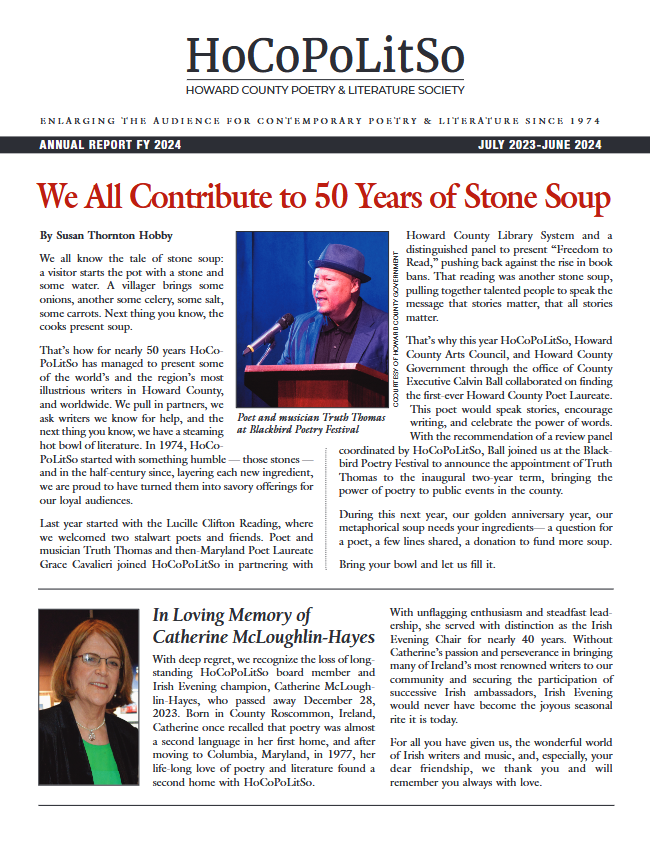
Read Our Annual Report

High School Student Tunes into Siobhan Fallon via HoCoPoLitSo’s The Writing Life.
October 16th marked my first experience with HoCoPoLitSo’s “The Writing Life”.
I’m an aspiring writer and high school senior, and this year I’m developing my craft under the mentorship of Dr. Tara Hart, creative writing professor at Howard Community College and Co-Chair of HoCoPoLitSo. She’d invited me to HCC-TV’s taping of a Writing Life episode with writer Siobhan Fallon, hosted by journalist Kristin Henderson, and I was excited to accept—I’d never been in a T.V. studio before.
On the morning of the taping the campus was bustling, and I wondered if the featured Howard County Book Connection project author, Siobhan Fallon, had had any trouble finding a parking spot.
My first thought when I arrived at the HCC TV studio room was that I was overdressed,—but that was okay—it actually made me more comfortable; perhaps I was drawn to the down-to-earth yet relaxed nature of it all.
Mrs. Fallon was wonderful. I learned with surprise that she currently lives in Abu Dhabi, and I tried (unsuccessfully, I think) to fathom what kind of jet lag she must’ve been feeling. Nevertheless, she was amicable and eager for her interview.
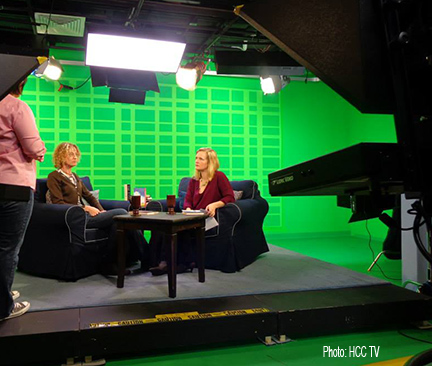 I got a peek into the room where the interview would be conducted, and I later marveled at how seamlessly the green screen behind the two arm chairs was turned into a sophisticated yet comfy library background. Being someone with little to no experience in TV and film, I thought it was pretty cool.
I sat in the “control room” while the taping was taking place, and not only was I able to listen to the interview (and watch it from three different camera angles), but I was able to hear the correspondence among the director and crew as well. I’m thankful for that, because I think it gave me a more well-rounded view of the entire production. Being a writer myself, I naturally emphasized the content of the interview with Ms. Fallon as the most important part of the taping, but now having seen both sides of the production I firmly believe that the technical aspect of it all is just as necessary and important.
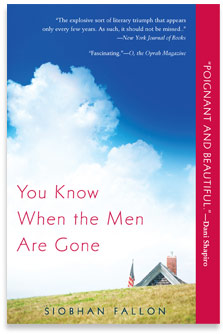
That being said, the interview was wonderful. Siobhan Fallon is the author of the award-winning short story collection You Know When the Men Are Gone, the content of which focuses on the emotional (and for most of us intangible) experience of military life. Ms. Fallon herself is a military wife, and I nearly choked up when she mentioned that soon her husband will be given leave for two years, and how wonderful it will be to have “such a long time to be together”.
But anyone writer could easily relate to her interview, as she gave wise and thought-provoking insight on the universal topics of fact versus truth, writing from different points of view, the short story versus the novel, and how personal experience ties into all writing, even fiction.
I almost got teary for a second time when she talked about care packages. Just a few days before I’d sent one to my nineteen-year-old cousin for his birthday; he’s serving in Afghanistan as an army medic. Hearing Mrs. Fallon speak so intimately about the military experience made me miss Jimmy more than ever, and I hope to share this post and the episode with him eventually.
All in all, my first experience with “The Writing Life” was personally and professionally gratifying in every way. I made some great new connections, with Ms. Fallon, with the TV crew, and with the other HoCoPoLitSo board members. They seemed so excited that I’d come, like it was their honor and not mine, and that just made me feel special.
I took a picture with Dr. Hart to commemorate the day, and left feeling satisfied and eager for the next episode. It was a lovely morning.
— Emily Bellor
The Best of It According to Some of Us.
 ‘Tis the season for rankings and “best of”-lists. Like this one by The New York Times or this one by Ron Charles for The Washington Post.
Last Saturday, the members of HoCoPoLitSo’s Board of Directors and staff met for our last meeting of the year. And we, too, shared our list of “Best Thing I Read in 2013.” So here it is!
- TransAtlantic by Colum McCann
- Bluets by Maggie Nelson
- Elizabeth Bishop and The New Yorker: The Complete Correspondence
- City of Veils by Zoe Ferrais
- Americanah by Chimamanda Adichie
- The Complete Poems of Anna Akhmatova
- The Sense of an Ending by Julian Barnes
And the grand winner of this list is Someone by Alice McDermott – named by three Board members and staff as their “Best Thing I Read in 2013.” You know who else liked Someone? NPR’s Maureen Corrigan – and you can see her picks for 2013 best books here.
Want to see more lists for best books?
Happy Readingdays!
– Laura Yoo
Board Member
Give the Gift of Lit: Tickets to Billy Collins and the 36th Annual Irish Evening Available.

Another year where you have to find that certain someone something especially special? HoCoPoLitSo is here to help.
This year, HoCoPoLitSo would like to make your life a little easier, giving you the opportunity to really delight your special someones with tickets to see Billy Collins or the 36th Annual Irish Evening, featuring Paula Meehan and Theo Dorgan. Happy Holidays.
36th Annual Evening of Irish Music & Poetry
Featuring Paula Meehan & Theo Dorgan, The Narrowbacks, Step dancing
March 14, 2014 • Smith Theatre – HCC
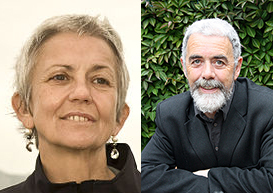 Poets Paula Meehan and Theo Dorgan will read from their latest works followed by a concert of traditional Irish music with Narrowbacks and step dancers from the Culkin School.
Dublin’s informal poet laureate, Ms. Meehan was recently named Irish Professor of Poetry. The post was created following the late Seamus Heaney’s Nobel Prize for literature in 1998. She is only the second women appointed to this position.
Theo Dorgan, a former director of Poetry Ireland, is also a poet, playwright, translator, editor and broadcaster. In 2010 he received The O’Shaughnessy Prize For Irish Poetry.

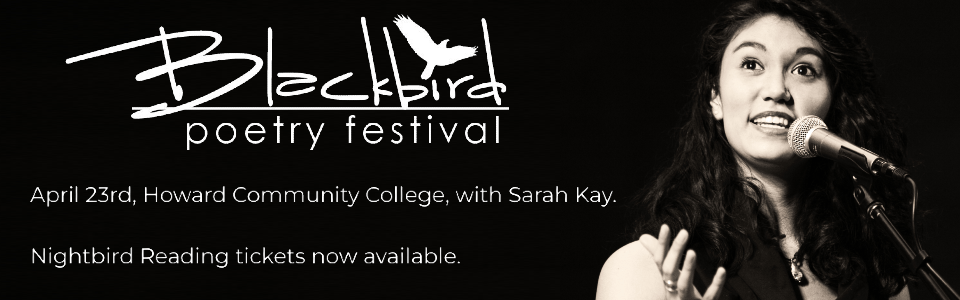
The Blackbird Poetry Festival’s Nightbird Reading
With Billy Collins
April 24th • Smith Theatre – HCC
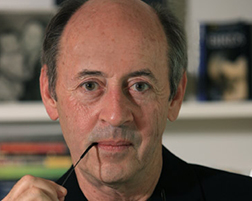 The Nightbird reading featuring two-term National Poet Laureate Billy Collins closes the annual Blackbird Poetry Festival. Called “the most popular poet in America” by The New York Times, Collins headlines the festival, which this year has the theme Poetry Unmasked.
“Billy Collins is famous for conversational, witty poems that welcome readers with humor,” writes The Poetry Foundation, “but often slip into quirky, tender or profound observation on the everyday, reading and writing, and poetry itself.”


Tripping over Lucille Clifton at Howard Community College
The latest installment in our occasional series of blog posts from friends of HoCoPoLitSo. Today, we spend a few moments with Amanda Fiore, a professor/fiction writer/occasional poet, who spent a day, recently, in our midst. Here is her telling of that story:
I was sitting at my desk, scrolling through junk mail and emptying my inbox at Howard Community College, when, to my immense pleasure and surprise, I came across a mouth-dropping subject line: Michael Glaser was coming to HCC’s campus to honor the late poet, Lucille Clifton, and conduct a free poetry workshop, Telling Our Stories — Michael S.
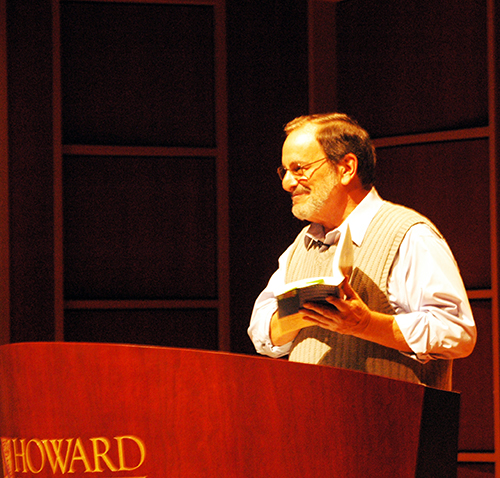
Michael Glaser.
Glaser Celebrates Lucille Clifton and Poetry Teaching! Unable to believe my eyes, I scanned the email and saw that it was being put on by an organization I had never even heard of before, HoCoPoLitSo, and was amazed when after looking into it I found out it was an arts council on which Lucille Clifton had served for many years, and that it was right here, in my own back yard!
Having been a former student of both Lucille and Michael at St. Mary’s College of Maryland, I knew immediately that the event HoCoPoLitSo was planning would be close to my heart. Michael Glaser was the first person to truly encourage me as a writer, and Lucille Clifton was a woman whose spirit and no-nonsense critiques had made me laugh, cry, and embrace my poetry with an honesty that had stayed with me the rest of my life. I immediately wrote to Michael, who returned my astonishment and excitement at being reunited after all these years, and started going through all my old journals until found the one I had kept twelve years ago in workshop with Lucille. I even found the very poem I once read in class, to which she had looked me in the eye and told me, with words I’ll never forget, “you’re hiding behind your words.” It was the hardest and most important thing I had ever heard about my poetry, and I ran out of that room hating her, sitting dramatically in the dark and crying over how mean she was until about three hours later, when I realized she had been right all along. I rewrote the poem. The result was, perhaps, the first honest poem I’d ever had the courage to write, and I never questioned her again.
Though I had thought about contacting her often over the years, by the time she passed I had still never had the chance to tell her how much she meant to me, and so the thought of sitting around a workshop table with Michael again and being given a forum through which to honor Lucille was just too perfect to seem real! But low and behold, a few weeks later there we were, sitting in a circle of tables in Duncan Hall on a cool Fall afternoon. We started off by remembering the lessons Lucille’s poems teach us all and thinking about how we could incorporate those into our own work.
Micheal was just as I remembered him — so much heart and creative energy we couldn’t help but be inspired. We read and talked and each composed a poem of our own, every one written with words that either calmed or stung the air.

Amanda Fiore reads her workshop poem.
Later that evening, some of us went to the reading to celebrate Lucille and were graced by a beautiful evening of poems, stories, and heartfelt emotion. By the end I not only had the opportunity to read what I had composed that day in the light of Lucille’s memory, but to meet her daughter, buy a book, and discover a group of like-minded people through HoCoPoLitSo whose energy and love for the arts mirrored my own. Afterwards, I was stunned at how satisfying and invigorating it was, with just one question repeating in my mind: how did I not know about this organization before, and why wasn’t I more involved?
One thing I know is that I will come to each of these annual Lucille events in the future, and that I will be attending many other HoCoPoLitSo events as well . . . as many as they can put on! But most of all, I am so thankful to Lucille who, even after she has passed, is still managing to connect me to poems. Thank you Lucille, I owe you so much.

From Abu Dhabi to Howard County and Back, Author Siobhan Fallon Lives Through the Jet Lag to Tell About It.
Jet lag, medically referred to as desynchronosis, is a physiological condition which results from alterations to the boy’s circadian rhythms resulting from rapid long-distance transmeridian (east-west or west-east) travel on an aircraft.

The Library’s Megan Maguigan, Siobhan Fallon and Lisa Bankman, also from the Library.
I was asking for it. Heading to Maryland from Abu Dhabi, with two little daughters in tow, was bound to be trouble. But when the generous folks of Howard County chose You Know When the Men Are Gone for their Book Connection Project read, there was no way I was just going to send an ethereal Skype-self to their computer screens on October 15 and 16th. I wanted my flesh and blood and exhausted self right there in person.
We arrived in NY after nearly 24 hours of transit (made interesting by my nine-month-old trying to pull the hair out of the head of the nice lady in front of us all the way to Heathrow). On October 14, I left my girls with my mother and drove a rental car to a hotel in Howard County. I got on the treadmill for an hour of uphill climbing while looking through my notes and skimming my stories, brushing up for the talk the following morning at Howard Community College (HCC).

Authors Siobhan Fallon and Kristin Henderson.
Ten p.m. (six a.m. Abu Dhabi time) I was in my room and wired (for future reference, getting on a treadmill at 9 pm is not a good way to tire oneself out). I decided to post the upcoming readings on Facebook and ended up getting into a lively discussion about Kenny Rogers with Laura Yoo, HCC faculty member and member of the board of directors at HoCoPoLitSo. I mentioned Rogers’ lyrics make for great stories, she posted her favorite childhood songs with videos, and she even found one where Kenny still had his wonderful, original face.
Her sense of humor confirmed what I had already suspected — these events were going to be awesome.
And each one was, filled with enthusiastic, kindly, curious readers in sparkling learning spaces at both HCC and the Miller Branch of the Howard County Library System (no wonder it was voted Library of the Year 2013).
Here are some of my favorite moments:
 – After reading at HCC, a student asked me to sign his book. His teacher required proof of attendance and he had me inscribe a paperback to her. I couldn’t help adding, Please give this man an A for creativity!!
– When I walked into Margaret Garroway’s English class (she joined forces with other English classes and the room was full), Margaret was in Alex Trebek mode, moderating a trivia game, classes pitted against each other with representatives sitting at a long table in front. The trivia was taken from my collection, and there was even an answer I didn’t know (but the students did, good job, guys!).
– After the English class, one student brought me a red sharpie and asked me to sign the cover of his book rather than inside. Everyone behind him in line liked the way it looked and asked to borrow his pen (I liked the graffiti feel of it myself—I’m going to start carrying a red sharpie and ‘tag’ all my books from now on) until the poor kid had to run off to his next class.
– During the taping of HoCoPoLitSo’s TV show The Writing Life, I finally got to meet fellow mil spouse author and my Writing Life host, Kristin Henderson. When I lived in Virginia, she and I played email tag (she is part of a group of mil spouse writers who get together once a month; alas I had my hands full of new baby and the move to Abu Dhabi and couldn’t manage to meet them). She is just as fabulous as I imagined her to be.
Now I am back in Abu Dhabi. Yes, I spent about a week downing too much coffee and railing at my kiddos for not sleeping enough (the nine-month-old was waking up bright-eyed at 2 a.m. every night, ready to pull my hair out).
Jet lag be damned, I wouldn’t trade a minute of the great time I had at Howard County.
Oh, and can somebody please tell Trivia Pursuit to add questions about my stories to their next edition?
Siobhan Fallon
Author of You Know When The Men Are Gone
Special thanks to Candace DePass, Lisa Bankman, Alesia McManus, and Susan Thornton Hobby for all their hard work coordinating this trip across time zones! I hope to be back in your beautiful Howard County again someday.
Telling Our Stories — Michael S. Glaser Celebrates Lucille Clifton and Poetry Teaching in The Third Annual Lucille Clifton Poetry Series Reading — November 9th
Join us on November 9th for a two-part event celebrating the poetry of Lucille Clifton and the teaching of poetry with Michael Glaser.
“…writing is a way of continuing to hope … perhaps for me it is a way of remembering I am not alone.”
– Lucille Clifton from her interview
with Michael S. Glaser in Antioch Review
Part 1: Michael S. Glaser Leads A Poetry Workshop for Teachers
10:30 a.m.-3 p.m.
Duncan Hall, Room 202
Howard Community College
FREE – requires advance registration.
Michael S. Glaser leads English and language arts teachers in a poetry workshop inspired by the work of Lucille Clifton. Some participants will read at the evening event. Lunch served. Space limited and registration is required.
Visit poetryworkshopforteachers.eventbrite.com to register.
Part 2: Telling Our Stories — Michael S. Glaser Reading & Tribute to Lucille Clifton
7:30-9 p.m., followed by a book signing and reception
Monteabaro Recital Hall, Horowitz Center
FREE – registration requested.
“Glaser views his work as an exercise in honesty, rarely practiced on the more flip side of popular culture. ‘When we can no longer recognize authentic, truthfully spoken language, we become lost as a civilization,’ he says.”
– The Baltimore Sun
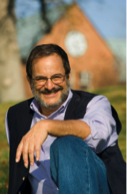 Former Poet Laureate of Maryland, Michael S. Glaser was a longtime friend of the late Lucille Clifton. A recipient of the Homer Dodge Endowed Award for Excellence in Teaching, Glaser has also received the Columbia Merit Award for service to poetry, and Loyola College’s Andrew White Medal for commitment to sustaining the poetic tradition in Maryland. Glaser served as a Maryland State Arts Council poet-in-the-schools for more than 25 years. He is the author of several books of poetry and an editor of two books on Lucille Clifton.
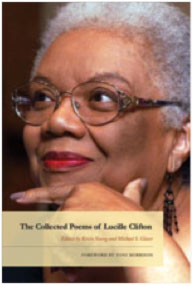 Beloved poet and national treasure Lucille Clifton was a HoCoPoLitSo board member until her passing in 2010. Along with Carolyn Kizer, she was the first poet to read for HoCoPoLitSo, in 1974. She was a National Book Award winner and two-time Pulitzer Prize finalist.
Free. Limited seating. Advance reservations are requested at lucillecliftonpoetryseries.eventbrite.com.
A presentation of HoCoPoLitSo. Co-presented by Delta Sigma Theta Sorority, Inc., Columbia, MD Alumnae Chapter.
“child, i tell you now it was not
the animal blood i was hiding from,
it was the poet in her, the poet and
the terrible stories she could tell.”
From “telling our stories” by Lucille Clifton, from The Collected Poems of Lucille Clifton 1965-2010. Used by permission of BOA Editions.
Seamus Heaney, HoCoPoLitSo Remembers His Visits to Columbia
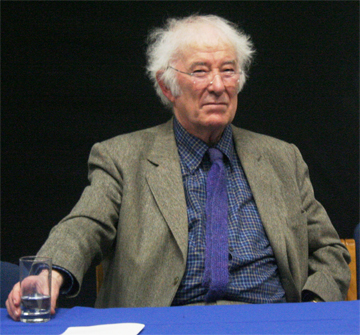
Picture of the Irish poet and Nobel Prize winner Seamus Heaney at the University College Dublin, February 11, 2009. Photographer: Sean O’Connor.
The many who heard Seamus Heaney during his three HoCoPoLitSo visits to Columbia (1982,1988 and 1994), the last not long before his being named Nobel Laureate for Literature, are saddened to learn of his recent death at age 74.
We treasure the memories of hearing him read his poems no less than the acquaintance we made with his warm and generous person. From his 1982 visit to our 4th Evening of Irish Music and Poetry, we recall the place, our companions, his voice and afterwards the many books he signed and annotated for long lines of admirers.
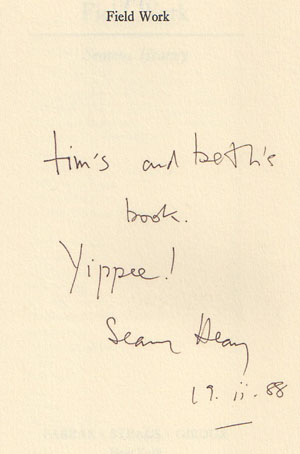 From 1988 we prize our “Afternoon with Seamus Heaney” video. He read from his poems, talked with his friend George O’Brien, and responded to questions from a Smith Theater audience. Edited down to one hour, this TV program aired locally in Maryland in January 1989.
The circumstances of Heaney’s third visit in 1994 were dramatic. Close to 700 advance tickets sold for his evening appearance at the Interfaith Center in Columbia, but a winter blizzard had closed even the Kennedy Center in Washington. Traffic in the region was paralyzed, and only a few highways were passable. Nonetheless, about 230 people, some hiking through the snow, arrived to hear him. Earlier in the day a skeleton crew opened the Howard Community College TV studio, this time to record a half hour interview with Heaney reading several new poems – hosted by Roland Flint. The one hour 1988 program aired again in 1995 to celebrate our favorite Irish poet’s Nobel Prize.
Ellen Conroy Kennedy
Founder, Director Emeritus
A few Seamus Heaney links:
- Seamus Heaney at
- On his passing:
- from the Irish Times
- Paul Muldoon’s eulogy for Heaney
- Paul Simon’s piece in the New York Times
- A video collection of Seamus Heaney reading his work.
Poet Laura Shovan Ignites a Creative Summer School Spark in 4th & 5th Grade Writers
The latest installment in our occasional series of blog posts from friends of HoCoPoLitSo. Today, the multi-talented — poet, blogger, teacher, editor, (the list goes on and on) — Laura Shovan shares with us her experience working with elementary school writers this summer.
It was my first, and only, time calling into a radio show. Former U.S. Poet Laureate Billy Collins was on the air with WYPR’s Dan Rodricks. I often use and recommend Collins’ website Poetry 180: A Poem a Day for American High Schools for classroom-friendly poems.
I wanted to know: Was there a Poetry 180 for younger students in the works? Collins said “No” and reasoned that elementary school children get enough poetry in their literary diet already.
Perhaps. But that poetry is often limited to work that’s easily digested. Elementary schoolers love Jack Prelutsky, yet are unfamiliar with more complex poets writing for children: Marilyn Singer, Sharon Creech, and Tony Medina. Their curriculum for poetry composition is rarely richer than limericks, haiku of the 5-7-5 variety, and cinquain. That’s why poetry educators, such as those on the Maryland State Arts Council artist-in-residence roster, are such highly valued classroom visitors. We are poetic master chefs. Give us the ingredients of poetry – form, figurative language, and voice – and we’ll turn out a dishy treat even the most reluctant writers will enjoy.
This month, I visited Lisa Johnson’s creative writing class at the Howard County Public School System’s G/T Summer Institutes. Certainly the fourth and fifth graders in a class called “Creative Writing: Ignite the Creative Spark” must like to write or they wouldn’t have been in the class. Still, many of them were unsure about writing poetry. Distaste for poetry often sets in by fifth grade, as evidenced by one student who wrote me this note: “At first, I thought you were going to be BORING!”
 As this was a group of strong writers, I brought a favorite lesson: portrait poems. To begin the workshop, we looked at a photograph of a man holding a baby. Our discussion focused on the facts of the picture. For example, we noted that “The man is wearing a baseball cap”. Once we exhausted the facts of the photograph, we let our imaginations take over. The class told stories about the man and the baby. Were the two of them related? Had the man rescued the baby from an accident? Was this a family reunion?
Next, we read a poem called “Face Poem” written in response to the photograph in question. [The poem and the related photo can be found at The Poem Farm, the online home of children’s poet Amy Ludwig VanDerwater.] We compared the class’s imaginings to the details of the poem. How did “Face Poem” work as a portrait?
After seeing the example, the students were ready to begin the writing process. Ms. Johnson and I had clipped portraits out of newspapers and magazines ahead of time. The children each chose one image to write about. They sat with their writing notebooks and the photographs and created a T-chart. On one side: the facts of the portrait. On the other: Who is this person? What is she doing? What is he thinking? What happens next?
Imagining someone else’s life through a workshop like this stretches young writers. My students often express a depth of empathy that surprises the adults in the room. The tangible details of a photograph are like a list of ingredients. How the children use those ingredients is what gives the resulting poems substance.
Here are three of the students’ responses.
The Newborn
By Aiai C.
A baby cry echoes through the room. The mother
rushes to calm her. The baby was as pale as snow,
her hair as black as the night sky, her lips
as pale pink as peaches. She would resemble
a snow maiden. She thinks she is the only one there,
but her mother is there gently whispering in her ear,
“Little one, little one, go to sleep.” The necklace
on her mother’s neck gently sweeping on her face.
her mind finally relaxes as she drifted off to dream
through the clouds of sleep.
The Hard Working Teacher
By Katelyn M.
The night was warm and bright
No noises filled the night
Her eyes sparkled like the night sky
Her chalkboard filled with white letters like the moon
Her lamp shines on her like the sun shining on the earth
That’s my teacher that teaches me
The Fisher
By Samuel C.
I stand in the lake
with a red shirt,
waiting for a fish to take
the bait on my hook.
I have a backpack
to carry fish back,
but now I just wait.
My family also waits
patiently as can be,
but they also wait
as quietly as a mime.
As soon as I catch a fish
I will go back to them,
I think to myself,
but now I just wait.
My son also waits.
On the land he stands,
as tense as a cricket
waiting for me to catch one.
The he’ll go back
and bring the fish back
for my family to eat.
Suddenly I feel a tug,
so I pull the fish ashore,
and go back to my family,
to eat that big fish.
I finally got back
to my family
at the camp
in the forest
in the depths of Quebec.
— Laura Shovan
Confessions of a Poetry-Phobic by Laura Yoo
The latest installment in our occasional series of blog posts from members of the HoCoPoLitSo board...
I’ve been a HoCoPoLitSo board member for several years now, but I am only now brave enough to make this confession: Poetry always scared me a bit.  As an English major in school, I avoided poetry – I took the required Introduction to Poetry class during my senior year because I put it off ‘til the very end. I was afraid.
But during the last few years, I’ve had real contact with (and real context for) poetry. What I’ve come to accept is simply that when I read or hear a poem, either I get it or I don’t get it – either I feel something or I feel nothing. And that’s good enough.
When Martín Espada came to Blackbird Poetry Festival in 2011 and read “Imagine the Angels of Bread” I definitely, most clearly, undeniably felt something. Oh yeah. When Patricia Smith performed with the Sage String Quartet just last weekend, I didn’t just feel something – my mind was blown to pieces. And when the pieces found each other again and returned to whole, it looked different. Changed.
All of this made me think about poetry and my fear of it. This thing that made me tremble in fear had been making me feel things all my life. It had introduced me to new ideas and paths, it had comforted me, it had fired me up, and it had given me peace.
My family moved to the U. S. from Korea when I was ten years old. During the first months of my life here, my fifteen-year-old cousin taught me the alphabet using the Dick and Jane primers (which are poetic in their own way). It was also this cousin who introduced me to Shel Silverstein several years later, when she thought I was finally “ready” for poetry. I remember quite clearly how I loved the repetitive sound in this particular poem, “Ations”:
If we meet and I say “Hi,”
That’s a salutation.
If you ask me how I feel,
That’s consideration.
If we stop and talk awhile,
That’s a conversation[…]
And all these ations added up
Make civilization.
Silverstein’s poems were my first introduction to the idea of playing with words to create meaning – and to make people laugh.
Next “poetry” came in the form of Macbeth in the tenth grade at Wilde Lake High School right here in Columbia. That Mr. Berkowitz was a tough teacher – he made us keep a journal documenting ALL of the imageries in the play. This arduous task illuminated all the instances of amazing things that words could do – like striking fear in the reader when Lady Macbeth speaks:
[…] Come, you spirits
That tend on mortal thoughts, unsex me here,
And fill me from the crown to the toe top-full
Of direst cruelty. Make thick my blood.
Stop up the access and passage to remorse,
That no compunctious visitings of nature
Shake my fell purpose, nor keep peace between
The effect and it! Come to my woman’s breasts,
And take my milk for gall, […]
Macbeth sealed my fate – I would study English in college.
When I was in college, I discovered “The Lake Isle of Innisfree” and it has become my favorite poem – the one that I keep in my pocket on Poem in Your Pocket Day every April. It speaks peace to me.
I will arise and go now, for always night and day
I hear lake water lapping with low sounds by the shore;
While I stand on the roadway, or on the pavements grey,
I hear it in the deep heart’s core.
When I started teaching, Taylor Mali’s “What Teachers Make” gave me a sense of justice. On those days when I felt knocked down by unreasonable students, failing students, mean students, nice but underprepared students, Mali’s poem gave me hope.
You want to know what I make?
I make kids wonder.
I make them question.
I make them criticize.
I make them apologize and mean it.
I make them write.
I make them read, read, read.[…]
I make a goddamn difference.
When a few years ago, my father died of cancer, I turned to Emily Dickinson, whose poems I had never been able to understand. Her poems seemed like words that were almost randomly strung together with dashes. But I realize now that I never “got” them because I never needed them before.
So We must meet apart –
You there – I – here –
With just the Door ajar
That Oceans are – and Prayer –
And that White Sustenance –
Despair –
I’m not a poet. And I don’t even claim to be a poetry lover. All I can say is that poetry has been in my life – it had been sneaking up on me now and then to guide me, to help me, and to change me. And guess what? It has been doing it to you, too.
Laura Yoo
HoCoPoLitSo board member
Patricia Smith, Sage String Quartet, and the Art of an Afternoon
An artist works alone in a garret, her solitary room the site of revelation. Or not.
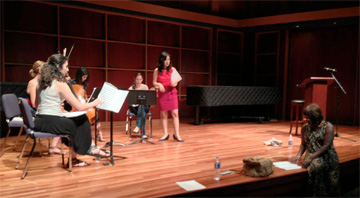 Patricia Smith, who recited and read her poetry detailing the wrath of Hurricane Katrina last week, labored on the afternoon of the performance for four hours with four musicians.
The five of them collaborated on a performance that brought tears to the eyes of the audience. Smith even wrote extra lines – just a few moments before the performance – to make her poem better fit the musical score.
In four hours, having never met before, the poet and the musicians meshed their work into a tightly woven performance for HoCoPoLitSo and the Columbia Festival of the Arts called “The Sound and Fury of New Orleans.”
Audience member Mike Clark said he emerged from the reading feeling “flayed,” he had been so moved by the show.
First performed in October 2012, the synthesis of music and poetry was the brainchild of Martin Farawell, director of the Geraldine R, Dodge Poetry Festival, and had not been performed since. Board member Tim Singleton saw Smith at Dodge, and decided HoCoPoLitSo just had to host her.
Smith performed work from her book, Blood Dazzler, a National Book Award finalist, as the Sage String Quartet played Wynton Marsalis’ “At the Octoroon Balls” for an audience that grew deeply silent.
 Violinists Arminé Graham and Laura Chang reached deep into the heart of the poems, Maggie Hummel on cello drew out the voice of Katrina during “Blue Lights on the Bayou,” and Sarah Hart and her viola flirted with the ragtime. Each note, whether quavering or raucous, seemed to speak intimately with Smith’s poems about New Orleans as lascivious flirt and nursing home residents left to drown in their beds, about a dog howling at the looming sky, about a woman with three babies and two arms, who drops her littlest one with a tiny splash.
But before it became art, there was the devil in the details. The musicians knew the music, the poet knew the poems, but in one short rehearsal on the afternoon of the performance, they had to make those two types of art speak as one.
The rehearsal started on a good note. Smith walked into the Monteabaro Recital Hall, saw the four musicians warming up onstage and chortled: “Girl party!”
The quartet laughed, the tension broken. Then, in their shorts and sundresses, the five women settled into the rehearsal.
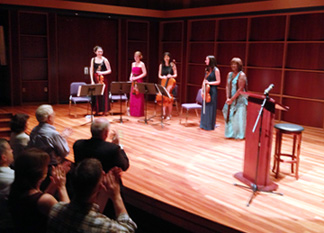 Smith began by explaining each poem, and reading it, as the musicians looked at the score. They talked about the silences that punctuated the piece, the times when the musicians would play “Hellbound Highball” and would have to tone down the frenzy so Smith’s words about running just ahead of Katrina’s winds could be heard.
The cellist, Maggie Hummel, took on the voice of Katrina, as Smith read poems in the hurricane’s hungry voice: “Every woman begins as weather.” Hummel’s fingers plucked insistently at the beginning of every poem in Katrina’s voice, lending an urgency to the hurricane’s approach.
Just at the end, when everyone was tired and the snacks of nuts and cherries had run out, Smith said she needed to say something about the ending.
“I’m hearing something,” she said. “Katrina’s voice.”
So Smith read the last few lines, and Hummel plucked those strings again.
“That’s it,” Smith said.
Throughout the rehearsal, if they weren’t sure how the piece would go, they just tried it.
“Let’s just do it and see what happens,” Smith said more than once. They did, then tried again. And art happened.
Susan Thornton Hobby
board member
 HoCoPoLitSo