



Read Our Annual Report
Students’ Moments of ‘Quiet Potential’ with Writer-in-Residence
Sometimes the hands rise slowly. Sometimes they shoot up quickly.
Other times, hands rise up cautiously as the eyes dart around the room. I love this moment for its honesty, its quiet potential, and the way that question maps out the terrain I have to travel to at the least show each and every school in Howard County that poetry is present, possible and matters. As writer-in-residence for HoCoPoLitSo, I travel to the county high schools to read and talk poetry.
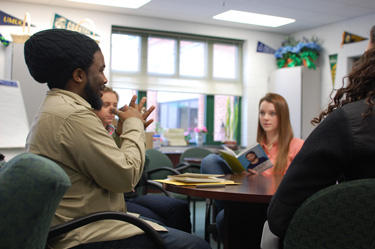
Poet Derrick Weston Brown speaks with students at Atholton High School. (Photo by Paige Feilhauer)
During the reading, I share stories behind the inspiration and origin of some of the poems and then I ask the students if they have any questions about certain poems. Many even request me to read certain poems and then give their own interpretations on them. We talk about other things as well. Ipod playlists. If Twitter is an appropriate space for poetry. Role-playing games. Favorite books. Dating. Haiku. Race. Gender. The list goes on.
If I have any sort of a complaint, I wish that perhaps my visits could extend past the usual fifty-minute class time. Usually the bell rings and the students make their way to lunch or to another class and I find myself a little melancholy that the connection we’ve built in just a short time is broken. But so much has happened within those small bubbles of time. I’ve witnessed brave students share their own poems when I’ve asked if there are any other poets in the room.
I’ve watched them deliver heartbreakingly honest and earnest poems, shaking paper and all, with the kind of sophistication and insight I truly wished I possessed at their age. I’ve stayed after my allotted time with passionate teachers and their poetry-hungry students who fire questions like pistons at me about form, meter, and content.
I enjoy this job most of all because I realize that Howard County is not as mysterious as I thought, because poetry dwells there, and anywhere poetry lives is home.
Derrick Weston Brown
HoCoPoLitSo writer-in-residence
To support HoCoPoLitSo’s Writer-In-Residence program in Howard County high schools, consider making a donation.
Students and a Writer Ask: Am I Really Here for Poetry?
When I got the news that I was tapped to be the 2012-2013 HoCoPoLitSo writer-in-residence for Howard County back in early August, I was as nervous as I was excited. The nervousness I mention first because with my own schedule that ebbs and flows with the responsibilities of being a working poet and teacher, I wondered if I could fit these visits in, and more importantly, if I could find my way around in the mysterious Howard County.
Honestly, Howard county was only familiar to me for two reasons: the city Columbia and the absolutely awesome vegan restaurant not too far from Columbia called Great Sage. But beyond the nervousness, my excitement was also sparked by the mystery of the unknown. As my imagination began its snowball’s journey down the hill of infinite possibilities, all sorts of questions were percolating around in my brain . . .
What are Howard County high schools like?

Poet Derrick Weston Brown speaks with students at Atholton High School. (Photo by Paige Feilhauer)
What will they think of my poems?
Will they care?
Will I get lost?
Will they relate to my poems?
How should I present my poems?
Should I just read?
Should I talk and then read, or read and just talk?
I carried all of these questions with me on my first school visit to Oakland Mills High School and I was pleasantly surprised and relieved to find that my first reading would be in the school’s media center. As I scanned the faces of those students that first day as they filed into the library, quietly chatting to each other while stealing looks at me, I was strangely calmed by the spectrum of expressions I saw.
There was curiosity, vague interest, teen-aged skepticism, and of course, the glazed over “Am I really here for poetry?” look. What I realized, after taking in the expressions I saw, was that I had worn each and every look displayed in front of me. I was reminded that I was a high school student once, a student who was immediately skeptical, inquisitive and up-in-arms whenever we were told we had a special guest speaker.
So I bundled up all of my nervousness and excitement, and made myself a promise in the few seconds that remained as Joyce Braga (a HoCoPoLitSo volunteer) introduced me. I wouldn’t read at the students, I wouldn’t lecture the students. To me, poetry is a conversation, a call and response; to rob the person or audience of their right to respond is a crime. So I opened my first reading that day and every day since then with a question. “Who in this room — be honest — actually likes poetry?”
To be continued …
Derrick Weston Brown
Writer-in-residence, 2012-2013
To support HoCoPoLitSo’s Writer-In-Residence program in Howard County high schools, consider making a donation.
HoCoPoLitSo Recommends Free Readings: Pinsky, LPR, Artists’ Gallery
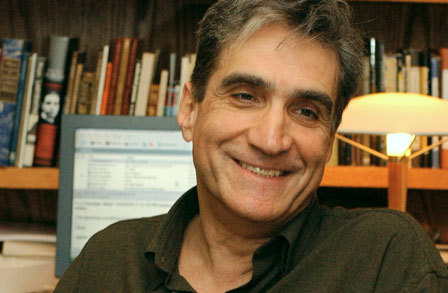
Robert Pinsky will be reading at 2pm in Frederick, Maryland, on Super Bowl Sunday.
It’s happening again, but don’t worry… you’ll be home in time for the Super Bowl. In their annual Super Bowl Sunday event, Frederick Reads, the Weinberg Center for the Arts, and the C. Burr Artz Trust will host a free public reading and book signing by American poet, essayist, literary critic and translator Robert Pinsky.
The 2013 theme is “Food,” and Pinsky is enthusiastically preparing a special feast of his favorite poems related to food and beverage, both his own work and that of other poets.
Is there a better way to get hungry for the game? Details on the reading can be found here.
The event usually contains a question and answer period, we can ask him which team he is rooting for. Now what would you expect a poet’s choice to be?
But first, the Howard County Tourism office will host a free Little Patuxent Review reading Saturday afternoon from 2-4. With their latest Doubt-themed issue hot off the presses and in readers’ hands, editors, members and contributors will read from their works and host an audience talk-back about music and the ways it influences our lives in preparation for the release of the Summer 2013 music-themes issue during the Columbia Festival of the Arts.
The reading will feature Michael Salcman, Susan Thornton Hobby, Anne Bracken, Prudence Barry, Patricia Van Amburg, Emily Rich, Lisa Biggar, Kim Jensen, and a special musical guest. Co-hosts will be Linda Joy Burke and Laura Shovan.
The following Friday, the Artists’ Gallery located in the American City Building in downtown Columbia will launch their popular “Poets and Painters” show with a reading and reception. The reception is from 6-8pm on February 8. The show, featuring the collaborations of poets and painters, will be up from the 1st of February through March 29th. Do drop in.
Against the Ruins, Her Book of Poems
These fragments I have shored against my ruins.
T.S. Eliot, “The Waste Land”
by Tara Hart
If nothing else, I am a reader. Perhaps because I always had my face in a book, my parents logically wondered when I would finally write one. As much as I love reading novels (the longer the better), I have also always been aware that I am not driven to create them. Characters do not haunt me, demanding I write their stories, as in Pirandello’s Six Characters in Search of an Author. Extended, magical narratives do not spring into my mind on the train. My few hesitant attempts at starting a story and seeing where it would go led . . . nowhere.
And then our first child died, our Tessa. And that experience was too large to hold, and I  was helpless to know where to put it. I only wanted poems. I had always loved poetry, but in the casually passionate way we love favorite foods. Now I came to poems in a state of complete surrender, starving to know I was not alone, that the world is not all just a darkling plain. Lucille Clifton. Mark Doty. W. S. Merwin. Sharon Olds. They said many things that helped. They said some things that called to other things inside me. Slowly, I found relief in getting a few words down: a line, an image, a phrase. Sometimes I could write a whole page, breaking the lines like twigs wherever they were weakest, and create what might look like poems from arm’s length, but they had no music. I kept writing a little at a time, though, grateful for tiny shards of light, and I’d throw the scraps in a box. Or I’d think of something at work – like a new fear of crocuses – and type it into a document called “bits.”
 I wondered if I would ever be able to find sustained time to shore the fragments, and after a few years, the answers were all, suddenly, yes. My angriest, saddest lines, after thirteen discordant tries, flew into place like a blackbird and won a Pushcart Prize. I applied for a sabbatical, and received it. A friend taking a graduate course in design asked if she could work with me to produce a chapbook. And so in the spring of 2012, when Tessa would have been eight, I filled our birdfeeder, said a prayer of thanks, shook out the pieces, printed the drafts, and spread everything out on a table. I looked at my notes in the margins of great poets. In the softly silent house, for six hours a day, I listened to what I remembered. I followed those fragments, my breadcrumbs, my torches, planchettes. They were tickets, too, to a prize I was finally able to claim – the gift of understanding how I and my whole here and absent family are connected to a much, much larger story of love and loss, and what comes after. So I guess I do have that blessed clamoring that leads to the work, the words, and the release. It is one of my daughter’s many gifts, to turn me into a writer, after all.
Tara Hart co-chairs the board of HoCoPoLitSo and chairs the Howard Community College Division of English and World Languages, where she teaches creative writing and literature. Her chapbook, The Colors of Absence, is available at http://www.tarajhart.com/purchase.html
Make Frank McCourt Proud: Buy a Ticket to Irish Evening Today.
On a tight budget? You have no idea.
Here’s how Frank McCourt’s family’s budget – funded by the Irish dole — is tallied by his mother.
“Nineteen shillings for the six of us? That’s less than four dollars in American money and how are we supposed to live on that? What are we to do when we have to pay rent in a fortnight? If the rent for this room is five shillings a week we’ll have fourteen shillings for food and clothes and coal to boil the water for tea.”
That’s from McCourt’s Angela’s Ashes, his amazing memoir of a miserable Irish Catholic childhood, from which he read at HoCoPoLitSo’s 2009 Irish Evening of Music and Poetry.
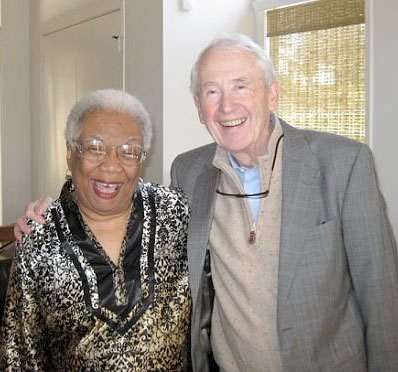
Lucille Clifton and Frank McCourt share a laugh during his Irish Evening visit to HoCoPoLitSo in 2009.
Which is all to say that the Irish have a history of thrifty.
My great-grandmother, who grew up in the Irish and African-American section of Georgetown when it was more the country than the city, could put a meal on the kitchen table for her five children and hungry husband for an amazingly small amount of money. That meal, of course, required hours of her bent-back labor in a small patch of garden, sweating over Ball jars of stewed tomatoes in August and kneading bread until her forearms were as cut as Jillian Michaels’ (almost).
Those around here who want to hear a good Irish story don’t need to sweat or scrape to save a little bit. On Feb. 1, the price of an Irish Evening of Music and Poetry ticket goes from $30 to $35. A small rise, grant you, but a rise nonetheless that my great-grandmother would cluck over, and one that could feed all those little McCourts for a week.
Buy a ticket today and make Frank proud. Save five bucks and here’s what you receive on March 1: Colum McCann, that swashbuckling former reporter who spins yarns that win National Book Awards and lift readers high over Manhattan (Let the Great World Spin) and lower them deep into the tunnels under New York (This Side of Brightness). At the Irish Evening, McCann will read from his work, Narrowbacks will play their sprite Irish tunes, stepdancers from the Culkin School will fling their feet higher than their heads. Bartenders are cooking up a signature Irish drink to go with the Irish coffee and Guinness. Win raffle baskets of Irish books and music and food. Bid on signed Seamus Heaney broadsides and custom-made jewelery. Go on, have a scone.
For tickets, go to http://www.brownpapertickets.com/event/287811 or call 443-518-4568.
Susan Thornton Hobby
Board Member
HoCoPoLitSo: The Known Fertile Ground
Poet, publisher, and HoCoPoLitSo board member Truth Thomas takes a look at the year ahead for the organization and sees the promise of fertile ground.

Fertile ground is a wondrous thing. That is one of the first lessons I remember learning as a child growing up in Knoxville, Tennessee, along with the fact that my late grandmother could cook anything and make it taste good. Indeed, in the right hands, even a small stretch of land can yield a multitude of edible miracles. In the context of literary activist organizations, the Howard County Poetry and Literature Society (HoCoPoLitSo) represents a similar patch of fertile ground.
The first grand HoCoPoLitSo New Year harvest is the poetry of Derrick Weston Brown, our 2012-2013 writer-in-residence. Brown holds an MFA in creative writing from American University and is brilliance personified. He is a highly published poet, Cave Canem Fellow, Tony Medina workshop alumnus, and the author of an inspiring collection of coming-of-age poems entitled Wisdom Teeth. It gives me great joy to announce that he will be visiting every high school in Howard County to captivate our young people with the sunshine of his work.
In addition to the poetry of Derrick Weston Brown, the New Year brings the literary bounty of our 35th Annual Evening of Irish Music and Poetry. This year, the award-winning, internationally acclaimed author Colum McCann will be featured. McCann has published five novels, numerous short stories and a storehouse of articles. His book, Let the Great World Spin, won the National Book Award in 2009. I have always loved Irish Evening, because by virtue of it, I have been blessed to see the profound similarities between African Americans and Irish people. Both groups of folks have come through suffering with unbent backs of beauty. The event will be held at 7:30 p.m., March 1, 2013, at the Smith Theatre, Horowitz Center for Visual and Performing Arts on the campus of Howard Community College.
The literary crop of events that will spring forth from the Howard County Poetry and Literature Society in 2013 is one of great volume, quality and diversity. On March 19, HoCoPoLitSo partners with the Howard County Library—the fairest of them all—to welcome Pulitzer Prize-winning novelist Edward P. Jones into our midst.
On April 23, HoCoPoLitSo connects with HCC to host the Blackbird Poetry Festival. This year, the festival highlights the sterling poetry and photography of author Rachel Eliza Griffiths—a Cave Canem Fellow, as well as the poetry of author Kendra Kopelke, director of the MFA program at the University of Baltimore. There are many more events planned that I will refrain from mentioning, at this time, because a little suspense makes life worth living. Suffice it to say that one of those events has something to do with the Columbia Festival of the Arts in June, and that the writers invited will stir ovations in every heart. Yes, I think that is enough to say, for now.
Truth Thomas
Poet and board member
Speak Water, the latest collection of poems by Truth Thomas, is available online from Cherry Castle Publishing. A kindle e-version is available through Amazon.
Who is rescuing whom? The writers or the readers?
 The latest installment in our occasional series of blog posts from friends of HoCoPoLitSo. Today Patricia VanAmburg, poet and professor of English at Howard Community College, writes of the power of sharing in literature and asks a ‘simple’ question:
Four thousand years ago, the Sumerians immortalized their king Gilgamesh (and their civilization) by telling his story. This has been a universal phenomenon. A few years ago, I had the opportunity to work with American poet Galway Kinnel, who defined poetry as “rescue work in time.” Broadening that definition to encompass all literature, I sometimes ask students what gets “rescued” in a poem or story.
They always guess the writer first and the reader second. Innately we know the healing quality of sharing our feelings and the relief in knowing someone else has felt or struggled with some of our own issues. Finally though, students realize that something even bigger gets rescued—the microcosm of a single event—the macrocosm of human experience.
We all belong to communities whose stories are important on local and global levels. Turkish writer and Nobel prizewinner Orhan Pamuk said in his 2006 acceptance speech: “The writer who shuts himself up in a room and first goes on a journey inside himself will, over the years, discover literature’s eternal rule: he must have the artistry to tell his own stories as if they were other people’s stories, and to tell other people’s stories as if they were his own, for this is what literature is. But we must first travel through other people’s stories and books.” Through the words of other writers, I have come to visualize literature as a flowing infinity symbol—the connection between teller and listener—the connection between individual and community. What literature connects you?
Patricia VanAmburg
Poet and professor of English
Howard Community College
The HoCoPoLitSo board of directors constantly thinks of how literature connects with the community, and how we can share those words with our audiences. But we thought a few book recommendations – especially at this time of year and considering the recent tragedies in our country – would be apropos.
What follows is a quick list of some of our board members and staff and the books they’re thinking of at this time:
- Tara Hart, board co-chair, recently sent her nephew, a veteran, a copy of Tim O’Brien’s Vietnam classic, The Things They Carried.
- Tim Singleton, board co-chair, reaches for Donald Hall’s Without, elegiac poems written of the dying of his wife, Jane Kenyon, that share the idea that one can let go, hold, carry on.
- Pam Simonson, HoCoPoLitSo’s managing director, is reading Elizabeth Spires’ Now the Green Blade Rises: Poems. Spires’ poems about her mother’s death are moving and comforting, as well as full of hope, when hope feels distant, Simonson says.
- Kathy Larson, treasurer, says she has read The Secret Garden, by Frances Burnett, many times, and “come away with a renewed appreciation for fresh air and sunshine and the healing power of nature.”
- Susan Thornton Hobby, secretary of the board, loves Mary Oliver’s New and Selected Poems, with the line: “Tell me, what is it you plan to do with your one wild and precious life?” from the poem “The Summer Day.”
- Laura Yoo, board member at large, found comfort in the collected works of Emily Dickinson when she had a sudden death in the family.
We’d love to hear what literature connects you. Feel free to comment below.
Two Points of View on The Year’s Writer-In-Residence — Derrick Weston Brown
Guest bloggers Joyce Braga and Sam Rubin share their experiences of this year’s Writer-in-Residence in the Howard County Public School System, Derrick Weston Brown.
His poems have swagger, but the poet
remains introspective

Derrick Weston Brown
As the high school liaison for HoCoPoLitSo’s writer-in-residence, I’ve guided many poets around Howard County high schools. After I e-mailed Derrick Weston Brown, this year’s writer-in-residence. I prepared myself for our first meeting, scheduled for Nov. 12 at Oakland Mills High School, by reading his biography and his on-line interviews. I expected the usual poet—a little bit of a performer, a lot of ego and touch of swagger. I looked at the picture of Derrick Weston Brown, and knew I was right. But I was wrong, and in a good way.
I met Derrick at the school front desk. I rattled off instructions: Here’s the packet, here are your poems, sign the book, here’s the room. Oh, and please tell me how you want me to introduce you. Derrick seemed surprised, almost shy about telling me his accomplishments.
When Derrick began rather softly to read, I soon discovered why. He’s a very introspective individual. He thinks very deeply about life. He lets the students know “life’s a journey” and not always an easy one. He’s been writing since he was a child. Even with a masters’ degree in writing, getting published was a struggle for him.
As Derrick spoke, the students were fascinated, and so was I. He told the students he likes to eavesdrop on people, and I too felt a little voyeuristic in the classroom, listening to his stories. Rather than giving students his biography, Derrick uses poetry to tell his audience about himself.
As he read, I learned more about Derrick. One poem was dedicated to his father, called “Legacy.” Another was about his mother, called “Mother to Son.” And one poem, which was hard for him to read, was called “Forgiveness.” It was about him belittling a schoolmate. He told the class he’s still looking for that girl. He wants to ask forgiveness.
With each new visit I hope to discover a little bit more about Derrick Weston Brown. I now know he’s not shy, he just likes to let his poems talk for him.
Joyce Braga
volunteer liaison for
the writer-in-residence program
For Oakland Mills High students,
Brown’s words are supercalifragilisticexpialidocious
As I sat down at the November 12th Derrick Weston Brown presentation at Oakland Mills High School, I truly had no idea what to expect. Shortly after my arrival students started piling in, filling row after row. When Derrick started his presentation, he did not start with a poem or an introduction, rather he started it with a few questions to the class. “Who likes poetry?” he asked first. The audience seemed indifferent. “Who could care less about poetry?” A few went up.
“Who hates poetry?” A few more hands hit the air. “Who likes to write poetry?” A couple of hands rose tentatively.
The questions were a great way to grab the attention of the students, who perhaps did not care about this random writer they had never heard of standing in front of the room.
As the event went on, Derrick read his work, he asked and answered questions and it seemed like he, as well as the students, were having a good time. However, it was not the poetry alone that made the program so enjoyable. Derrick’s interactions with the students seemed so natural and so unplanned that it allowed the flow of the presentation to move artlessly.
One interaction in particular stuck in my mind and I believe will stick in the mind of every audience member at the reading. Derrick asked the students for ten words. After he compiled the list of words, Derrick recited a freestyle improvisation, something he might call an “off the dome” poem. It was an elegant piece, into which he somehow fit “supercalifragilisticexpialidocious.”
Just as in any class, only a select number of students raised their hands to answer and or ask questions, but perhaps a few more hands will go up next time someone asks “Who likes poetry?”
Sam Rubin
HoCoPoLitSo’s intern
Atholton High School
Gwendolyn Brooks — Watch a Treasure from HoCoPoLitSo’s The Writing Life Archive Now Online
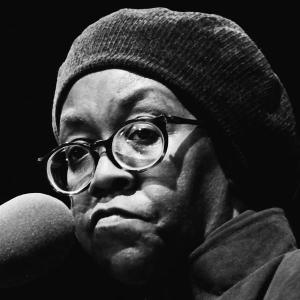 In this edition of HoCoPoLitSo’s The Writing life, revered American poet Gwendolyn Brooks sat down in 1986 to talk with Alan Jabbour, director of the Library of Congress’ American Folklore division, and E. Ethelbert Miller, poet and director of the African American Resource Center at Howard University.
Brooks was the Library of Congress’ 29th consultant in poetry, and tells the story in this program of winning the Pulitzer at age 32, and getting the phone call in the dark because the electric company had cut off their power because they couldn’t afford to pay the bill. She recites “We Real Cool,” a poem she says has lasted because of its “insouciance and staccato effect.” She talks about her introduction to black nationalism, feminism and James Baldwin. Brooks says, “I like for blacks to be proud of what they have come from. They need to learn they have much to be proud of.”
 HoCoPoLitSo