Home » Posts tagged 'Ellen Conroy Kennedy Poetry Contest'
Tag Archives: Ellen Conroy Kennedy Poetry Contest


Meet Neha Misra — Second Place Winner of the Ellen Conroy Kennedy Poetry Contest
In 2021, Howard County Poetry and Literature Society launched the Ellen Conroy Kennedy Poetry Prize in honor of its founding member, Ellen Conroy Kennedy. Now in its forth year, contest judges evaluated many submissions for mechanics and technique, clarity, style/music for our contemporary age, imagery/sensory power, and emotional resonance. Congratulations to this year’s second place winner, Neha Misra and the poem, “Vanishing Gardens Return”. The judges appreciated the skillful use of form; vivid and original imagery; compact storytelling; familial, social, and cultural resonance. Read on (below the video) to learn a little about our second place poet and to hear the poem recited.
Tell us about your poem “Vanishing Gardens Return”. How did it come about? What sparked or inspired it?
“Vanishing Gardens Return” is a poetic contemplation on the loss of metaphorical and physical gardens in the Anthropocene age of disconnection from Mother Earth, of which we human beings are a fractal part. We are living through a global climate emergency whose disproportionate impacts are all around us. 2024 was the hottest year in the entire recorded history of our planet. “Vanishing Gardens Return” is inspired by the personal, collective, planetary context of this reality. The poem ponders the inter-generational seduction of relentless industrialization that took me and so many farther and farther away from mother tree. The poem is a ritual of grief. By recognizing and honoring this grief, I plant the seeds of possibilities where vanishing gardens return and healing is possible.

What was an early experience where you learned that language had power?
I am a first-generation immigrant poet rooted in my Global Majority lineage as a multi-lingual Indian American woman. Embodying the power of language is an inheritance from my elders, culture, and migratory life experiences. My parents — an engineer and a doctor, are avid poetry lovers so my whole life has been soaked in poetry as an integral part of life. From my first waking memory, I remember being enveloped in songs, lullaby’s, poems that are a part of family’s fabric. From dinner tables to traffic jams to daily triumphs and aches, I have been lucky that have this inheritance of poetry in the most ordinary and extraordinary ways.
As a writer, what would you choose as your mascot/avatar/spirit animal?
I would not choose the word “spirit animal” out of a deep respect for what is very specific sacred cultural term for the Indigenous traditions of Turtle Island that is my adopted home.
As a writer rooted in the spiritually ecology traditions of my South Asian culture, I feel a multi-species kinship with flora and fauna across Asia, where I was born; Africa, where I spent a considerable time working on grassroots women-led climate solutions, and North America – my adopted immigrant home. Trees and birds are especially abundant across my poetics.
Tell us about a writer or a book that you return to over and over for inspiration.
Nikki Giovanni, who we lost last year, is one of my favorite poetry elders. I return to her book “A Good Cry” time and again. My much loved and annotated copy of her book feels like an old friend with whom I have cried and giggled through many time travels.
What are you working on next and where can we find you?
I am working on finding a values-aligned, community driven publisher for my debut poetry collection inspired by my migratory life and dreams. I curate, perform, share poetry and art in many forms across the Washington, metro region and online. The best way to find about these offerings is through my monthly newsletter “Color Portals”. Learn more at nehamisrastudio.com or follow me on Instagram @nehamisrastudio
Neha Misra नेहा मिश्रा (she/her) is an award-winning immigrant poet, contemporary eco-folk artist, and climate justice advocate. Her interdisciplinary practice builds bridges between private, collective, planetary healing and justice. Neha is a Public Voices Fellow on the Climate Crisis — an initiative of the OpEd Project and the Yale Program on Climate Change Communication to change who writes history. She is the Global Ambassador of non-profit Remote Energy, making solar training more accessible for women of color. Learn more at nehamisrastudio.com
The 2024 Ellen Conroy Kennedy Poetry Prize
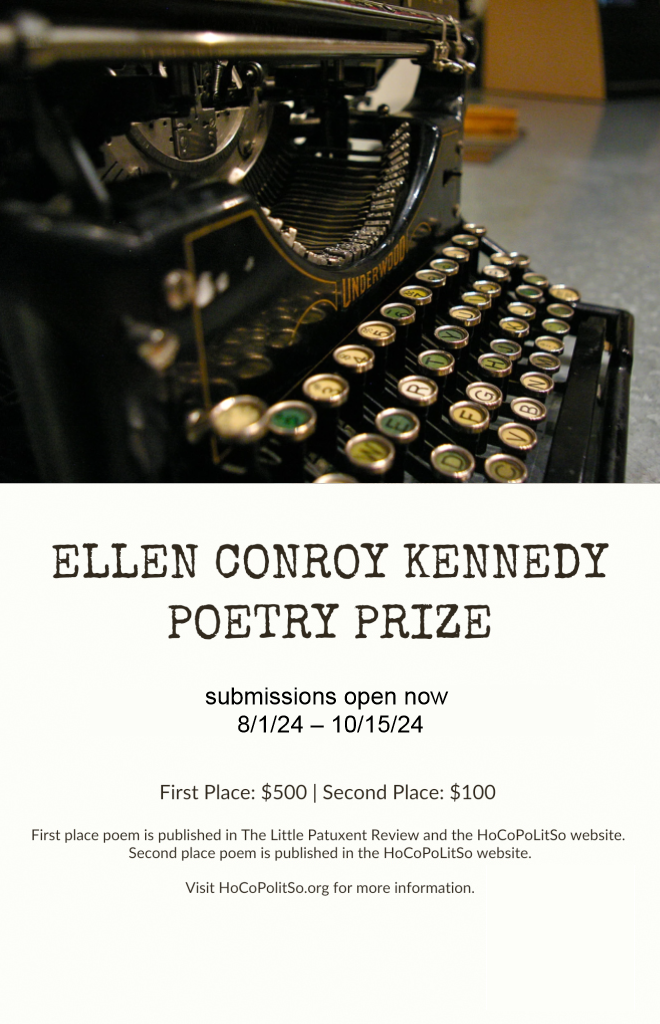
Held annually in loving memory of HoCoPoLitSo’s co-founder, the 2024 Ellen Conroy Kennedy Poetry Prize is now open to all entrants! Whether you are a life-time poet or have never written a line before, we invite you to share with us whatever moves you to poetry.
The author of the poem selected for first place will be awarded a cash prize of $500, celebrated on HoCoPoLitSo’s website, social media, and in our annual report— and have their winning poem published in The Little Patuxent Review and right here on HoCoPoLitSo’s front page.
To enter, click here, or visit the contest’s page to learn more or to read past winners’ poems. A reading fee of $10 per entrant supports a panel of fair and balanced judges.

Meet Chrissy Stegman — 2022 Second Place Winner of the Ellen Conroy Kennedy Poetry Contest
In 2021, Howard County Poetry and Literature Society launched the Ellen Conroy Kennedy Poetry Prize in honor of its founding member, Ellen Conroy Kennedy. Now in its second year, contest judges evaluated many submissions from poets in ten states and three countries for mechanics and technique, clarity, style/music for our contemporary age, imagery/sensory power, and emotional resonance. They noted in “Blue Irises” the creative use of form, the original approach to this poignant subject, the resonant voice of the speaker, and the powerful tension of the poem’s arc.
Tell us about your poem “Blue Irises” How did it come about? What sparked or inspired it?

I received my annual postcard in the mail from GBMC hospital, asking for donations to the NICU. It reminded me.
My youngest son was born early and via emergency c-section. When he arrived, he was whisked away to the NICU.
The poem came from this experience and from the despair I felt at being in the NICU to nurse him or see him whenever they allowed me but also, the other babies sometimes didn’t survive. It was a devastating juxtaposition, living in that space of life and death. It stayed with me.
What was an early experience where you learned that language had power?
That’s a difficult question for me to answer. I suppose it would be the hours I spent in various libraries as a child. Reading saved me so many times, supported me, gave me strength. The power was evident. Language can do that — it reminds me of a passage from The Bow and the Lyre (Octavio Paz): Man is a being who has created himself in creating a language. By means of the word, man is a metaphor of himself.
As a writer, what would you choose as your mascot/avatar/spirit animal?
My mascot would be pure crystalline silence. I have four school-aged kids in the home (one adult child out in the world) and it’s challenging to find the space and quiet to write and work things out. If not silence, then all of Rocky Mount and Ferrum, VA and the blackberry brambles there, the train tracks, and the cemetery. The Blue Ridge mountains? Take me home. Country roads.
Tell us about a writer or a book that you return to over and over for inspiration.
It’s always Elizabeth Bishop, Rilke, Harryette Mullen, Camus, Anne Carson, Theodore Roethke, Mark Strand, Larkin … I mean, it’s impossible to pick only one writer or book. The Order of Time by Carlo Rovelli is gorgeous.
What are you working on next and where can we find you?
Currently, I’m taking an advanced masterclass at the 92NY Unterberg Poetry Center, New York. I’m also working on a book of poems that offers an interactive quality for the reader and finishing up my first chapbook. I have two poems coming out in March (Gone Lawn) and May (Blue Heron Review) so 2023 is off to a great start.
I can be found on IG: thegoosefaerie and Twitter: @pimpledrose
 HoCoPoLitSo