Home » Posts tagged 'poems'
Tag Archives: poems


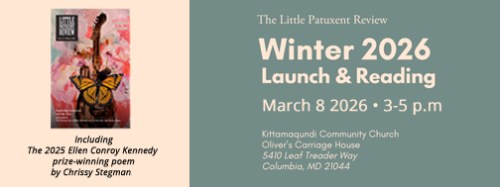
Meet Chrissy Stegman, Winner of the 2025 Ellen Conroy Kennedy Poetry Prize.
In 2021, Howard County Poetry and Literature Society launched the Ellen Conroy Kennedy Poetry Prize in honor of its founding member, Ellen Conroy Kennedy. Now in its fifth year, contest judges evaluated many submissions for mechanics and technique, clarity, style/music for our contemporary age, imagery/sensory power, and emotional resonance. Congratulations to first place winner this year, Chrissy Stegman, and the poem “Please Be Kind, Rewind”. Read on to learn a little about the this poet and to hear the poem recited. Stegman was runner up for the 2022 Ellen Conroy Kennedy Poetry Prize. Congratulations to the poet!
Tell us about your poem, “Please Be Kind, Rewind.” How did you balance the gravitas of its content with its formal charm?
The formal constraints of “Please Be Kind, Rewind” are not ornamental, more they function as a kind of psychic architecture. The poem’s reversals, repetitions, and palindromic logic enact the speaker’s denial of the loss event itself. By fracturing the experience into segments, into units that can be read forward, backward, or laterally, my poem resists narrative finality. There is no single, forward-moving version of what happens. The loss is broken into parts small enough to be handled, rearranged, yet almost disguised.
Because the poem is designed to be read in reverse at its close, the reality the speaker gestures toward never fully arrives. The catastrophe is perpetually deferred. In this sense, the form becomes a strategy of hiding: the speaker is always just before the moment of recognition, always rewinding to the last place where hope still exists. The music and symmetry create a kind of inertia where transformation does not lead to release but to suspension. Grief is present everywhere, but it is never allowed to complete itself.
Talk a little bit about your process. How does the spark find you and then make its way into a poem?
The spark usually comes through language before the meaning, like in an image, a sound, a misreading, a word that tilts and becomes something else. I’m interested in what happens when words collide or misbehave, when sound begins to generate sense rather than merely accompany it. A phrase will catch because of its music or its pressure, and I’ll carry it around, letting it accrue associations. Like most poets, I’m obsessive about words, their textures, their echoes, the way one word calls another into the room.
So I play in that space. I rarely sit down determined to write a particular poem. Sometimes there’s a memory I’m curious about, but I rarely begin thinking, I need to write about this. I also write a lot of ekphrastic poetry because I’m drawn to color and to art as a medium. It’s easy to imagine a different story from a painting. I enjoy casting old scenes into new landscapes. I often think, while writing: why not? I am fascinated by transformation.
If you could turn yourself into a metaphor, what would it be and why?
This was such a fun question! I’d probably be a VHS tape that’s been recorded over too many times, weddings, footage of a farm, home movie of a dog, emergency broadcast, all bleeding into one another. A little warped for sure, a little ghost-y, but still functional. Still holding.
Tell us about a new poet or book of poems that you’ve come across that stopped you in your tracks.
Susan Leary’s Dressing the Bear stopped me immediately. The poems are intimate without being precious, emotionally astute without over-explaining themselves. What struck me first was her lyric precision and sonic control. What she does with sound is impressive work. The lines are attentive to cadence and pressure, to what repetition can hold, to how music can sharpen rather than soften emotional impact.
The book also landed with particular force for me because of its attention to loving someone who is struggling, especially when that struggle is shaped by addiction and unfolds within a family system. There is a deep, aching intelligence in the way the poems hold love alongside harm and responsibility alongside helplessness.
What are you working on next and where can we find you now?
I’m finishing a full-length manuscript while staying open to the world around me, or at least I hope! Working, looking, paying attention. Alongside that, I’ve completed a second chapbook and am currently looking for the right publisher for it. You can also find me at my website: www.chrissystegman.com
I’ve also begun exploring a 1940s Purma camera, a British camera designed to relinquish control: it rotates internally, making each exposure dependent on chance and gravity rather than intention. I’m drawn to it as a practice I’m still learning, a way of seeing that resists mastery. I’m curious about how its unpredictability might begin to inform my poems rather than simply accompany them.
In addition, I’m experimenting with stop-motion animation and linocut, interested in what happens when poems leave the page!
I’m also very aware that my creative life is inseparable from my domestic one. I’m the mother of five children, which means my days are structured around attention, interruption, negotiation, and wondering why I came into a room. Somewhere between packing lunches, locating lost shoes, and refereeing minor domestic epics, the poetry work continues.
Chrissy Stegman is a three-time Best of the Net and Pushcart-nominated poet and writer from Baltimore, Maryland. Recent work has appeared in Rattle, River Heron Review, Jake, UCity Review, Gone Lawn, Gargoyle Magazine, Stone Circle Review, Fictive Dream, Inkfish, 5 Minutes, Libre, and BULL. Her chapbook, Somewhere, Someone Is Forgetting You, was published by Alien Buddha Press. She is a 2025 MVCWI Fellow and recipient of the Idyllwyld Arts Scholarship for Poetry and a finalist in the 2025 Wergle Flomp Humor Poetry Contest.
Meet Neha Misra — Second Place Winner of the Ellen Conroy Kennedy Poetry Contest
In 2021, Howard County Poetry and Literature Society launched the Ellen Conroy Kennedy Poetry Prize in honor of its founding member, Ellen Conroy Kennedy. Now in its forth year, contest judges evaluated many submissions for mechanics and technique, clarity, style/music for our contemporary age, imagery/sensory power, and emotional resonance. Congratulations to this year’s second place winner, Neha Misra and the poem, “Vanishing Gardens Return”. The judges appreciated the skillful use of form; vivid and original imagery; compact storytelling; familial, social, and cultural resonance. Read on (below the video) to learn a little about our second place poet and to hear the poem recited.
Tell us about your poem “Vanishing Gardens Return”. How did it come about? What sparked or inspired it?
“Vanishing Gardens Return” is a poetic contemplation on the loss of metaphorical and physical gardens in the Anthropocene age of disconnection from Mother Earth, of which we human beings are a fractal part. We are living through a global climate emergency whose disproportionate impacts are all around us. 2024 was the hottest year in the entire recorded history of our planet. “Vanishing Gardens Return” is inspired by the personal, collective, planetary context of this reality. The poem ponders the inter-generational seduction of relentless industrialization that took me and so many farther and farther away from mother tree. The poem is a ritual of grief. By recognizing and honoring this grief, I plant the seeds of possibilities where vanishing gardens return and healing is possible.

What was an early experience where you learned that language had power?
I am a first-generation immigrant poet rooted in my Global Majority lineage as a multi-lingual Indian American woman. Embodying the power of language is an inheritance from my elders, culture, and migratory life experiences. My parents — an engineer and a doctor, are avid poetry lovers so my whole life has been soaked in poetry as an integral part of life. From my first waking memory, I remember being enveloped in songs, lullaby’s, poems that are a part of family’s fabric. From dinner tables to traffic jams to daily triumphs and aches, I have been lucky that have this inheritance of poetry in the most ordinary and extraordinary ways.
As a writer, what would you choose as your mascot/avatar/spirit animal?
I would not choose the word “spirit animal” out of a deep respect for what is very specific sacred cultural term for the Indigenous traditions of Turtle Island that is my adopted home.
As a writer rooted in the spiritually ecology traditions of my South Asian culture, I feel a multi-species kinship with flora and fauna across Asia, where I was born; Africa, where I spent a considerable time working on grassroots women-led climate solutions, and North America – my adopted immigrant home. Trees and birds are especially abundant across my poetics.
Tell us about a writer or a book that you return to over and over for inspiration.
Nikki Giovanni, who we lost last year, is one of my favorite poetry elders. I return to her book “A Good Cry” time and again. My much loved and annotated copy of her book feels like an old friend with whom I have cried and giggled through many time travels.
What are you working on next and where can we find you?
I am working on finding a values-aligned, community driven publisher for my debut poetry collection inspired by my migratory life and dreams. I curate, perform, share poetry and art in many forms across the Washington, metro region and online. The best way to find about these offerings is through my monthly newsletter “Color Portals”. Learn more at nehamisrastudio.com or follow me on Instagram @nehamisrastudio
 HoCoPoLitSo