Home » Posts tagged 'Poetry Moment' (Page 2)
Tag Archives: Poetry Moment


Poetry Moment: Li-Young Lee pays attention to reading
If we’re lucky enough, we remember elders reading books to us as children. And then, if we’re doubly lucky, we become readers, and pass the literary love down to successive generations.
In this week’s Poetry Moment, Li-Young Lee distills this moment of everyday parenthood into a poem that transforms the act of reading into something sacred. A mother reads to her child in the next room. A listener can hear the cadence, the love in the voice, but not discern the story.
Lee explains the origin of the poem in the full Writing Life interview from 1995.
“I was waking up every morning and listening to my wife read to our son in the other room, morning after morning after morning,” Lee said. “Every morning I woke up experiencing that, I realized I was in the presence of something really magical and wonderful, and on the one hand, eternal, and on the other hand, very impermanent. I didn’t know how much longer he would allow his mother to read to him like that. I knew that somehow I was in the presence of poetry, and it was up to me to find the place in myself where I could pay attention enough to write this.”
And by paying attention to this moment, Lee calls readers of his poem to attend as well.
“It’s unconscious when I’m writing,” Lee said. “I’m hearing a story being read, I never hear the story, I just hear the voice. The poem is trying to enact the voice. I’m really interested in, not so much the particular stories that are being told, but I feel as if there’s a greater telling that goes on in the universe. That there’s a telling voice that is telling all the time. Everything is discourse–leaves, trees, clouds–it’s all discourse, not only language. Or we can say everything is language. I’m curious about what that other language is. Sometimes it’s clearer when you don’t hear the words, because of the wall that separates you, but you hear the intonation of the voice, so you know you’re in the presence of a telling, but not necessarily what is being told. So it’s the telling voice that I’m really just in love with.”
Lee had a harrowing early start to his life. His father had been Mao Zedong’s personal physician, but his parents fled China as political exiles. After settling in Indonesia, anti-Chinese sentiment rose in that country and his father was arrested and held as a political prisoner for a year. After a five-year trek through Macau, Hong Kong and Japan, the family finally settled in America. But he does remember his father reading to him, even during their flight, and how later his father required him to memorize literature and recite it.
The poetry Lee writes has a quality of mysticism to it, a way of taking a sacred look at everyday events, such as reading a story to a child. He compares writing poetry to praying. In an interview with Poets & Writers, Lee said that part of the mission of poetry was to help build heaven on earth.
“The condition of prayer is a state wherein we have a kind of focus and yet we have a wide peripheral attention, and somehow it seems to me that good poems enact that kind of condition, where we are very focused, very concentrated, on the one hand, and on the other hand, we have a very wide periphery, a wide awareness,” Lee said in The Writing Life interview.
Lee’s memoir of his early childhood, The Winged Seed, is an amalgamation of his memories, his father’s sermons, dreams, prayers, and lyrical moments: “My father asleep at a train window is a member of the rain fallen momentarily out of favor. And only he and God know he’s changed his name again to flee yet another country. And the child singing beside him is me. And I am so many things: An expert in tying and untying knots. A traveler stranded on that ancient peak called Father’s Heart. A hidden grape distilling light and time to render news of the living.
A man fallen asleep at his desk while reading is apple blossoms left lying where they fell. The child who comes to wake him by kissing his hands is so many things: Love succeeding. The eye of the needle. Little voice calling the flowers to assembly.
May the child never forget the power of the small.
May the man never wake a stranger to himself.”
Lee never forgot the power of the small, the sacred moment of reading to a child. This poem helps readers do the same.
Susan Thornton Hobby
Producer of The Writing Life
Poetry Moment: Welcome to the party, Seamus Heaney
Back in April, HoCoPoLitSo conceived of its Poetry Moment series as a dose of soothing literature during the pandemic shut-in. When George Floyd was murdered in May, renewing the Black Lives Matter movement, we changed our focus. In support of the racial justice, HoCoPoLitSo wanted to amplify the voices of the Black poets who have read for our audiences here in Howard County. Now it’s September and we’re inviting other voices to join our verse party to continue these conversations about what divides and unites us.
Poetry Moment will now include poets of other backgrounds, including Irish, Chinese, Muscogee (Creek), Latinx, and Baltimorean, including Lucille Clifton and Josephine Jacobsen.
We’re starting with Seamus Heaney, a Nobel Prize-winner and force of nature who read for our audiences three times. Called the greatest Irish poet since Yeats, Heaney died in 2013. But the hour-long interview from 1988, excerpted here, remained in our archives until we could negotiate and pay for rights to air it. We finally secured those rights last year, and we’re grateful to Padraic Kennedy for his donation that covered those costs.
This week’s Poetry Moment also includes a face many in Howard County knew and loved, Ellen Conroy Kennedy, who co-founded HoCoPoLitSo in 1974, and died this past February. Padraic and Ellen, married for nearly 65 years, are the foundation that HoCoPoLitSo is built upon.
At the beginning of this week’s video, Ellen can be heard, and then seen, requesting Heaney’s poem “Digging.” “Recited,” she adds. Heaney smiles. He knew Ellen well, and like most in the poetry world, could not refuse her.
He then recites his iconic poem. When I was teaching students this poem, they didn’t understand how the rhymes fit together until they heard it in his voice. Then they understood the connection between “ground” and “down” and “sods” and “bog.” They didn’t know that when Heaney pronounced “gravelly ground,” it sounded just like the scrape of a shovel into soil.
Any time we can offer poems in the voice of the author, we’re doing the world a service. And this voice seems timely to hear now because of the increasing fracturing of our country over racial justice, and political divisions in general.
Heaney’s voice was well known in Ireland during the troubles, the sectarian divisions and violence that pitted citizens of different religions against each other from the 1960s to 1998.
“Ireland has been characterized by a tradition of sectarian violence,” Duke University’s President Richard Brodhead said during a Trinity College of Arts and Sciences tribute to Heaney after his death. “Not armies against armies, but between people who live together by day and (had) the violence suddenly intrude on their domestic lives. His poems are an uncanny evocation of this intimate violence.”
While he was never overtly political, Heaney talks in this hour-long episode of The Writing Life about an intimately violent poem he wrote in the seventh section of Station Island, the shooting of a young man he knew in Ulster after police arrived at his door.
“Because, see, in Ulster, as in shall we say, you could have imagined a situation some years or decades ago in the Southern states of the United States, where someone could be a virulent bigoted Klan member, but also be wearing the uniform of impersonal justice, in other words a policeman, so that they hygiene of the uniform is no guarantee. You actually have the festering stuff underneath it,” Heaney tells the audience in 1988. He explains that he isn’t pinning blame in his poem, he doesn’t accuse the police, he’s talking in universal terms about the killing of a man he knew. And he finishes with explaining, “Politics in Northern Ireland, and politics in El Salvador and politics in Iran and politics in Israel, it’s all spectator sport for most people. Of course it’s necessary for those of us outside to be concerned, but the real energy is intimate. I think that writing has to concern itself with the first circle, with the intimate place where everything is exact, rather than with the second or third circle, where the big parties are watching and you’re getting publicity. Poetry isn’t concerned with publicity.”
Poetry not publicity. Sounds like a great motto. Now more than ever, poetry’s witness and wisdom provide a window of understanding into other’s lives. Listen to this voice, so specifically Irish, and hear the universal, as when Gwendolyn Brooks spoke of her seven at the Golden Shovel in “We Real Cool,” or Tyehimba Jess read about Blind Tom the musical savant, or Patricia Smith channeling the voice of a hurricane. HoCoPoLitSo’s mission is to amplify literature’s voices, to allow words to change the world.
Susan Thornton Hobby
The Writing Life producer
Poetry Moment: Patricia Smith stuns with hurricane poem
Fifteen years ago today, Hurricane Katrina blew apart the bayou.
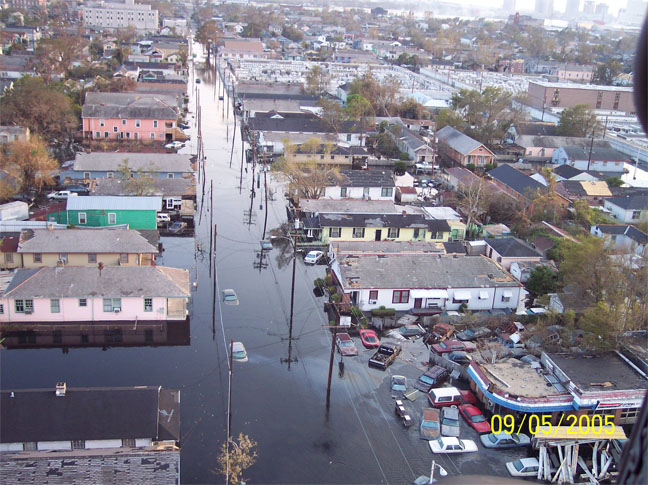
While many people suffered in the storm and its aftermath, Black and brown people who lived in the path of that category 5 Atlantic hurricane were disproportionally traumatized.
New Orleans and its surrounding bayous were soon filled with the dead bodies of more than of its 1,200 citizens. Eighty percent of the city was under water and didn’t drain for weeks. Survivors waited on bridges and rooftops for days in the blistering sun. The Superdome shelter became a vision of hell—steaming hot and filled with thirsty, wounded, and moaning hurricane survivors. The government’s lackluster rescue operation, as well as the determination that the Army Corps of Engineers had built faulty levees that failed to protect the city’s residents, are the bitter pills that New Orleans had to swallow.
Poet Patricia Smith, like most of the rest of America, watched horrifying images on television of the storm and its aftermath. But Smith turned the horror into something beautiful, a collection of poems, Blood Dazzler.
In 2013, as part of the Columbia Festival of the Arts, HoCoPoLitSo hosted Smith. She read her suite of poems about the hurricane as the Sage String Quartet played Wynton Marsalis’ “At the Octoroon Balls” for an audience that was struck silent and teary-eyed.
HoCoPoLitSo also produced a television interview that weekend. Poet Joseph Ross interviewed Smith for a conversation that touched on her origin as a writer listening to her father tell stories on their Chicago back porch, and her inspiration for Blood Dazzler. Ross describes the collection as coming from a choir of voices, including that of the hurricane herself. Smith explained that she’s not from New Orleans, she has no tether to the Gulf region.
“The primary role of a storyteller is as a witness,” Smith said. “And Katrina was not just a regional story, it was a national story. You’re seeing what your country is capable of. I watched Katrina unfold the way thousands of other people did. The difference is that in my role as witness, in my role as writer, I felt that I could use my writing to process that story. I’m trying to make the story makes sense–that’s how I approach a lot of stories–this can’t be possible, this can’t be true. Let me enter it through my writing and see if I can find something that I’m not seeing on the surface.”
This Poetry Moment’s poem, “8 a.m. Sunday, August 28, 2005”, is in Katrina’s commanding, menacing voice. Finding Katrina’s voice, Smith said, was easiest for her.“Persona allows me to enter a story in a way that is going to open up a lot of other avenues right away,” Smith said. “It never occurred to me not to give Katrina a voice. That also left me some touchstones – I tried to keep it roughly chronological and follow the development of the storm, but every once in a while, I’d say, “Now Katrina is feeling this. Now she’s angry, now she’s remorseful, now she’s saying ‘Maybe I overdid it.’ ”
Katrina, like one of the Greek goddesses spurred into destruction by humans’ blunders, came down hard on the planet. But she was fed with warm water from the oceans, growing warmer by the minute thanks to humans causing climate change.
This summer has been a hard one for so many. As I write, Hurricane Laura is barreling toward Category 4 status, with the Gulf Coast in its path. Wildfires are blazing in California, destroying homes and animals and redwoods and people’s lives. Death Valley hit 130 degrees, the highest temperature recorded since 1913 on this planet. Climate change isn’t in the distance. It’s here. And there is an intimate link between racial injustice and climate change, with communities of color disproportionately suffering as the world warms.
Poetry can tell stories, and it can bear witness. We’re going to need to witness much more in the coming years, as climate change whips up storms and harsh weather that will batter this country, and the world. Words can change the world, yes, but only if humans listen.
Susan Thornton Hobby
Producer of The Writing Life
Poetry Moment: Jason Reynolds offers a pep talk for everyone
Students across the nation are returning to their studies this fall in a time of fear and in methods that are bizarre. Most of them won’t board buses with their parents sniffing back tears on the sidewalk. They won’t giggle in clusters or eat in cafeterias. College students won’t be packing stadiums or gathering on the quad. This fall, hardly any students need new backpacks full of crisp lined paper and pointy pencils.
Instead, there are masks outside their homes, and Zoom inside. Instead, students are learning on their own. They’re sharing computers or borrowing them from schools. And freshly reopened wounds of systemic violence and racism against Black Americans are compounding the pandemic pain. Students are suffering in ways that adults can’t begin to understand.
HoCoPoLitSo can’t fix things. But we can offer a token of our appreciation of the circumstances. This week’s Poetry Moment is a shot in the arm from Jason Reynolds, New York Times bestselling writer of books such as Long Way Down, Patina and the rest of his track series, All-American Boys, and the Marvel Comics graphic novel Miles Morales: Spider-Man.
Reynolds, who grew up in D.C. and Maryland and had never finished a complete book until he was 17, used the power of poetry, rap, and his own determination to become an author. He’s now won the Walter Dean Myers Award, a Newbery, a Kirkus Prize, the Coretta Scott King Award, and an NAACP Image Award.

In this Poetry Moment, Reynolds reads from his book For Every One, a sort of pep talk in verse, recorded in 2018, long before a pandemic was dreamt of.
“This is a pep talk for me,” Reynolds explains. “This isn’t a book of answers, I don’t know how to fix it, but I do know how it feels to have it feel broken.”
His book isn’t a self-help book, he explains, because he doesn’t feel qualified to assist. In fact, he tells young people, he needs help to get done the things he does. Writing is difficult, Reynolds says. Without editors, he says, he wouldn’t be able to get by. “I still don’t know how to use a comma,” he says.
In his writing, he says, he tries to show his characters’ vulnerability and the difficulties that they’re facing. Just like students, he says.
“I tell the teachers, you have no idea what some of your students had to do just to get there,” he says.
Named in January as the Library of Congress National Ambassador for Young People’s Literature, Reynolds is evangelizing words as a power to change the world.
“The truth is, if we’re looking at history as our compass, it will show us over and over again that the way to change is through children. The way to change is through youth,” he said, in an interview after his appointment as ambassador.
His new book, Stamped: Racism, Anti-Racism, and You, is a remix for young people of Ibram X. Kendi’s National Book Award-winning Stamped from the Beginning: The Definitive History of Racist Ideas in America. In the first chapter, Reynolds explains what he’s hoping to talk about in the book: “This isn’t a history book. Or, at least, it’s not that kind of history book. Instead, what this is, is a book that contains history. A history directly connected to our lives as we live them right this minute. This is a present book. A book about the here and now.”
The here and now is pretty rough. And we don’t know how it’s going to turn out. But Reynolds is mindful of uncertainty. In fact, his books embrace an unconventional plot strategy. We never know whether Patina or any of the other characters from his series about a track team of runners, win their races. “They show up,” Reynolds says. And that’s enough.
Patina’s story, he explains, “doesn’t tie up in a neat bow, but none of my books do, only because I think life doesn’t do that. … I think it’s disrespectful of the reader to give away answers. I think our job is to lead them to the point where they can do the rest of the work themselves.”
Sending strength for the rest of the work to students, teachers, parents, and every one, from Jason Reynolds and HoCoPoLitSo.
— Susan Thornton Hobby
The Writing Life producer
Poetry Moment: Toi Derricotte evokes a legacy of poetry and cruelty
This week’s poem contains a legacy.
Like a story told and retold on families’ front porches, this Poetry Moment features author Toi Derricotte reading a poem that changed her life, “Southern Road” by Sterling Allen Brown.
With colloquial rhymes and dialect, the poem’s haunting rhythms echo the stories and songs of chain gangs. Conceived during the Civil War to provide free labor, chain gangs proliferated in the South until the 1950s, when they were largely phased out in most of the nation. The practice lingered in Georgia and North Carolina until the 1970s, and was resurrected in the 1990s “tough on crime” era.
Chain gangs became part of American culture, with Nina Simone and Sam Cooke writing songs about the lines of prisoners often seen along Southern roads.
Prisoners, many of whom were Black and most of whom were convicted of minor crimes, were shackled together at the ankles to provide states free labor. They broke rocks, built the nation’s roads and highways, dug holes. Treated cruelly, prisoners were sometimes kept in cages, and usually fed little and beaten liberally. For photos and history of the chain gang, see this fascinating and horrifying history project by the University of North Carolina Greensboro.
Brown’s poem called forth the chain gang’s speech and song in a way that American readers had never seen. Poet Derricotte explained that besides Langston Hughes, she read no works by Black writers in grade school, in high school, or even in college. When she started reading Brown’s poems, “they blew my mind.” In this Poetry Moment, Derricotte reads only the last three stanzas of Brown’s iconic poem.

Brown was born on the campus of Howard University in Washington, D.C., attended Harvard, then returned to Howard to teach for more than 40 years until he retired in 1969. Brown, whose father was born into slavery and became a prominent minister and professor at Howard, became a bridge between the Harlem Renaissance and contemporary Black poets like Derricotte.
A 2019 finalist for the National Book Award for Poetry, Derricotte visited HoCoPoLitSo in November 2012 to read her own poetry and talk about the legacy of Lucille Clifton, our longtime artistic advisor and the nation’s beloved, award-winning poet. Before she read for our audience, Derricotte filmed an interview about her work with E. Ethelbert Miller, poet and activist from D.C. who knew Brown well. Miller asked her to read some poetry that inspired her. Derricotte chose a Sylvia Plath poem, and this work by Brown.

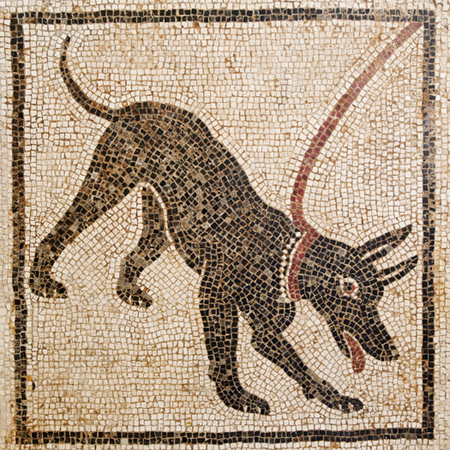
Derricotte has her own legacy to pass on. She and poet Cornelius Eady formed Cave Canem, a retreat and foundation to support and host African American poets. Cave Canem, which translates from Latin as “Beware the Dog,” was named after the mosaic of the protective dog at the entrance to the House of the Tragic Poet, preserved in Pompeii (see image below). Founded in 1996 to nurture Black poets, Cave Canem has supported thousands of Black poets with workshops, prizes, and readings. Fellows of the program have published more than 250 books.
Try one of their books, listen to “Southern Road” here, pick up The Collected Poems of Sterling Brown, read some of Derricotte’s confessional and personal work. Then sit on the porch with your family and tell these stories.
— Susan Thornton Hobby
Producer of The Writing Life
Sterling Brown Photo: By Source (WP:NFCC#4), Fair use, https://en.wikipedia.org/w/index.php?curid=42296826

Poetry Moment: A cool recitation by Gwendolyn Brooks
In 1985, Gwendolyn Brooks arrived from Chicago in Washington D.C., to become America’s first Black person to hold the position of Poetry Consultant to the Library of Congress.
Early in her term, she read at the Howard Woodson High School in D.C. As she began to recite her signature poem, “We Real Cool,” students popped up around the library, chanting her lines and snapping their fingers.
“I loved that,” she told the Library of Congress’s Alan Jabbour and poet E. Ethelbert Miller, who were interviewing her for HoCoPoLitSo’s first author interview show, which would become The Writing Life. “Young people like it because it has a kind of insouciance and a staccato effect that they enjoy.”
More than thirty years before, she had won the Pulitzer Prize in Poetry, but by the mid 1980s, Brooks had reached the pinnacle of her success. The very young poet and activist Miller and Jabbour interviewed Brooks in 1986 in a small room at the Library of Congress, supervised and produced by HoCoPoLitSo founder Ellen Conroy Kennedy. Here is that interview in full.
Brooks had also recited “We Real Cool” September 30, 1985, in front of a packed audience, after 300 people had been turned away from the Library of Congress’s auditorium. Her most anthologized work, the poem had become one that audiences would request.
The Library of Congress, just this past April, digitized and uploaded the recording of that reading, during which Brooks says, “At this point I better recite ‘We Real Cool’ before I forget. I know some of you are sick and tired of this poem, because if you see my name, you see it. It’s been published in a good many school textbooks, but it has also been banned here and there—chiefly because, I understand, the word ‘jazz’ has been considered a sexual reference. That was not my intention, though I have no objection if it helps anybody—but I was thinking of music when I used the word ‘jazz.’ ”
In the HoCoPoLitSo interview, Brooks explains the short poem’s origin, which still speaks volumes to the nation’s treatment of young black people.
“I wrote it because I was passing by a pool hall in my neighborhood in Chicago one afternoon. And I saw, as I said in the poem, seven boys shooting pool,” Brooks said during the episode. “I wondered what they felt about themselves. I decided they felt not quite valid, certainly they were insecure, not cherished by the society, therefore, they would feel that they should, well, spit in the face of the establishment. I used the month of June as an establishment symbol. Whereas the rest of us love and respect June and wait for it to come so we can enjoy it. They would “jazz June,” derange it, scratch at it, do anything that would annoy the establishment.”
When Brooks recites the poem, she drops her voice at the end of the lines on the word “we.” She told interviewer George Stavros in 1969 that she does so because the protagonists are questioning their own validity.
“I say it rather softly because I want to represent their basic uncertainty, which they don’t bother to question every day, of course,” Brooks explained.
— Susan Thornton Hobby
Producer of The Writing Life

A Poem for Freedom: HoCoPoLitSo presents its third Poetry Moment
The former National Poet Laureate and official national treasure Rita Dove stars in this week’s Poetry Moment, featuring her poem “Lady Freedom Among Us.”
In an episode of The Writing Life, Dove explains to fellow poet Michael Collier that in 1993, she walked down to see the massive bronze statue of Freedom. The statue was lowered from its perch atop the U.S. Capitol Building by helicopter in May 1993 for repair and cleaning.

Dove thought the statue looked disheveled and dirty, rather like a homeless woman, and was inspired to write a poem.
Freedom, who wears a helmet of stars topped with an eagle’s head and a robe trimmed in fur, holds a sheathed sword, a laurel wreath, and the shield of the United States. On Oct. 23, 1993, when the buffed-up and repaired statue was lifted back onto its pedestal atop the Capitol building, Dove read her poem for the ceremony.
Dove visited HoCoPoLitSo audiences in 1999 and in 2015. In this clip, Dove reads her poem about the statue, “Lady Freedom Among Us” from her book On the Bus with Rosa Parks.
— Susan Thornton Hobby
Producer of The Writing Life
HoCoPoLitSo Stands Against Racism; Poetry is One of Our Weapons
HoCoPoLitSo was founded to celebrate diverse literary heritages and to foster literary appreciation in diverse populations, including varying gender, ethnic and cultural identities, age groups, and income levels. We believe that opening a book, reading a poem, or attending a literary event can be a powerful humanistic journey of exploration, education, and enlightenment. We all benefit when we seek to deepen and extend our understanding of the experiences of others and ourselves.
We are profoundly sad and outraged by the violence perpetuated against black lives and by the ongoing systemic lack of accountability. We believe black lives matter, and we stand in solidarity with all those seeking to effectuate long-lasting change in our communities.
In an effort to do our part, we offer something new — HoCoPoLitSo’s Poetry Moment — as a way to address, extend, and deepen these crucial conversations. Starting today, we will be showcasing poems written and read aloud by black authors hosted by HoCoPoLitSo over our forty-five years, whose art examines and illuminates our American experience.
— The board and staff of HoCoPoLitSo
Poetry Moment: Terrance Hayes reads “Carp”
Terrance Hayes is an American poet and educator who has published seven poetry collections. In conversation with the poet Tara Betts in this #PoetryMoment clip from 2011, he reads “Carp” from the book Lighthead.
Because Black Lives Matter: Introducing The Poetry Moment
HoCoPoLitSo was founded to celebrate diverse literary heritages and to foster literary appreciation in diverse populations, including varying gender, ethnic and cultural identities, age groups, and income levels. We believe that opening a book, reading a poem, or attending a literary event can be a powerful humanistic journey of exploration, education, and enlightenment. We all benefit when we seek to deepen and extend our understanding of the experiences of others and ourselves.
We are profoundly sad and outraged by the violence perpetuated against black lives and by the ongoing systemic lack of accountability. We believe black lives matter, and we stand in solidarity with all those seeking to effectuate long-lasting change in our communities.
In an effort to do our part, we offer something new — HoCoPoLitSo’s Poetry Moment — as a way to address, extend, and deepen these crucial conversations. Starting today, we will be showcasing poems written and read aloud by black authors hosted by HoCoPoLitSo over our forty-five years, whose art examines and illuminates our American experience.
Sincerely,
The HoCoPoLitSo Board and Staff
Poetry Moment: Lucille Clifton reads “good times”
#BlackLivesMatter #HoCoPoLitSoPoetryMoment #PoetryMoment
 HoCoPoLitSo