Home » Posts tagged 'Writing'
Tag Archives: Writing


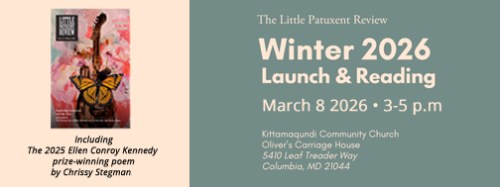
Meet Chrissy Stegman, Winner of the 2025 Ellen Conroy Kennedy Poetry Prize.
In 2021, Howard County Poetry and Literature Society launched the Ellen Conroy Kennedy Poetry Prize in honor of its founding member, Ellen Conroy Kennedy. Now in its fifth year, contest judges evaluated many submissions for mechanics and technique, clarity, style/music for our contemporary age, imagery/sensory power, and emotional resonance. Congratulations to first place winner this year, Chrissy Stegman, and the poem “Please Be Kind, Rewind”. Read on to learn a little about the this poet and to hear the poem recited. Stegman was runner up for the 2022 Ellen Conroy Kennedy Poetry Prize. Congratulations to the poet!
Tell us about your poem, “Please Be Kind, Rewind.” How did you balance the gravitas of its content with its formal charm?
The formal constraints of “Please Be Kind, Rewind” are not ornamental, more they function as a kind of psychic architecture. The poem’s reversals, repetitions, and palindromic logic enact the speaker’s denial of the loss event itself. By fracturing the experience into segments, into units that can be read forward, backward, or laterally, my poem resists narrative finality. There is no single, forward-moving version of what happens. The loss is broken into parts small enough to be handled, rearranged, yet almost disguised.
Because the poem is designed to be read in reverse at its close, the reality the speaker gestures toward never fully arrives. The catastrophe is perpetually deferred. In this sense, the form becomes a strategy of hiding: the speaker is always just before the moment of recognition, always rewinding to the last place where hope still exists. The music and symmetry create a kind of inertia where transformation does not lead to release but to suspension. Grief is present everywhere, but it is never allowed to complete itself.
Talk a little bit about your process. How does the spark find you and then make its way into a poem?
The spark usually comes through language before the meaning, like in an image, a sound, a misreading, a word that tilts and becomes something else. I’m interested in what happens when words collide or misbehave, when sound begins to generate sense rather than merely accompany it. A phrase will catch because of its music or its pressure, and I’ll carry it around, letting it accrue associations. Like most poets, I’m obsessive about words, their textures, their echoes, the way one word calls another into the room.
So I play in that space. I rarely sit down determined to write a particular poem. Sometimes there’s a memory I’m curious about, but I rarely begin thinking, I need to write about this. I also write a lot of ekphrastic poetry because I’m drawn to color and to art as a medium. It’s easy to imagine a different story from a painting. I enjoy casting old scenes into new landscapes. I often think, while writing: why not? I am fascinated by transformation.
If you could turn yourself into a metaphor, what would it be and why?
This was such a fun question! I’d probably be a VHS tape that’s been recorded over too many times, weddings, footage of a farm, home movie of a dog, emergency broadcast, all bleeding into one another. A little warped for sure, a little ghost-y, but still functional. Still holding.
Tell us about a new poet or book of poems that you’ve come across that stopped you in your tracks.
Susan Leary’s Dressing the Bear stopped me immediately. The poems are intimate without being precious, emotionally astute without over-explaining themselves. What struck me first was her lyric precision and sonic control. What she does with sound is impressive work. The lines are attentive to cadence and pressure, to what repetition can hold, to how music can sharpen rather than soften emotional impact.
The book also landed with particular force for me because of its attention to loving someone who is struggling, especially when that struggle is shaped by addiction and unfolds within a family system. There is a deep, aching intelligence in the way the poems hold love alongside harm and responsibility alongside helplessness.
What are you working on next and where can we find you now?
I’m finishing a full-length manuscript while staying open to the world around me, or at least I hope! Working, looking, paying attention. Alongside that, I’ve completed a second chapbook and am currently looking for the right publisher for it. You can also find me at my website: www.chrissystegman.com
I’ve also begun exploring a 1940s Purma camera, a British camera designed to relinquish control: it rotates internally, making each exposure dependent on chance and gravity rather than intention. I’m drawn to it as a practice I’m still learning, a way of seeing that resists mastery. I’m curious about how its unpredictability might begin to inform my poems rather than simply accompany them.
In addition, I’m experimenting with stop-motion animation and linocut, interested in what happens when poems leave the page!
I’m also very aware that my creative life is inseparable from my domestic one. I’m the mother of five children, which means my days are structured around attention, interruption, negotiation, and wondering why I came into a room. Somewhere between packing lunches, locating lost shoes, and refereeing minor domestic epics, the poetry work continues.
Chrissy Stegman is a three-time Best of the Net and Pushcart-nominated poet and writer from Baltimore, Maryland. Recent work has appeared in Rattle, River Heron Review, Jake, UCity Review, Gone Lawn, Gargoyle Magazine, Stone Circle Review, Fictive Dream, Inkfish, 5 Minutes, Libre, and BULL. Her chapbook, Somewhere, Someone Is Forgetting You, was published by Alien Buddha Press. She is a 2025 MVCWI Fellow and recipient of the Idyllwyld Arts Scholarship for Poetry and a finalist in the 2025 Wergle Flomp Humor Poetry Contest.
Meet Neha Misra — Second Place Winner of the Ellen Conroy Kennedy Poetry Contest
In 2021, Howard County Poetry and Literature Society launched the Ellen Conroy Kennedy Poetry Prize in honor of its founding member, Ellen Conroy Kennedy. Now in its forth year, contest judges evaluated many submissions for mechanics and technique, clarity, style/music for our contemporary age, imagery/sensory power, and emotional resonance. Congratulations to this year’s second place winner, Neha Misra and the poem, “Vanishing Gardens Return”. The judges appreciated the skillful use of form; vivid and original imagery; compact storytelling; familial, social, and cultural resonance. Read on (below the video) to learn a little about our second place poet and to hear the poem recited.
Tell us about your poem “Vanishing Gardens Return”. How did it come about? What sparked or inspired it?
“Vanishing Gardens Return” is a poetic contemplation on the loss of metaphorical and physical gardens in the Anthropocene age of disconnection from Mother Earth, of which we human beings are a fractal part. We are living through a global climate emergency whose disproportionate impacts are all around us. 2024 was the hottest year in the entire recorded history of our planet. “Vanishing Gardens Return” is inspired by the personal, collective, planetary context of this reality. The poem ponders the inter-generational seduction of relentless industrialization that took me and so many farther and farther away from mother tree. The poem is a ritual of grief. By recognizing and honoring this grief, I plant the seeds of possibilities where vanishing gardens return and healing is possible.

What was an early experience where you learned that language had power?
I am a first-generation immigrant poet rooted in my Global Majority lineage as a multi-lingual Indian American woman. Embodying the power of language is an inheritance from my elders, culture, and migratory life experiences. My parents — an engineer and a doctor, are avid poetry lovers so my whole life has been soaked in poetry as an integral part of life. From my first waking memory, I remember being enveloped in songs, lullaby’s, poems that are a part of family’s fabric. From dinner tables to traffic jams to daily triumphs and aches, I have been lucky that have this inheritance of poetry in the most ordinary and extraordinary ways.
As a writer, what would you choose as your mascot/avatar/spirit animal?
I would not choose the word “spirit animal” out of a deep respect for what is very specific sacred cultural term for the Indigenous traditions of Turtle Island that is my adopted home.
As a writer rooted in the spiritually ecology traditions of my South Asian culture, I feel a multi-species kinship with flora and fauna across Asia, where I was born; Africa, where I spent a considerable time working on grassroots women-led climate solutions, and North America – my adopted immigrant home. Trees and birds are especially abundant across my poetics.
Tell us about a writer or a book that you return to over and over for inspiration.
Nikki Giovanni, who we lost last year, is one of my favorite poetry elders. I return to her book “A Good Cry” time and again. My much loved and annotated copy of her book feels like an old friend with whom I have cried and giggled through many time travels.
What are you working on next and where can we find you?
I am working on finding a values-aligned, community driven publisher for my debut poetry collection inspired by my migratory life and dreams. I curate, perform, share poetry and art in many forms across the Washington, metro region and online. The best way to find about these offerings is through my monthly newsletter “Color Portals”. Learn more at nehamisrastudio.com or follow me on Instagram @nehamisrastudio
Neha Misra नेहा मिश्रा (she/her) is an award-winning immigrant poet, contemporary eco-folk artist, and climate justice advocate. Her interdisciplinary practice builds bridges between private, collective, planetary healing and justice. Neha is a Public Voices Fellow on the Climate Crisis — an initiative of the OpEd Project and the Yale Program on Climate Change Communication to change who writes history. She is the Global Ambassador of non-profit Remote Energy, making solar training more accessible for women of color. Learn more at nehamisrastudio.com
Meet Larraine Denakpo — 2023 Second Place Winner of the Ellen Conroy Kennedy Poetry Contest
1n 2021, Howard County Poetry and Literature Society launched the Ellen Conroy Kennedy Poetry Prize in honor of its founding member, Ellen Conroy Kennedy. Now in its third year, contest judges evaluated many submissions for mechanics and technique, clarity, style/music for our contemporary age, imagery/sensory power, and emotional resonance. Here, judges noted this poem’s “restrained composition” and “universal resonance.” One said, “This neatly packed, tiny poem is so enjoyable to read.” Congratulations on the second place win.
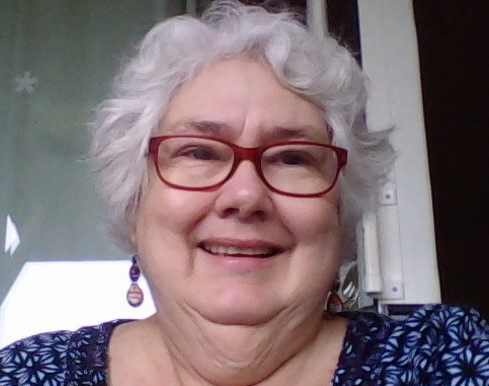
Tell us about your poem “Lullaby for Daughters”. How did it come about? What sparked or inspired it?
The poem was written around 1988-89 when our small family was living overseas in Bujumbura, Burundi. I had written some poems in a journal with no date and left them to mull for many years. The sentiment was inspired once as I watched our two young daughters sleeping. I am white, my husband black, and I was struck by how little the girls looked like me.
What was an early experience where you learned that language had power?
The written word has always been my friend; I was an early reader and devoured books constantly, escaping boredom and looking for answers. Later the poetry of lyrics in the 60s and 70s—from Bob Dylan to Joni Mitchell to Leonard Cohen – helped me cope with the world. But I first felt the power of poetry moving me to new ways of thinking in the works of women (Nikki Giovanni, Lucille Clifton and others) when I was in college. I attended Seton Hill College in Greensburg, PA and I credit several of the faculty there (the late Sister Lois Sculco and Dr. Lynn Conroy) for encouraging me to explore and practice poetry. I was lucky to attend poetry readings in Pittsburgh when I was in college and experienced readings by powerful poets like Derek Walcott and Adrienne Rich. I even put together a collection of poems as a senior in college (1975) and won an award, but then life happened and I only wrote poems when I found some calm in the daily bustle.
As a writer, what would you choose as your mascot/avatar/spirit animal?
I feel a stronger connection to all things green than to any animal. One of my earliest poems evokes a 10-year old me sitting in a maple tree and dreaming; no longer a tree climber I get inspiration from woods and gardens and memories of the green hills of tea and bananas that I found in Burundi.
Tell us about a writer or a book that you return to over and over for inspiration.
While I was working full-time and raising a family, I didn’t find much time for poetry or books. Now I am enjoying exploring much loved poets and discovering new ones. I do go back to both the poet A.R Ammons and the writer Annie Dilliard for the way they communicate about nature.
What are you working on next and where can we find you?
I am mostly retired after working for years on education projects in Africa. I have been focusing on quilting–combining African fabrics with the calico cottons of my childhood. I also explore my new hometown, Columbia, as well and just recently learned about HoCoPoLitSo. This contest took me by surprise and I entered a few old poems on a whim. Maybe I will work on putting together a collection in the years ahead. I have a LinkedIn profile if anyone wants to connect there.
Here, Larraine Denakpo reads “Lullaby for Daughters:
Bio:
I grew up in Carlisle, PA and left after high school in 1971, rarely returning during the next fifty years. After college (BA in English), I joined the Peace Corps and taught English in a small town in Benin. There I met my husband and together we spent time in the US with me getting an MA in Linguistics from the University of Pittsburgh. Then we raised a family while working on education and health development programs in Burundi, Egypt, and Senegal. Our daughters went off to college and we continued working, often separately, for shorter assignments including stints for me in Madagascar, the Democratic Republic of Congo and Rwanda. I still work part-time at FHI 360 as an education specialist but more and more of my time is spent enjoying my grown children and grandchildren and catching up on my own creative aspirations like quilting and learning to draw. I also enjoy living in Columbia and spend time most days pondering nature on one of its pathways.
Meet Steph Sundermann-Zinger — 2023 First Place Winner of the Ellen Conroy Kennedy Poetry Contest
1n 2021, Howard County Poetry and Literature Society launched the Ellen Conroy Kennedy Poetry Prize in honor of its founding member, Ellen Conroy Kennedy. Now in its third year, contest judges evaluated many submissions for mechanics and technique, clarity, style/music for our contemporary age, imagery/sensory power, and emotional resonance. Here, judges noted the poem’s “gorgeous language” and “strong imagery, alliteration, and meter.” One said, “This poem has the strongest voice of all,” and another called it: “a mature poem that is a moment in time.” Congratulations to this year’s winner, Steph Sundermann-Zinger and the wonderful “A Dream of Solitude”.

Tell us about your poem “A Dream of Solitude” How did it come about? What sparked or inspired it?
Sometime last fall, I woke up to find the word “beekeeper” written in my bedside journal. The details of the dream that prompted my midnight scribbling were hazy even then, but I couldn’t get the word out of my mind, so I decided to dig deeper. It was a beautiful, sunny afternoon – my children were in the backyard, giggling, sword-fighting with sticks, and part of me wanted to join them. The rest of me realized that sitting down to write was remarkably like putting on a bee suit – I was choosing solitude, making room to nurture something small and new. I didn’t know anything at all about beekeeping, so I spent the next hour or so watching YouTube videos about various mid-Atlantic hives. That’s one of the things I enjoy about writing poetry – you never know where the development of a piece might take you.
What was an early experience where you learned that language had power?
I learned to talk very early; by the age of two, when my parents decided to have me baptized, I was speaking in complete sentences. I knew the priest very well, as he dined at our house regularly, so I went willingly into his arms – when he began to pour cold water from a dainty silver seashell onto the crown of my head, though, I decided enough was enough. I sat bolt upright in his arms and screamed, “Get that water off my head, Wally!” That was the first time I embarrassed my parents with my blunt, poorly-timed honesty – it was by no means the last.
As a writer, what would you choose as your mascot/avatar/spirit animal?
My study has a big window that looks out onto our backyard, and I’m lucky enough to be visited by a lot of animals while I’m writing. Families of deer, a fox or two, a stumpy-legged groundhog, and a surprising variety of birds – goldfinches, woodpeckers, red-winged blackbirds, cardinals, crows, we even have a Cooper’s hawk nesting on the back hill. They show up in my poetry regularly – so I guess I’d say regional wildlife.
Tell us about a writer or a book that you return to over and over for inspiration.
Oh, goodness. Ada Limon, Ross Gay, Mary Oliver, Ellen Bass, Louise Gluck, Lucille Clifton, Victoria Chang, Brenda Shaughnessy – I could go on. There are so many poets whose work inspires me to push the boundaries of my own, but these are the ones who come immediately to mind.
What are you working on next and where can we find you?
I’m currently completing my thesis year in the University of Baltimore’s MFA program. We’ll be holding our graduation reading and bookfair on Sunday, May 19, and copies of my thesis project will be available; you’ll also have the chance to hear my very talented classmates read their work, so I’d definitely recommend marking your calendar! You can also find me at stephwritespoems.com and on instagram @steph_writes_poems.
Here is poet Steph Sundermann-Zinger reading “A Dream of Solitude”:
Bio: Steph Sundermann-Zinger (she/they) is a queer poet living and writing in the Baltimore area. Her work explores themes of identity, relationship, and connection with the natural world, and has appeared or is forthcoming in Blue Unicorn, Lines + Stars, The Little Patuxent Review, Literary Mama, Every Day Fiction, Litbreak, and other journals.
You will find this winning poem published in the January 2024 issue of Little Patuxent Review. Thanks to LPR for their partnership in presenting the winning poem of the Ellen Conroy Kennedy Poetry Contest each year.
Tripping over Lucille Clifton at Howard Community College
The latest installment in our occasional series of blog posts from friends of HoCoPoLitSo. Today, we spend a few moments with Amanda Fiore, a professor/fiction writer/occasional poet, who spent a day, recently, in our midst. Here is her telling of that story:
I was sitting at my desk, scrolling through junk mail and emptying my inbox at Howard Community College, when, to my immense pleasure and surprise, I came across a mouth-dropping subject line: Michael Glaser was coming to HCC’s campus to honor the late poet, Lucille Clifton, and conduct a free poetry workshop, Telling Our Stories — Michael S.
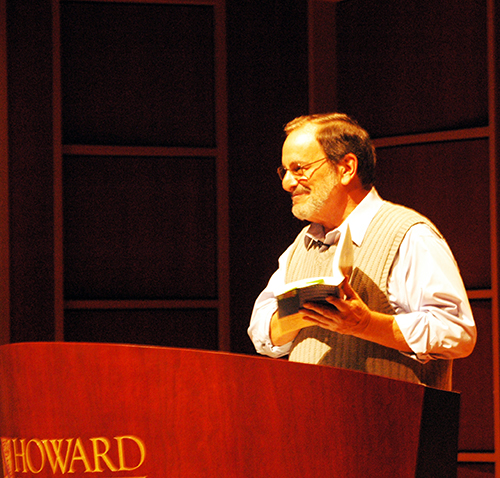
Michael Glaser.
Glaser Celebrates Lucille Clifton and Poetry Teaching! Unable to believe my eyes, I scanned the email and saw that it was being put on by an organization I had never even heard of before, HoCoPoLitSo, and was amazed when after looking into it I found out it was an arts council on which Lucille Clifton had served for many years, and that it was right here, in my own back yard!
Having been a former student of both Lucille and Michael at St. Mary’s College of Maryland, I knew immediately that the event HoCoPoLitSo was planning would be close to my heart. Michael Glaser was the first person to truly encourage me as a writer, and Lucille Clifton was a woman whose spirit and no-nonsense critiques had made me laugh, cry, and embrace my poetry with an honesty that had stayed with me the rest of my life. I immediately wrote to Michael, who returned my astonishment and excitement at being reunited after all these years, and started going through all my old journals until found the one I had kept twelve years ago in workshop with Lucille. I even found the very poem I once read in class, to which she had looked me in the eye and told me, with words I’ll never forget, “you’re hiding behind your words.” It was the hardest and most important thing I had ever heard about my poetry, and I ran out of that room hating her, sitting dramatically in the dark and crying over how mean she was until about three hours later, when I realized she had been right all along. I rewrote the poem. The result was, perhaps, the first honest poem I’d ever had the courage to write, and I never questioned her again.
Though I had thought about contacting her often over the years, by the time she passed I had still never had the chance to tell her how much she meant to me, and so the thought of sitting around a workshop table with Michael again and being given a forum through which to honor Lucille was just too perfect to seem real! But low and behold, a few weeks later there we were, sitting in a circle of tables in Duncan Hall on a cool Fall afternoon. We started off by remembering the lessons Lucille’s poems teach us all and thinking about how we could incorporate those into our own work.
Micheal was just as I remembered him — so much heart and creative energy we couldn’t help but be inspired. We read and talked and each composed a poem of our own, every one written with words that either calmed or stung the air.

Amanda Fiore reads her workshop poem.
Later that evening, some of us went to the reading to celebrate Lucille and were graced by a beautiful evening of poems, stories, and heartfelt emotion. By the end I not only had the opportunity to read what I had composed that day in the light of Lucille’s memory, but to meet her daughter, buy a book, and discover a group of like-minded people through HoCoPoLitSo whose energy and love for the arts mirrored my own. Afterwards, I was stunned at how satisfying and invigorating it was, with just one question repeating in my mind: how did I not know about this organization before, and why wasn’t I more involved?
One thing I know is that I will come to each of these annual Lucille events in the future, and that I will be attending many other HoCoPoLitSo events as well . . . as many as they can put on! But most of all, I am so thankful to Lucille who, even after she has passed, is still managing to connect me to poems. Thank you Lucille, I owe you so much.

 HoCoPoLitSo