

Joelle Biele brings poetry alive for HoCo students
a blog post by Anne Reis, HoCoPoLitSo Board Member
Poetry is alive and well at the Homewood Center, Howard County’s alternative school. I know this to be true because I am Homewood’s Media Specialist and for the past 10 years, with the support of HoCoPoLitSo, I have been able to host poetry workshops in my library.
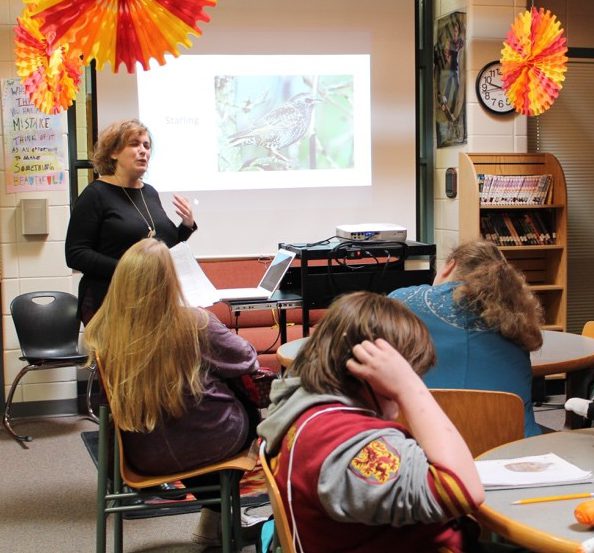 Students who attend Homewood have not succeeded in the comprehensive school environment. Poetry gives these students a safe and therapeutic way to express themselves and exposes them to the power of the written word. The transformative power of poetry was never more apparent than earlier this year when HoCoPoLitSo’s Writer-In-Residence, Joelle Biele came to our library for a visit.
From the moment that she greeted the students with her calm spirit and razor sharp intellect, she engaged them in a different way of thinking. With so much emphasis in school curriculum on STEM related subjects, students are rarely given the space or the time to think creatively.
Ms. Biele began her presentation by literally opening the space in the room with a Youtube video of Sandhill cranes migrating. The peaceful images of cranes in flight gave our students a moment of Zen and the background knowledge that they needed to understand her poem, Autumn. Ms. Biele challenged our students to think about what it means to write and the types of writing that they do in their daily lives. Is a text writing? Can a Facebook post be poetry? And from where does a writer find his or her voice?
Students were also asked to respond to the prompt called “I am.” Such an important question for every young person, and perhaps even more important for the struggling learners at Homewood: Who Am I? Who asks students such questions and who cares about their answers? The answer is loud and clear: poets!
For many of the students at Homewood the time spent with Ms. Biele was their first encounter with a poet, but hopefully it won’t be the last.
mana’s musings: celebrating marilyn chin on international women’s day
a blog post by Laura Yoo
It was my very first visit to the famous Dodge Poetry Festival. It was Saturday, October 22nd in 2016, right around 7:15 in the evening. There stood on this enormous stage at the New Jersey Performing Arts Center a petite Asian woman, speaking with a slight accent and a lot of voice. She read her poem, “One Child Has Brown Eyes.” First I googled “vacuity.” Then, I was mesmerized. Also on stage were poets like Martin Espada, Robert Haas, Claudia Rankine, and Jane Hirshfield, but it was Marilyn Chin who spoke to me that night. She was smart, powerful, and funny – and she looked like me.
Ever since getting a serious high on Macbeth in high school, I’ve been studying and loving English literature. In college, I chose all of my electives to be in English literature, and I studied abroad in England to nerd it up with Shakespeare and Jane Austen – and to drink a lot of beer. My area of study was eighteenth-century British literature (which even other English majors didn’t want to touch) so I can say for sure there were no likes of Marilyn Chin in my curriculum. In the last 10 years, thanks to HoCoPoLitSo, I’ve met many wonderful writers and poets, and among them a few Asian American writers, too. But the poet embodied and represented by Marilyn Chin was something new for me.
See, I always wanted to be like Sandra Oh’s character in Grey’s Anatomy, someone who wasn’t on the show to play Asian. She was just another doctor, who happened to be Asian. Her name wasn’t Johnson or Smith. Her name was Cristina Yang, best friend to the main character, but the “Yang” part did not define her character. Sandra Oh, who is Korean-Canadian, plays this “best friend” role also in Sideways and Under the Tuscan Sun. In both of these movies, she is just the best friend, not the Asian best friend. I applauded these characters. Yes! Finally! Asian people are just people! In retrospect, however, I am seeing that in some ways this is denial, a kind of self-imposed erasure. Yes, it hurts to be locked inside the limits of stereotypes, but it also hurts to deny my self from myself in an apparent fight against such stereotypes. At this point, I can hear a frustrated voice saying to me, “What do you want, then? You want Cristina Yang to be Korean or not?” Well, I think I want Cristina Yang to be her self, all of the things that she is.
Recently a Korean-American writer, Mary H.K. Choi, posted this:
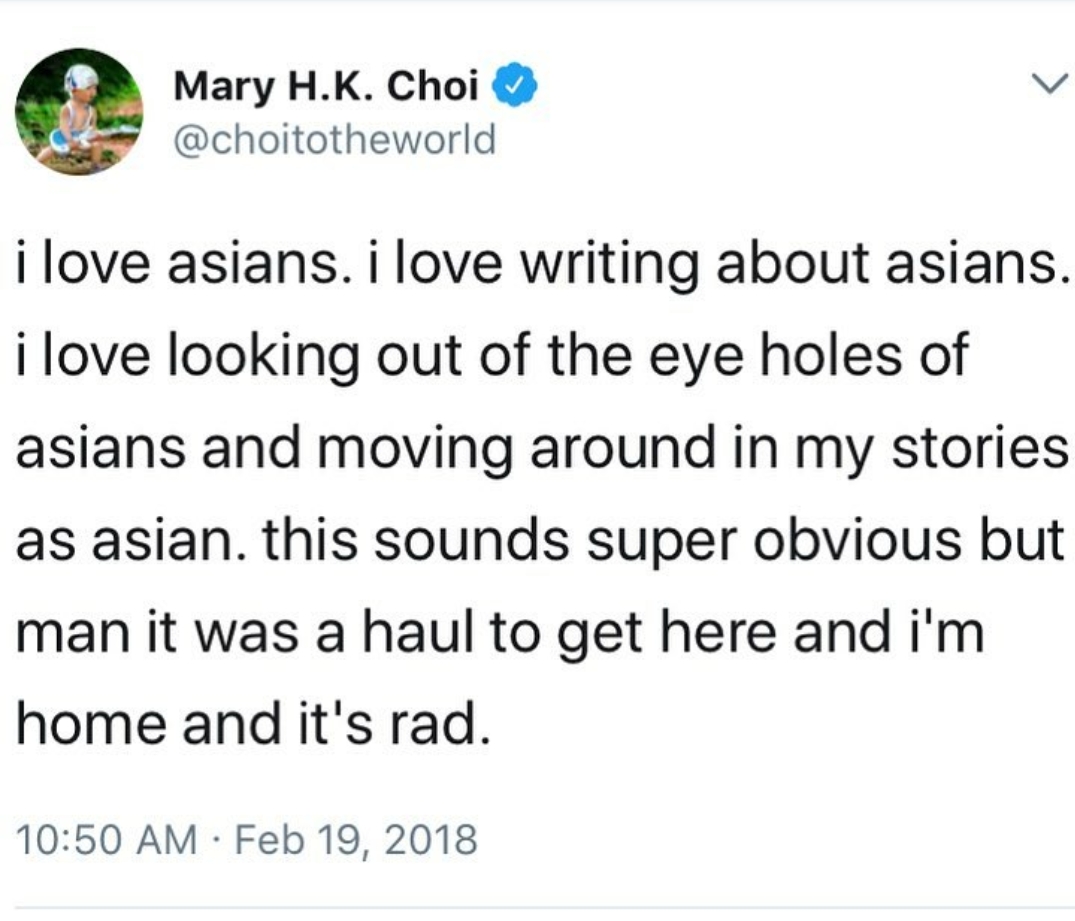
From this post, I suspect that, like me, Ms. Choi has been struggling – maybe unbeknownst to her – with her relationship to the Korean part of her “Korean-American” identity. So, I have been thinking about my own going home (or coming home) and how art helps me on that journey. A great example of such art is Ms. Chin’s novel, Revenge of the Mooncake Vixen, which Sandra Cisneros called “bad ass,” Maxine Hong Kingston “What fun!” and Gish Jen “Deeply provocative and deeply Chinese.” The story of two Chinese girls growing up in California focuses very much on their grandmother’s voice and legacy, weaving 41 separate stories together into what Ms. Chin calls a “manifesto.” The story is magical, mythical, and yet so very painfully and beautifully real. The opening story is heartbreaking, shocking, and ultimately triumphant.
Ms. Chin’s poem, “How I Got My Name: An Essay on Assimilation,” is another good example. It starts like this:
I am Marilyn Mei Ling Chin
Oh, how I love the resoluteness
of that first person singular
followed by that stalwart indicative
of “be,” without the uncertain i-n-g
of “becoming.” Of course,
the name had been changed
somewhere between Angel Island and the sea,
when my father the paperson
in the late 1950s
obsessed with a bombshell blond
transliterated “Mei Ling” to “Marilyn.”
And nobody dared question
his initial impulse—for we all know
lust drove men to greatness,
not goodness, not decency.
And there I was, a wayward pink baby,
named after some tragic white woman
swollen with gin and Nembutal.
My mother couldn’t pronounce the “r.”
The assimilation happens with the choosing of an “American name.” I am also named after a white woman, Laura Ingalls Wilder, but more accurately the character Laura Ingalls on Little House on the Prairie the TV show. My mom had watched this show in Korea and loved the character. This custom is seen as practical as it is difficult for Americans to pronounce Korean names. Luckily, my family – like most Korean people – also could not pronounce the “r” and has always called me Yoonji, by my real name. Now, my little sons hear my mom calling me Yoonji and once in awhile, very quietly, they test it out in a kind of whisper “Yoonji” and then giggle. It’s like they’re wondering, “Who is this Yoonji? She’s like a whole another person from my mom who is Laura.” Maybe so. Maybe not. All of this, of course, is not to deny the name Laura, which my mom gave me and therefore an important part of my identity. Besides, it’s a beautiful name. But it’s complicated, you see.
I know it sounds cliche to say this, but Ms. Chin’s poetry, novel, and her performances have raised my awareness. No, it did not happen like a bolt of lightning or anything that dramatic, but rather like a gradual stewing and simmering in this idea about who I am and what I am. So, on this International Women’s Day, I want to thank her for being on that stage on that day at Dodge Poetry Festival to help me widen the way I might think about my cultural identities.
I am ecstatic that I will have another chance to meet Ms. Chin and maybe – if I have the guts – thank her in person on April 26th when she reads at the Blackbird Poetry Festival at Howard Community College. Read more about Marilyn Chin’s visit here.

Laura Yoo
HoCoPoLitSo Board member and Professor of English at Howard Community College.
mana’s musings: Step Aside, Ambien! Here comes Dr. Seuss’s Sleep Book!
Laura Yoo
HoCoPoLitSo Board member and Professor of English at Howard Community College.
A blog post by Laura Yoo
I did not grow up with Dr. Seuss because by the time I came to the United States from Korea, I was already 10 years old and my parents certainly didn’t know who Dr. Seuss was. That’s right. I had a Seuss-less childhood.
It was when I was in high school and doing a lot of babysitting that I came across Dr. Seuss. The children just loved his books, almost as much as they enjoyed watching Disney movies. I learned quickly that Cat in the Hat and Green Eggs and Ham were some of the kids’ favorites. As a 15 year old, I didn’t see the real value of these books, of course. They were just fun.
Now as a mom to young children, a teacher of writing, and a human fascinated by language and literature, I have a whole new appreciation for Dr. Seuss. Hop on Pop, The Lorax, The Cat in the Hat, and Green Eggs and Ham are probably some of the most popular of Dr. Seuss’s books. My own two boys say Fox in Socks and One Fish Two Fish Red Fish Blue Fish are their two favorites.
While all these are wonderful stories, my personal favorite is Dr. Seuss’s Sleep Book. This is the book that truly showcases Dr. Seuss’s genius.
Oh boy, does it work. Try to stifle the yawn while you read it. You can’t do it. At least half way through, someone – you or one of the little listeners – will yawn. And once that first yawn comes out, there’s no stopping the flood of yawns to come. As Dr. Seuss says: “A yawn is quite catching, you see. Like a cough.” Turns out – just reading the word “yawn” or seeing illustrations of creatures yawning will make you yawn. That’s how powerful a yawn is.
So, by the time you reach the end of the book to read “When you put out your light, / Then the number will be / Ninety-nine zillion / Nine trillion and three” I swear the little ones look sleepy – and I am also sleepy.
And this is one of the many magical powers of Dr. Seuss. Yes, the silly names, the nonsense words, and the insane rhymes are so fun to read. Yes, the books have valuable life lessons. In addition to all that, it will help your kids go to sleep. Now, if he had just written a book called Dr. Seuss’s Clean Up Your Room Book…
Happy Dr. Seuss Day!

 HoCoPoLitSo