Home » Articles posted by hocopolitso (Page 5)
Author Archives: hocopolitso


Poetry Moment: Jason Reynolds offers a pep talk for everyone
Students across the nation are returning to their studies this fall in a time of fear and in methods that are bizarre. Most of them won’t board buses with their parents sniffing back tears on the sidewalk. They won’t giggle in clusters or eat in cafeterias. College students won’t be packing stadiums or gathering on the quad. This fall, hardly any students need new backpacks full of crisp lined paper and pointy pencils.
Instead, there are masks outside their homes, and Zoom inside. Instead, students are learning on their own. They’re sharing computers or borrowing them from schools. And freshly reopened wounds of systemic violence and racism against Black Americans are compounding the pandemic pain. Students are suffering in ways that adults can’t begin to understand.
HoCoPoLitSo can’t fix things. But we can offer a token of our appreciation of the circumstances. This week’s Poetry Moment is a shot in the arm from Jason Reynolds, New York Times bestselling writer of books such as Long Way Down, Patina and the rest of his track series, All-American Boys, and the Marvel Comics graphic novel Miles Morales: Spider-Man.
Reynolds, who grew up in D.C. and Maryland and had never finished a complete book until he was 17, used the power of poetry, rap, and his own determination to become an author. He’s now won the Walter Dean Myers Award, a Newbery, a Kirkus Prize, the Coretta Scott King Award, and an NAACP Image Award.

In this Poetry Moment, Reynolds reads from his book For Every One, a sort of pep talk in verse, recorded in 2018, long before a pandemic was dreamt of.
“This is a pep talk for me,” Reynolds explains. “This isn’t a book of answers, I don’t know how to fix it, but I do know how it feels to have it feel broken.”
His book isn’t a self-help book, he explains, because he doesn’t feel qualified to assist. In fact, he tells young people, he needs help to get done the things he does. Writing is difficult, Reynolds says. Without editors, he says, he wouldn’t be able to get by. “I still don’t know how to use a comma,” he says.
In his writing, he says, he tries to show his characters’ vulnerability and the difficulties that they’re facing. Just like students, he says.
“I tell the teachers, you have no idea what some of your students had to do just to get there,” he says.
Named in January as the Library of Congress National Ambassador for Young People’s Literature, Reynolds is evangelizing words as a power to change the world.
“The truth is, if we’re looking at history as our compass, it will show us over and over again that the way to change is through children. The way to change is through youth,” he said, in an interview after his appointment as ambassador.
His new book, Stamped: Racism, Anti-Racism, and You, is a remix for young people of Ibram X. Kendi’s National Book Award-winning Stamped from the Beginning: The Definitive History of Racist Ideas in America. In the first chapter, Reynolds explains what he’s hoping to talk about in the book: “This isn’t a history book. Or, at least, it’s not that kind of history book. Instead, what this is, is a book that contains history. A history directly connected to our lives as we live them right this minute. This is a present book. A book about the here and now.”
The here and now is pretty rough. And we don’t know how it’s going to turn out. But Reynolds is mindful of uncertainty. In fact, his books embrace an unconventional plot strategy. We never know whether Patina or any of the other characters from his series about a track team of runners, win their races. “They show up,” Reynolds says. And that’s enough.
Patina’s story, he explains, “doesn’t tie up in a neat bow, but none of my books do, only because I think life doesn’t do that. … I think it’s disrespectful of the reader to give away answers. I think our job is to lead them to the point where they can do the rest of the work themselves.”
Sending strength for the rest of the work to students, teachers, parents, and every one, from Jason Reynolds and HoCoPoLitSo.
— Susan Thornton Hobby
The Writing Life producer
Poetry Moment: Toi Derricotte evokes a legacy of poetry and cruelty
This week’s poem contains a legacy.
Like a story told and retold on families’ front porches, this Poetry Moment features author Toi Derricotte reading a poem that changed her life, “Southern Road” by Sterling Allen Brown.
With colloquial rhymes and dialect, the poem’s haunting rhythms echo the stories and songs of chain gangs. Conceived during the Civil War to provide free labor, chain gangs proliferated in the South until the 1950s, when they were largely phased out in most of the nation. The practice lingered in Georgia and North Carolina until the 1970s, and was resurrected in the 1990s “tough on crime” era.
Chain gangs became part of American culture, with Nina Simone and Sam Cooke writing songs about the lines of prisoners often seen along Southern roads.
Prisoners, many of whom were Black and most of whom were convicted of minor crimes, were shackled together at the ankles to provide states free labor. They broke rocks, built the nation’s roads and highways, dug holes. Treated cruelly, prisoners were sometimes kept in cages, and usually fed little and beaten liberally. For photos and history of the chain gang, see this fascinating and horrifying history project by the University of North Carolina Greensboro.
Brown’s poem called forth the chain gang’s speech and song in a way that American readers had never seen. Poet Derricotte explained that besides Langston Hughes, she read no works by Black writers in grade school, in high school, or even in college. When she started reading Brown’s poems, “they blew my mind.” In this Poetry Moment, Derricotte reads only the last three stanzas of Brown’s iconic poem.

Brown was born on the campus of Howard University in Washington, D.C., attended Harvard, then returned to Howard to teach for more than 40 years until he retired in 1969. Brown, whose father was born into slavery and became a prominent minister and professor at Howard, became a bridge between the Harlem Renaissance and contemporary Black poets like Derricotte.
A 2019 finalist for the National Book Award for Poetry, Derricotte visited HoCoPoLitSo in November 2012 to read her own poetry and talk about the legacy of Lucille Clifton, our longtime artistic advisor and the nation’s beloved, award-winning poet. Before she read for our audience, Derricotte filmed an interview about her work with E. Ethelbert Miller, poet and activist from D.C. who knew Brown well. Miller asked her to read some poetry that inspired her. Derricotte chose a Sylvia Plath poem, and this work by Brown.

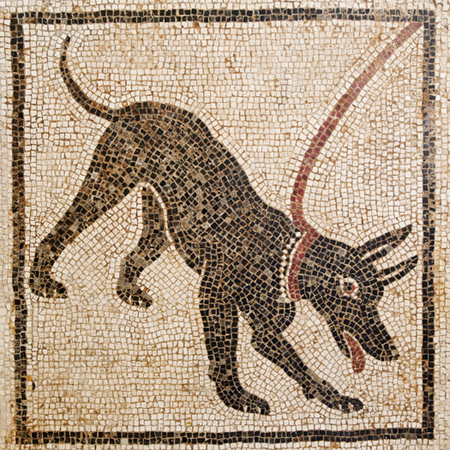
Derricotte has her own legacy to pass on. She and poet Cornelius Eady formed Cave Canem, a retreat and foundation to support and host African American poets. Cave Canem, which translates from Latin as “Beware the Dog,” was named after the mosaic of the protective dog at the entrance to the House of the Tragic Poet, preserved in Pompeii (see image below). Founded in 1996 to nurture Black poets, Cave Canem has supported thousands of Black poets with workshops, prizes, and readings. Fellows of the program have published more than 250 books.
Try one of their books, listen to “Southern Road” here, pick up The Collected Poems of Sterling Brown, read some of Derricotte’s confessional and personal work. Then sit on the porch with your family and tell these stories.
— Susan Thornton Hobby
Producer of The Writing Life
Sterling Brown Photo: By Source (WP:NFCC#4), Fair use, https://en.wikipedia.org/w/index.php?curid=42296826
Add a single goal to the pandemic to-do list: Read more
We all have such lofty goals for our pandemic selves–learn Chinese, perfect sourdough, tone those arms, finish making photo albums, and clean out the closet that spawns candles, wrapping paper, vases, and packing tape.
I, personally, have done only one of those “to do’s.” I will not divulge which one. But adding “read more books” to our list should be an absolute. We have time, we need to escape our four walls, and heaven knows, we’re done talking to our families. Burying one’s nose in a book is a great excuse to sit somewhere cool and cocoon.
That’s where the trusted voice of Ron Charles comes in. An editor and book critic for the Washington Post, Charles was gracious enough to answer my questions and talk with his fans for more than an hour last week through the Howard County Library.
We talked about his background (English teacher that hated grading papers), his process (read the book, scribble in margins and on the back pages notes about specifics for his reviews), and his costumes. Yes, costumes—sexy nurse, Rocky Horror vamp, Tigger, cowboy, astronaut, android—that he puts on to film his hilarious and tongue-in-cheek Totally Hip Video Book Reviews.

Silliness aside, Charles did talk about his belief that books shouldn’t just be items that gather dust on a shelf. Literature can speak to a cultural moment, can provide wisdom and transformation, and can broaden our worlds.
“Books are repositories of real thoughtful consideration of an issue in a way that doesn’t happen much outside of books,” Charles said. “Books are a unique cultural object for us. I think they have a kind of wisdom, and they serve as guides of where we were and where we are now. … Books don’t just sit on the shelf. They’re not like old cups and saucers. They speak to us and they’re rich, and they should inform us and help us think more deeply about what’s going on in the world.”
As a bonus at the end of his talk, Charles gave readers a pre-screened, critic-vetted summer list of books, which I can now share with you. Most of these titles are available through the county library.
- Hamnet, by Maggie O’Farrell
- Inland, by Tea Obreht
- Make Russia Great Again, by Christopher Buckley
- Friends and Strangers, by L. Courtney Sullivan
- Such a Fun Age, by Kiley Reid
- A Children’s Bible, by Lydia Millet
- Rodham, by Curtis Sittenfeld
- Writers and Lovers, by Lily King
Now get reading. We’ll work on the closets in September, right?
— Susan Thornton Hobby
Recording secretary, HoCoPoLitSo

Poetry Moment: Tara Betts And a poetic girl that switches
Tara Betts’s poem “Switch” is old school.
Betts has been reciting a version of the poem for twenty years, first at Chicago and then national poetry slams.
Two decades later, she still reads a version of the verse. The poem was the only one from second chapbook, Switch (2003), that made the cut into her first full-length collection, Arc & Hue.
The poem’s protagonist, a young woman with a metronomic pelvis and glossed-up lips, secretly studies the periodic table to get an A in chemistry.
The poem begins with a quote from Nas’s song “Black Girl Lost”: “Typical day that a black girl sees/ coming home wanting more than a college degree.”
Betts worked closely with young women through GirlSpeak, a weekly writing and leadership workshop she founded in Chicago. So she knows the pressures that Black girls are under in America, and the poem speaks to those issues.
The poem’s form is even more old school.
In the early 2000s, Betts met poet Lucille Clifton at Cave Canem (Latin for “Beware the dog”), the retreat and advocacy organization for African-American writers. A few days later, after reading Clifton’s poem “Move,” Betts wrote “Switch,” using the same form, with two-word refrain that changes at the end.
In an interview with Mosaic Magazine, Betts explained, “ ’Switch’ marked the transition where I knew I was going to cling more tightly to a forceful sense of sound and imagery to talk about issues I feel need to be articulated.”
Betts, who appears in this video with poet Terrance Hayes, has published two books of poetry, Break the Habit, and Arc & Hue, and her book Refuse to Disappear will be published soon. She’s a co-editor of The Beiging of America: Personal Narratives about Being Mixed Race in the 21st Century.
In an interview with The Rumpus, Betts explained that she seeks to speak honestly in her poetry: “That’s what I’m aiming for more often than not: How do I create an emotional truth that will ring true to what someone else has experienced?”
Susan Thornton Hobby
Producer, The Writing Life
HoCoPoLitSo’s Poetry Moment: Tyehimba Jess and Blind Tom
Experiencing Tyehimba Jess read his verse at the Blackbird Poetry Festival in April 2017 was like watching Cirque de Soleil with words.
Jess, who had won the Pulitzer Prize a few weeks before he arrived to read for HoCoPoLitSo, stood at the front of Smith Theatre and flashed on-screen his poems and pictures of the minstrel musicians that were the subjects of his compositions. In a demonstration of poetic acrobatics, Jess then proceeded to read his works forwards, backwards, diagonally, and circularly.

His collection, Olio, speaks in the voices of the Black musicians from the minstrel tradition, the main form of theater in America from 1830 until 1910. White actors and singers put on blackface and performed degrading caricatures of Black people.
But some Black artists made their creative living in minstrel shows. In Olio, Jess writes their stories: Henry Box Brown, Edmonia Lewis, Sissieretta Jones, Scott Joplin, Williams and Walker, the Fisk Jubilee Singers, the McCoy twins–talented performers who worked in the only venues available to them.
Jess seeks to give full voice to the artists’ stories, instead of making insulting, two-dimensional representations of the performers, as the shows did. The pages in his book Olio can be ripped out, Jess explained.
“The reader is invited to deconstruct the book,” Jess told E. Ethelbert Miller in the edition of The Writing Life they filmed together. “The pages are perforated so the pages easily tear out of the books. So you can use the poems in their form to manipulate them. You’re going from a two-dimensional form to a three-dimensional composition, in much the same way that many of the performers were working in a two-dimensional strata and had to take the received instrument and bend it.”
In this week’s HoCoPoLitSo Poetry Moment, Jess reads “Blind Tom Plays On,” the last in a sonnet series about Tom Wiggins, born blind, a slave, and autistic. By age 4, he had become a savant piano player. With uncanny talent, Wiggins could imitate sounds, repeat reams of speech, and compose and play music. One of his “tricks” was to perform three pieces of music–playing one song with one hand, another with his second hand, and singing a third song. James Bethune and his family owned Tom most of his life, and profited to the tune of nearly a million dollars from his talents, with Tom receiving only subsistence from them.
Though marketed as a freak, Wiggins’ gifts were prodigious. Wiggins was a composer as well as a mimic, including “The Rainstorm”, one of a series of works recorded in 1999 by pianist John Davis.
Jess’s poems pay tribute to Wiggins’ strange genius, and to the mother that protected him as much as she could, from slavery, and from the people that sought to exploit him. One of Jess’s other sonnets in the series ends with the following lines, starting with the metaphor of teeth as piano keys:
Jangle up its teeth until it can tell
our story the way you would tell your own:
the way you take darkness and make it moan.
Susan Thornton Hobby
Producer of The Writing Life

Poetry Moment: A cool recitation by Gwendolyn Brooks
In 1985, Gwendolyn Brooks arrived from Chicago in Washington D.C., to become America’s first Black person to hold the position of Poetry Consultant to the Library of Congress.
Early in her term, she read at the Howard Woodson High School in D.C. As she began to recite her signature poem, “We Real Cool,” students popped up around the library, chanting her lines and snapping their fingers.
“I loved that,” she told the Library of Congress’s Alan Jabbour and poet E. Ethelbert Miller, who were interviewing her for HoCoPoLitSo’s first author interview show, which would become The Writing Life. “Young people like it because it has a kind of insouciance and a staccato effect that they enjoy.”
More than thirty years before, she had won the Pulitzer Prize in Poetry, but by the mid 1980s, Brooks had reached the pinnacle of her success. The very young poet and activist Miller and Jabbour interviewed Brooks in 1986 in a small room at the Library of Congress, supervised and produced by HoCoPoLitSo founder Ellen Conroy Kennedy. Here is that interview in full.
Brooks had also recited “We Real Cool” September 30, 1985, in front of a packed audience, after 300 people had been turned away from the Library of Congress’s auditorium. Her most anthologized work, the poem had become one that audiences would request.
The Library of Congress, just this past April, digitized and uploaded the recording of that reading, during which Brooks says, “At this point I better recite ‘We Real Cool’ before I forget. I know some of you are sick and tired of this poem, because if you see my name, you see it. It’s been published in a good many school textbooks, but it has also been banned here and there—chiefly because, I understand, the word ‘jazz’ has been considered a sexual reference. That was not my intention, though I have no objection if it helps anybody—but I was thinking of music when I used the word ‘jazz.’ ”
In the HoCoPoLitSo interview, Brooks explains the short poem’s origin, which still speaks volumes to the nation’s treatment of young black people.
“I wrote it because I was passing by a pool hall in my neighborhood in Chicago one afternoon. And I saw, as I said in the poem, seven boys shooting pool,” Brooks said during the episode. “I wondered what they felt about themselves. I decided they felt not quite valid, certainly they were insecure, not cherished by the society, therefore, they would feel that they should, well, spit in the face of the establishment. I used the month of June as an establishment symbol. Whereas the rest of us love and respect June and wait for it to come so we can enjoy it. They would “jazz June,” derange it, scratch at it, do anything that would annoy the establishment.”
When Brooks recites the poem, she drops her voice at the end of the lines on the word “we.” She told interviewer George Stavros in 1969 that she does so because the protagonists are questioning their own validity.
“I say it rather softly because I want to represent their basic uncertainty, which they don’t bother to question every day, of course,” Brooks explained.
— Susan Thornton Hobby
Producer of The Writing Life
This Week’s Poetry Moment: A Party in Verse by E. Ethelbert Miller
Here’s how I began my recent interview with E. Ethelbert Miller for this summer’s issue of Little Patuxent Review: “Interviewing E. Ethelbert Miller is like trying to keep track of everyone’s names at a crowded cocktail party after downing a couple of glasses of something potent. Miller’s fifty-year immersion in the poetry world means that he befriended and interviewed people like Sterling Brown and Amiri Baraka (and does spot-on imitations of them) and gave a boost to writers such as Elizabeth Alexander, Ta Nehisi Coates, Charles Johnson, Dwayne Betts, and Cornelius Eady. Faster than one can jot them on a soggy napkin, Miller throws out names and titles and conferences and institutions and acronyms, punctuated with his trademark giggles.”
Watching Miller read his poem, “Is Eric Dolphy Coming or Going?” in this week’s episode of HoCoPoLitSo’s Poetry Moment is a similar experience, a poetic party that he guides his audience through, throwing out names and ideas thick and heavy. Miller is such a polymath that it helps to have a glossary to his poetry, since there are so many references to his fifty-two year history in the poetry world, as well as his lifelong devotion to jazz, Black culture, and baseball.
Though I’m sure I’ve missed many references he’s made, below is an attempt at a glossary of his poem, in order of appearance. Listen to the poem, read some of these notes, listen to the poem again, drown in Eric Dolphy’s music, marvel at some photos of Roberto Clemente sliding home, then listen to the poem again.
- Frank O’Hara, leader of the New York School of Poets, wrote personal, conversational, and abstract poems about New York Life, though he was born in Baltimore. A curator at the Museum of Modern Art, O’Hara was immersed in the worlds of poetry, music, and art. He died young and gorgeous.
- Billy Strayhorn spent nearly thirty years composing, arranging, and playing with Duke Ellington. With compositions that included “Take the A Train,” “Lush Life” (as a teenager), and “Chelsea Bridge,” Strayhorn was a classically trained pianist who died at age 51, also gorgeous.
- August Wilson was awarded two Pulitzer Prizes and a Tony for his plays. He wrote a series of ten plays — The Pittsburgh Cycle – set one in each of ten decades, which included works such as “Fences,” “Ma Rainey’s Black Bottom,” and “The Piano Lesson.”
- Roberto Clemente was born in Puerto Rico and died in a plane crash delivering supplies to Nicaragua. In between he collected 3,000 career hits and played for years for the Pittsburgh Pirates. He won twelve consecutive Golden Glove awards, and after his death, he became the first Latin American ballplayer to be elected to the Hall of Fame.
- John Ashbery is generally regarded as one of the greatest 20th-century American poets, winning prizes such as the Pulitzer, the National Book Award, the Ruth Lilly Poetry Prize, the Yale Younger Poets Prize and a MacArthur “Genius” grant.
- Eric Dolphy played the bass clarinet, flute, piccolo, and the alto saxophone, for which he is best known. Before he died at age 36, he put out his album “Out to Lunch,” about which the Penguin Guide to Jazz wrote, “If it is a masterpiece, then it is not so much a flawed as a slightly tentative masterpiece.”
- “In a Sentimental Mood” by John Coltrane and Duke Ellington, needs no other explanation besides listening to it.
— Susan Thornton Hobby
Producer of The Writing Life

A Poem for Freedom: HoCoPoLitSo presents its third Poetry Moment
The former National Poet Laureate and official national treasure Rita Dove stars in this week’s Poetry Moment, featuring her poem “Lady Freedom Among Us.”
In an episode of The Writing Life, Dove explains to fellow poet Michael Collier that in 1993, she walked down to see the massive bronze statue of Freedom. The statue was lowered from its perch atop the U.S. Capitol Building by helicopter in May 1993 for repair and cleaning.

Dove thought the statue looked disheveled and dirty, rather like a homeless woman, and was inspired to write a poem.
Freedom, who wears a helmet of stars topped with an eagle’s head and a robe trimmed in fur, holds a sheathed sword, a laurel wreath, and the shield of the United States. On Oct. 23, 1993, when the buffed-up and repaired statue was lifted back onto its pedestal atop the Capitol building, Dove read her poem for the ceremony.
Dove visited HoCoPoLitSo audiences in 1999 and in 2015. In this clip, Dove reads her poem about the statue, “Lady Freedom Among Us” from her book On the Bus with Rosa Parks.
— Susan Thornton Hobby
Producer of The Writing Life
HoCoPoLitSo Stands Against Racism; Poetry is One of Our Weapons
HoCoPoLitSo was founded to celebrate diverse literary heritages and to foster literary appreciation in diverse populations, including varying gender, ethnic and cultural identities, age groups, and income levels. We believe that opening a book, reading a poem, or attending a literary event can be a powerful humanistic journey of exploration, education, and enlightenment. We all benefit when we seek to deepen and extend our understanding of the experiences of others and ourselves.
We are profoundly sad and outraged by the violence perpetuated against black lives and by the ongoing systemic lack of accountability. We believe black lives matter, and we stand in solidarity with all those seeking to effectuate long-lasting change in our communities.
In an effort to do our part, we offer something new — HoCoPoLitSo’s Poetry Moment — as a way to address, extend, and deepen these crucial conversations. Starting today, we will be showcasing poems written and read aloud by black authors hosted by HoCoPoLitSo over our forty-five years, whose art examines and illuminates our American experience.
— The board and staff of HoCoPoLitSo
Poetry Moment: Terrance Hayes reads “Carp”
Terrance Hayes is an American poet and educator who has published seven poetry collections. In conversation with the poet Tara Betts in this #PoetryMoment clip from 2011, he reads “Carp” from the book Lighthead.
 HoCoPoLitSo