

facing the chaos of truth: Tara Hart on the Poetry of Tyehimba Jess

Tara Hart, Co-Chair of HoCoPoLitSo Board of Directors and Professor of English at Howard Community College
A blog post by Tara Hart, Co-Chair of HoCoPoLitso Board of Directors
Especially at this time, when the arts are so clearly at risk of losing national support, we are so grateful to live in a community composed of people who value what poet Marilyn Nelson calls “communal pondering” of meaning, who value spacious perspectives.
At the ninth annual Blackbird Poetry Festival, we were dazzled all day by the presence of two important master poets, E. Ethelbert Miller and Tyehimba Jess, who conducted student poetry workshops in the morning, charmed us over lunch, inspired a variety of eager new poets and poetry lovers in a free open reading of many voices, taped a TV interview for our show The Writing Life, and finally, after we squeezed them up into balls and rolled them towards overwhelming questions, we let them have a dinner break and catch their breath before Mr. Jess took the stage for the last time for the Nightbird Reading.
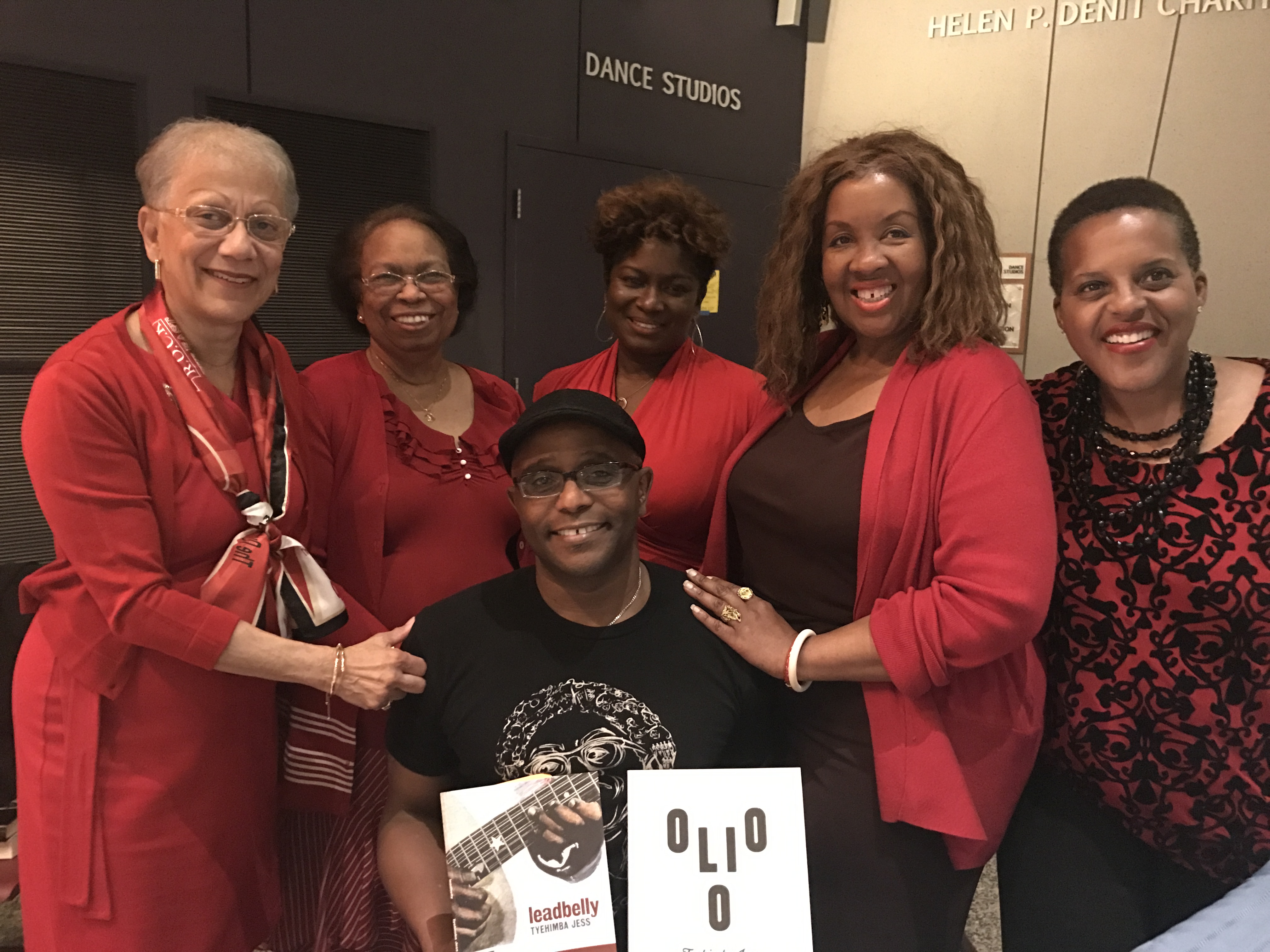
Tyehimba Jess at Blackbird Poetry Festival @ Howard Community College’s Smith Theatre
It was my honor to introduce Pulitzer Prize winning poet Tyehimba Jess to the Howard County community. Years ago, at one of the wonderful Dodge Poetry Festivals held bi-annually in New Jersey, Tim Singleton and I and several other HoCoPoLitSo board members did our usual reconnaissance to see who we thought we should invite for you. During one debriefing, I remember Tim saying, “Tyehimba Jess, Tyehimba Jess!” and I said “Yes! I saw him too, he’s amazing. And his name sounds like a song, or a prayer.” And then when we finally did connect with Mr. Jess and he accepted our invitation to come, he said, “HoCoPoLitSo! It sounds like a dance!” So I think this music Jess and HoCoPoLitSo made that evening at Nightbird Reading was meant to be.
Tyehimba Jess is the author of two award-winning books Leadbelly and Olio, and their significance and groundbreaking nature are difficult to convey sufficiently. Olio, the collection of first generation freed voices from the post-Civil War era to World War I does, as those at Found Poetry Review said, “distract you from your preconceived notions about what poetry can be, what it can do, and, ultimately, what you think you know. More than a book (and many reviewers have commented at length about what a fantastic object the book is), Olio is an extended performance, a musical score, and an epic libretto…”
Olio is made up of poems that Mr. Jess directly invites us to read in our own way and in any order (you can read the lines straight across the page, or up one side and down the other). “Weave your own chosen way among these voices,” Jess invites. There are even instructions for turning some of the pages into a sort origami that allow you to make the poems and their meanings three-dimensional. You’ll find interviews, historical documents, lists, and hymns. He faces the chaos of truth, and of our own fickle, diverse, various ways of seeing and not-seeing, and makes it all sing. Truly it is both deconstructive, giving voices back to the silenced, the misunderstood, the invisible, the abducted and it is creative – weaving them back together into patterns and inviting the reader to weave them back in ways that they choose.
There are even other ways to read the poems – I think they also tell the story of what the poet himself is achieving. Even as the poet breathes life into these people from the past, his words illuminate the impact of his own art. I’m using his words now: They “show the world the gut meaning of grace.” They are “a hurricane of back and forth notes.” They are “the sound of one mallet against history’s pale fist.” They say, “listen to how we’re bound in unison, this is our story I want you to hear.”
In his poems, boxes and trunks packed long ago are opened up, and what we find makes us question everything we thought we knew.
In the collection Leadbelly, the poems ask, “how to weed graveyard from his garden of tongue? What rainbow of prayer to pull between teeth?” They ask how we might find “a place where I can dream drought into rain, pray storm cloud out of spotless sky” or find the hope that “our wondrous oneness exists”? They speak in the voices of women as well as men, and in the voices of the objects we tie our meaning to, like guitars, or streets.
Overall, I agree with Brigit Pegeen Kelly that “It is exhilarating to be invited into a world so large and muscular, so rooted in history, a world where so much is at stake.”
And, finally I must say that the work of Mr. Jess, as well as the Poetry Out Loud program itself, are the two best arguments I know of for sustaining the National Endowment of the Arts, if these tremendous artists and their work are the result of that small investment.
WAYR Series – A Gentleman in Moscow
In this this month’s “What are you reading?” HoCoPoLitSo’s Board Member Kathy Larsen tells us about The Gentleman from Moscow by Amor Towels.
 Although The Gentleman from Moscow by Amor Towles could be a quick read, it is so beautifully written that I chose to savor it.
The novel opens in 1922 Moscow with an interrogation between Count Rostov and a Bolshevik charged with sending aristocrats to the firing squad. Expecting to die, the Count gives flippant answers. Asked if he had written a poem seen as a “call to action” prior to the Russian Revolution, the Count replies that the poem was attributed to him. Surprisingly, his life is spared. Instead, he is exiled to the Metropole Hotel and shifted from his suite above the Bolshoi to what used to be the servants’ quarters in the attic.
With the interactions among these characters working and living in the hotel, the author builds a community of hope and friendship amidst a world of fear. The Count, always charming and always observant, befriends a small girl who teaches him the terrain of the hotel. He’s kept informed by the concierge stationed at the door and kept sane by the rooftop beekeeper. He is also challenged by his nemesis, a boorish waiter who becomes the Communist enforcer.
Subtle changes in the Count’s situation reflect the changes in the greater Russian world during the 1920s and on. As Communism solidifies, the Count’s elitism and knowledge are discounted, even condemned. But when Stalin takes over and Russia returns to the world stage, the Count is asked to teach table manners to a potential ambassador.
Despite the turmoil, the love that Russians have for their homeland vibrates through the novel.
by Kathy Larsen
HoCoPoLitSo’s Board Member
black nature – a reading for earth day and national poetry month
By Laura Yoo
April is National Poetry Month, and Saturday, April 22nd is Earth Day. And I have a book recommendation that can help celebrate both: Black Nature: Four Centuries of African American Nature edited by Camille T. Dungy.

Black Nature edited by Camille T. Dungy is edited by .
Black Nature offers a different perspective through which we might read, understand, and talk about the 93 black poets and their 180 poems included in this anthology. Dungy writes a compelling introduction in which she describes the noticeable absence of black writers from anthologies and discussions in ecocriticism and ecopoetics. She reminds us of the complex and unique connection that African Americans have to “land, animal, and vegetation in American culture”.
Despite all these connections to America’s soil, we don’t see much African American poetry in nature-related anthologies because, regardless of their presence, blacks have not been recognized in their poetic attempts to affix themselves to the landscape. They haven’t been seen, or when they have it is not as people who are rightful stewards of the land. They are accidentally or invisibly or dangerously or temporarily or inappropriately on/in the landscape. The majority of the works in this collection incorporate treatments of the natural world that are historicized or politicized and are expressed through the African American perspective, which inclines readers to consider these texts as political poems, historical poems, protest poems, socioeconomic commentary, anything but nature poems.
I want to test this new perspective, and with this in mind I turn to the poetry of Tyehimba Jess, the newly minted 2017 Pulitzer Prize in Poetry winner, who is coming to headline HoCoPoLitSo and Howard Community College’s annual Blackbird Poetry Festival on Thursday, April 27th. He will be reading and speaking with E. Ethelbert Miller during the Sunbird Reading. Notably, Miller’s “I am Black and the Trees are Green” is included in Dungy’s anthology.
Much of Jess’s acclaimed body of work illuminates on the African American experience. About Olio, Wave Books says, “Part fact, part fiction, Jess’s much anticipated second book weaves sonnet, song, and narrative to examine the lives of mostly unrecorded African American performers directly before and after the Civil War up to World War I.”
In an interview with LitHub about Olio, Jess spoke about the power and the politics of song: “To be able to sing under that kind of oppression I think, in a lot of ways, is the very essence of survival, of a people, of the ability to have to the hope to make something beautiful amongst so much wretchedness. That’s critical to the concept of human survival. And in this particular context, of African Americans working through slavery… that’s what we had.”
But in the context of Dungy’s Black Nature, I turn to Jess’s leadbelly with a different ear.
In “john wesley ledbetter,” Jess writes,
singing a crusade of axe and machete i take virgin texas territory by force, clear it of timber and trouble. each eastern twilight, i till top soil ’til sun plants itself back into that western horizon. i keep struggling against a brooding moon’s skyline until dark sleep is my friend again, a place where i can dream drought into rain, pray storm could out of spotless sky.
The poem goes on with, “there’s only one way out of slave time dues: hump this land down till it shrieks up a crop of cancelled debt into your wagon.” In this poem, we see an illustration of what Dungy describes as African Americans’ “complex relationship to land, animals, and vegetation.” She says, “African Americans are tied up in the toil and soil involved in working the land into the country we know today,” and she reminds us how they were “viewed once as chattel, part of a farm’s livestock or asset in a bank’s ledger.”
In “leadbelly: runagate,” Jess writes,
where water and land meet is shore, and on shore is iron in fists of jailers in sun of texas swamp. i wade into bubble and blue ink of red river, my head is shaven, bobbing, brown island of shine. […]
i want to let the water take me, i want to surrender to this river’s rock and swirl, come up clean and white as death itself, but the black in me breaks into blues, and i feel the coffle of their claws. i am stepping toward dry land, the dance of ankle chains, where i scream history into song that works itself into blood, sweat, memory.
The water in this poem reminds me of Dungy’s description of the “river” in Rita Dove’s “Three Days of forest, a River, Free”: it is “more than a moving body of water. It is a biblical allusion, a historical reality, a geographical boundary, a legal boundary, a decoy, the center of emotional and personal change, an aspiration, a metaphor: all these things at once.”

Tyehimba Jess’s leadbelly
As I re-see the poems in leadbelly with a different framework, I am reminded how the way we group, categorize, thematically arrange, and shelf literature can limit or expand our experiences of literature. We put the poems under one category or another, and it’s hard to imagine what else it can be.
Dungy’s Black Nature is important, because it acknowledges the African American perspective these 93 poets highlight while introducing what else their work is – and how that “what else” amplifies our understanding of their works. As Dungy says, Black Nature “encourage[s] readers to divert their gaze into new directions, demanding they notice new aspects of the world and accept alternative modes of description.”
To put it another way, a book like Black Nature is like a hearing aid. It can give us that extra power to hear poetry in an even more powerful way. It can help us turn up the volume on that work – perhaps turn up the bass or the treble and experience the poem in a myriad of ways.

Laura Yoo
HoCoPoLitSo Board member and Associate Professor of English at Howard Community College.
an English major goes to a literary reading for the first time

Author Belinda McKeon reading on stage at the 39th Annual Irish Evening – photo by Lee Waxman
A guest blog written by Christina Smith, a student in Professor Ryna May’s literature class at Howard Community College
—————————————
Admittedly, I had never attended a literary reading prior to the HoCoPoLitSo Irish Evening on February 10th. I hope that it is not too shocking that I say this, given that I am an English major. So, I am happy that I finally had the opportunity to experience a literary reading at the 39th Irish Evening held at the Smith Theater at Howard Community College.
Before I went I knew little about the program, only that the author would read from at least one of her two books, and that there would be Irish music and dancing for entertainment. Even though my friend Amy and I were probably some of the youngest people to attend that night, I did not feel awkward there. On the faces of the people there, you could tell everyone was having a fantastic time. The entire evening was a hit.
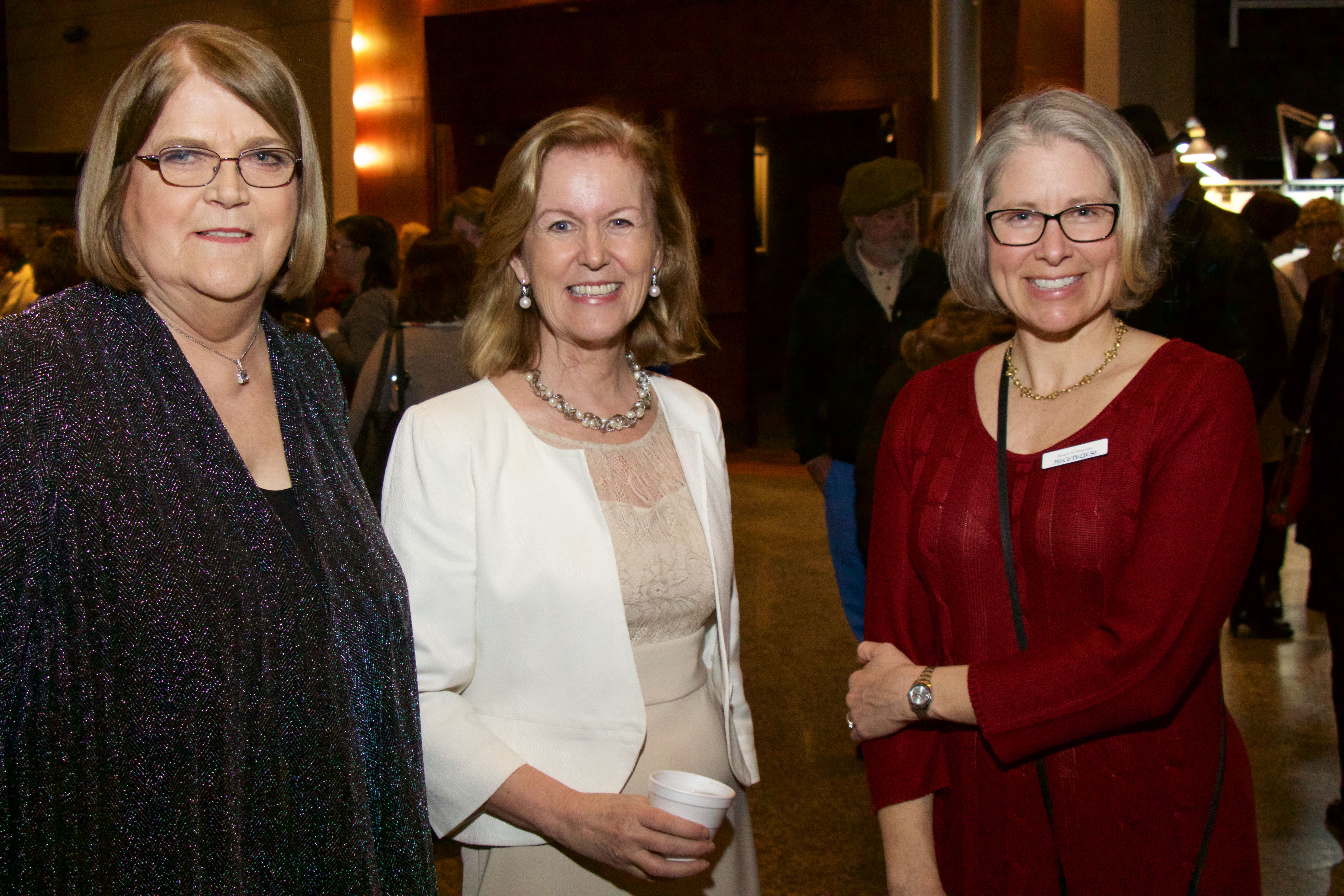
Catherine McLoughlin-Hayes, Ambassador Anne Anderson, and Susan Thorton Hobby at the 39th Annual Irish Evening- photo by Lee Waxman
I was shocked to see that the program boasted the Ambassador of Ireland, her Excellency Anne Anderson. She was very gracious, and it was impressive that Mrs. Anderson was able to join us for the Irish Evening despite her busy schedule. A list of her accomplishments made me feel lazy and slightly light-headed at the enormity of her dedication to civil rights and women’s right’s worldwide.
While I like to think myself well read, I had not been made familiar with Belinda McKeon’s work. It was a treat to have her read from both her books, Solace and Tender. I was quite taken with her reading from Tender as I could feel the insecurities that her characters suffered from, the anguish of unrequited love and how truly awkward it is to be a young 18-year-old. She was witty and kind with her characters, as though greeting an old friend. Hearing the author read her own work gives you an idea of how those characters really present themselves in her mind. From her reading, the audience got a feel that these characters were real, that they had pains, hopes, flaws, and humor.
I loved the reading from Tender so much that I even ordered it from Amazon when I got home. Now when I read it, I will have the added pleasure of knowing how the author intended for it to be read. And in a way I will be able to connect with the characters on a more personal level.
The evening wrapped up with a performance from the Narrowbacks and Irish step dancing by the Culkin School. The music was traditional Irish music, a perfect nightcap to a fantastic evening.
I admit that I got some strange looks when I told people about my Friday night, but it was definitely worth it to let my inner nerd have a fun evening. I look forward to attending more events produced by the HoCoPoLitSo.
And a big thank you to Professor May for making it possible for me and a plus one to attend.
By Christina Smith
a taste of Ireland right here in Columbia

Belinda McKeon read from Solace and Tender at the 39th Irish Evening in Columbia, Maryland
A guest blog submitted by Cara Caccamisi, a student in Professor Ryna May’s literature class at Howard Community College in Columbia, Maryland
—————————————
Howard County Poetry and Literature Society’s 39th Annual Irish Evening, which took place at Howard Community College’s Smith Theater on Friday, February 10th at 7:30 pm, was an event of Irish pride and culture. Hosted by Columbia’s own Catherine McLoughlin-Hayes, the HoCoPoLitSo Irish Evening Chair, the evening was a great way to experience Ireland without leaving the state of Maryland.
The auditorium was filled with fascination, excitement, and anticipation from the many spectators, while musician Jared Denhard performed the Celtic Harp. Then, Ms. McLoughlin-Hayes came on stage to introduce the main event for the night. Her enthusiasm set the tone for the evening.
Ms. McKeon chose to read first from Solace which was awarded the Faber Prize and Irish Book of the Year. The passage she read described a conflicting relationship between father and son on a farm in Ireland. Ms. McKeon’s second reading was from her latest book, Tender, about two college friends who meet in Dublin and become close; it shows the transformation of friendship from being teenagers to becoming adults. In her unique and exhilarating story, Ms. McKeon depicts the friend’s difficult relationship as Catherine grows strong feelings for James, who is a homosexual. The book grows extra complicated as it is set in the 1990’s when being homosexual was not widely accepted.
Following the author were the Narrowbacks. The Narrowbacks name is a tribute to the term immigrant, as many of the band members have roots in Ireland and they are inspired by the band, Celtic Thunder. The group members consisted of brothers, Jesse and Terence Winch, Dominick Murray, and Linda Hickman, all of whom were apart of Celtic Thunder. Other members were Terence’s son, Michael Winch and Eileen Estes, daughter of Celtic Thunder’s lead singer.
Many of the songs performed consisted of main themes of nature, growing up as an immigrant, and love. One of the most memorable songs, “Childhood Ground”, was written by Terence Winch and sung by Eileen Estes. It remembers the time when the Bronx Expressway was built and shattered the homes of many Irish families, including Winch’s family home. Traditional Irish music is so distinctive as it combines poetry of hardships, life, and love with rare instruments, known in Ireland. The Irish step dancers from the Culkin School performed during some of the songs played by the Narrowbacks.
With the outstanding performance by the Narrowbacks and the talented step dancers, the audience was very well-entertained. The auditorium was filled with the sound of Ireland, and the spectators joined in on clapping hands and nodding their heads to the music. And Belinda McKeon, a truly brilliant writer, left the listeners craving more of the stories.
HoCoPoLitSo created an enjoyable evening and allowed the viewers a chance to spend an evening immersed in Irish culture.
gifting books this holiday
Posted by Laura Yoo
This Christmas season, give the gift of reading! Here’s my shopping list for the grownups and the little people on my list.
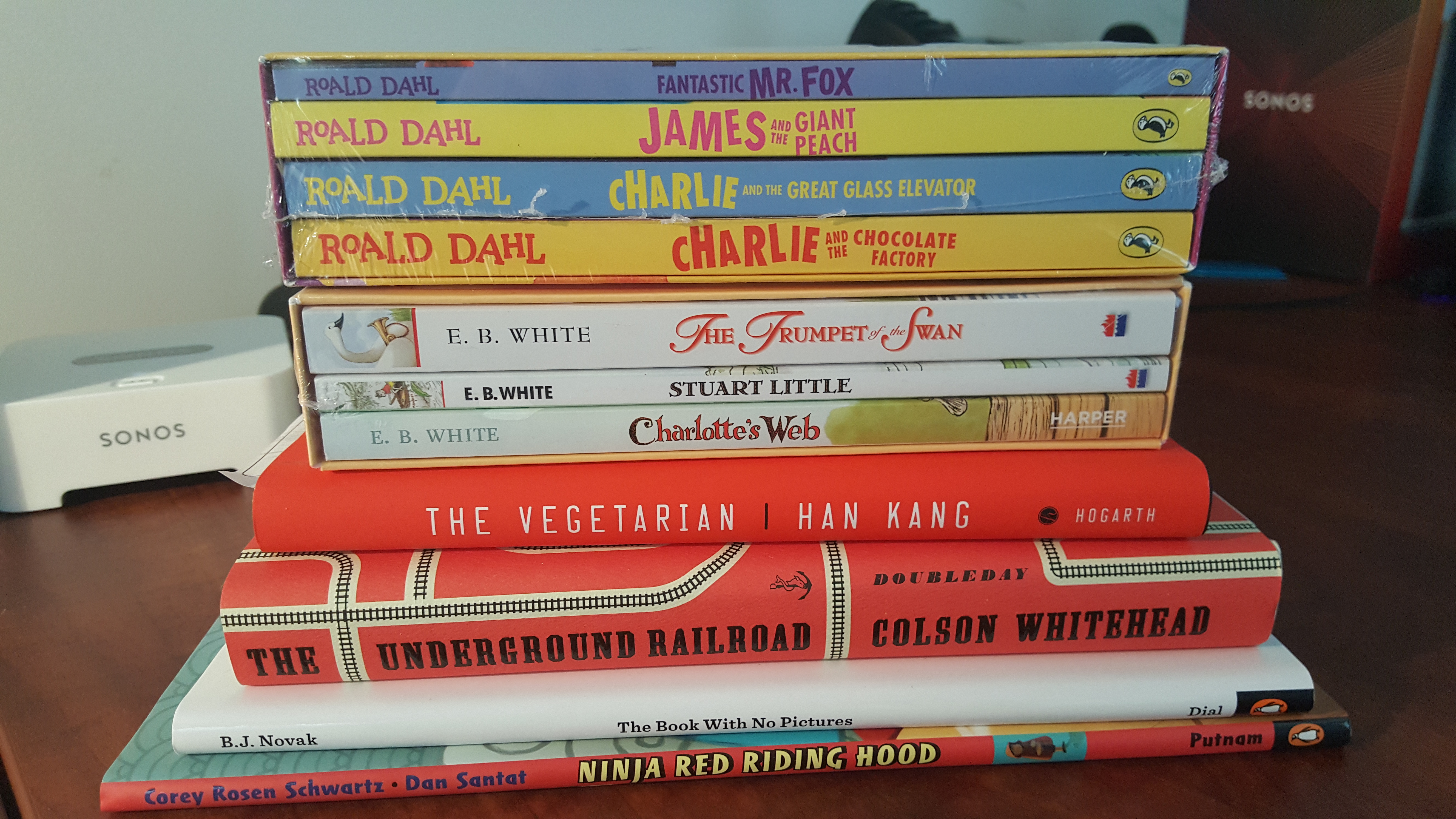
The links will take you to Amazon. Don’t forget to shop Amazon Smile and choose Howard County Poetry and Literary Society for your charity!
For the Little People
E.B. White collection: Charlotte’s Web, Stuart Little, and The Trumpet of the Swan $13.97
The Book With No Pictures by B.J. Novak $10.99 – This one is my kids’ absolute favorite. They think it’s so hilarious and love making the parents read it – but they also enjoy reading it themselves to say the funny words, especially “butt”.
Ninja Red Riding Hood by Corey Rosen Schwartz $12.80 – This one is actually one of my favorites. I love retelling of fairy tales and I love this little ninja girl version of Red Riding Hood.
Encyclopedia Brown set of 4 books – $12.19 – I loved reading these books when I was a kid – time to get the next generation hooked!
Curious George Around Town – $8.29 – Curious George is probably my favorite series in little, little people books.
For the Grownups
The Vegetarian by Han Kang $8.92
“Celebrated by critics around the world, The Vegetarian is a darkly allegorical, Kafka-esque tale of power, obsession, and one woman’s struggle to break free from the violence both without and within her.” – Amazon
The Underground Railroad by Colson Whitehead $16.17
“The National Book Award Winner and #1 New York Times bestseller from Colson Whitehead, a magnificent tour de force chronicling a young slave’s adventures as she makes a desperate bid for freedom in the antebellum South” – Amazon
Vaseline Buddha by Jung Young Moon (translated by Jung Yewon) $10.13 –
“A tragicomic odyssey told through free association scrubs the depths of the human psyche to achieve a higher level of consciousness equal to Zen meditation. The story opens when our sleepless narrator thwarts a would-be thief outside his moonlit window, then delves into his subconscious imagination to explore a variety of geographical and mental locations—real, unreal, surreal—to explore the very nature of reality.”- Amazon
The Best American Essays 2016 $8.79
“A true essay is ‘something hazarded, not definitive, not authoritative; something ventured on the basis of the author’s personal experience and subjectivity,’ writes guest editor Jonathan Franzen in his introduction. However, his main criterion for selecting The Best American Essays 2016 was, in a word, risk.”- Amazon
Shirley Jackson’s The Lottery: The Authorized Graphic Adaptation $11.72
“This graphic adaptation by Jackson’s grandson Miles Hyman allows readers to experience “The Lottery” as never before, or to discover it anew. He has crafted an eerie vision of the hamlet where the tale unfolds and the unforgettable ritual its inhabitants set into motion. Hyman’s full-color, meticulously detailed panels create a noirish atmosphere that adds a new dimension of dread to the original story.” – Amazon
Happy gifting! And don’t forget to select Howard County Poetry and Literary Society on Amazon Smile!
Laura Yoo
HoCoPoLitSo Board member and Associate Professor of English at Howard Community College.
mana’s musings: poetry-binge at dodge poetry festival 2016
Laura Yoo
HoCoPoLitSo Board member and Associate Professor of English at Howard Community College.
It was my first time. I was nervous. I was excited. I felt better that a friend was going to be there with me the whole time, a friend who had done it before.
My first Dodge Poetry Festival.
I had two goals and I had 24 hours (if I didn’t sleep) to achieve them. First, hear Claudia Rankine, my new literary hero whose formidable poetic and intellectual power show us what a real-life super hero looks like. Move over, Captain America! Second, discover one new poet – someone I’ve never read or heard
The first event I attended was called “American Poetries” with Brenda Hillman, Khaled Mattawa, Claudia Rankine, and Anne Waldman – all Chancellors of Academy of American Poets. While I would have loved to hear these poets read from their own impressive repertoire of works, it was also wonderful to hear the poems they’re reading and who they recommend for us to discover.
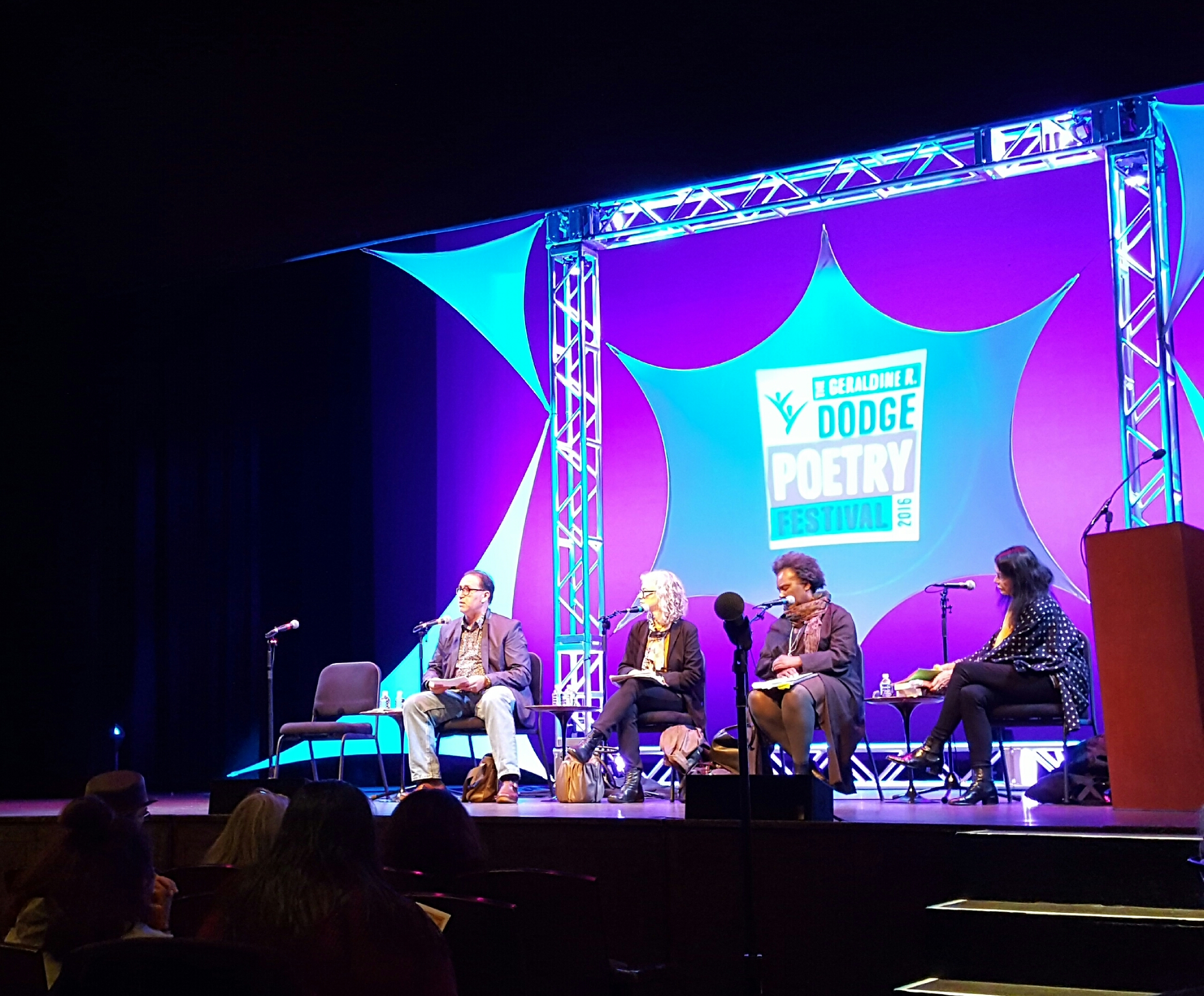
from the left – Khaled Mattawa, Brenda Hillman, Claudia Rankine, Anne Waldman
Khaled Mattawa read a poem by Hayan Charara called “Animals,” a haunting story about the violence we commit against each other. The poem, Mattawa reminded us, exposes the horrors that we’re not allowed to speak of. I immediately ordered a copy of Charara’s book, Something Sinister.
Claudia Rankine told us about a poet named Mark Nowak and his book, Shut Up Shut Down. In referring to Nowak, Rankine brought to the foreground a voice that is sometimes ignored in our discussions about race – the working white class. This voice is essential to Rankine’s new project of studying whiteness.
Much of this forum’s discussion on “America’s Poetries” highlighted the diversity of voices, experiences, and perspectives. The takeaway for me was that poets feel a deep sense of responsibility in their roles not only as artists but also as people who speak for, about, and on behalf of American lives. Their poetry gives us language with which we can speak of our world in ways that are creative and enlightening.
That evening, I experienced one of the most special poetry performances I’ve ever attended at “Poetry like Bread – Poems of Social and Political Consciousness.” The lineup included Marilyn Chin, Robert Hass, Martín Espada, Juan Felipe Herrera, Brenda Hillman, Claudia Rankine, Vijay Seshadri, and Gary Snyder. I know, right? Yes, let that list sink in.
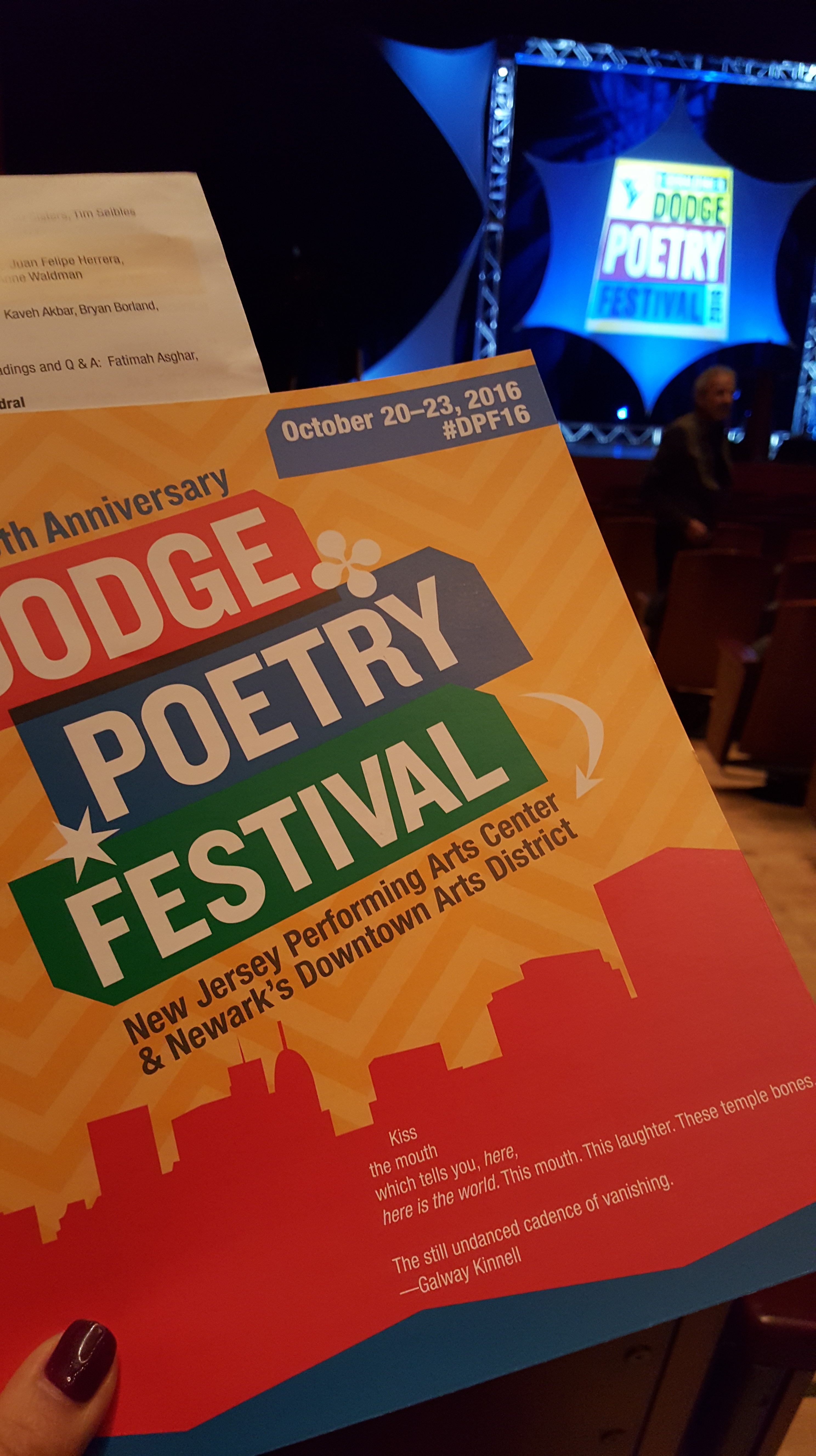 I rediscovered Robert Hass. Though I had read his works and studied them in school, experiencing his poetry live on stage sparked a new interest. His reading of what can only be called an epic poem titled “Dancing” – about human history of violence and weapons – brought people to a standing ovation.
That same evening, I discovered Marilyn Chin. I don’t know many poets who look like me – an Asian American woman. And there is something powerful about seeing someone who looks like you speaking of an experience, a perspective, a history, a family, or a value that you are personally familiar with. She is a cool performer with a bit of an attitude and spunk. I like that.
So within hours of arriving at the festival, I met both of my goals.
But it’s not just the poets and the poetry that made this overnight trip to Newark deeply moving. Conversations with my friend about language, education, art, race, politics – those conversations had me doing mental gymnastics. My ideas were both validated and challenged. My mind stretched.
I learned that the community of poets and poetry is a thing of beauty and power. Dodge got me hooked. I can’t wait to go back in two years.
Carolyn Forche: Lest We Forget
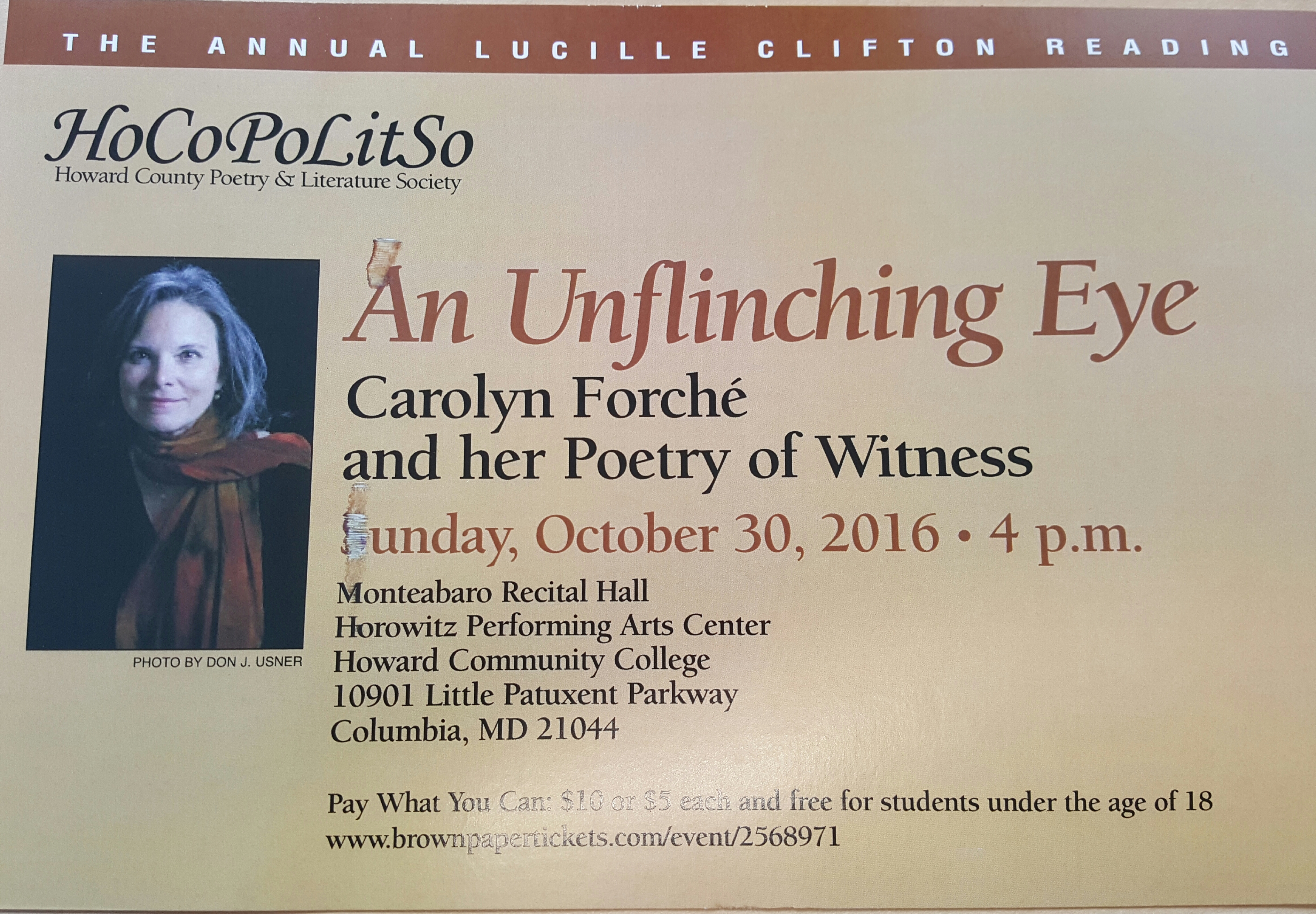
On October 30th at 4 pm, HoCoPoLitSo hosts Carolyn Forche for the Annual Lucille Clifton Reading.
Here is a reflection by Sama Bellomo who is a rehabilitation technologist who writes accessible curricula to help individuals with disabilities gain employable skills on their way into the workforce. Sama has previously contributed to this blog with a letter to HoCoPoLitSo after attending the 2014 Lucille Clifton Reading event with Michael Glaser.
***************
When it is not possible to stop the suffering of others the decent thing to do is listen and bear witness. When we validate someone by hearing and retelling their story we help them carry the heaviest bricks of the human condition to a new space where their suffering can be built into something meaningful.
By devoting years of her life to the protection of human dignity in war-torn places Carolyn Forché gives people’s pain a way to connect, to rest. First she collects the writings of devastated people. She listens, empathizes, and surely cries. Next, she connects the works with those of others who endure similar horrors, breaking their isolation by organizing and cataloguing their grief. Perhaps she reunites neighbours, lovers, or siblings among the pages. Maybe the loneliest are finally in good company. Wars ruin lives – but poets like Forche give that tremendous sense of loss a new purpose, a community, a voice.
I’ve been revisiting my studies of Carolyn Forché, whose book, “Against Forgetting,” has a permanent spot in my living room. I keep it in plain sight so that it’s a ready tool when I need to share an example of ordinary people who do extraordinary things on the worst and last days of their lives. The book is so thick and yet it was pared down from thousands of poems for whose inclusion Forché fought individually. Forché wrote an introduction to every single author, giving their poetry context, finding what the poem needed to say and clearing space for it in the reader’s mind. I flip through it to remind myself to keep ownership of my responsibility to improve the human condition where I can. I use the dog-eared pages to empower budding self-advocates. I harvest the hope and earnestness that Forché writes into each author’s leading biography to play my part in suicide prevention, which I spend a great deal of time doing, with no regrets, and with great thanks to http://www.IMAlive.org for training me to do without fear.
I gratefully tip my hat to Professor Jean Sonntag at Howard Community College who had a profound impact on the way I view myself and the world around me, through the lens of others’ written voices. She supported my investigation into the Japanese Internment further by giving me an Incomplete grade at the end of the semester which gave me time to catch up on the coursework I’d set aside. She was teaching me that I could and should make time to grow as a decent human being when there was something I really needed to understand. Because she taught me that making time was possible I got my first good look at how delicate we are, at how quickly we will treat each other poorly if we are not careful. The work I did to assimilate E.O. 9066 into my prior knowledge of “Great Man History” changed my sense of what it means to be proud of American History. But even then, the most gruesome inhumanities had yet to hit me because there are so few first-hand accounts and even fewer images from the Japanese Internment Camps. First-hand accounts have a unique way of haunting a reader’s conscience about what cruel acts people can commit against each other in deeply evil times, when just yesterday they had been neighbours.
Also at Howard Community College, Professor Lee Hartman first introduced me to Carolyn Forché. In a Creative Writing class Professor Hartman played a video where Forché spoke with HoCoPoLitSo. Forché told me in that recording what it was going to take for me to become a force to ease human suffering: I would have to listen, and it was going to hurt.
Of course I’d known what the Holocaust was, and of course I was sorry about it – for as sorry as a then-twenty-something could be about what public high school had said about it. Forché told me through her talk that I knew too little and could not be sorry if I did not truly know how the Holocaust had undone an entire people.
Fanni Radnoti published “The Borscht Notebook,” a posthumous final volume of her late husband, the Hungarian poet and writer Miklos Radnoti. To get the book she had sifted through a mass grave, through more than twenty bodies’ worth of human remains. Hoping and dreading that one of those bodies belonged to her beloved, whom she had not seen in more than two years since they had been separated by the Nazis, she found him. The book was in his pocket. Forché dutifully told these details to my Creative Writing class through her video recording session with HoCoPoLitSo and I was no longer just sorry. Sorry was no longer enough, and it never will be again.
My two neighbours at the time had been Holocaust survivors from Poland, who had been devoting their lives to recovering artifacts and human remains for proper burial, remains that had been turned into decorations such as tattooed skin lampshades and shrunken, sand-packed heads. After I saw Forché speak in that video I knocked on my neighbours’ door and asked them humbly about their experiences. They spent the next six hours showing me what they had recovered, articles and letters they had written, denials they had gotten from museums and private collections for items that had no hallowed ground.
It puts a strain on their marriage. They lose sleep. Their basement is a fully devoted workshop of recovery. They write home. They live modestly. They carry themselves happily despite the torture that continues in their histories, in their daily life. I was able to provide some technical support, a modest kindness to help their heroic efforts. We have lost touch but not a day passes that they are not in my heart, a part of who I am now, determined to help with activism, closure, and rehabilitation, using any skills I have.
As a member of the LGBTQ. community I am still trying to assimilate the confusing and overwhelming truth that I myself would not have survived the Holocaust, nor would much of my community, had I lived in Eastern Europe, where part of my family is from the former Yugoslavia. Forché’s works brought up the question in me: what do I have yet to learn about LGBTQ history, what should I be against forgetting? I have grown to raise awareness of genocide and to resist cultural eliminativism, be the acts overt or covert.
Knowing better leaves no excuse for not doing better, and then-twenty-something me was learning that in my college years. Somewhere in the world starvation, murder, and torture have happened today. They happened yesterday. They have happened since time immemorial. They have never happened to me, and they likely never will. That means I am in a position to do something about it. Knowing better leaves no excuse for not doing better: what can I do for my part to move the world forward?
Forché is featured in “Voices in Wartime,” another anthology volume that portrays exactly what one would imagine it does. A video documentary bearing the same title accompanies the book on my shelf and bears witness to the fact that Forché is not alone in her work. There are others concerned with trying to put words on the unspeakable, to educate, an appeal for peace, a chorus of humanitarian voices.
Regretfully, I’ve read comparatively little of Forché’s own poetry. Am I worried about what else she is going to teach me? Am I afraid my own conscience will become too heavy a boulder, that I won’t have the strength or won’t summon the will, to push it up the mountain? Am I afraid she will have a lighter side, and I’ll then have to find my own ways to lighten up?
Forché is so big a force in my life that it is not possible to count all the places in which her efforts have propped me up when I have stood up for myself or others, and my legs wobbled. Lest we forget, Carolyn Forché chronicles what we need to know about human suffering if we truly wish to end it.
__________________________________________________
To reserve your ticket for the Lucille Clifton Reading to hear Carolyn Forche and her Poetry of Witness at Monteabaro Hall at Howard Community College, please visit: http://brownpapertickets.com/event/2568971
mana’s musing: where the wilde things are
Laura Yoo is a HoCoPoLitSo Board member and Associate Professor of English at Howard Community College.
This is a story of a prodigal daughter.
At the beginning of the summer, I made big plans. A long list of books I wanted to read. Big goals. Ambitious. I would read, read, and read some more. I had books to read. And I had the time to read them.
Instead, all through July and August, I watched TV. A lot of it. Game of Thrones, Orange is the New Black, Stranger Things, Master Chef, and endless episodes of Chopped. And all these hours that were committed to watching means I haven’t been reading. There is the still-not-finished Fates and Furies on my night stand. I’m about 50 pages into Wilde Lake by Laura Lippman. Though Pride and Prejudice and Zombies intrigued me at the bookstore, I haven’t even opened it yet. Though I made good progress on Claudia Rankin’s Citizen: An American Lyric, it is not finished. (Though, you might argue, one simply does not plow through a work like Citizen.)
This summer, the room we call the “reading room” in my house was used to get away from the children to watch stuff on Netflix on my tablet with earphones shoved into my ears.
I am ashamed. Fail. Major fail.
So, clearly, I needed help.
And help came on September 13th in the form of a very wild Wilde Reading. Organized by Laura Shovan, Ann Bracken, and LindaJoy Burke, Wilde Readings launched its first open mic night with featured readers Jen Grow and Le Hinton. An audience of about 30 gathered in one of the art studio spaces at the Columbia Art Center, the same space where my son had art summer camp. It was comfortable, friendly, and intimate.
As Laura told us, though there are many wonderful literary organizations, publications, and events in Howard County, a place for writers to come together and share freely and informally had been lacking for many years. And Wilde Reading’s inaugural event demonstrated the very reason such gatherings are needed: it created a collage of unique, diverse literary voices. Each time a reader went up to the podium, you just didn’t know what you were gonna get.
Jen Grow’s short story about a daughter and her dying mother just about killed me. Before she read, Jen promised to go for the jugular – her words – and she didn’t miss. I was relieved and astonished at the same time when Jen ended by reassuring us that her mother is still living, that the story is indeed fictional. I thought, how can one create a story like that – so moving, so real, and so visceral – without actually having lived it? Even if one had experienced it, telling it in such a powerful way would be a difficult task. I suppose that’s why poets are artists, creators.
Le Hinton’s reading was enhanced by a tactile experience he created for the audience. He passed around cotton blooms for us to feel between our fingers while he read his poems on the motif of cotton. When he read an autobiographical poem about doing math lessons with his father, he passed around Tootsie Rolls for us to enjoy. The taste of chocolate in our mouths transported us to that room with that little boy, his father, math lessons, and Tootsie Rolls for reward.
The open mic readers included Jan Bowman and Michael Ratcliffe, two writers who will be featured in future Wilde Reading events. The open mic evening ended with a powerful performance by Analysis the Poet.
While the voices of the evening were divergent and their subject matter so varied, together these writer-performers created a one-of-kind literary sound. And that sound, that experience can never be recreated again. I feel lucky to have been there to witness it.
This Wilde Reading invited me back to the written word. It pushed me around a bit – from one emotion to another and yet another – and left me wanting more. And more I shall get – on October 4th with Jan Bowman and Derrick Weston Brown as featured readers at the second Wilde Reading.
Inspired by this Wilde Reading, I did something different today. During my son’s 45-minute swim practice, instead of browsing my Facebook page or taking quizzes on Buzzfeed, I opened a book: Roxanne Gay’s Bad Feminist. And I’m in love with the written word again.
Thank you, Wilde, for welcoming back this prodigal daughter.
mana’s musing: unfolding the mystery with Jean Sonntag
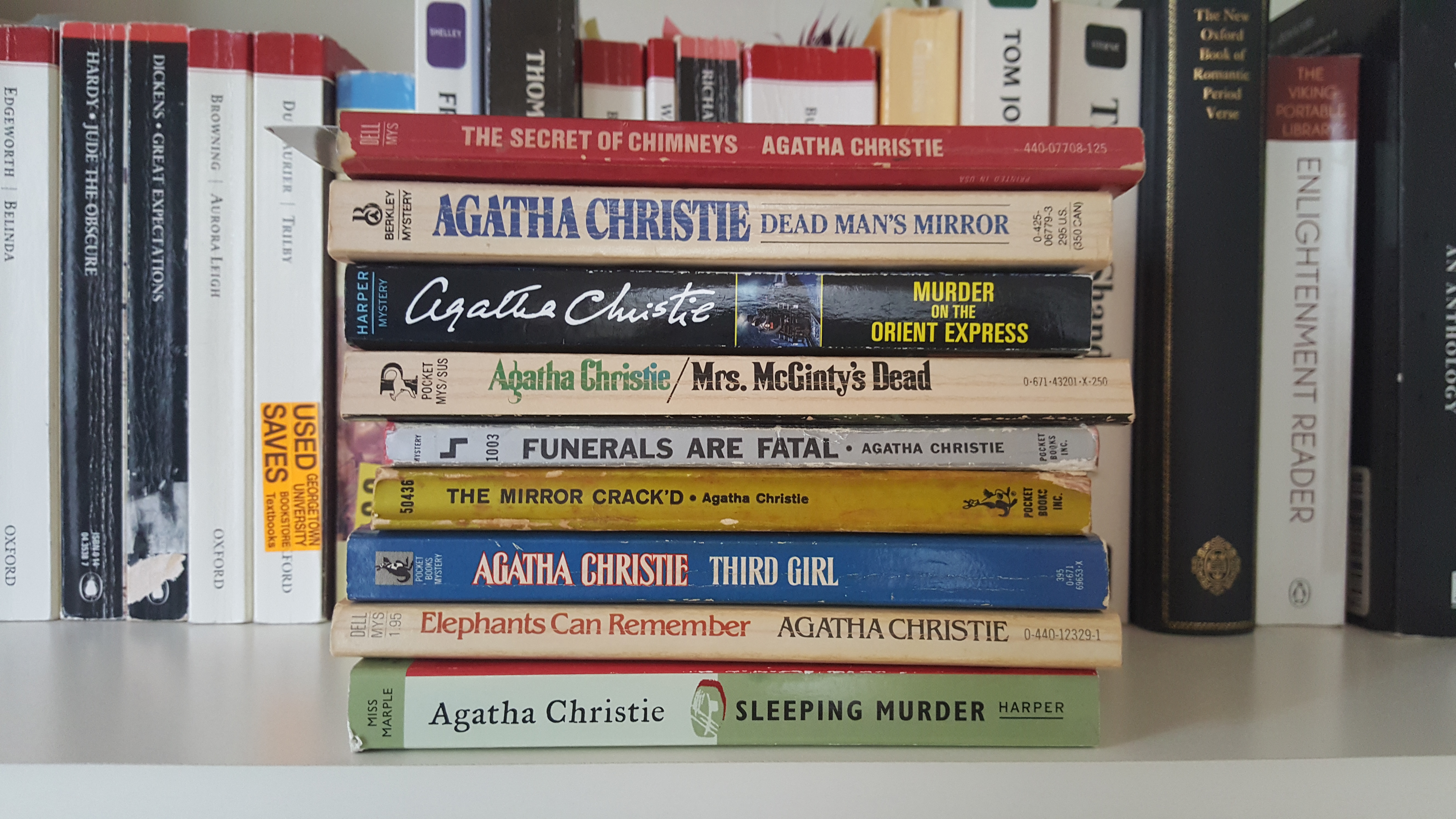 During my last visit to Antique Depot in Old Ellicott City (if you’ve been reading this blog, you know I LOVE this place), I picked up several paperback copies of Agatha Christie’s mysteries.
My memories of reading Agatha Christie are also memories of growing up. On my parents’ bookshelves, I found Korean novels, histories, and poetry. But also there were the classics like Dostoevsky and Don Quixote as well as detective novels by Agatha Christie and thrillers by Sidney Sheldon. All in Korean. In middle school, I read my first Christie, And Then There Were None, in Korean.
So it was with a bit of nostalgia that I began reading The Secret of Chimneys, one of my finds at Antique Depot. Right away I noticed in her writing something dramatically different from the mystery novels of today. Novels like Girl on the Train and Gone Girl which were wildly popular recently (and made into movies) have character development (some better than others) and complicated plot twists, a mix of whodunit and exploration of various themes. Compared to these, Christie’s mystery seemed rather… plain. Instead of sex, drugs, infidelity, violence, and blood, we find witty dialogue and a slow building of a puzzle.
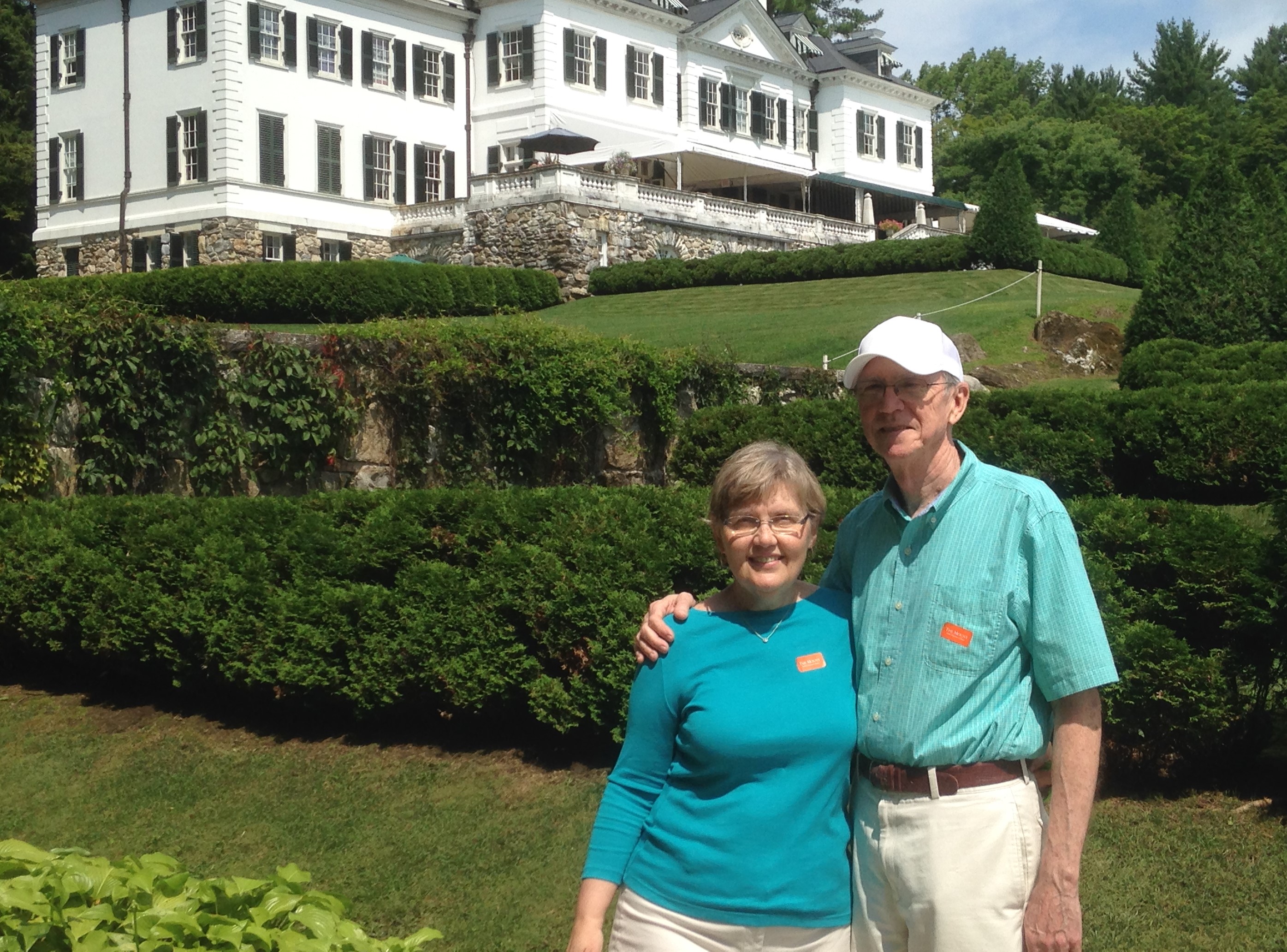
Jean Sonntag with her husband Bill at Edith Wharton’s home, The Mount, in the Berkshires.
This re-introduction to Christie made me want to learn more about the mystery genre, so I turned to my friend Jean Sonntag with some questions. Jean is an adjunct instructor of English at Howard Community College as well as a mystery enthusiast. Here’s what she had to say about Christie and the development of the mystery genre.
Laura: How would you describe Christie’s kind of mystery-telling and our contemporary mystery-telling?
Jean: There is a huge difference. The key thing is the emphasis in Christie on solving a puzzle to the subordination of characterization, psychological analysis, or any larger themes. Christie was part of a group called The Detection Club who had a quite elaborate set of rules for writers of detective stories in the 30’s. In short, everything should be there so the reader could solve the puzzle. Writers, of course, violated these rules at times. The tradition of ratiocination (Poe’s word) and very often an eccentric detective were part of the development of this 30’s Golden Age and Christie fits this tradition, particularly with Hercule Poirot.
Today’s detective story leaves room for more in-depth characterization and is minus the formulaic considerations of the detective stories of Christie’s era. Thus, someone like Elizabeth George’s Inspector Thomas Lynley and P.D. James’ Adam Dalgleish have a history that unfolds throughout the works while they are solving crimes committed by complex characters in complex situations. The modern detective story tends to be longer, more in depth, with more sophisticated style in many cases. And some have themes; P.D. James has pointed out that she sets out to write a detective story as any one would a novel, where the plot is a natural outgrowth of plot and setting.
Laura: Beyond the experience of thrill or curiosity, what do you think draws people to mysteries like Christie’s?
Jean: Reading Christie is a thinking (not feeling) exercise. Her works are not exceptionally long and her style is relatively simple, with pretty good dialogue. Those attracted to puzzle solving or who are reading strictly for entertainment love her. All of us have times we’d like to read like that – consider that layover in an airport or the need for pure escape. Interestingly enough, many of my friends who are Christie fans cut their teeth on her as middle or high schoolers. I came to Christie late, so the meatier mystery appeals more to me unless I need that strictly lighter entertainment option.
In addition, Christie and the other Golden Age writers got their start between the two world wars. I think this really supported their popularity as it was a time when readers badly needed stories where everything was tied up neatly at the end. Even today, one school of thought says we read mysteries because we like to have that sense of closure. More modern detective or crime novels sometimes leave us with more modern senses of ambiguity or disquiet, but I still think the solving of the crime still meets that need today.
Laura: What are your thoughts on Agatha Christie? How would you describe her influence in the mystery genre?
Jean: Although Christie is part of that rational puzzle approach to the mystery, she has had incredible success for a variety of reasons. One is the sheer number of works she produced – over 80 detective (or thriller) novels, and over 90 novels total over a 50-year career. The second is the fact that she escapes a bit of the label of formula fiction because of the variety of her detectives, the ingeniousness of her puzzles and the variety in settings. The relative simplicity of her style also made it easier to translate her works into other languages. At one point, she was second to the Bible in the number of languages in which her books have appeared.
Laura: Is there a writer writing now (or recently) that you’d compare to Christie?
Jean: Someone more expert than I might have a candidate for this comparison. I don’t think there is anyone who compares because the nature of the detective story has changed so much, and because I doubt anyone will come close to her huge output.
I do see influences, however. One is what we now call the “cozy mystery” – a set of writers who minimize the goriness of the crime and focus more heavily on solving the mystery but also provide more character development. Someone once said that in Agatha Christie, the representation of the crime itself is nothing more than a bloodstain left on the floor, so the cozies are in this tradition.
The other influence is the tradition brought to perfection in Miss Marple, a detective whom no one suspects of being involved and therefore one who can pick up clues where others couldn’t. This sort of detective, always an amateur, is also usually a feature of the cozy mystery. One of my favorites that fits this bill is Alan Bradley’s series (The Sweetness at the Bottom of the Pie is the first one) with a precocious child detective Flavia de Luce. No one suspects her as she solves crimes.
Jean calls herself an enthusiast rather than an expert, but certainly I learned a great deal from this crash course in mystery. I think my reading of Christie and other detective novels, crime novels, mysteries, and thrillers will be a bit richer for it. Jean is hoping to teach a continuing education course on the topic sometime in the near future, and I bet the mystery enthusiasts of Howard County will thoroughly enjoy it.
Laura Yoo
HoCoPoLitSo Board member and Associate Professor of English at Howard Community College.
 HoCoPoLitSo