Home » Event (Page 11)
Category Archives: Event


HoCoPoLitSo Welcomes 2012 PEN/Voelcker Winner for Poetry
Toi Derricotte Celebrates Lucille Clifton

Photo by Seishi Tsutsumi
Toi Derricotte, 2012 PEN/Voelcker Winner for Poetry, will read for HoCoPoLitSo 8 pm, November 2, at the Horowitz Center for Visual and Performing Arts’ Monteaboro Recital Hall on the Howard Community College campus.
Tickets are available $15 to the general public; $10 for students and senior citizens. Credit card orders are available at www.brownpapertickets.com/event/280070.
Good Times: Toi Derricotte Celebrates Poetry and Lucille Clifton celebrates distinguished poet and University of Pittsburgh professor Derricotte’s recent work, The Undertaker’s Daughter, and Lucille Clifton’s influence on Derricotte’s work.
“We are proud to welcome back Toi to read for HoCoPoLitSo and celebrate our good friend and former board member, Lucille Clifton,” said Dr. Tara Hart, Co-Chair, HoCoPoLitSo.
“Lucille was a personal friend and also a supporter of other poets’ work,” Derricotte said, reflecting upon the personal impact Clifton had on her own work, on other writers’ work and on the literary community.
Derricotte, co-founder of Cave Canem, a summer poetry workshop for African-American writers, frequently hosted Clifton who provided constructive, critical advice to young and emerging writers.
“She (Clifton) came to Cave Canem several times even when she was extremely ill, so you can imagine how grateful we all were for her presence,” Derricotte said. “She gave of herself without holding back. This, in itself, was a totally unique gift to all of us.”
Clifton (1936-2010) was a two-time Pulitzer Prize finalist for poetry, a former Maryland Poet Laureate, The Ruth Lilly Poetry Prize winner, and she is scheduled to receive The Robert Frost Medal for lifetime achievement for poetry from the Poetry Society of America.
She left a 45-year legacy of poetry, children’s books and other writing. The Collected Poems of Lucille Clifton 1965-2010, edited by Kevin Young and Michael S. Glaser, “provides a definitive statement about this major American poet’s career.”
Derricotte’s work, greatly influenced by Clifton, makes a statement of its own. The Undertaker’s Daughter has been hearlded as another great work from Derricotte. The Washington Post has described these “Poems that stick with you like a song that won’t stop repeating itself in your brain…”
“Derricotte’s work continues to have a profound impact on society and HoCoPoLitSo is honored to add her to the long list of distinguished, award-winning writers that have shared their work with our community,” Hart said.
For more than 38 years, HoCoPoLitSo has nurtured a love and respect for contemporary literary arts and global literary heritage in Howard County. The society sponsors live readings by authors and hosts a monthly television series, literary contest, writers-in-residence outreach programs and activities, and partners with other cultural arts societies to support the arts in Howard County, Maryland.
Let Our Kids Read
 “Children are made readers on the laps of their parents,” says author Emilie Buchwald. That’s a nice cuddly sort of sentiment, isn’t it? But she’s right. Most of us with children do read to them, almost from birth. It’s one of the best tools we have to introduce them to the vast new world around them.
We read to teach colors, shapes, letters, numbers, and textures. To teach them about animals and flowers, babies, and brothers and sisters, mommies and daddies. We read to teach them about themselves and living among others, about their world and their place in it. We read to help them learn to think. And in the process, we fervently hope – in fact it’s our duty – that we spark in them a sense of curiosity and a love of words, both so powerful that they will learn and love to read and to seek out answers on their own.
There’s an old joke about bringing up kids that goes something like this: We spend the first two years of our children’s lives teaching them to walk and talk. Then we spend the next sixteen trying to get them to sit down and shut up. Isn’t it more or less the same thing when, after we teach and encourage our children to explore the world through reading, we allow a book to be removed from a school curriculum or public library shelf because a vocal parent or small group in some way objects to its contents?
It happens more often that you might think. Every year, for the past thirty years, the American Library Association has recorded all reported challenges and bans of books in schools and public libraries in the United States. That’s hundreds of challenges every year. And those are only the reported ones. The ALA estimates that four out of five challenges go unreported. Most of the challenges come from well-intentioned parents trying to protect their children from some difficult idea or information. And that would be within their rights if they were protecting their children. The problem, however, is that challenges and bans might also deprive other children whose parents don’t share the same objections.
The challenging or banning of a book is akin to pulling the reading rug right out from under our kids. Take a look at the ALA’s list of frequently challenged books of the 21st century. You’ll see that along with the usual characters – Huckleberry Finn, The Catcher in the Rye, To Kill a Mockingbird, and so on – are a host of children’s and young adult books, the very books that we should be thrilled that our children are reading.
Reading is an active process of discovery. Our children will encounter new ideas and new ways of thinking; it’s bound to happen more and more as advances in technology continue to shrink our world and move us ever closer to true globalization. If as responsible parents we embrace such encounters as teachable moments, helping our kids “enter into a dialogue” with what they are reading, instead of saying, emphatically, “NO, you can’t read that,” we will teach our children to truly think for themselves, to consider the tough questions of our world, to make it a better and more accepting place.
In a nation that bemoans the fact that our educational system and student performances are lagging behind those of other developed nations, why would we ever even consider, if we hope to regain the intellectual edge, denying our children the opportunity to think by preventing them from exploring through reading? It may not sound quite as cuddly as what Emilie Buchwald says, but what a world of good we could do if we made our children thinking “readers on the laps of their parents,” and then let them read to their hearts’ content.
The American Library Association’s 30th Anniversary Banned Books Week observance is September 30-October 6. Join your Howard County neighbors and supporters of your First Amendment rights. Celebrate your freedom to read by reading a banned book – or by sharing one with your children.
Rick Leith
Assistant Professor of English
Howard Community College
Join HoCoPoLitSo and Howard Community College in their celebration of Banned Book Week at “Freedom to Read: The Historic Role of Grove Press in the Publication of Banned Books,” with Jeannette Seaver and Michael Dirda, Tuesday, October 2, 2-3:20 PM in Monteabaro Recital Hall in the Horowitz Visual and Performing Arts Center at Howard Community College. The event is free and open to the public.
Banned Book Profile: Naked Lunch
 Would you have published this banned book?
Book: Naked Lunch
Author: William S. Burroughs
Controversy: First published in 1959 by Olympia Press in France, Naked Lunch (initially misprinted as The Naked Lunch) was banned in the United States because of obscenity laws. The book’s subject matter deals with drug use, sexually explicit acts and obscene language.
Challenge: In 1962, Grove Press published the unedited American edition of The Naked Lunch, that is, as it was originally written for publication. It was banned in both Boston and Los Angeles, and European publishers were harrassed for printing and distributing the book. However, in 1966 the Massasschuetts Supreme Judicial Court reversed the decision finding that it did not violate obscenity laws. The book was deemed to have social value.
Impact: While his book dealt with “risque” subjects under the McCarthy Era, Burrough’s book also tackled the problems of drug addiction and protesting the death penalty. The book ‘s overall theme deals with failings of society through the exploration of the main characters encounters with the books more risque subject matter.
Burrough’s Naked Lunch was said to have influenced Thomas Pynchon, J. G. Ballard, and William Gibson.
It is included on Time magazine’s “100 Best English-language Novels from 1923-2005”.
Join HoCoPoLitSo and Howard Community College in their celebration of Banned Book Week at “Freedom to Read: The Historic Role of Grove Press in the Publication of Banned Books,” with Jeannette Seaver and Michael Dirda, Tuesday, October 2, 2-3:20 PM in Monteabaro Recital Hall in the Horowitz Visual and Performing Arts Center at Howard Community College. The event is free and open to the public.
HoCoPoLitSo, HCC Celebrate Banned Books Week – 9/30-10/6
 Co-chair of the HoCoPoLitSo board and Division Chair of English/World Languages at Howard Community College, Dr. Tara Hart previews a few upcoming Banned Book Week events in Howard County:
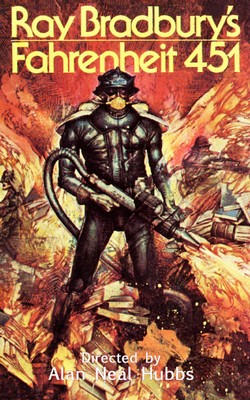
My New Jersey high school reading list made sure I met and never forgot Ray Bradbury’s perverse firemen, called to burn wherever books were found. Pop culture let rebellious ‘80s teens share Kevin Bacon’s Footloose character’s horror at finding that his new hometown is a place that incinerates piles of Kurt Vonnegut’s Slaughterhouse-Five in front of the public library. Much more recently, Terry Jones’s treatment of the Koran lit a global flame that continues to profane what many hold sacred. Also, “Hundreds of books [including, ironically, Fahrenheit 451] have been either removed or challenged in schools and libraries in the United States every year. According to the American Library Association (ALA), there were at least 326 in 2011. ALA estimates that 70 to 80 percent are never reported,” (www.bannedbooksweek.org). We may not understand, or feel we understand all too well, what drives those who burn or strive to hide books, but the good news is that the drive to protest such destruction and suppression is loud and sustained.
The Howard County Poetry and Literature Society (HoCoPoLitSo) celebrates National Banned Books Week (September 30 – October 6, 2012) and our freedom to read by partnering with Howard Community College to present an important conversation between Jeannette Seaver, widow of publishing giant Richard Seaver, and Michael Dirda, Pulitzer-Prize-winning critic for the Washington Post, about the historic role of Grove Press in the publication of banned books through discussion of Richard Seaver’s extraordinary memoir, entitled The Tender Hour of Twilight: Paris in the 50s, New York in the 60s: A Memoir of Publishing’s Golden Age (Farrar, Straus and Giroux, 2012).
“Dick” Seaver had a unique gift for recognizing, appreciating, and advocating for the translation and publication of previously unknown authors, especially Samuel Beckett, and was a unique presence in the publishing age that ultimately delivered to American readers, triumphing through much literal trial and other’s error, essential titles that continue to be challenged by contemporary citizens, including Lady Chatterley’s Lover, Naked Lunch, The Story of O, The Tropic of Cancer, Last Exit to Brooklyn, and The Autobiography of Malcolm X. The memoir resonates, in spite of his modesty, with a spirit of highly intelligent discernment and sense of vocation that played an enormous role in revolutionizing the American literary landscape, leading it from priggishness to possibility.
Michael Dirda is a well-versed expert on such landscapes and an ideal conversational host for Ms. Seaver, who is fascinating in her own right as an accomplished musician and later publisher who shared her husband’s intellectual and professional life and has her own opinions of and experiences with many of the literati mentioned in the book. It promises to be an engrossing, important, provocative, and academically enriching event, so come join today’s literati at “Freedom to Read: The Historic Role of Grove Press in the Publication of Banned Books,” with Jeannette Seaver and Michael Dirda, Tuesday, October 2, 2-3:20 PM in Monteabaro Recital Hall in the Horowitz Visual and Performing Arts Center at Howard Community College. The event is free and open to the public. Also check out HCC’s “parade” of banned books and the media clip festival that week.
Dr. Tara Hart
Board co-chair, HoCoPoLitSo
For more information, see
For event details, visit
Freedom to Read – Would You Print a Banned Book?
Freedom to Read – Would You Print a Banned Book?
Book: Tropic of Cancer
Author: Henry Miller
Controversy: First published in 1934 by Obelisk Press, Tropic of Cancer was banned in the United States for obscenity (graphic sexual content). U.S. Customs banned the book from being imported and sold in the United States. However, the book was frequently smuggled into the country. From the 1930s to the 50s, Tropic of Cancer was the subject of many lawsuits between the government and publishers/book sellers.
Challenge: In 1961, Grove Press legally published Tropic of Cancer, and lawsuits, once again, were filed in 21 states against store owners that sold the book. The case against it went all the way to the U.S. Supreme Court in 1964 with the decision of it being obscene was overturned.
Impact: Tropic of Cancer is considered a 20th Century literary masterpiece. Miller broke ground with a new literary writing style with his fusion of real life with fiction, free association writing, mysticism, and philosophy in the book. Many writers of the time hailed Miller as a new literary voice despite critics of the book.
Beat Generation writers, Jack Kerouac, Allen Ginsberg, Williams S. Burroughs and Lawrence Ferlinghetti, claimed to be greatly influenced by Miller’s work.
It has been named on several 100 Best or Must Read Book lists and was instrumental in paving the way for challenging censorship in the United States and Freedom of Speech cases.
A Few Edith Pearlman Resources Ahead of Her June 27th Reading in Columbia, Maryland
 On June 27th, HoCoPoLitSo will host the renowned short story writer Edith Pearlman. The event, part of this year’s Columbia Festival of the Arts will be held at the lovely Oakland Manor. In preparation for Ms. Pearlman’s visit, we offer these resources.
(Note: Edith Pearlman’s books, available online through the normal outlets, will be for sale at the reading. Edith Pearlman will be recording an episode of HoCoPoLitSo’s The Writing Life on her visit where she will be in conversation with author Carrie Brown. Look for information about airing dates on this website in the coming months.)
Interviews:
- The Millions Interview, “Overnight Sensation? Edith Pearlman on Fame and the Importance of Short Fiction.” As The Rumpus says, “The interview includes ambling thoughts on Pearlman’s work and interests, and includes mention of Hermes typewriters, polar expeditions, gun collecting, Pearlman’s stylistic influences, and the task of literature.”
- Biblio Buffet’s Talking Across the Table: “Edith Pearlman: An Interview.“
Articles:
- The Practice of Creativity: “Women Writers form the Present Who Inspire – Edith Pearlman.“
- Boston Globe, “With ‘Binocular Vision,’ Brookline’s Edith Pearlman catches the eye of the literary establishment Short Stories, Long Career.“
- Wall Street Journal, “Butterflies and Pariahs.”
- Wikipedia
Reading Guide:
YouTube:
- Edith Pearlman reads from Binocular Vision at the 2011 NBA Finalists Reading
- Reading “Lineage” from Binocular Vision, Center for Fiction, 2011.
And, of course, there is Pearlman’s own website: www.edithpearlman.com.
Check It Out: The Baltimore Sun Previews This Year’s Blackbird Poetry Festival
The Baltimore Sun‘s Explore Howard website has previewed this year’s Blackbird Poetry Festival. The article reports: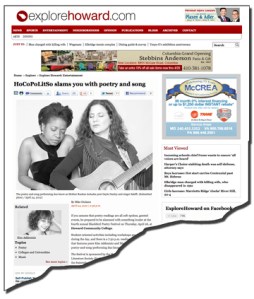
HoCoPoLitSo executive director Carla Du Pree says her group “promises a night of poetry, slam and song from contemporary poets who aren’t afraid to push the boundaries of our comfort zones. Addonizio’s red dress poem, ‘What Women Want,’ has people writing about what they want in that same saucy manner of hers. Cirelli directs one of the leading youth literary organizations in the country, and Mother Ruckus … sings for women and the men who can handle them.'”
This year’s Festival features Kim Addonizio, Michael Cirelli, Naomi Ayala and Mother Ruckus. Click here to read the article in full, including insight into the poet performers, then, we’ll see you at the Festival’s Nightbird reading, 7:30 pm in the Kittleman Room – Duncan Hall 100, for a wonderful evening of poetry adventure through slam and song.
Now Online: The Writing Life with Colum McCann on HoCoPoLitSo’s YouTube Channel.
In this edition of HoCoPoLitSo’s “The Writing Life,” poet and musician Terence Winch talks with Irish novelist Colum McCann (winner of the 2009 National Book Award for Let the Great World Spin) after his second novel debuted to great acclaim. McCann, who grew up middle class in Dublin, talks about his two-year bicycle trek around America, gathering stories as a journalist, that helped turn him into a novelist. And while he counts Irish writers as influences, he mostly read Kerouac and Burroughs as a teen.
McCann reads from his first novel, Songdogs, and from This Side of Brightness, about the New York subway tunnels and the homeless who make their homes there, as well as the sand hogs who built the tunnels. McCann spent a year in the tunnels, and counts listening as the best way to research. “I don’t want to write about my family, about me. I think it’s much more liberating to be in the imagination. People always tell to write what you know about, but I say no, write about what you don’t know about.”
Visit www.youtube.com/user/hocopolitso to view all the episodes currently available online. Enjoy and give us feedback, please, so we can improve this award-winning series.
30 Things You Might Do To Celebrate National Poetry Month
- Read a poem. Out loud. Feel it the sound of it move through you and into the air.
- Watch and listen to Billy Collins’ Ted Talk.
- Practice the math of counting syllables by writing a 5-7-5 haiku.
- Follow HoCoPoLitSo on Facebook. And Twitter.
- Read a Poetry Blog.
- Stop by the library on the way home and borrow a volume of poetry.
- Read the latest issue of Little Patuxent Review.
- Tweet some poetically purple prose. Retweet someone else’s.
- Email a friend a favorite poem.
- Print out a poem and put it on a bulletin board for others to see.
- Watch a poet on YouTube.
- Bilingual? Have a go at translating a poem. Not? Try the exercise with a friend that has a second language.
- Write a love poem, just for fun. Share it with the intended.
- Subscribe to Poets.org’s Poem a Day email.
- Make a comment on a Poetry Blog.
- Find a soon to be significant other and read Neruda’s 20 Love Poems and a Song of Despair to each other.
- Donate to HoCoPoLitSo.
- Read a poem out loud to someone else.
- Go to a poetry reading at a coffee house. If it is an open mic, share your own work.
- Jot down an ode to something ordinary in your life.
- Buy tickets for yourself and a friend to the Nightbird Reading, featuring Kim Addonizio, Michael Cirelli, Nayma Ayala, and Mother Ruckus. After the evening reading, post on the HoCoPoLitSo page about your experience.
- Support a poet, buy their book. Now really support them: read it.
- Celebrate National Poem in You Pocket Day, April 26th, by carrying a poem in your pocket and sharing it with others.
- Take on Poets.org’s list of 30 things to do for National Poetry Month.
- Tweet about poetry. If it’s Friday, tell your followers to #ff @hocopolitso.
- Memorize a poem and carry it around inside you. Let it out again and again when the occasion warrants.
- Add a quote from a poem to your email signature for a month. Switch it with a new one next month. (No reason to stop the practice just because it isn’t National Poetry Month in May.)
- Watch an episode (or two) of HoCoPoLitSo’s The Writing Life on YouTube.
- Tell a poet what their work means to you. They’d love to hear. Face to face, in email, in a good old fashioned card.
- Encourage someone else to join you in taking on this list. After all, poetry is a thing best shared with others.
National Book Critics Award Winner Edith Pearlman to Read in Columbia, Maryland, June 27th

Edith Pearlman
Now that Edith Pearlman has won the National Book Critics Award for fiction, what is she going to do? She’s going to visit Columbia and read from her acclaimed work, that’s what. Mark your calendars for Wednesday, June 27, 2012 and get yourself reading a copy of her Binocular Vision, wonderful stories often exploring the theme of accommodations people make in life. You’ll be glad you did.
Who is Edith Pearlman? some find themselves asking… like, um, even The New York Times, “Why in the world had I never heard of Edith Pearlman? And why, if you hadn’t, hadn’t you? It certainly isn’t the fault of her writing, which is intelligent, funny and quite beautiful.”
Pearlman’s website touts:
Edith Pearlman has published more than 250 works of short fiction and short non-fiction in national magazines, literary journals, anthologies, and on-line publications. Her work has appeared in Best American Short Stories, The O. Henry Prize Collection, New Stories from the South, and The Pushcart Prize Collection – Best of the Small Presses.
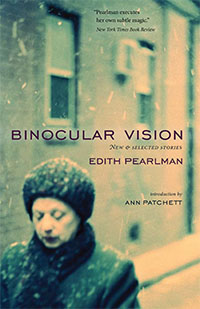 And yet it is just now, in her seventies, she is finding the greater fame and public attention she deserves. The National Book Critics Circle board, a group of 600 reviewers selecting Binocular Vision for the award, stated the recognition “a triumph for Pearlman’s distinctive storytelling, bringing it to a larger audience.” We are all glad for that — this is work that deserves to be read. And we at HoCoPoLitSo, working with the Columbia Festival of the Arts and the Town Center Community Association,* are ecstatic to be bringing Pearlman in person to Columbia so soon after this accolade.
We’ll keep you abreast of details, like ticket sales, here and on our Facebook page (you are following us, aren’t you?) as they develop. In the meantime, share this wonderful news with friends in email, on Facebook, with your book clubs, everywhere. And get yourself a copy of her work to enjoy! It won’t be long till you are listening to her in person, getting a chance to ask her questions you have and to sign a copy of your new favorite book.
* Guess what intimate venue the reading is going to be held in….
 HoCoPoLitSo