Home » Event (Page 7)
Category Archives: Event


Carolyn Forche: Lest We Forget
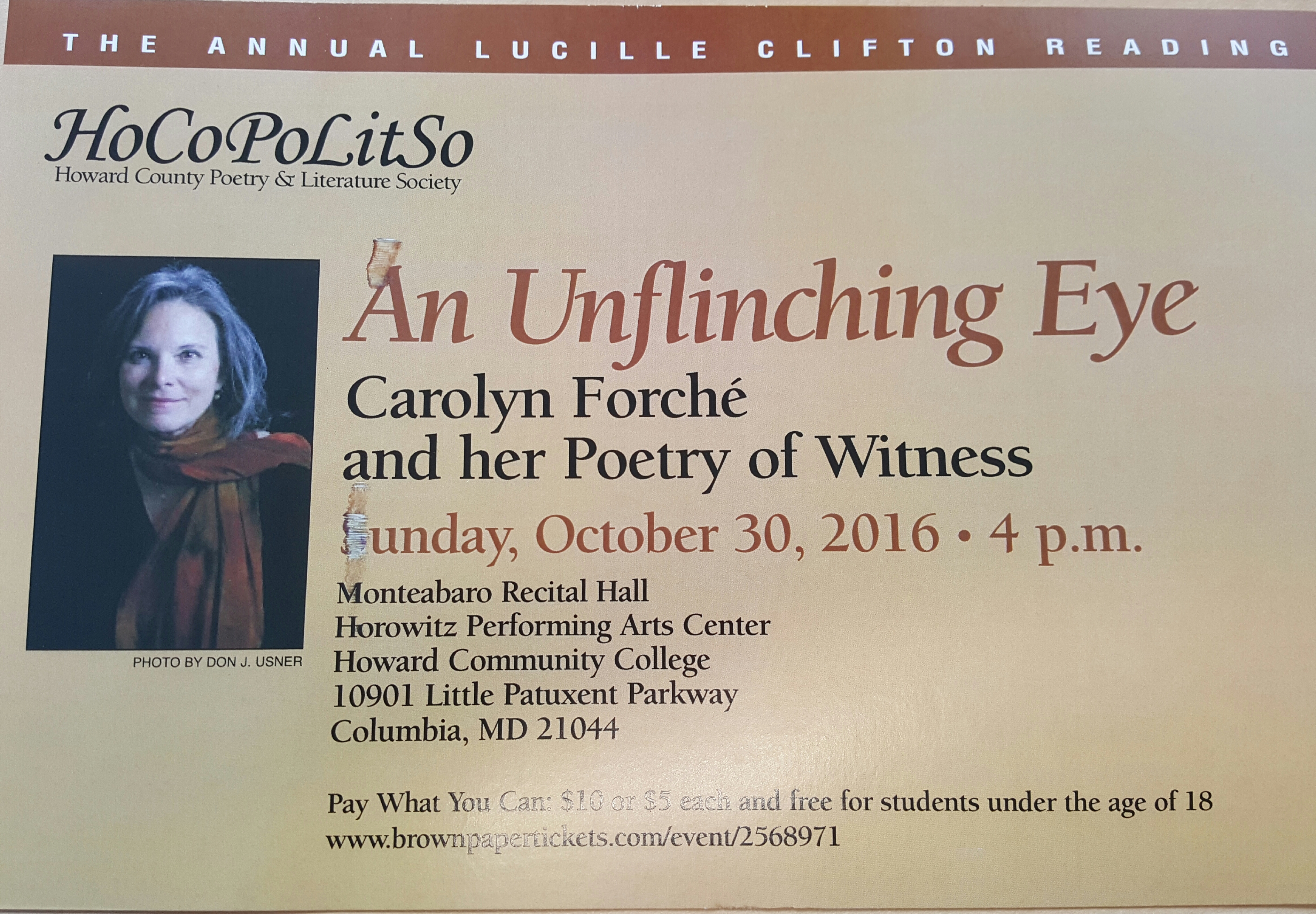
On October 30th at 4 pm, HoCoPoLitSo hosts Carolyn Forche for the Annual Lucille Clifton Reading.
Here is a reflection by Sama Bellomo who is a rehabilitation technologist who writes accessible curricula to help individuals with disabilities gain employable skills on their way into the workforce. Sama has previously contributed to this blog with a letter to HoCoPoLitSo after attending the 2014 Lucille Clifton Reading event with Michael Glaser.
***************
When it is not possible to stop the suffering of others the decent thing to do is listen and bear witness. When we validate someone by hearing and retelling their story we help them carry the heaviest bricks of the human condition to a new space where their suffering can be built into something meaningful.
By devoting years of her life to the protection of human dignity in war-torn places Carolyn Forché gives people’s pain a way to connect, to rest. First she collects the writings of devastated people. She listens, empathizes, and surely cries. Next, she connects the works with those of others who endure similar horrors, breaking their isolation by organizing and cataloguing their grief. Perhaps she reunites neighbours, lovers, or siblings among the pages. Maybe the loneliest are finally in good company. Wars ruin lives – but poets like Forche give that tremendous sense of loss a new purpose, a community, a voice.
I’ve been revisiting my studies of Carolyn Forché, whose book, “Against Forgetting,” has a permanent spot in my living room. I keep it in plain sight so that it’s a ready tool when I need to share an example of ordinary people who do extraordinary things on the worst and last days of their lives. The book is so thick and yet it was pared down from thousands of poems for whose inclusion Forché fought individually. Forché wrote an introduction to every single author, giving their poetry context, finding what the poem needed to say and clearing space for it in the reader’s mind. I flip through it to remind myself to keep ownership of my responsibility to improve the human condition where I can. I use the dog-eared pages to empower budding self-advocates. I harvest the hope and earnestness that Forché writes into each author’s leading biography to play my part in suicide prevention, which I spend a great deal of time doing, with no regrets, and with great thanks to http://www.IMAlive.org for training me to do without fear.
I gratefully tip my hat to Professor Jean Sonntag at Howard Community College who had a profound impact on the way I view myself and the world around me, through the lens of others’ written voices. She supported my investigation into the Japanese Internment further by giving me an Incomplete grade at the end of the semester which gave me time to catch up on the coursework I’d set aside. She was teaching me that I could and should make time to grow as a decent human being when there was something I really needed to understand. Because she taught me that making time was possible I got my first good look at how delicate we are, at how quickly we will treat each other poorly if we are not careful. The work I did to assimilate E.O. 9066 into my prior knowledge of “Great Man History” changed my sense of what it means to be proud of American History. But even then, the most gruesome inhumanities had yet to hit me because there are so few first-hand accounts and even fewer images from the Japanese Internment Camps. First-hand accounts have a unique way of haunting a reader’s conscience about what cruel acts people can commit against each other in deeply evil times, when just yesterday they had been neighbours.
Also at Howard Community College, Professor Lee Hartman first introduced me to Carolyn Forché. In a Creative Writing class Professor Hartman played a video where Forché spoke with HoCoPoLitSo. Forché told me in that recording what it was going to take for me to become a force to ease human suffering: I would have to listen, and it was going to hurt.
Of course I’d known what the Holocaust was, and of course I was sorry about it – for as sorry as a then-twenty-something could be about what public high school had said about it. Forché told me through her talk that I knew too little and could not be sorry if I did not truly know how the Holocaust had undone an entire people.
Fanni Radnoti published “The Borscht Notebook,” a posthumous final volume of her late husband, the Hungarian poet and writer Miklos Radnoti. To get the book she had sifted through a mass grave, through more than twenty bodies’ worth of human remains. Hoping and dreading that one of those bodies belonged to her beloved, whom she had not seen in more than two years since they had been separated by the Nazis, she found him. The book was in his pocket. Forché dutifully told these details to my Creative Writing class through her video recording session with HoCoPoLitSo and I was no longer just sorry. Sorry was no longer enough, and it never will be again.
My two neighbours at the time had been Holocaust survivors from Poland, who had been devoting their lives to recovering artifacts and human remains for proper burial, remains that had been turned into decorations such as tattooed skin lampshades and shrunken, sand-packed heads. After I saw Forché speak in that video I knocked on my neighbours’ door and asked them humbly about their experiences. They spent the next six hours showing me what they had recovered, articles and letters they had written, denials they had gotten from museums and private collections for items that had no hallowed ground.
It puts a strain on their marriage. They lose sleep. Their basement is a fully devoted workshop of recovery. They write home. They live modestly. They carry themselves happily despite the torture that continues in their histories, in their daily life. I was able to provide some technical support, a modest kindness to help their heroic efforts. We have lost touch but not a day passes that they are not in my heart, a part of who I am now, determined to help with activism, closure, and rehabilitation, using any skills I have.
As a member of the LGBTQ. community I am still trying to assimilate the confusing and overwhelming truth that I myself would not have survived the Holocaust, nor would much of my community, had I lived in Eastern Europe, where part of my family is from the former Yugoslavia. Forché’s works brought up the question in me: what do I have yet to learn about LGBTQ history, what should I be against forgetting? I have grown to raise awareness of genocide and to resist cultural eliminativism, be the acts overt or covert.
Knowing better leaves no excuse for not doing better, and then-twenty-something me was learning that in my college years. Somewhere in the world starvation, murder, and torture have happened today. They happened yesterday. They have happened since time immemorial. They have never happened to me, and they likely never will. That means I am in a position to do something about it. Knowing better leaves no excuse for not doing better: what can I do for my part to move the world forward?
Forché is featured in “Voices in Wartime,” another anthology volume that portrays exactly what one would imagine it does. A video documentary bearing the same title accompanies the book on my shelf and bears witness to the fact that Forché is not alone in her work. There are others concerned with trying to put words on the unspeakable, to educate, an appeal for peace, a chorus of humanitarian voices.
Regretfully, I’ve read comparatively little of Forché’s own poetry. Am I worried about what else she is going to teach me? Am I afraid my own conscience will become too heavy a boulder, that I won’t have the strength or won’t summon the will, to push it up the mountain? Am I afraid she will have a lighter side, and I’ll then have to find my own ways to lighten up?
Forché is so big a force in my life that it is not possible to count all the places in which her efforts have propped me up when I have stood up for myself or others, and my legs wobbled. Lest we forget, Carolyn Forché chronicles what we need to know about human suffering if we truly wish to end it.
__________________________________________________
To reserve your ticket for the Lucille Clifton Reading to hear Carolyn Forche and her Poetry of Witness at Monteabaro Hall at Howard Community College, please visit: http://brownpapertickets.com/event/2568971

Presenting Novelist Nadia Hashimi on June 26
Here are some numbers about Afghan refugees:
- 2 million Afghan citizens were displaced by violence in 2015.
- 5 million are awaiting repatriation or citizenship in Pakistan, but the government there is starting to force the refugees back to Afghanistan.
- 1 million wait in Iran and are enduring increasingly rough treatment and deportation.
And here’s why we can read those sentences and glaze over: because our brains can’t comprehend the millions of stories in the refugee crisis.
That’s why one photograph, of one drowned toddler and his two tiny shoes sparked more outrage than the daily tally of refugees. That photo told a story that had been incomprehensible.
 Novelist Nadia Hashimi, who is of Afghan descent but grew up in New York and New Jersey, wanted to tell one family’s story, to show the humanity in the humanitarian crisis that is the migrant emergency.
Hashimi centered her 2015 novel, When the Moon is Low, around a schoolteacher, Fereiba, who lives with her family in Kabul until the Taliban imprison and kill her husband. She and her children escape the violence of Afghan’s capital and endure boat trips in the dead of night, border crossings, predatory smugglers, hunger, cold and exhaustion in their quest to reach family in London.
In the prologue, Hashimi writes in the voice of Fereiba, who is lying in a hotel bed with her children: “One day, we will not look over our shoulders in fear or sleep on borrowed land with one eye open or shudder at the sight of a uniform. One day we will have a place to call home. I will carry these children — my husband’s children — as far as I can and pray that we will reach that place where, in the quiet of their slumber, I, too, will rest.”
Hashimi will read from that novel June 26 as part of a program HoCoPoLitSo is producing with the Columbia Festival of the Arts’ summer festival. The Toronto Star wrote of When the Moon is Low: “A heartfelt story of courage amidst a world short on compassion.”

Novelist Nadia Hashimi
Hashimi’s own story is compelling. Her mother grew up in the 1960s and ’70s in a modern Kabul, going to college, wearing mini skirts, listening to music with her friends. When the Soviet invasion was imminent, her mother migrated to the Europe, then got her master’s degree in engineering. Her father emigrated to the U.S. to seek his own education. Afghanistan, under the influence of the Taliban and extremist warlords, forced women to cover, divided families, reinstituted child marriage and outlawed women’s education.
Now a pediatrician from Potomac with four children, Hashimi has written three novels in four years. When she traveled to Afghanistan after the publication of her first two novels, she found it much changed from her parents’ stories. The years have not been kind to her parents’ home country, she told an audience at the Miller Library earlier in April. Since 1970, life in Afghanistan has become especially hard for women — who were for years forbidden to work, go to school or walk unaccompanied — and she wanted to tell those stories.
When the Moon is Low is particularly topical now, in the midst of the ongoing wave of migrants seeking a better life than in their turbulent, violent native land.
Foreign Policy, in a fascinating piece about the responsibility of America in the twisted history of Afghanistan, wrote, “The case of the Afghans, one of the world’s largest refugee communities and the second-largest group – behind Syrians – to arrive in Europe recently, should serve as a reminder that the origins of today’s predicament are neither recent nor confined to the refugees’ home countries.” (Full article.)
America and its policies bear responsibility for the refugees struggling to reach a peaceful place. We should not ignore the crisis, neither its numbers, its images nor its stories. Join HoCoPoLitSo and the Columbia Festival of the Arts on June 26 to hear Hashimi read from When the Moon is Low, and a sneak peek at her upcoming book about the stories in a women’s prison in Afghanistan, House Without Windows (August 2016).
— Susan Thornton Hobby
HoCoPoLitSo board member
and recording secretary

Marie Howe to read at 8th Annual Blackbird Poetry Festival
 HoCoPoLitSo’s guest for its eighth annual Blackbird Poetry Festival is former New York State Poet Laureate and acclaimed author Marie Howe.
The Blackbird Poetry Festival, to be held April 28, 2016, on the campus of Howard Community College, is a day devoted to verse, with student workshops, book sales, readings and patrols by the poetry police. The Sunbird poetry reading, featuring Ms. Howe, as well as Washington, D.C., poet Sandra Beasley and Howard Community College students, will start at 2:30 p.m. Ms. Howe will read from and discuss her most recent work, The Kingdom of Ordinary Time, as well as new, unpublished poems, during the Nightbird Poetry Reading, starting at 7:30 p.m. in the Smith Theatre of the Horowitz Center for Visual and Performing Arts. Nightbird general admission tickets are $20 each (students and seniors are $15) available on-line at http://www.brownpapertickets.com/event/2476204 or by sending a self-addressed envelope and check payable and mailed to HoCoPoLitSo, 10901 Little Patuxent Parkway, Horowitz Center 200, Columbia, MD 21044.
“Marie Howe’s poetry is luminous, intense, and eloquent, rooted in an abundant inner life.
Her long, deep-breathing lines address the mysteries of flesh and spirit, in terms accessible
only to a woman who is very much of our time and yet still in touch with the sacred.”—Stanley Kunitz
Acclaimed poet and teacher Marie Howe served as the Poet Laureate of New York State from 2012 to 2014. Her mentor and former U.S. Poet Laureate Stanley Kuntz said: “Marie Howe’s poetry is luminous, intense, and eloquent, rooted in an abundant inner life. Her long, deep-breathing lines address the mysteries of flesh and spirit, in terms accessible only to a woman who is very much of our time and yet still in touch with the sacred.”
Presenting Beans with No Salt: a Performance of Poetry and Percussion with Steven Leyva and Josh Soto
 Beans with No Salt: Poetry and Percussion
featuring Steven Leyva and Josh Soto
Kittleman Room of Duncan Hall
Howard Community College
February 6, 4-6 pm (Get Tickets)
Join HoCoPoLitSo for a coffeehouse afternoon of poetry and music, flavored with a bit of Zydeco as a warm-up for Mardi Gras.
Baltimore poet and Little Patuxent Review editor Steven Leyva reads from his work, centered around his tuneful hometown of New Orleans. He will be accompanied by drummer Josh Soto on congas and drum set. Coffee and snacks will be served before and during the performance, and a question and answer session follows.
In Créole the word Zydeco could translate to “Green Beans,” but colloquially a better approximation would be “Beans with no salt,” which is a sly way of expressing hard times. The reciprocal movement between lack and plenty, famine and feast, often inspires innovation in literature and music, making the borders of genres porous. Using improvisation, audience participation and a bit of luck, Leyva and Soto seek to carve out a space in the ear and imagination where hard times breed a new music for the heart, and percussion becomes the poet’s blank page.
This event is presented by HoCoPoLitSo in partnership with the Columbia Festival of the Arts winter performance series, “Beyond the Blues.” Join us for Poetry and Percussion at 4 p.m. on Saturday, Feb. 6, 2016, at the Kittleman Room on the campus of Howard Community College. A book signing and reception will follow. Tickets are $15 general admission and $10 for students and seniors. They are available online through Brown Paper Tickets.

Eamon Grennan to read at 38th Irish Evening of Music and Poetry
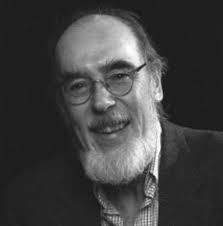 HoCoPoLitSo’s guest for its 38th Annual Irish Evening is the award-winning poet Eamon Grennan. He will read from his work starting at 7:30 p.m., February 19, 2016, at the Smith Theatre in the Horowitz Center for Visual and Performing Arts on the campus of Howard Community College. Grennan’s reading will be followed by Narrowbacks Eileen Korn Estes, Jesse Winch, Terence Winch, Linda Hickman, and Brendan Mulvihill on fiddle in a concert of traditional Irish music, with stepdancers from the Culkin School and Irish coffee and beer for sale in the lobby.
Starting with Wildly for Days in 1983, Grennan’s work has earned him much praise from the literary collective, including fellowships from the National Endowment for the Arts, the National Endowment for the Humanities, and the Guggenheim Foundation. Former U.S. Poet Laureate Billy Collins said of Grennan: “To read him is to be led on a walk through the natural world of clover and cricket and, most of all, light, and to face with an open heart the complexity of being human.”
Grennan has published more than twenty books of verse, along with translations and a collection of essays about modern Irish poetry; his latest is There Now (July 2015). His works have won the PEN Award for Poetry in Translation for Leopardi: Selected Poems (1997), the Lenore Marshall Poetry Prize from the Academy of American Poets for Still Life with Waterfall (2002), and Pushcart Prizes. His collection Out of Breath (2007) was nominated for the 2008 Poetry Now Award and he was a finalist for both the LA Times Book Prize for What Light There Is and Other Poems (1989) and So It Goes (1995) for the Paterson Poetry Prize.
Grennan follows other luminary Irish authors who have come to Howard County, including Frank McCourt, Eavan Boland, Hugo Hamilton, Paula Meehan, Colm Tóibín, Anne Enright, Colum McCann, and Emma Donoghue, to name a few. For 38 years, HoCoPoLitSo’s Irish Evening has recognized and celebrated the enormous impact of Irish-born writers on the world of contemporary literature.
General admission tickets are $35 each; available on-line at http://www.brownpapertickets.com/event/2465863 or by sending a check payable and self-addressed envelope mailed to HoCoPoLitSo, 10901 Little Patuxent Parkway, Horowitz Center 200, Columbia, MD 21044.

Join Us and Others: Underground Rooftop Coffee House — Voices from the Edge
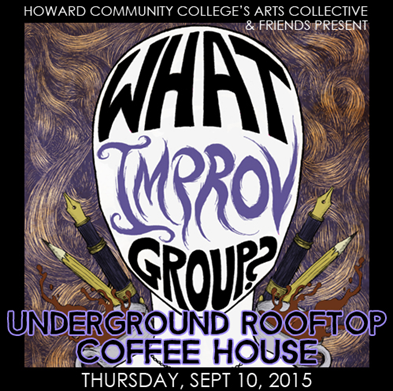 Thursday, September 10, at 7:00pm-9:00pm
HoCoPoLitSo is ecstatic to work with Howard Community College’s Arts Collective’s “What Improv Group?!?!” (W.I.G.) and the campus’s Creative Writers to present an “Underground Rooftop Coffee House.” Please join us on September 10th and see why.
The event fuses W.I.G.’s underground, edgy take on improv with powerful and evocative stories inspired by poets and writers. W.I.G.’s cast features HCC students, staff and guest artists: Douglas Beatty, Noah Bird, Diego Esmolo, Doug Goodin, Daniel Johnston, Autumn Kramer, Terri Laurino, Scott Lichtor, Thomas Matera, Apryl Motley, Shannon Willing, Sierra Young… and a few secret-surprise guests! This event will also feature poetry and prose written by HoCoPoLitSo’s Nsikan Akpan and Katy Day and local Stoop star James Karantonis. You can’t have a coffee house without music, right? Chris Sisson and Steven Caballero will provide an acoustical array of songs for the evening.
But wait, there’s more: W.I.G. will want you to raise your voice to the collective “primal scream” to celebrate this, the start of Arts Collective’s 21st season. Happy Anniversary to them.
Tickets: Includes Coffee & Treats!
$10 All Students with I.D., Seniors/Military/Groups
$15 General Admission
Parental guidance suggested. No one under 14 admitted. Seating is limited, reserve tickets now!
Special Event – Post-Show Discussion:
Following 9/10’s performance!
Nsikan’s Young Life with Poetry
In the last few months, we heard from Katy Day and Faheem Dyer about what poetry means to them. Today, in the last part of our series on young people on poetry and literature, we hear from Nsikan-Abasi Akpan. She is a student at Howard Community College and an aspiring writer.

Nsikan reading her poem to Taylor Mali
What do you get out of literary events like Taylor Mali’s reading at Blackbird Poetry Festival?
I recently met slam Poet Taylor Mali. He is a fire that enhances the light in others. It was nice spending time with him and the HoCoPoLitSo team and seeing that he doesn’t do what he does just for the stage – it’s inside of him. Poetry is inside of me and meeting him has encouraged me to not force my way into it, but rather to allow it to come naturally, perhaps when I least expect it to.
As a student and as a citizen of this world, what benefits do you see in reading and studying literature (especially poetry)?
The benefits of studying literature is growth. I spend many days cooped up in my room like a hermit, watching documentaries of great writers like Jack Kerouac and George Eliot, but it doesn’t mean I’m up to no good. It sounds silly, but when I get anxious (mostly due to my fear of not making it as a writer), I remember the struggles of J.D. Salinger and how he had to try many times before The New Yorker accepted his work; when I feel misunderstood, I think about Virginia Woolf and how she never truly fit in; an most importantly, when I find myself almost giving into anger and sin, I think of God and how He has given me poetry. Then I recite a poem in my head and end with “Amen” – and all is well again.
What’s your favorite piece of literature (a particular poem, poet, or novel maybe)?
“You might as well have asked, “What’s your favorite grain of sand?” Am I allowed to have a favorite? It’s just too much, but I’ll tell you this: In Stephen Chbosky’s book “The Perks of Being a Wallflower,” the main character, Charlie, is asked what his favorite book is. His answer: “The one I just read,” or something like that. I just read “Catholicism,” a poem by Billy Collins, so for this moment, that is my favorite poem.
Do you have any thoughts on what literary organizations like HoCoPoLitSo might do to encourage more young people to read, study, and encounter poetry?
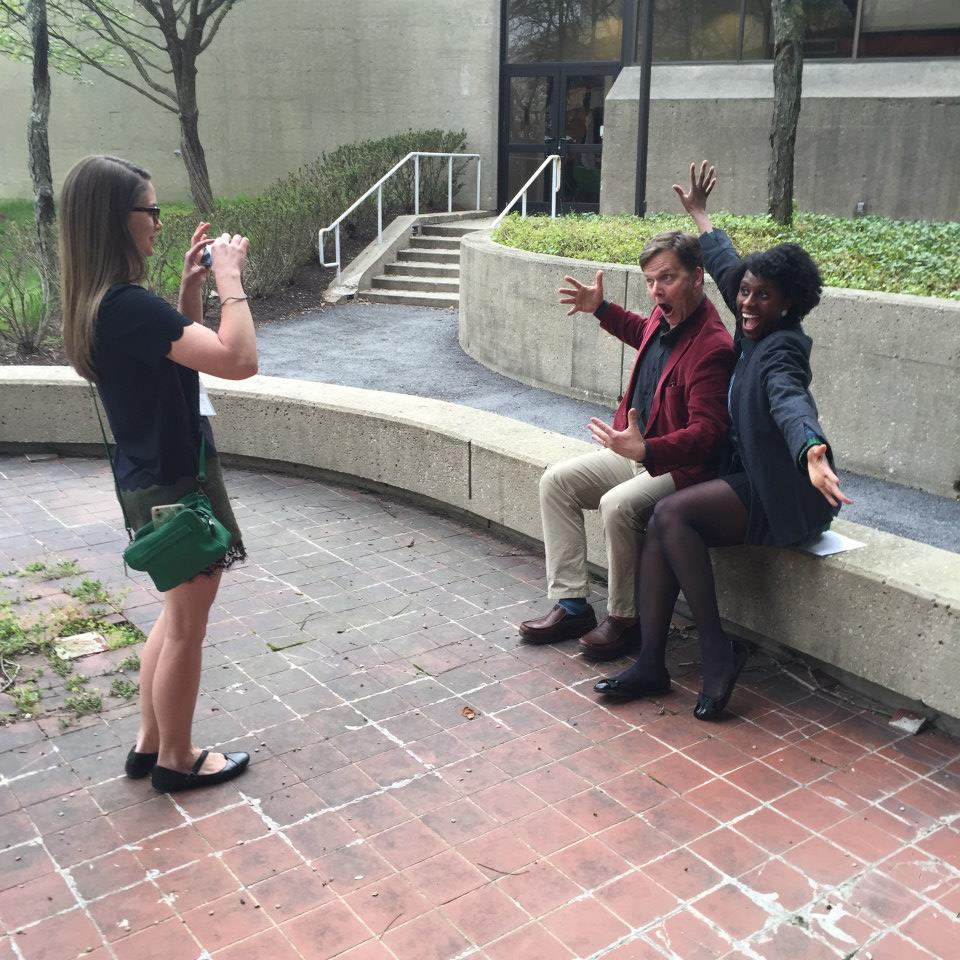
Who says poets aren’t silly? Katy and Nsikan share a moment with Taylor Mali
To some crazy people out there, poetry is no longer important. I once heard someone say “Poetry is dead.” Of course that person only said so because they were feeling bitter about failing the poetry unit in English class, but still we live in a world where such statements seem almost true. HoCoPoLitSo reminds us, though, that people who love poetry still exist, that poetry lives. It was through HoCoPoLitSo that I met Billy Collins and was able to recite my poem, “Frank,” right in front of him. HoCoPoLitSo is energetic and on the ball of everything literary, and young people need that. By providing the opportunity to not only read poetry , but also to meet the poets and share our own works, HoCoPoLitSo encourages us to stay involved and to stay in touch with literature. There are also local sources, like HCC’s literary magazine, The Muse, which bring us closer to literature. Young people are willing when it comes to being a part of the poetry world. It’s absolutely magical.
Rest assured, poetry lovers everywhere, that young people like Katy, Faheem, and Nsikan will become stewards of all that is beautiful and magical in the world of language and literature. But you and I have to support them, so that they can continue to spark and renew their energy.
And I promise you this – your support of HoCoPoLitSo will continue to foster their love of poetry and literature. Katy, Faheem, and Nsikan are the reason that HoCoPoLitSo does what it does.
– Laura Yoo
Member, HoCoPoLitSo Board of Directors
Dominique Morisseau’s SUNSET BABY – A Special Presentation with Discussion/Discount
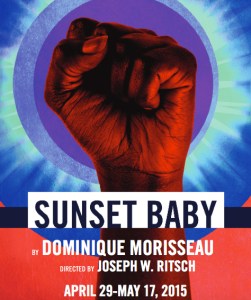 Discounted tickets are available now for a one-night-only presentation of Dominique Morisseau’s Sunset Baby, at 8 p.m. Friday, May 15, 2015, in Smith Theatre, Horowitz Center, Howard Community College, 10901 Little Patuxent Parkway, Columbia, Md 21044. Two-for-one tickets are available at http://www.repstage.org/Productions/sunsetbaby/ using code: HOCO; general admission is $40. This program, presented in partnership with the Howard County Poetry and Literature Society (HoCoPoLitSo), Rep Stage and Center Stage, is made possible by an Outreach Grant from the Howard County Arts Council through Howard County government and seeks to engage and connect Howard County and Baltimore audiences.
The Guardian calls the play, “Smart, entertaining and moving as it grapples with the tensions between past and present while asking penetrating questions about the nature of liberation. Morisseau’s script sings with intelligence.” A drama of family and revolution, the play explores what happens when a former black revolutionary and political prisoner decides to reunite with his daughter. The Huffington Post names Morisseau as a “direct heir to the magical wordsmiths named Lorraine Hansberry, Tennessee Williams, and August Wilson” for her vibrant exploration of the point where the personal and political collide. Morisseau, who received the Kennedy Prize for Drama in 2014, is a playwright and actress. Her literary work has been featured in the New York Times best-selling short-story collection, Chicken Soup for the African American Soul.
This Baltimore/D.C. area premiere of Sunset Baby, directed Joseph Ritsch, will be performed by Rep Stage and streamed live to Baltimore’s Center Stage, then followed by a post-performance panel discussion facilitated by production dramaturg Khalid Long, an instructor and researcher at the University of Maryland, College Park. Artistic Director Kwame Kwei-Armah will host the Center Stage live streaming event.
For more information visit www.repstage.org, call 443.518.1500 or email hocopolitso@yahoo.com.
Seniors in Columbia can request transportation by calling the Senior Events Shuttle at
(410) 715-3087. HCC is an accessible campus. Accommodation requests should be made to HoCoPoLitSo by May 7, 2015.
For more information about HoCoPoLitSo and its sponsored programs and activities, visit http://hocopolitso.org.
PDF of this press release.
HoCoPoLitSo is a nonprofit organization designed to enlarge the audience for contemporary poetry and literature and celebrate culturally diverse literary heritages. Founded in 1974, HoCoPoLitSo sponsors readings with critically acclaimed writers; literary workshops; programs for students; and The Writing Life, a writer-to-writer interview show. HoCoPoLitSo receives funding from the Maryland State Arts Council, an agency funded by the state of Maryland and the National Endowment for the Arts; Howard County Arts Council through a grant from Howard County government; The Columbia Film Society; Community Foundation of Howard County; the Jim and Patty Rouse Charitable Foundation; and individual contributors.


Something Wonderful To Do on a Saturday Afternoon in Columbia, Maryland
Columbia, Maryland, is almost fifty. At forty years (young) itself, HoCoPoLitSo has watched what was once America’s New City grow up. Way back when, there seemed hardly a thing to do in a place that had only just magically appeared out of the vision of James Rouse and onto the landscape, a new type of community curiously growing out of the farmland of Howard County.
Today, Columbia boasts ever more things to do and the schedule can be oh so cluttered. Back in the day, that wasn’t so true, not true at all. That lack of things to do was the impetus behind a bunch of Columbia pioneers forming the Howard County Poetry and Literature Society in order to bring their favorite writers to town to read to them and their friends. They wanted something to do. Something special to do. They made it happen and it has been happening every year since.
 It’s been a great forty years and the organization continues to “enlarge the audience for contemporary poetry and literature and celebrate culturally diverse literary heritages,” as its mission states. The list of writers HoCoPoLitSo has brought to Columbia dazzles many from afar who — drop-jawed — wonder how a suburban town that didn’t exist all that long ago is a now a treasure on the literary landmark map and regarded around the world. At last count, the list of visitors includes 5 Nobel prize winners, 17 US Poets Laureate, 11 National Book Award winners, 22 Pulitzer Prize winners, and 7 Maryland Poets Laureate.
This weekend, another name will join the list: recipient of a MacArthur Foundation genius grant, Ethiopian American novelist, and book club favorite Dinaw Mengestu.
On Saturday, Mr. Mengestu will read from his work as part of the Columbia Festival of the Arts’ “American Routes” program, a weekend festival of exploring the visual and performing arts. Mengestu’s route to America began when his family fled war-torn Ethiopia and immigrated to the United States when he was two years old. His novels and nonfiction pieces open a window into the little-explored world of the African diaspora in America. “This is not an immigrant story we already know quite well,” writes The Washington Post. He is expected to read from his latest novel, How To Read The Air, as well as a selection of his beloved The Beautiful Things That Heaven Bears, set in Washington DC.
Please join us and become a part of the history of HoCoPoLitSo, the Columbia Festival of the Arts, and the wonderful, unique place that is Columbia, Maryland.
For tickets, event details, a video preview, and directions, visit this Columbia Festival of the Arts event webpage.
Presented in partnership with the Columbia Festival of the Arts, another of the wonderful reasons there are so many things to do in Columbia, Maryland, these days.
Next Up – Faheem Dyer on Poetry
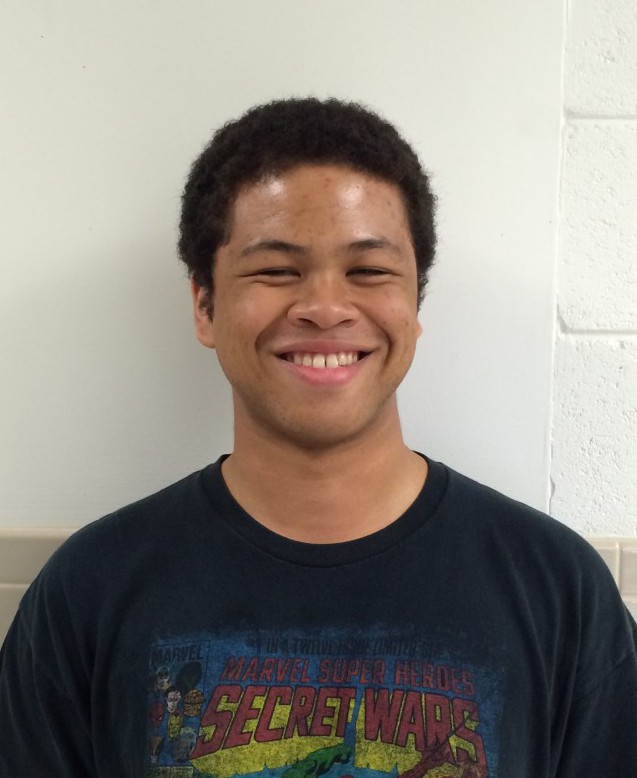 In this mini-series on young people in/of poetry, I have made my own observations about the importance of poetry in the lives of young people and I have interviewed HoCoPoLitSo’s Student on Board, Katy Day about poetry in her life. Next up is HoCoPoLitSo’s student intern, Faheem Dyer.
Faheem is a senior at Atholton High School. He has been pursuing his interest in poetry since middle school, and some of his favorites are Whitman, the Beats, and the Romantics. At Atholton, he is the president of the Poetry Club, and he serves his school’s student newspaper, Raider Review, as the Opinions Editor and the Online Editor. When he graduates this summer, he hopes to attend college in the fall to study creative writing or comparative literature. He says, “I believe that a deep engagement with the written word is essential to the intellectual growth and a healthy understanding of the world, both on a personal, and social level.”
Here’s what he had to say.
What do you get out of attending poetry and literary events, such as the Rita Dove and Joshua Coyne event last year?
I think the most profound thing I gained was the direct exposure to talent and experience of Ms. Dove’s and Mr. Coyne’s caliber. More than that, though, I think the chance to see these two people share their insights and ideas on their crafts with an attentive, engaged audience helped deepen my understanding of those art forms, both as a consumer and aspiring creator.
As a student and as a citizen of this world, what benefits do you see in reading and studying literature (especially poetry)?
I believe that being well-read in literature is the most important part of being a well-educated and informed individual. Whether it’s lofty philosophical theory, or raw poetic passion, all human knowledge and experience is cataloged with language; writing is one of the most important vessels of thought, and to make oneself a student of that is to put oneself at the heart of it. That is invaluable in growing as a person, and it is absolutely essential to a robust education.
What’s your favorite work of literature (a particular poem, poet, or novel maybe)?
I personally never get tired of Leaves of Grass by Walt Whitman, specifically “Song of Myself.” The wild, loving, and almost holy way Whitman addresses the nature of the world around him is beautiful and altogether profound and spiritual on a deeper one.
Do you have any thoughts on what literary organizations like HoCoPoLitSo can do to engage young people?
I may not be able to speak for all young people, but I know that if I were not already interested, simply being shown poetry in ways that demonstrate its continued relevance could easily engage me. Also, in introducing poetry to others, I would keep in mind what priorities and temperaments I’m trying to appeal to, because there is something for any young person of any mindset to gain from poetry, but the ways to make it appealing differ greatly from circle to circle.
You can read Faheen’s review of HoCoPoLitSo’s 2014 Lucille Clifton Poetry Series event when Rita Dove and Joshua Coyne read and performed together on stage at Howard Community College.
As a teacher, I am envious of teachers who get to teach students like Faheem. His commitment to poetry signifies more than his interest or even “skills” in language and literature – for me, it signifies the potential for a deep and wide understanding of the world that I believe literature students like Faheem can cultivate.
Poetry and other forms of literary arts ask us to look outward – at the world, at people, at history, at cultures, at empowering ideas as well as dangerous ideas. At the same time, they ask us to look inward, too – to think, to feel, to ask questions of ourselves, to imagine, and to nurture our interior lives.
Yes, poetry can do that. And Faheem knows it.
– Laura Yoo
Member, HoCoPoLitSo Board of Directors
 HoCoPoLitSo