Home » Guest post (Page 4)
Category Archives: Guest post


Boys’ Book Club: How these five third graders roll
A blog post by Laura Yoo

BOYS’ BOOK CLUB (Photo included with parents’ permission)
“My favorite part of the book was when James’s parents died!” my 9-year old son Sammy yelled. And everyone around the table yelled back, “What? Oh my God! Why?” He had a perfectly reasonable response: “Because! That’s what made the whole story possible!”
Five 9-year old boys sat around the kitchen table at the home of Brooke Dalesio on a gorgeous, sunny April afternoon talking about Roald Dahl’s James and the Giant Peach. School had gotten out three hours early, and the five boys were invited to the first installment of the Boys’ Book Club organized by Brooke for her son Nate and four of his friends. Brooke is a reading specialist who currently works with education majors at University of Maryland College Park, supervising their student teaching. She also works with the reading team as a Title 1 reading tutor at the five boys’ school, Longfellow Elementary in Howard County, Maryland.
Back in February, when Brooke texted me with, “I have a crazy idea that I thought we could do together,” I responded with, “I’m scared.” She proposed to host a book club for a few of Nate’s friends, including Sammy. After a few more text messages back and forth about the logistics, I answered the call with “What the hell! Let’s try it!”
At first, Sammy wasn’t so sure. I guess he just didn’t know what to expect. He asked, “Is it like school work? It sounds like school work.” I assured him that it’d be EVEN MORE FUN than school work. Brooke got the ball rolling by emailing the moms, and Sammy started reading James and the Giant Peach. He loved it right away. When he was finished, he handed it to me (I had not yet read the book) and moved onto Fantastic Mr. Fox. He was counting the days til the first book club meeting. (I cheated by listening to the audio book of James and the Giant Peach, which I highly recommend, by the way.)
For the first book club meeting, Brooke offered fresh peach slices and peach smoothies for snack. They also munched on peach flavored gummy snacks that Sammy and I found at Lotte. While the boys enjoyed their snacks, they started the meeting by sharing general impressions of the book. They kept raising their hands – just like in school – instead of having a conversation. But that was okay – they’d need practice.
They took turns picking discussion questions that Brooke had prepared. The boys got a kick out of the question asking them to find “juicy words” from the book. They loved “ghastly,” “mammoth,” “frantically,” “brute,” and “peculiar.” (Later, one of the boys used “peculiar” in his sentence, just casually throwing it in there as if he’d always known that word.) Brooke told them about British English versus American English, and we listened to a short clip of the audio book on my phone so we could hear the accent. Other questions asked about their favorite characters, how James changes throughout the book, and about the role of magic in this fantasy novel. My favorite question, though, asked the boys to imagine other ways that James and his friends could have gotten out of some of the sticky situations during their adventures, because it encouraged creative problem solving.
After the discussion, the boys created a storyboard of the novel using a long piece of paper Brooke had prepared. They had to decide how to break up the story and how they’d represent the important events in the book. This part got a little hairy and Brooke and I offered some suggestions, but we let them sort it out. (Brooke, by the way, is much better at letting them be than I am. I’m, shall we say, much more “hands on.”) And of course they did a fantastic job.
-

- Part 1 of James and the Giant Peach
-
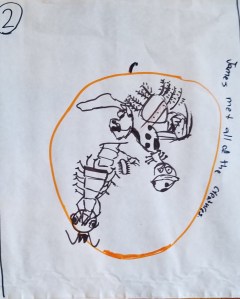
- Part 2 of James and the Giant Peach
-

- Part 3 of James and the Giant Peach
-
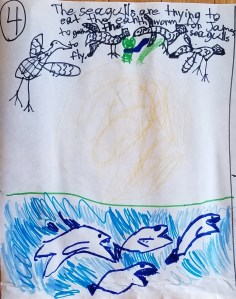
- Part 4 of James and the Giant Peach
-

- Part 5 of James and the Giant Peach
-
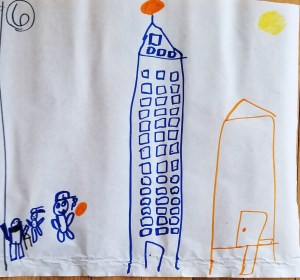
- The End
Brooke did the facilitating, and I enjoyed my peach smoothie and observed with fascination. I loved the level of energy in the room. The boys were excited to talk and to share their ideas. Sure, they all got a bit silly at times. Occasionally, one of them would get up and walk around the room – or dance. They talked on top of each other. Sometimes they got excited and yelled. Still, Brooke kept her cool and steered the group back to the table and back to the book. Other times, she just let them get their energy out for a minute or two. I was impressed. This was a serious level up from “playdate.”
The boys agreed on The BFG for their next book club meeting, which will be in June. After the official book club meeting was adjourned, the little literary scholars dashed outside to play basketball and soccer in the sun while enjoying peach flavored ice pops.
“It was awesome,” Sammy said to me as we left Nate’s house. He cannot wait til June. I joined my first book club when I was 38 years old, so clearly Sammy is getting a serious head start thanks to Ms. Brooke’s “crazy idea” that turned out to be quite awesome.

Laura Yoo
HoCoPoLitSo Board member and Professor of English at Howard Community College.
Lessons of Passing: Remembering Nella Larsen on her birthday
A guest blog post by Nsikan Akpan
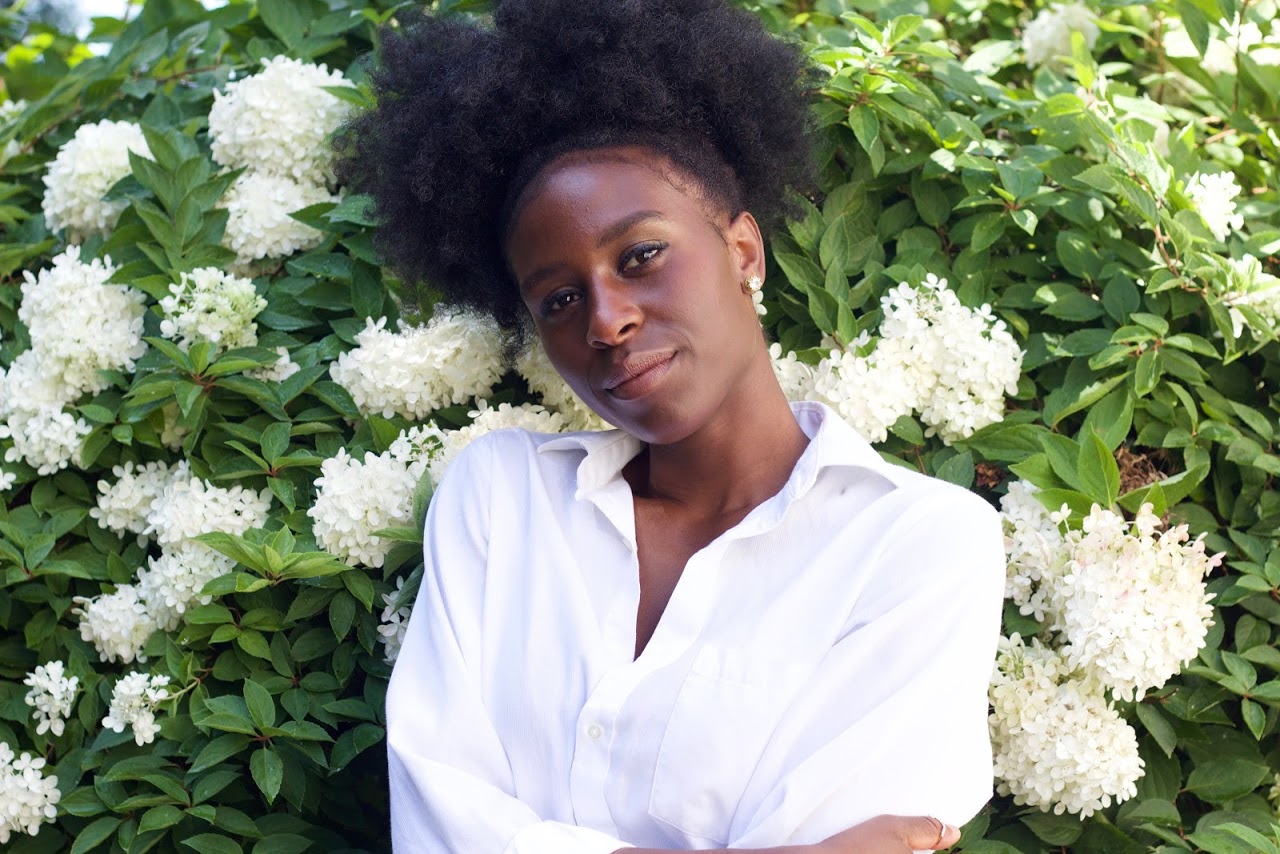
Nsikan Akpan serves on the board of HoCoPoLitSo and is a student at Howard Community College. She is a writer, actress, and future lawyer for black rights. She enjoys reading big books and watching long movies. To read more of Nsikan’s work, visit her blog: onmogul.com/nsikan-akpan.
Characters in stories are hardly given enough credit for their bravery of taking on the task of representing the idiosyncrasies and lifestyles that the public prefers to keep private. Clare and Irene in Nella Larsen’s Passing are appropriate examples. Irene’s complexion is light enough to pass for a white woman but makes the choice to side with her true community. On the other hand, Clare, Irene’s friend from childhood, is also light enough to pass for white and finesses this fact to marry Bellew, a white racist. As readers maneuver their way through the lonely, privileged lives of both Irene and Clare, we find that wealth and passing for the sake of wealth may not be worth one’s peace of mind. It can lead to a fatal end.
Passing by Nella Larsen examines themes of hypocrisy, physical (racial) as well as social “passing,” and the sacrifices made for the American dream. Passing is a form of pretending, and sometimes we cross boundaries when playing pretend. What makes Larsen’s work significant is that it displays passing as an example of natural human desire to survive. Judging Clare equates to judging anyone that has been put in a situation where the only way out is to be something they are not. Humankind has done worse for survival. Still, Clare’s life is a lesson: one can make it to the other side and realize there is nothing there for them.
I am reminded of O. J. Simpson’s story. Simpson, a black man, had been a supreme football player, the first to run over 2,000 yards in one season. He was an athletic mogul. He helped paved the way for athletes to not only play the sport of their choice, but to do so while starring in movies, commercials, and gaining fortune from various endorsements. He was treated as an American hero and embraced by white America. If Larsen’s Clare had her pale skin that allowed her to pass as white, Simpson had wealth and his white wife that made up for his chestnut skin color and allowed him to pass in white society. In 1978, Simpson starred in a famous Hertz commercial, running through an airport as people – notably, all white people – cheered him on. “Go Juice, go!” They hailed. Until they stopped. In 1994, Simpson was accused of murdering his ex-wife, Nicole Brown Simpson and her friend, Ron Goldman. When Simpson was accused of murder, he became black again.
Passing is seductive. Joe Bell, a childhood friend, said of Simpson, “He is seduced by white society.” In Larsen’s novel, Clare was seduced enough to want to be a part of that society, so much so that she became a part of it. As examples of passing – physical and social – Clare and Simpson demonstrate that passing does not turn out well in fiction or in real life. In Larsen’s words, Clare “had been there, a vital glowing thing, like a flame of red and gold. The next thing she was gone.”
While reading Passing, I realized that there are many types of passing. I have come to recognize my own privilege of intellectual passing. I am an educated and cultured black woman who has sat next to distinguished authors and poets. These stimulating cerebral experiences allow me to go into spaces where my color is not considered because my ability to articulate trumps any stereotype that is connected to me. Or so it seemed. It turns out that intellectual passing connects very much with racial and social passing. We must put an end to associating intelligence with whiteness.
I have made a conscious choice not to give into passing. What Clare showed me is this: One can fool people with skin but not with soul. Throughout high school, despite my dark skin, I made myself “more palatable” for my white counterparts. Every time I had an opinion on something, I tried my best to express it very nicely, or sometimes I’d say nothing at all, knowing people might take it the wrong way. Fortunately, I have grown out of that nonsense. I am who I am. An exit is always available, but for me, passing is never an option. It’s too exhausting. In my own skin, I am at rest.
Expanding and Deepening the Reading List
A blog post by Laura Yoo
Expanding and Deepening the Reading List: How Centennial Lane Elementary School is providing diverse books to its students
“All children and young adults deserve excellent literature which reflects their own experience and encourages them to imagine experiences beyond their own.” – Cooperative Children’s Book Center
One afternoon when my son was 4 years old, he began to jump up and down excitedly while watching TV. He was screaming, “Mommy! She’s talking in Korean!” Indeed, a cat-like animal in a cartoon called Littlest Pet Shop was speaking in Korean while the other animal and human characters tried to understand her. The Korean-speaking animal was a ferret named Jebbie Cho who later meets a recurring Korean character on the show, a human named Youngmee Song.
My son hears Korean all the time at home, spoken by his grandma and by mommy and daddy when they don’t want him to know what they’re saying. But seeing Korean characters and hearing Korean names on TV was special. His family’s cultural identity was being reflected back to him. He saw himself. And what I saw on his little face was a sense of validation and pride. What I witnessed was the power of representation.
At Centennial Lane Elementary School in Ellicott City, Maryland, parents, staff, and teachers understand this power of representation, particularly as it is reinforced in children’s books. With the support of school staff and teachers, the members of the CLES PTA’s Diversity, Equity, and Inclusion Committee created a book list with 70 titles that represent various nationalities and heritages as well as LGBTQ, dis/abilities, and religions. Many of the books also explore diversity as a general theme.
The CLES DEI BOOK LIST includes titles like Out of My Mind by Sharon Draper, a GR 4-6 book about an 11-year old girl with a photographic memory and cerebral palsy; Skin Again by bell hooks, a GR K-4 book about skin – about what it is and what it isn’t; and The People Shall Continue by Simon Ortiz, a GR 1-5 book about the history of Native Americans. The CLES’s list demonstrates a wide definition of diversity and aims to be as inclusive as possible.
“[It’s important] the kids see themselves in those books,” says Sabina Taj, the chair of the committee. The project, which is coordinated by Anu Prabhala, has received a donation of $500 from a parent to achieve the goal of purchasing some of these books for the school’s media center. The committee’s work has been supported by CLES Principal, Amanda Wardsworth, and the list of books has been reviewed and approved by the school’s Media Specialist, Marnie Beyer. “This was truly a labor of love,” says Ying Matties, a member of the DEI Committee.
“I’m hoping each school asks the diverse populations of the individual school and teachers to use this process as a model to create their own,” says Ms. Taj. She emphasizes the importance of focusing on community involvement in gathering ideas and feedback from various stakeholders. Then, she says, the various lists compiled by many schools could be combined to create an even more comprehensive and representative sample of books for the students in Howard County.
This vision reflects a national debate and discussion about representation in children’s books. A national non-profit organized called We Need Diverse Books, founded by YA and MG writer Ellen Oh, envisions “a world in which all children can see themselves in the pages of a book.” There is tremendous power in seeing what is possible. As Marian Wright Edelman famously said, “You can’t be what you can’t see.” This idea was reiterated when Misty Copeland became the first African American to be named principal dancer for the American Ballet Theatre and when Sheridan Ash set up a program for PwC called Women in Tech. When the Time Magazine published its “Firsts” issue about female firsts, they titled it, “Seeing is Believing.”
However, at Centennial Lane Elementary School, it’s not just Muslim children or children with two dads who will benefit from reading these books. As B.J. Epstein, professor of literature who researches and teaches children’s literature, writes in The Conversation, “Research on prejudice shows that coming in contact with people who are different – so-called ‘others’ – helps to reduce stereotypes.” So, the effect is twofold: children will learn about themselves and children will learn about the experiences and lives outside their own. Duncan Tunatiuh, author and illustrator, notes in Language Arts, “we need multicultural books so that different kinds of children can see themselves reflected in the books they read, and so that children can learn about people from diverse backgrounds and cultures.”
The Diverse Books project at Centennial Lane Elementary School is one of the various ways that parents, staff, and teachers are trying to encourage and implement curriculum that is diverse, equitable, and inclusive. The DEI Committee is also currently working with the school administration on organizing Community Circles, a venue for diverse parents to provide in-person feedback to the school on how to make it more inclusive to all its constituents.
Note: To learn about setting up a DEI Committee in your school, please contact Sabina Taj <sabinataj@gmail.com>. For more information on the CLES DEI Committee’s work, please contact Anu Prabhala <prabhala.anu@gmail.com>.
Laura Yoo HoCoPoLitSo Board member and Professor of English at Howard Community College.
mana’s musings: celebrating marilyn chin on international women’s day
a blog post by Laura Yoo
It was my very first visit to the famous Dodge Poetry Festival. It was Saturday, October 22nd in 2016, right around 7:15 in the evening. There stood on this enormous stage at the New Jersey Performing Arts Center a petite Asian woman, speaking with a slight accent and a lot of voice. She read her poem, “One Child Has Brown Eyes.” First I googled “vacuity.” Then, I was mesmerized. Also on stage were poets like Martin Espada, Robert Haas, Claudia Rankine, and Jane Hirshfield, but it was Marilyn Chin who spoke to me that night. She was smart, powerful, and funny – and she looked like me.
Ever since getting a serious high on Macbeth in high school, I’ve been studying and loving English literature. In college, I chose all of my electives to be in English literature, and I studied abroad in England to nerd it up with Shakespeare and Jane Austen – and to drink a lot of beer. My area of study was eighteenth-century British literature (which even other English majors didn’t want to touch) so I can say for sure there were no likes of Marilyn Chin in my curriculum. In the last 10 years, thanks to HoCoPoLitSo, I’ve met many wonderful writers and poets, and among them a few Asian American writers, too. But the poet embodied and represented by Marilyn Chin was something new for me.
See, I always wanted to be like Sandra Oh’s character in Grey’s Anatomy, someone who wasn’t on the show to play Asian. She was just another doctor, who happened to be Asian. Her name wasn’t Johnson or Smith. Her name was Cristina Yang, best friend to the main character, but the “Yang” part did not define her character. Sandra Oh, who is Korean-Canadian, plays this “best friend” role also in Sideways and Under the Tuscan Sun. In both of these movies, she is just the best friend, not the Asian best friend. I applauded these characters. Yes! Finally! Asian people are just people! In retrospect, however, I am seeing that in some ways this is denial, a kind of self-imposed erasure. Yes, it hurts to be locked inside the limits of stereotypes, but it also hurts to deny my self from myself in an apparent fight against such stereotypes. At this point, I can hear a frustrated voice saying to me, “What do you want, then? You want Cristina Yang to be Korean or not?” Well, I think I want Cristina Yang to be her self, all of the things that she is.
Recently a Korean-American writer, Mary H.K. Choi, posted this:
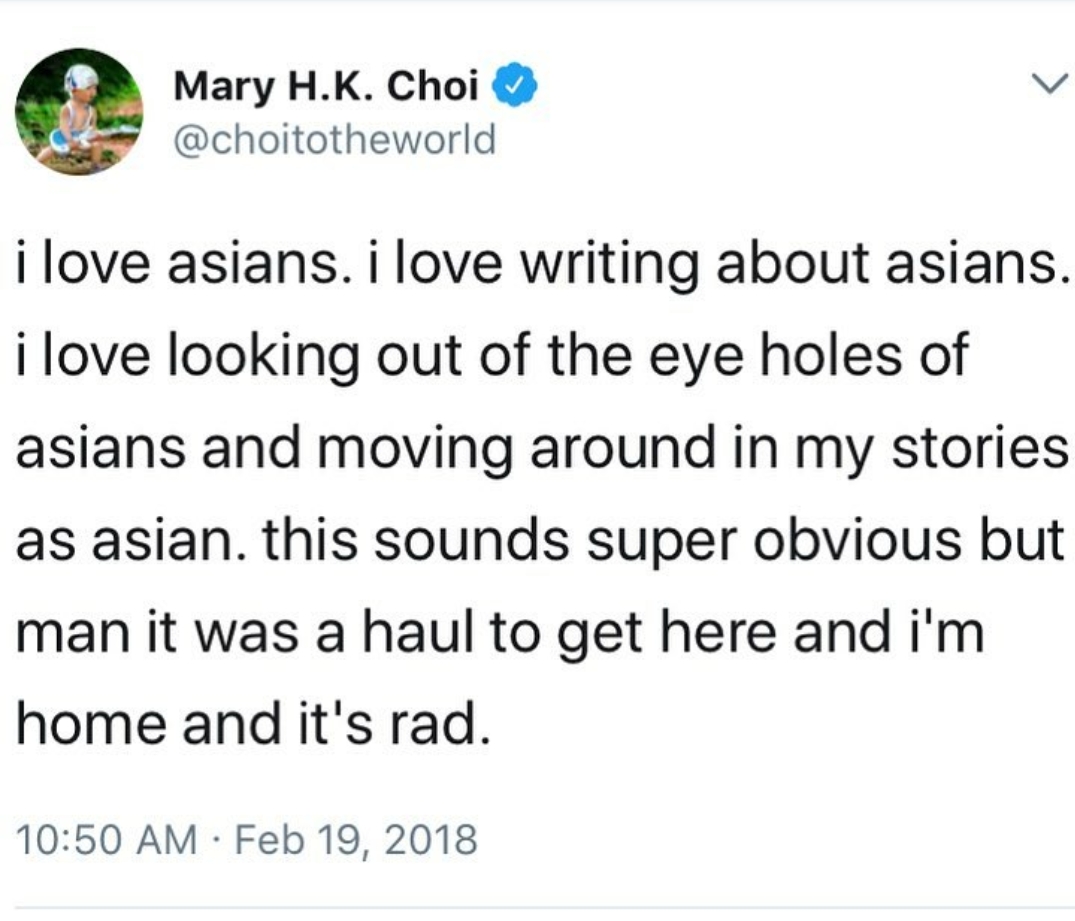
From this post, I suspect that, like me, Ms. Choi has been struggling – maybe unbeknownst to her – with her relationship to the Korean part of her “Korean-American” identity. So, I have been thinking about my own going home (or coming home) and how art helps me on that journey. A great example of such art is Ms. Chin’s novel, Revenge of the Mooncake Vixen, which Sandra Cisneros called “bad ass,” Maxine Hong Kingston “What fun!” and Gish Jen “Deeply provocative and deeply Chinese.” The story of two Chinese girls growing up in California focuses very much on their grandmother’s voice and legacy, weaving 41 separate stories together into what Ms. Chin calls a “manifesto.” The story is magical, mythical, and yet so very painfully and beautifully real. The opening story is heartbreaking, shocking, and ultimately triumphant.
Ms. Chin’s poem, “How I Got My Name: An Essay on Assimilation,” is another good example. It starts like this:
I am Marilyn Mei Ling Chin
Oh, how I love the resoluteness
of that first person singular
followed by that stalwart indicative
of “be,” without the uncertain i-n-g
of “becoming.” Of course,
the name had been changed
somewhere between Angel Island and the sea,
when my father the paperson
in the late 1950s
obsessed with a bombshell blond
transliterated “Mei Ling” to “Marilyn.”
And nobody dared question
his initial impulse—for we all know
lust drove men to greatness,
not goodness, not decency.
And there I was, a wayward pink baby,
named after some tragic white woman
swollen with gin and Nembutal.
My mother couldn’t pronounce the “r.”
The assimilation happens with the choosing of an “American name.” I am also named after a white woman, Laura Ingalls Wilder, but more accurately the character Laura Ingalls on Little House on the Prairie the TV show. My mom had watched this show in Korea and loved the character. This custom is seen as practical as it is difficult for Americans to pronounce Korean names. Luckily, my family – like most Korean people – also could not pronounce the “r” and has always called me Yoonji, by my real name. Now, my little sons hear my mom calling me Yoonji and once in awhile, very quietly, they test it out in a kind of whisper “Yoonji” and then giggle. It’s like they’re wondering, “Who is this Yoonji? She’s like a whole another person from my mom who is Laura.” Maybe so. Maybe not. All of this, of course, is not to deny the name Laura, which my mom gave me and therefore an important part of my identity. Besides, it’s a beautiful name. But it’s complicated, you see.
I know it sounds cliche to say this, but Ms. Chin’s poetry, novel, and her performances have raised my awareness. No, it did not happen like a bolt of lightning or anything that dramatic, but rather like a gradual stewing and simmering in this idea about who I am and what I am. So, on this International Women’s Day, I want to thank her for being on that stage on that day at Dodge Poetry Festival to help me widen the way I might think about my cultural identities.
I am ecstatic that I will have another chance to meet Ms. Chin and maybe – if I have the guts – thank her in person on April 26th when she reads at the Blackbird Poetry Festival at Howard Community College. Read more about Marilyn Chin’s visit here.
Laura Yoo
HoCoPoLitSo Board member and Professor of English at Howard Community College.
mana’s musings: Step Aside, Ambien! Here comes Dr. Seuss’s Sleep Book!
Laura Yoo
HoCoPoLitSo Board member and Professor of English at Howard Community College.
A blog post by Laura Yoo
I did not grow up with Dr. Seuss because by the time I came to the United States from Korea, I was already 10 years old and my parents certainly didn’t know who Dr. Seuss was. That’s right. I had a Seuss-less childhood.
It was when I was in high school and doing a lot of babysitting that I came across Dr. Seuss. The children just loved his books, almost as much as they enjoyed watching Disney movies. I learned quickly that Cat in the Hat and Green Eggs and Ham were some of the kids’ favorites. As a 15 year old, I didn’t see the real value of these books, of course. They were just fun.
Now as a mom to young children, a teacher of writing, and a human fascinated by language and literature, I have a whole new appreciation for Dr. Seuss. Hop on Pop, The Lorax, The Cat in the Hat, and Green Eggs and Ham are probably some of the most popular of Dr. Seuss’s books. My own two boys say Fox in Socks and One Fish Two Fish Red Fish Blue Fish are their two favorites.
While all these are wonderful stories, my personal favorite is Dr. Seuss’s Sleep Book. This is the book that truly showcases Dr. Seuss’s genius.
Oh boy, does it work. Try to stifle the yawn while you read it. You can’t do it. At least half way through, someone – you or one of the little listeners – will yawn. And once that first yawn comes out, there’s no stopping the flood of yawns to come. As Dr. Seuss says: “A yawn is quite catching, you see. Like a cough.” Turns out – just reading the word “yawn” or seeing illustrations of creatures yawning will make you yawn. That’s how powerful a yawn is.
So, by the time you reach the end of the book to read “When you put out your light, / Then the number will be / Ninety-nine zillion / Nine trillion and three” I swear the little ones look sleepy – and I am also sleepy.
And this is one of the many magical powers of Dr. Seuss. Yes, the silly names, the nonsense words, and the insane rhymes are so fun to read. Yes, the books have valuable life lessons. In addition to all that, it will help your kids go to sleep. Now, if he had just written a book called Dr. Seuss’s Clean Up Your Room Book…
Happy Dr. Seuss Day!


A teeny bit of corporate evil cuts into the HoCoPoLitSo budget
Google started with a good motto: “Don’t be evil.”
A new policy on the Google-owned YouTube channel though, seems like a teeny bit of corporate evil to thousands of small, independent channels.
The new policy, announced this week, forbids smaller channels to monetize their videos – earning pennies per view – because they don’t have enough subscribers or time that viewers watch their videos.
YouTube sent HoCoPoLitSo an email Jan. 17 that read as follows:
Under the new eligibility requirements announced today, your YouTube channel, hocopolitso, is no longer eligible for monetization because it doesn’t meet the new threshold of 4,000 hours of watchtime within the past 12 months and 1,000 subscribers. As a result, your channel will lose access to all monetization tools and features associated with the YouTube Partner Program on February 20, 2018 unless you surpass this threshold in the next 30 days. Accordingly, this email serves as 30 days notice that your YouTube Partner Program terms are terminated.
Grammatical errors aside – and those truly bother us literary types – the announcement is another cut that the arts cannot afford.
HoCoPoLitSo uses its YouTube channel to show editions of its writer-to-writer talk show, The Writing Life, featuring conversations with Nobel and Pulitzer winners, with local poets made good, with beloved authors like Lucille Clifton and Frank McCourt and Amiri Baraka who have died. Often, we have the most extensive interviews with writers like Gwendolyn Brooks; that’s because HoCoPoLitSo’s founder Ellen Conroy Kennedy had the foresight to begin recording the show to preserve – in a kind of literary time capsule – the moments of writers talking about their craft. Here is a smallest sample, the wonderful Stanley Kunitz talking about the value of poetry:
In a little more than a month, HoCoPoLitSo will be removed from the possibility of making tiny amounts of money on these shows that help fund the taping of new shows, like the one just uploaded featuring Laurie Frankel, and the digitization of archived shows, such as the Michael Longley and Edna O’Brien vintage gems that hit YouTube this week. HoCoPoLitSo usually makes only a few pennies per view, but in this current climate of reduced funding for the arts, HoCoPoLitSo needs every penny. YouTube revenues added a few hundred dollars a year to the budget; that amount could fund a visit by HoCoPoLitSo’s writer-in-residence to a high school.
What can literary lovers do? It’s not too hard. Help us reach the goal of 1,000 subscribers – the channel has 890 now – and 4,000 hours of watch time in a year. Subscribe. Try one episode of The Writing Life while you’re folding laundry or doing your New Year’s resolution sit-ups; Frank McCourt will make you laugh with stories of his Irish childhood, Tyehimba Jess will cause a brain explosion explaining and reading his three-dimensional poetry from Olio, dear Lucille Clifton will warm your heart and put a fire in your gut on five different episodes. Think of the time as a creative respite from the chaos of business and politics. And, as always, donate to help our small nonprofit bring literature to this capitalistic world, which sorely needs it.
Susan Thornton Hobby
Recording secretary and
YouTube channel manager
To subscribe to HoCoPoLitSo’s YouTube channel, click here and then click on subscribe (it’s free).
Carrying a country on their backs, And telling their stories

Susan Thornton Hobby is an editor and a writer. She serves as a board member and the recording secretary for HoCoPoLitSo.
This is a guest blog post by Susan Thornton Hobby in commemoration of #ThankASoldierWeek (Dec 19-25) and sharing #veteranswritingproject
———————————————-
I’m a Quaker. I don’t believe in war. Among my many bumper stickers is this one: “War is not the answer.”
But I do believe in warriors, and in supporting those who believe differently than I do and who serve their countries.
This week is “Thank a Soldier Week,” a commemorative week made up by a marketing company. But I agree with the sentiment. Other than on Veteran’s Day, I don’t believe Americans think about the troops, much less support them enough. Fewer than one percent of Americans have participated in the recent wars in Iraq and Afghanistan. Most of us don’t have direct experience with wartime, unlike in past generations.
My Grandma Jane had five children serving in World War II at one point; her daughter Margaret joined underage and drove a transport truck.
I had three grandfathers, two by birth, one by marriage. All three were in the military. My mother’s father joined the National Guard at 17, then at age 20, when World War II broke out, he joined the Marines. He rose to the rank of sergeant major, and served in special forces in World War II, Korea, and Vietnam. He retired after 35 years in the corps. My mother stands when she hears the “Marines’ Hymn.”
My father’s father was in the Marines as well, met my grandmother at Quantico and drove supply trucks through Shanghai during World War II. Fifty years afterward, he could still describe the route he drove through the city.
My stepfather’s father served in the Canadian Army and landed on France’s beaches during D-Day. My stepfather took his father to Normandy for the fiftieth anniversary of the invasion, and for a few weeks, they visited battlefields, villages, and cemeteries together. He remembered distinctly many spots they found.
I had heard stories of war, some of my grandfathers’ tales and some from my years as a reporter. I had seen old black and white pictures of battles and movies about conflicts. But I don’t think I truly started to understand the horrors of war until I was in college, when I read Tim O’Brien’s masterpiece, “The Things They Carried.”
That’s the power of story, the power of literature, to describe something in a way that thirty years later, I can’t forget the image of a man carrying, through Vietnam’s horrors, a small, milky-white pebble found on a beach by a girl and mailed to him.
O’Brien describes the literal things these soldiers carried – canned peaches and mosquito repellent, rifles and smoke grenades, girlfriends’ pantyhose and letters from home. But he also talks about the metaphorical burdens they bore: “They carried all they could bear, and then some, including a silent awe for the terrible power of the things they carried.”
Or later, he writes, “Some things they carried in common. Taking turns, they carried the big PRC-77 scrambler radio, which weighed 30 pounds with its battery. They shared the weight of memory. They took up what others could no longer bear. Often, they carried each other, the wounded or weak. They carried infections.”
His writing humanized the soldiers and the Vietnamese people they were fighting; with the act of inventing characters and story, he told more truth than I’d ever heard about war.
I think the “Thank a Soldier Week” is meant to urge everyone to express gratitude to those who have served, and to maybe put together a care package or two. Those are good aims. But I think we need more stories, more stories about war written by people who have actually been there. I urge people to learn about and support the Veterans Writing Project, which offers free writing seminars and workshops for veterans, service people and their families. Their sister site publishes out a quarterly literary journal, O-Dark Thirty (O-Dark-Thirty).
The Veterans Writing Project describes itself as: “We approach our work with three goals in mind. The first is literary. We believe there is a new wave of great literature coming and that much of that will be written by veterans and their families. The next is social. We have in the United States right now the smallest ever proportion of our population in service during a time of war. … Our WWII veterans are dying off at a rate of nearly 900 per day. We want to put as many of these stories in front of as many readers as we can. Finally, writing is therapeutic. Returning warriors have known for centuries the healing power of narrative. We give veterans the skills they need to capture their stories and do so in an environment of mutual trust and respect.”
We should read more of their stories, so we can understand the troops who keep us safe. Literature brings me joy and solace; I can only hope it does the same for the soldiers who are carrying what most of us cannot.
#ThankASoldierWeek (Dec 19-25)
what are libraries for?
Laura Yoo
HoCoPoLitSo Board member and Associate Professor of English at Howard Community College.
Many, many things.
This past week, we celebrated the National Friends of Libraries Week and these wonderful folks shared their memories of libraries and what the library means to them. Thanks to Tara, Darby, Sandra, Susan, Jocelyn, Sharon, Kristine, Ale, Liz, Annette, Trudie, Kaitlyn, and Lorraine for sharing your memories with all of us. In these stories, we see that the library is a place that offered solace, growth, independence, and of course knowledge for many.
My parents, immigrants from Korea, also found comfort at the Central Library in Columbia because they could borrow Korean books there. For them, borrowing these books allowed them to remember and connect with their homeland. For me, it was a place where I could continue my journey to becoming proficient in English. I devoured the Nancy Drew books, the Hardy Boys books, The Babysitters’ Club, and the Boxcar Children. I also borrowed many cassette tapes and later CDs of Debbie Gibson, Tiffany, Sheena Easton, and the New Kids on the Block. We borrowed movies. The library granted access to these materials – books, CDs, and movies – that were otherwise not available to me.
But it’s not just these things that the library gives us. It’s also the space it provides. When the time came for me to study for the SATs, I went to the Central Library to study. When I needed a computer, I went to the library. Many years later, when I had to study for the GREs, I went there to study in one of the study carrels on the second floor of the Central Library. Now, I take my own children there to borrow books, trying to hunt down the elusive and long-awaited copy of a Diary of a Wimpy Kid, and to sign up for summer reading programs. When we are about to go on a long road trip, we go there to borrow DVDs.
The library may have changed over the years to keep up with the changing times, especially with the changes in technology. Still, the library continues to provide space and access that many of us need and crave.
Read on to see what the library has meant for so many of us.
I have vivid memories of my small hometown library in the 1970s and can recall every section, specific places where favorite books lived, the smells of leather and hot mimeographed paper, even the words on the tiny bathroom wall.
– Tara
My love of books was born when I was a child, and to me, going into a library conjures up memories of me, twelve years old, digging through bookshelves for something new to feed my imagination. I remember the somehow comforting strain of trying to get my arms around a large stack of books, and the feeling of resting my chin on top of the stack as I hauled it to the front desk. Even today as a college student, I feel peaceful in a library, and standing between shelves, surrounded by old books, is something wonderful to me.
– Darby J.
In fifth grade summer, shortly after we immigrated to the States in the early 90s, my parents decided this summer break thing, unheard of in South Korea, was ridiculous. They dropped my younger sister and me off at the White Oak library in the morning and picked us up close to dinner time every single working days of the week for a while (around the third day or so, they decided we should have lunch and packed us something to eat). We did EVERYTHING in that children’s section in the library from eating, napping, getting to know the two very lazy hamsters we saw for the first time in our life, learning checkers from strangers to list a few. We didn’t speak or read much English at all, so when we discovered comic books, it was as if we had uncovered hidden treasures. There were two kinds, Garfield and Calvin and Hobbes. Naturally, we went with shorter plots, bigger letters, and easier expressions to guess (his eyes said it all): Garfield. I hadn’t realized then, but I was living a dream. As an English professor now, how I wish I could just roll around on the library floor without a care, rummaging through shelves after shelves and chatting away with my sister as if we were the only two in the world.
– Sandra Lee
I would visit our community public library everyday because it was the midpoint between my junior high school and my sister’s elementary school. We spent hours reading in the quiet corners of the library! I believe that my love for reading was fostered by my parents and the wonderful librarians.
– Susan Y. Williams
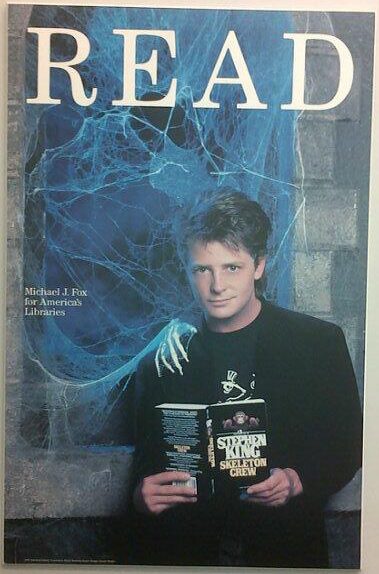 There was this feeling of a borderland for me as a young teenager in the library. I was able to be older, to be smarter somehow among the stacks. A Stephen King READ poster, a microfiche machine, a wide staircase, and low windows brushed with leaves. In the library, I was studious in wooden study carols, while the names of the Grateful Dead danced in my sight line, etched in pen years ago. In the library, I did my research with the help of those titans of knowledge behind the tall desks, their faces blooming with joy at my questions. In the library, I saw homeless men sit and read the newspapers with dignity. In the library, I saw my life stretch out before me, echoed over time, echoed under the hanging lights, layers of books and memories forever in the same borderlands of my old heart today.
– Jocelyn Hieatzman
1. My childhood library was a big stone building with stone lions guarding the front door. It made the institution impressive and important . As a child, we couldn’t borrow “adult” books, and it seemed like they must hold some secret knowledge. 2. The bookmobile came to our neighborhood every Monday afternoon. We were allowed to take 7 books, and it was air-conditioned. It was the 1960’s.
– Sharon O’Neill
I love the library. It’s a quiet place to work or explore new authors! I love the creativity with displays.
– Kristine
I moved to the United States when I was 13 years old. In Mexico libraries were not an everyday thing for me. If we went, they were usually surrounded by homeless people or too far from our home. However, once I moved to the U.S, libraries became my escape from a place I did not understand. At first I hated the library. Mostly because of my limited English and low reading level. I felt embarrassed when my teacher told me all I could read were elementary level books. It wasn’t until a lunch monitor saw me with one these books, The Ugly Duckling, that I learned the value of reading. She told me that the fastest and best way to improve my pronunciation and understanding was by reading out-loud to myself. After that day, I visited the public library and read as much as I could. I read through all the R.L Stine, Goosebumps, romances, mysteries, and many others until I was finally able to challenge myself and read the Harry Potter series. Thanks to the welcoming environment of my public and school libraries, I went from reading picture books at the age of 13 to 1000 pg Stephen King books by the time I was 16.
– Ale M.
I grew up in Ellicott City, MD, so I went to the (old) Miller Branch library when I was young quite often. My first memories are borrowing toys from the kids’ section, which was directly to your right when you entered the library. My mom loved that she could borrow toys for my sister and me since kids can be so fickle; I’m sure my family saved a lot of money by not having to buy us as many toys! In elementary school, I remember creating my own fantasy story about the small enclosed garden area directly across from the circulation desk (although I don’t remember what the story was now). In middle school, R.L. Stine novels engrossed me. I remember spending many weekends searching through the R.L. Stine books directly to the left when you entered the library, at the back. I also bought some of his books from the area to the left of the circulation desk at something like 25 or 50 cents per book. I loved that I had enough money to buy my own books! I didn’t care that they had clearly been read many times before. Finally, I remember doing a couple of research projects at Miller Branch and Central Branch. Unfortunately, I moved to another state before high school started and didn’t have such a fabulous library nearby anymore. I’m so glad to be back in Howard County with a renovated Miller Branch and an almost-ready renovated Elkridge branch within walking distance of my new house!
– Liz Campbell

the old Miller Branch library in Ellicott City, MD
Every Saturday when I was growing up, my dad and I would drop my mother off at the grocery store and walk over to the Randallstown Branch of BCPL which was in the same parking lot. While she shopped, my father and I would return the books we signed out the week before and take out new ones. We would walk back to the store and find my mom in one of the aisles and help her finish up. This is one of the fondest memories of my childhood and I remember many wonderful chats with my dad before curling up in an easy chair to read my newest treasures!
– Annette Kuperman
When I was a little girl, I lived in a small blue collar town just north (on the mainland) of Galveston, Texas. Hitchcock had a grocery store, a small bank, a doughnut shop, Mr. Charburger, a drug store and some other small local businesses! We also had a book mobile every three weeks or so, that parked in the bank’s parking lot. A large trailer with books, books and more books! I didn’t even know “libraries” existed, until one day Mother took all of us four little girls to Galveston Island to THE library. It was beautiful; with what I remember to be massive, dark-stained, ornate rails leading up the many steps to the magnificent entryway of the building. And books! Who knew there were that many books in the world? What pure, giddy joy I felt that day.
– Trudie Myers
When I was in late elementary school, I loved going to the Central Library with my mom. I loved the weird shape of the building and the nooks and crannies of the library. The library was also the first space I was allowed to be “alone” in a public space. I would look for my books while my mom would look for hers. We would meet at the check out line, her with her reasonable amount of books and me struggling to balance a stack that piled to my nose.
– Kaitlyn Curtis
I remember the Book Mobile routinely coming through our military Navy Housing in Bremerton, WA when I was in 6th grade. My two younger brothers and I so looked forward to the Book Mobile! It was such a different experience to walk-in to a library on wheels. It was a pleasurable experience I will not forget.
– Lorraine
what to read this Hispanic and Latin Heritage Month (9/15-10/15)
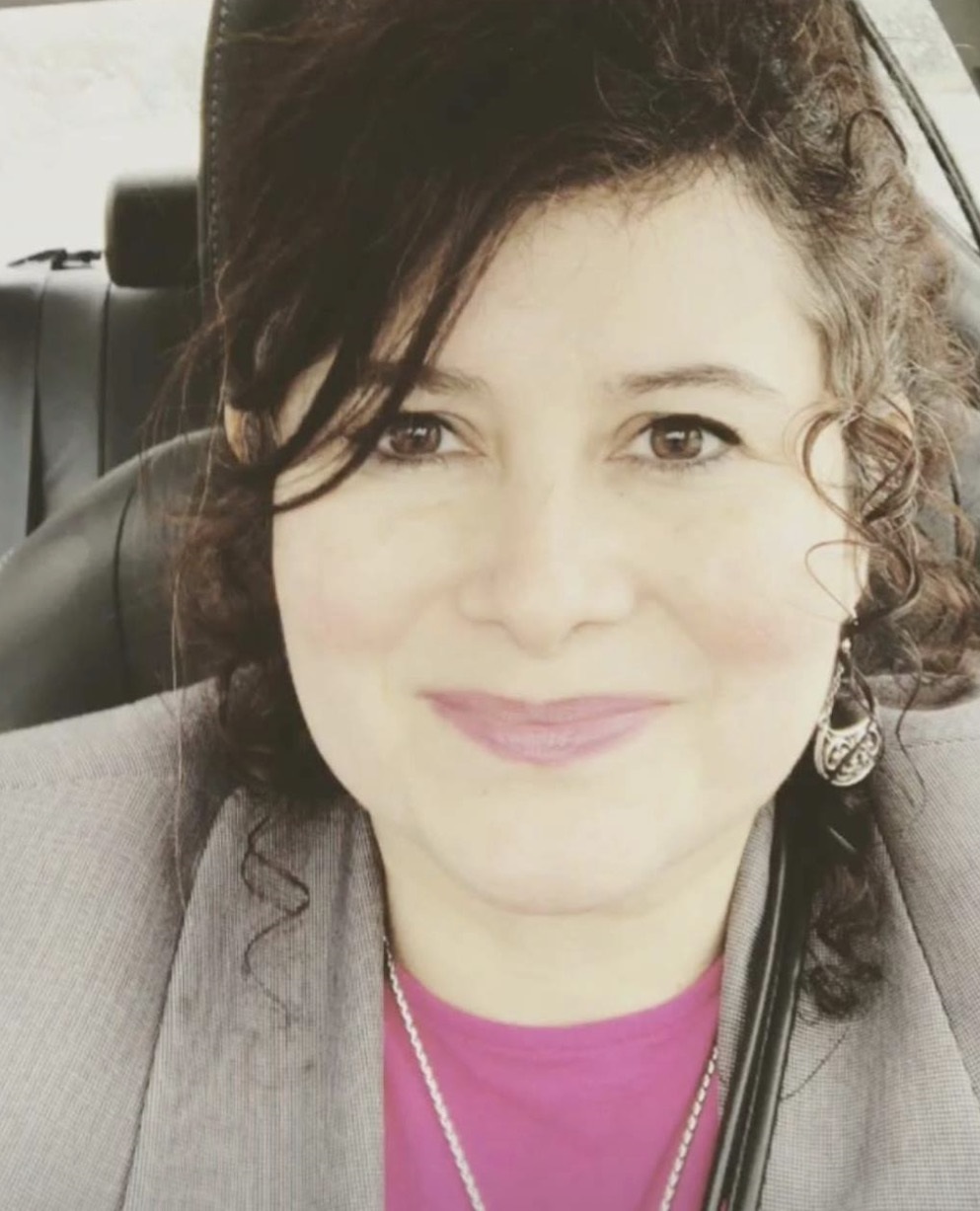
Associate Professor of Spanish at Howard Community College
A guest blog by Claudia Dugan
————————————
Sipping coffee at my desk last week, I tried to gather a list of favorite Latin American or Spanish books and I felt raptured into a labyrinth.
Should I go this way, or that? Which of the intricate paths should I take first? Should I do it in chronological order? But then again, the themes, like the paths in a maze, seem to meet each other, reoccur, and from time to time, give an opportunity to skip to another side… Chale! Is there an actual exit to this? Is it the task or is it me who, in an attempt to reflect about the books I love, often enter an identity labyrinth, similar to the one Octavio Paz describes?
I thought about The Broken Spears which invites the reader to be immersed into those ancient stories on the cosmology of the Aztecs, and to understand how ancient philosophies played an important role in the Spanish occupation of México, and in its current syncretism. Then, I thought that maybe Malinche by Laura Esquivel could be a better choice since it is written more like a love story, and who doesn’t love love.
But a different title kept knocking at the door of my thoughts. The one that most of us who have taken a class that requires Latin American Literature had to read: Gabriel García Márquez’s Cien Años de Soledad.
 The first time I read it in high school, it almost took me cien años to finish reading it, but the magic was worth it. You see, my classmates and I had transformed the book into a scavenger hunt. Our whiskers were wet. We looked for clues inside the book that would lead us to the next book to read. How excited I was to discover Artemio Cruz in Cien Años de Soledad, and I shared it with my friends. That served as a launching point to the next author, Carlos Fuentes, who believed that history would always provide revolutionary characters like Artemio Cruz.
But if you think such findings sparked enthusiasm and idealism inside us, you have not read much of Latin American literature. My goodness, just when your hopes get high, it begins to rain – in almost every single darn book. Fuentes, who introduced us to Artemio Cruz, reminded us in “Old Gringo” to be aware of the ugly-self-interest-seeking-human that lurks inside of each one of us, idealistic or not.
Another of my favorite on the subject of revolution is Mariano Azuela’s Los de Abajo written in the early 1900’s and centered in the Mexican Civil War. In English, the title is The Underdogs but it really does not evoke the same images that the Spanish title Los de Abajo does. Los de Abajo refers to “those who are at the bottom of the pyramidal structure of so many human social configurations throughout history.
When reading Latin American literature, you will always find those comedic chapters on the absurd, such as Capitan Pantoja and the Special Service by Mario Vargas Llosa, which provide much needed relief during raining seasons.
And of course in reading Latin American literature, there is the important question of language and translation. When I read the book Malinche in English, I noted that the culturally-rich word “temazcal” was merely translated as “hot-bath” (jacuzzi). If you knew what a Temazcal represented for Mezoamerican cultures, and its role in new-births, in healing, in cathartic ceremonies, then you would understand its significance in that chapter in which Malinali and Cortez bathe their fusing souls in it. I am sure you would be able to smell the copal and other aromatic fresh herbs when reading about it. Or, if you have studied Latin American history, you would notice the weaving of the threads that joined the voice of Oscar to the authors’ footnotes in The Brief Wondrous Life of Oscar Wao, by Junot Diaz, or the universe in the word Quetzalcóatl, in Juan Felipe Herrera’s Half of the World in Light.
So, during this Hispanic/Latino Heritage Month, connect with a book by a Latin American writer, maybe one from my list.
But more importantly, connect with a person of Hispanic or Latin heritage. What you might learn from them about the cultural values and practices, history, and character will enrich your reading experience. And of course that could lead to enriched relationships with your neighbors of Hispanic or Latin heritage as you hear their stories. After all, as Jonathan Gottschall points out in The Storytelling Animal, it is stories that make us human.
~ Claudia Dugan is an Associate Professor of Spanish at Howard Community College in Columbia, Maryland.
Did you know that it’s Be Kind To Editors and Writers Month?
A little kindness goes a long way in a writer’s life
 We don’t ask much.
Twenty minutes quiet.
Some inspiration.
A red pen.
Writers and editors — and I count myself in both those groups — are fairly undemanding types. Unobtrusive, even. We’d much rather observe than be observed. We just need a little space and time to be alone with our mortal struggle with the writing gods. Though we wouldn’t say no to a cup of tea.
September was named Be Kind to Editors and Writers month by a low-rent Texas publishing house in 1984. Gentleman Vampire is one of their titles, and whew, that bloodsucker sure is handsome on the book cover! How that itty-bitty publisher got to name a month, I don’t know, but I guess they fall into the same category as the group that named February as Sweet Potato Month and May as Good Car Keeping Month. The editor in me wants to lower-case all those words, because they’re really not worthy of a whole month’s worth of honor, not to mention capitalization.
But we’re into marketing here at HoCoPoLitSo, and so we are wholeheartedly behind Be Kind to Editors and Writers Month. In fact, we’re kind to writers all year here at Let There be Lit headquarters; we’re known for our warm treatment of the ink-stained masses. There are clots of Irish authors, apparently, who sit around in pubs, drinking warm beer and raving about HoCoPoLitSo’s welcome. (Make sure you save the date for our fortieth celebration of Irish poetry and literature, the Irish Evening on Feb. 9, 2018.)
 And as for editors – we are necessary nitpickers. It’s hard to be nice to someone who slashes away at your precious words. In fact, William Faulkner once wrote: “Only Southerners have taken horsewhips and pistols to editors about the treatment or maltreatment of their manuscript. This–the actual pistols–was in the old days, of course, we no longer succumb to the impulse. But it is still there, within us.” But sometimes, editors make good writing great.
So here’s to a month of kindness to editors and writers. Send us good thoughts of inspiration and hope. Buy your favorite editor a new pen. Watch the kids while we go to the Baltimore Book Festival (starting Sept. 22); they have terrific panel discussions (on the historical novel, and science fiction romance, and finding an agent, for example) and great readings (the Black Ladies Brunch Collective is reading from its new, hilarious and moving Not Without Our Laughter on Sunday, Sept. 24).
And this month – maybe not all year – give the editor or writer in your life a little respect.
Susan Thornton Hobby
Recording secretary, writer, and editor
 HoCoPoLitSo