Home » Guest post (Page 8)
Category Archives: Guest post


Poet Ann Bracken’s Visit to Patuxent Institution
Quality Poems: Offering a Window and a Voice
by Ann Bracken

Ann Bracken
So few of us ever visit a prison, yet many of us already have a vision of what it’s like, thanks to TV shows, such as the popular Orange is the New Black. On November 10, 2015, sponsored by the Howard County Poetry and Literary Society, I visited the Patuxent Institution to offer a writing and poetry workshop to some of the incarcerated men in the youth program. Pseudonyms have been used to protect the men’s identities.
The day was rainy and cool, and the gray skies nearly matched the gray walls and somber mood of the prison. Because I have worked with another writing group at the prison complexes in Jessup, I knew all I could take in were my art supplies, papers, and a book, in addition to my car keys and my license. The screening procedures are very much like going through the check-points of airport security, except that you must be patted down each time you enter the prison. I was not allowed to bring in my tote bag for the class supplies—instead, I was given a clear plastic bag.
Once I made it through security, Hillary Battle, a social worker who works with the youth program, escorted me to the education wing of the prison. I was curious about the designation of “youth program” because I knew the approximate ages of the men were between 25 and 35 years old. Ms. Battle explained the disconnect, “In order to be eligible for the Youth Program, the men must be sentenced under the age of 21. We could receive them at any time during their incarceration because the program distinction is based on when they were sentenced for their crimes.”
I’ve walked those long halls to the classrooms several times now, but I still shudder a little when I get on an elevator and the barred doors clank shut behind me. As Ms. Battle and I walk towards the classroom, many thoughts run through my head. Will the activity be beneficial for the men? What will they be like? Will they write and share? Do I have enough time for all I want to offer?
After discussing the men’s needs with Ms. Battle a few weeks earlier, we had both decided that my activity using J. Ruth Gendler’s book Quality Poems would provide a familiar starting point for the men to explore poetry. In her series of prose poems, Gendler personifies 100 character traits and invites us into their world—a world where “Commitment has kind eyes,” “Forgiveness is a strong woman,” and “Courage has roots.”
Dr. Cynthia Carter, the team leader for the youth program, greeted me with a warm smile and thanked me for coming when I arrived in the classroom. The men sat at their desks, quietly waiting for the lesson to start. As I surveyed the room, I noticed the standard furnishings: a large blackboard, several file cabinets, a few TVs, and about five computers. Nine men sat at desks arranged in rows. Because I’ve been a teacher for my whole career, the classroom felt familiar—even down to the four men who chose to sit in the back row. “We just feel safer here,” they told me and smiled. After I put my supplies on the desk, I walked up to each man, shook hands, and introduced myself. They smiled at me and thanked me for coming. In that moment I prayed that things would go well and that what I had planned would speak to their needs.
I began by reading the poem “Courage.” After a few moments of reflection, Claudio said, “Courage is quiet. He keeps to himself.” The other men chimed in, feeling more confident now that one of their friends had spoken. “Is Courage ever afraid?” Tony asked. My take? Yes, Courage is often fearful, but chooses to move ahead despite the fear. Tony shared his thoughts and said, “I like the line in the poem that goes, ‘Courage is not afraid to pray.’” I read another poem about “Forgiveness” and the men were visibly moved. As I read, they were nodding their heads. I knew they were ready to write when I heard Julio say, “Forgiveness is a gift you give yourself.”
All told, the men wrote two poems—one on a positive character trait they possessed and one on a trait they wanted to improve or change. When it was time to share their work, I invited all of them to form a circle with their desks so that we could all see and hear each other better. Here is a sample of the traits they wrote about and some lines from their poems; I found their words both powerful and beautiful.
Danny spoke up from the back row and offered to share first. He wrote about “Distrust” as if the character were a woman. “She lives within herself … I stood at the door of her heart … to let her know I understood, I called her by her name, Distrust.” For his other characteristic, Danny chose “Uncertainty”: “ … harsh forms like factory smoke … moist, unanswered questions.”
Claudio, with short-cropped hair, offered to share next. I had met Claudio during another visit, and I knew him to be a fine painter. He wrote these lines about intuition: “Like vapor in gulfless canyons, travels like a gadfly. Intuition chooses friends like a coal miner searches for diamonds.” As I listened to Claudio’s poem, I was struck by how he seemed to literally paint with words.
Armando, sitting in the front row, offered to read next. “Confidence is not arrogant. He takes responsibility. Confidence is a good trick to have.” All of us loved that last line—a real surprise.
Bernardo sat in the corner and raised his hand to share after his friends had read. He had this to say about creativity: “Creativity comes in every size. He recites rhymes for fun and lives in the forefront of my mind. Creativity has a humble hobby.”
The men’s poems were full of rhythm and memorable phrases. Even though I wanted copies of their work to share with HoCoPoLitSo, I didn’t feel right asking the men to give me the poems they had written that day. I encouraged them to keep writing more about the qualities they had chosen. I did ask them for permission to use some of their work and they all agreed, as long as I used pseudonyms to preserve their anonymity. Dr. Carter, Ms. Battle, and all of the men told me I was welcome to come again any time.
Once again, I could see that poetry had offered people two vital elements: a unique expression of their voices and a safe place to explore their lives.
Poet, certified poetry therapist, teacher
On Reading: What To Read Next?

Tim Singleton, co-chair of the HoCoPoLitSo board, writes ‘On Reading’ for the blog.
So we are at the end of one year and the beginning of another. For many, it’s the time to make a few resolutions. For me, I like to take a look back at what I have read and ponder what to read next. I don’t know which is more of a treat: looking backward at the cache or looking forward, ambitiously. Here’s a bit of both.
 Surprise of the year was Jen Grow’s book of stories My Life as a Mermaid. Not sure I have been as excited reading a collection of stories for the first time since Edith Pearlman. Get it; read it. Can’t wait for her next collection. The pressure is on, Jen, the pressure is on.
There were many things I expected to be great and they were. Pearlman’s Honeydew, Toibin’s Elizabeth Bishop, a number of works translated by Ted Hughes (magnificent), The Odyssey (Fitzgerald trans.). There were surprises, things that I wasn’t really expecting to have in my hands, but did and was thankful for them: Zachary Lazar’s first novel Aaron, Approximately, Dinaw Mengestu’s The Beautiful Things that Heaven Bears, Edmundo Paz Soldan’s The Matter of Desire, to name a few.
This was the year I finally finished Elizabeth Bishop and the New Yorker. It had been sitting bedside for dip-ins every now and then since it was published. It’s been replaced with Words In Air. Wonderful stuff. Thank goodness she was a prolific letter writer – years of joy ahead.
As you would expect for a HoCoPoLitSo-er, I do try to fill they year with a good selection of poetry. I’ll only name drop here as I tend to binge read, going through what I have on the shelf for a particular writer (if you see your name here, time to start publishing a few next books [hint hint Patricia Smith]). Patricia Smith, Bruce Ross, Saigyo, Marie Howe (she’s coming to Columbia in April), Eamon Grennan (he’s here in February), lots and lots of Maxine Kumin, Rachel Eliza Griffiths, Breyton Breytonbach, Grace Paley, a Rilke revisit… I’ll stop there or you’ll stop reading as it’s just a list of names.
On to that year ahead: Susan Sontag suggests one should read a book a day. That is a mighty goal, completely unrealistic for a mortal. In fact, I’d find two books a week and a day job to put a roof over those books unattainable. A book and a half a week: more realistic, though probably just as dreamy. (I bet I might bring books into the house some years at one a day on average — I’ll not stop to figure that out, it might get me in trouble – does that count for anything?)
There are a few things already in the pile to read next-ish. I have already started Rebecca Goldstein’s Plato at the Googleplex: Why Philosophy Won’t Go Away. A couple of years ago I started reading the works of Agatha Christie. In order. All of them. There’s always one to read next-ish. (Why? The story is for a future post.) I  know I’ll be reading more Grennon and Howe in advance of their visits. James Hillman’s A Terrible Love of War awaits with its insights into our bellicose behavior. Julian Barnes Keeping An Eye Open was a Christmas gift that won’t be waiting long, as is Rahael Jerusalamy’s The Brotherhood of the Book Hunters. And I do aim to have Jane Kenyon’s A Hundred White Daffodils in the mind soon, long overdue to do. Sontag is also on the list.
 The treat I have been saving to start the year is Belinda McKeon’s Tender, though. So looking forward to it. I had wanted to read the copy that crossed the Atlantic for me as summer ended, but I started teaching a semester of Philosophy 101 and that had me reading other things. Lots and lots of other things (Helen Buss Mitchel’s textbook Roots of Wisdom is excellent). I’ll start reading the McKeon after I put down Patti Smith’s delightful M Train. I think it is time to go back to that now. Happy reading, everyone, and Happy New Year!
Tim Singleton
Co-chair, HoCoPoLitSo Board
Mana’s Musing: poetry for the good, the bad, and the scary

Laura Yoo – HoCoPoLitSo member of Board of Directors and Associate Professor of English at Howard Community College
Some say poetry is irrelevant. That it belongs in the ivory tower.
Listen to this:
Earlier this year, The New Yorker published an article called “Battle Lines: Want to understand the jihadis? Read their poetry” by Robyn Creswell and Bernard Haykel (June 2015). The article is a study of the function of poetry in Arabic cultural history as well as in contemporary jihadist poetry. The authors write that, “For the jihadist, poetry is a mode of manifesto, or of bearing witness.” Creswell and Haykel remind us of the important role of poetry in shaping and propagating a culture. But that influence can go in the direction of “good” or in the direction of violence and hatred.
Analysts have generally ignored these texts, as if poetry were a colorful but ultimately distracting by-product of jihad. But this is a mistake. It is impossible to understand jihadism—its objectives, its appeal for new recruits, and its durability—without examining its culture. This culture finds expression in a number of forms, including anthems and documentary videos, but poetry is its heart. And, unlike the videos of beheadings and burnings, which are made primarily for foreign consumption, poetry provides a window onto the movement talking to itself. It is in verse that militants most clearly articulate the fantasy life of jihad.
The article gives many examples of the prominent role that poetry is given by some militant jihadist leaders, but the most shocking one is this:
Bin Laden himself recited an elegy for the nineteen hijackers of 9/11: ‘Embracing death, the knights of glory found their rest. / They gripped the towers with hands of rage and ripped through them like a torrent.”
What we must recognize in all this is that poetry is not only a tool that helps us see the world in all its beauty, but is also a tool that can aid the world in its ugliness. Sure, some poems are about roses and rainbows, about love forever and love unrequited. And those are beautiful and absolutely necessary to our humanness. However, we must not assume for a second that poetry is fluffy or inconsequential. It is a powerful mirror for the human condition – the good, the bad, and the scary.
I am thinking of Martin Espada – a lawyer turned poet – and his poem, “Imagine the Angels of Bread.” He says, “This is the year” the meek will rise and the powerful will fall because justice will be served cold and raw on a silver platter. Well, no, he doesn’t say that – but that’s how I hear it. (And that’s how I heard it when Mr. Espada read this poem on the Smith Theatre stage at Howard Community College for the Blackbird Poetry Festival in 2013). In this poem, we sense the urgency for change. And we see how we might change the world for the better.
We also look to poetry to react to events that shock and frighten us. Like when Billy Collins‘ poem “Names” honoring the 9/11 victims broke our hearts – in a way, a powerful answer to Bin Laden’s elegy of the hijackers. But we also look to poetry to challenge our own thinking, like when E. Ethelbert Miller wrote “Looking for Omar” in reflection of 9/11 and the growing anti-Muslim feelings and actions in our country. We might do well to read this poem once more today.
In November this year, a group of terrorists bombed Paris. I saw many friends turn to poetry to understand fear, tragedy, violence, and hatred as well as peace, comfort, and compassion. One of the favorites circulating social media platforms was Wendell Barry‘s “Peace of Wild Things.” It begins, “When despair for the world grows in me” – and you just know you have to read the rest. In it, you find sadness but also hope.
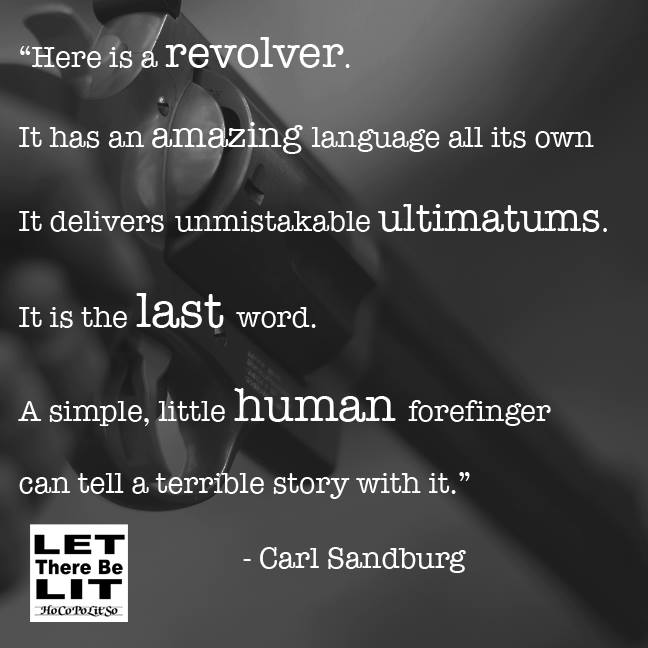 In January of 2013, a professor at University of Illinois discovered a poem by Carl Sandburg called “The Revolver.” It begins with “Here is a revolver,” and after comparing the revolver to the court of law, the poem ends with, “And nothing in human philosophy persists more strangely than the old belief that God is always on the side of those who have the most revolvers.”
The poem was discovered a few weeks after the Sandy Hook Elementary School shooting took place in Newtown, Connecticut (December 14, 2013). Now almost three years later, we again turn to this poem as we are angered and frightened by the two mass shootings in one day in Georgia and California on December 2nd.
In Claudia Rankin‘s Citizen (2014) we see the world through yet another lens.
Dean Rader of Huffington Post says, “Citizen has changed how we imagine a book of American poetry interacting with and commenting on the world we live in. It reminds us that the poet is first and foremost a citizen. It reminds us that American poetry can be both urgent and vital.” Holly Bass, writing for the New York Times, says, “Citizen throws a Molotov cocktail at the notion that a reduction of injustice is the same as freedom.”
As The New Yorker article on jihadist poetry reminds us, through poetry we can possibly know one another, about what propels our actions and shapes our beliefs. We must allow poetry to bring to light the violence and the injustices we commit against one another. We must recognize also the potential power of poetry – like many other forms of art – to comfort our sadness, calm our fears, expose our frailties, shape our vision, and even change our thinking.
Mana’s Musing: Lost and Gained in Translation
Laura Yoo – HoCoPoLitSo member of Board of Directors and Associate Professor of English at Howard Community College
While writing the last musing on “Multiple Writing Personalities” I began to pull at another thread – the art of translations.
There are many words that are not really translatable from Korean to English, and this is the case for many (if not all) languages. One example is the Korean word 한 (pronounced “hahn” and sort of means grievance) which comes from 원한 (pronounced “won-hahn” and sort of means grudge). Usually this word is used to describe the kind of deep grievance or regret that awakens a dead person’s body and spirit. Like Jason in Friday the 13th or the scary girls in The Ring or Grudge. But none of these words – hatred, resentment, grievance, regret – captures quite wholly the meaning that Koreans put in that word when they use it.
Language is cultural. Words communicate values, beliefs, cultural experiences, and history. Sometimes a single one-syllable word like 한 means a whole lot. This complexity is what makes a translation – especially a poetic translation – a work of art.
When Ko Un, one of the most well known Korean poets, read at the Dodge Poetry Festival in 2006, Richard Silberg performed the translation.
While Silberg’s translations communicate the idea of the poem, I think most would agree that it doesn’t transfer the whole meaning that is communicated in Ko Un’s reading – the audience can sense or experience the poem in the way Ko Un performs his poem that’s quite different from the way Silberg translates and performs it in English.
There is also an interesting translation of one of Ko Un’s poems by Suji Kwok Kim and Sunja Kim Kwok on Poetry Foundation’s website.
Taklamakan Desert by Ko UnWhy I’m going to the Taklamakan Desert:the emptiness there.Why I’m going to the Taklamakan Desertat seventy-five, leaving all words behind: the cryof the emptiness there.Why I’m going to the Taklamakan Desert:I can no longer standthe world’s greedor mine.There, in the Taklamakan Desert,the silence of a thousand-year-old skull.
Here is an excerpt from the translators’ notes.
With “Taklamakan Desert,” we tried to “translate” the translation towards greater spareness. […] We translated “명사도 동사도 다” (“all nouns and verbs”) as “all words,” which sounds less awkward in English, and decided not to isolate “there” (“거기”) on its own line, the way it’s isolated in the original, since it would sound overemphatic in English, especially as an ending. We added “in the Taklamakan Desert” in the penultimate line, for music, and “the silence of” in the last line, for rhythm, so that the last line becomes a line of iambic pentameter, a structural counterpoint to “the cry” in the second stanza, but only because silence is central to Ko Un’s work. (We could have rendered the last two lines more literally: “There —/ someone’s thousand-year-old skull.” — and again, may change our minds tomorrow.)
I highlight the last line above, because it shows the delicate choices one must make in translation – there is no such thing as “direct” translation, and we can see here the flexibility and creativity required in creating a work of translation.
In addition to the meaning of words, much of the art of translation has to do with the sound of words (and silences) – the intonation, the vowels, the consonants, the accents, the shapes that your mouth makes, and the way the tongue rolls to create sound. In the line “명사도 동사도 다” (“all nouns and verbs”), the Korean words for “nouns” and “verbs” rhyme: Phonetically, this line reads, “myung-sa-do dong-sa-do dah” (“do”=”too” or “and” and “dah”=”all”). So, there is a rhyme in “sa-do.” I wonder if it’s that difference in sound or the specificity of naming “verbs and nouns” instead of grouping them as “all words,” but the translation doesn’t quite… translate for me.
Still, I do not mean to argue that this translation is bad or that translations in general are inaccurate. Not at all. Ultimately, poetry translations are never about accuracy. It’s about telling and re-telling, creating and re-creating. Through the translators’ works, we share the words, the values, the thoughts, the stories, and the languages of all cultures. Works of translation open up poetry to interpretation, re-imagination, and even re-vision.
Translation itself is a work of art. It has its own creative process. It is original in its own sense of coming into creation.
Here are a few lines from Willis Barnstone’s “An ABC of Translating Poetry”:
Translation is the art of revelation.
Translation is an art between tongues, and the child born of the art lives forever between home and alien city.
Yet translation of poetry is conceivable.
A translation is never an exact copy. It is different.
A translation dwells in exile.
And so on. But “Z” is the best:
Good translation of poetry is essential to a hungry reader in a decent book store and to a global village of letters. We need it, for we still suffer under that early Babylonian God’s edict of language dispersal. Although Antigone and Lear sometimes speak in exotic tongues, subverting God’s rage against the monolingual builders of Babel writers still scrawl their words in a thousand scripts, pile them up on mounds of hope and futurity, awaiting translation. Translation is a zoo and a heavenly zion.
I love the phrase “a global village of letters.” That’s what the art of translation offers the world.
Last summer when a relative was returning from a trip to Korea, she brought back a few collections of Ko Un’s works for me. I thumbed the pages but found many of the poems too difficult for my comprehension – so my mother took the books. Having thought a little bit about translations through this little musing, though, I’m now processing my order on Amazon for several Ko Un translations by people like Richard Silberg, Brother Anthony, and Claire You – This Side of Time (2012) and Maninbo (2015).
Though my knowledge of the written Korean language is limited, having access to some of the poems in Korean and some in English (and maybe a few in both?) will give me a unique experience of Ko Un the Poet. Not necessarily fuller or more expansive experience – just different. Not only that, but it will also help me – a 1.5 generation Korean-American – become more familiar with Korean culture and history. And that is pretty awesome. Thank you, translators, for your word-art.
Mom, I need those books back please.
=========================================
“Taklamakan Desert” in Korean
타클라마칸 사막
내가 타클라마칸 사막에 가는 것은
내가 열 여섯살의 꿈속에서
타클라마칸 사막에 가는것은
거기
허허 망망 때문이다
내가 일흔다섯에 살의 대낮에
명사도 동사도 다 두고
타클라마칸 사막에 가는 것은
거기
무지무지한
허허 망망의 울음 때문이다.
내가
타클라마칸 사막에 가고 가는 것은
세상의 욕망에
내 욕망에
더 이상 견딜 수 없기 때문이다.
누구의 천년 해골
거기
Mana’s Musing: Multiple Writing Personalities
Laura Yoo, a member of HoCoPoLitSo’s Board of Directors and Associate Professor of English at Howard Community College, writes Mana’s Musings on the HoCoPoLitSo blog.
Even though I teach writing, I cannot really remember or trace the early years of my own journey of learning to write.
Thanks to my mother’s foresight and my own tendency to hold onto things, however, I do have two special artifacts from my childhood – photos below.
First is a report on Beethoven that I wrote in the 5th grade, only a few months after my family moved from Korea and I began to learn English. This is my first “writing” in English that I can find. Mostly, it seems, I copied sentences from the Britannica. And that was “writing.”
Second is a newspaper article that I wrote in the 5th grade to a Korean Catholic newspaper about my observations on adoption. In that article, I express sadness about Korean children who are adopted by families in other countries and I urge Koreans to adopt Korean children. An impassioned argument and plea from a 10 year old.
During my teenage years, I wrote a lot. Flipping through the many spiral notebooks that were my journals reveals that I wrote my “diaries” in English (even through the early years of my language acquisition) but insisted on writing my “poems” in Korean. In English, my writing was about what I did that day, what I saw, what happened to so-and-so, or what I was thinking. In Korean, on the other hand, my writing demonstrates an annoyingly dramatic teenage-angst in what appears to be verse. I can’t help but to roll my eyes at my 14 year old self. It seems that my young mind associated English with recording facts (information) and Korean with describing love, pain, betrayal, suffering, drama, and dreams in poetry.
Later on in college, the notebooks got fancier and I wrote exclusively in English – and I stopped writing poems. Probably realized how terrible they were. There was also a vague attempt at fiction-writing but I quickly learned that I was no good at it. So, instead of trying to create literature, I studied it.
The evidence of various transitions between Korean and English in my writings makes me wonder not only about my cultural identities but also my relationship to writing. You are what you write – and I guess how you write.
A recent article in The New Republic called “Multilinguals Have Multiple Personalities” cites studies that illustrate a personality difference exhibited by one person speaking in two different languages. The article summarizes one particular study:
In one session, the volunteer and experimenter spoke only French, while the other session was conducted entirely in English. […] When [Susan Ervin] compared the two sets of stories, she identified some significant topical differences. The English stories more often featured female achievement, physical aggression, verbal aggression toward parents, and attempts to escape blame, while the French stories were more likely to include domination by elders, guilt, and verbal aggression toward peers.
I find myself experiencing this kind of shift in my identity when I switch “code” between English and Korean in my day to day life. In speech, I communicate not just the words or the “thing” that I’m trying to get across but also the cultural mores, the values, the manners, and the habits deeply rooted in that language. And I dare say the language also shapes human beliefs and behaviors.
Sadly, I don’t know if the same kind of code switching applies to my writing now – mainly because I don’t write in Korean anymore. So, it seems I have lost my Korean writing personality. Or even more sadly, perhaps this means my Korean writing personality will stay trapped in that 14 year old teenager ridden with angst. Scary thought.
Poetry in Motion: How to Start a Movement
By Katy Day

Katy Day, student on the HoCoPoLitSo board, writes Poetry in Motion on the third Thursday of each month.
Mind-shattering. It’s a word that best describes so many current events. People shot dead in a church — Charleston. Church burnings – throughout The South. Reflexive incarceration — everywhere. Uprisings of the underserved — Baltimore. The impoverished. The unfortunate. Inequality. Racism. Hate.
What can one person do to change the current state of the world?
 I’ve come to know one place where you can begin to change things. Poetry.
If you hang around advocates of poetry and literature, you’ll often hear claims like “poetry has the power to promote change” or “poetry heals,” and if you’re like me, you’ll want evidence to support those claims. As you may know from a previous post of mine about what I’ve learned from the Humanities, I study both English literature and psychology. I appreciate theories about human nature that poetry and literature provide, but I also appreciate claims that are supported by science.
For the poetic minds, the scientific minds, and for those like me who fall somewhere in between, I have compiled a list of just a few ways in which words can make a difference that are all backed by science.
- Poetry has the power to reduce symptoms of depression and PTSD in adolescents who have suffered from abuse.
- Expressive writing causes increased physical and mental health.
There is a lot of research on the benefits of expressive writing. Dr. James Pennebaker is a leading psychologist in this field of research and has been studying the effects of expressive writing for over 20 years. He has found that people who write about deep emotions and difficult, traumatic experiences visit their doctor less frequently, experience an increase in immune system functioning, and report feeling happier. He has also found that participants in his studies who benefit most use insight and causal words. He posits that the act of meaning-making is, at least in part, responsible for the many benefits of expressive writing. This involves deriving meaning and insight from difficult experiences. Other research has found that expressive writing leads to decreased distress, negative affect, and depression. For advice on practicing expressive writing to improve physical and mental health, visit this website.
- Partaking in poetry therapy causes an increase in self-esteem, motivation for success, self-identity, self-expression, decision-making, and team cohesion in middle school students.
- Reading about friendships between fictional characters from different groups reduces prejudice.
There have been several experiments that studied the effects of reading fiction on reducing stigma associated with certain out-groups. One study found that reading Harry Potter novels decreases prejudice among stigmatized groups, including immigrants, homosexuals, and refugees.
- Youth slam poetry promotes social change.
One study analyzed 50 slam poems written by teenagers and found that poems addressed youth (including their agency, identity, and capacity to be critical thinkers), sexuality, health, and rights. Talking about health, sexuality, and human rights are often stigmatized, but poetry appears to be a place in which these topics are acceptable.
Need more proof? Read this poem by Lucile Clifton and experience the empowering capability of poetry for yourself. Poetry is a foundation for the individual looking out at a crazy world, a place from which change can grow.
won’t you celebrate with me
By Lucille Clifton
won’t you celebrate with me
what i have shaped into
a kind of life? i had no model.
born in babylon
both nonwhite and woman
what did i see to be except myself?
i made it up
here on this bridge between
starshine and clay,
my one hand holding tight
my other hand; come celebrate
with me that everyday
something has tried to kill me
and has failed.
Katy Day, student on the HoCoPoLitSo board, writes Poetry in Motion on the third Thursday of each month.
Source material:
Kloser, K. (2013). Positive youth development through the use of poetry therapy: The contributing effects of language arts in mental health counseling with middle school-age children. Journal Of Poetry Therapy, 26(4), 237-253. doi:10.1080/08893675.2013.849042
Brillantes-Evangelista, G. (2013). An evaluation of visual arts and poetry as therapeutic interventions with abused adolescents. The Arts In Psychotherapy, 40(1), 71-84. doi:10.1016/j.aip.2012.11.005
Vezzali, L., Stathi, S., Giovannini, D., Capozza, D., & Trifiletti, E. (2014). The greatest magic of harry potter: Reducing prejudice. Journal Of Applied Social Psychology, doi:10.1111/jasp.12279
Fields, A., Snapp, S., Russell, S. T., Licona, A. C., & Tilley, E. H. (2014). Youth voices and knowledges: Slam poetry speaks to social policies. Sexuality Research & Social Policy: A Journal Of The NSRC, 11(4), 310-321. doi:10.1007/s13178-014-0154-9
Greenberg, M. A., & Stone, A. A. (1992). Emotional disclosure about traumas and its relation to health: Effects of previous disclosure and trauma severity. Journal Of Personality And Social Psychology, 63(1), 75-84. doi:10.1037/0022-3514.63.1.75
Pennebaker, J. W. (1997). Writing about emotional experiences as a therapeutic process. Psychological Science, 8(3), 162-166. doi:10.1111/j.1467 9280.1997.tb00403.x
Pennebaker, J. W. Writing and Health: Some Practical Advice. Retrieved from
http://homepage.psy.utexas.edu/HomePage/Faculty/Pennebaker/Home2000/WritingandHealth.html
Pennebaker, J. W., Kiecolt-Glaser, J. K., & Glaser, R. (1988). Disclosure of traumas and
immune function: Health implications for psychotherapy. Journal Of Consulting And
Clinical Psychology, 56(2), 239-245. doi:10.1037/0022-006X.56.2.239
Mana’s Musing: Could a Robot Write Poetry?
LAURA YOO, a member of HOCOPOLITSO Board, writes MANA’S MUSINGS for the second week of each month on the HOCOPOLITSO BLOG.
Recently, I watched a movie called Ex Machina. It’s a science-fiction film about two people: Nathan is the creator of an Artificial Intelligence named Ava and Caleb is the man called upon to do the Turing Test, which is “a test of a machine’s ability to exhibit intelligent behavior equivalent to, or indistinguishable from, that of a human” (Wikipedia).
Like many movies and stories about AI, Ex Machina ultimately asks “What does it mean to be human?” The movie defines this difference between machine and human as self-awareness and consciousness. But the true question, of course, is this: What does that self-awareness or consciousness look like? The movie uses the example of a chess player: A chess playing AI may have all the possible moves in its data but is it aware of the game or itself as a player of that game? In another movie about artificial intelligence, Transcendence, the “self awareness problem” is also at the heart of the issue. When a super computer named PINN is asked to demonstrate its self-awareness, PINN asks the humans “How do YOU know you’re self aware?” Of course, the humans are stumped.
After watching Ex Machina, I got to thinking about this question about what makes us human, and I thought about Ava’s ability to create. She draws. At first, she makes random marks on paper that do not resemble any object. Then, Caleb encourages her to draw objects and she draws them very well, including a portrait of Caleb. She can draw what she sees but can she create something new? Could Ava write poetry?
But first, I think I have to start with “What is poetry?” If we can define this, then perhaps we can try to see if Ava could create it. There are many descriptions of poetry but to define it is quite challenging. The dictionary definition for poetry – “literary work in which special intensity is given to the expression of feelings and ideas by the use of distinctive style and rhythm” – is most unsatisfying to most of us, I think. Perhaps poetry is something that defies definition.
Nonetheless, many poets have penned famous lines about poetry that help us know poetry when we see one.
For example, William Wordsworth so famously wrote that “Poetry is the spontaneous overflow of powerful feelings: it takes its origin from emotion recollected in tranquility.” And Percy Shelley claimed “Poetry lifts the veil from the hidden beauty of the world, and makes familiar objects be as if they were not familiar.” How do you think Ava’s capacity for poetry would fare against these measures?
Let’s take “We Real Cool” by Gwendolyn Brooks, for example.
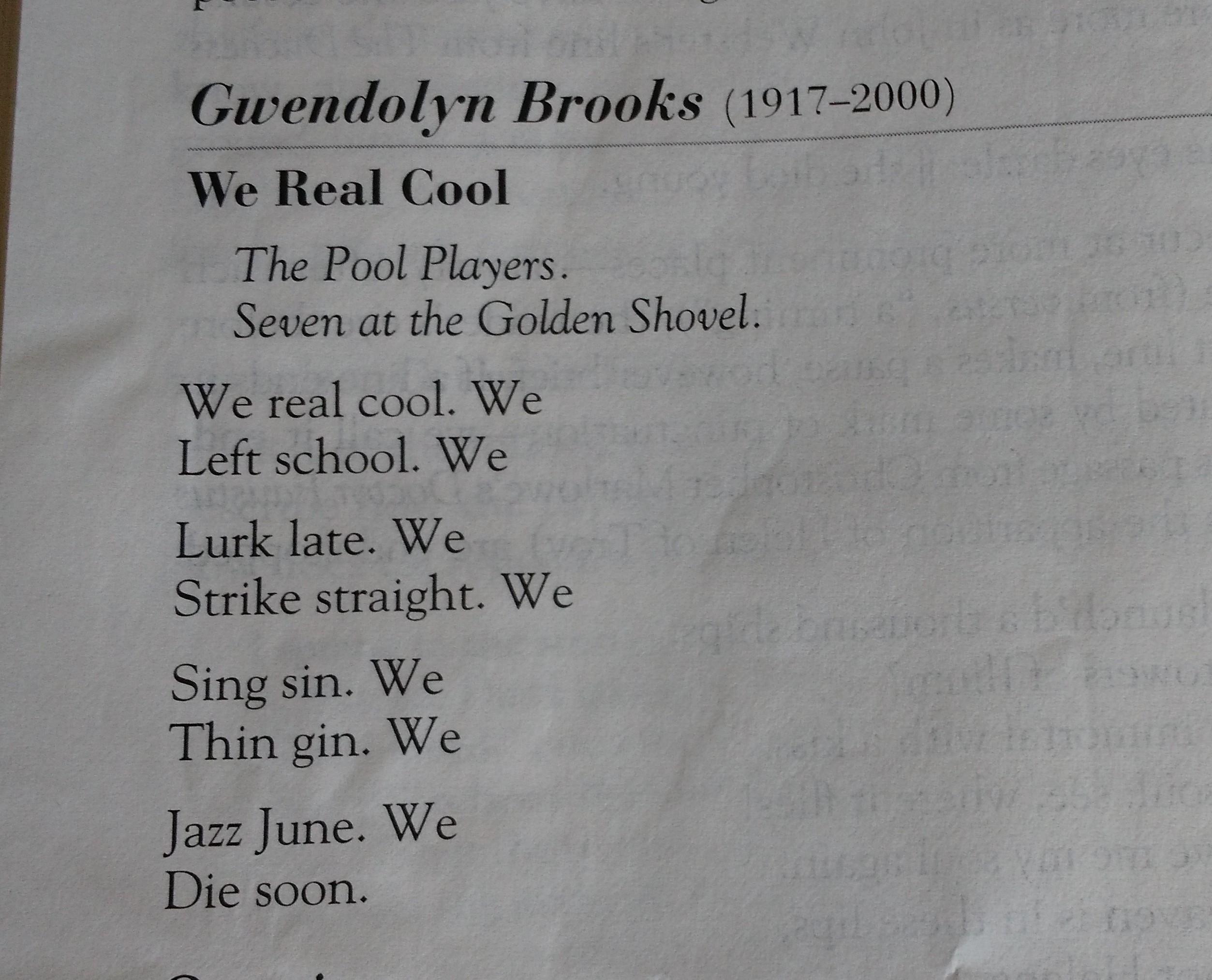
Could (or would?) Ava create the line-breaks that emphasize “We” at the end of each line? Those specific rhymes? That rhythm? What about the very idea of writing a poem? Brooks says that she saw these guys playing pool at the “Golden Shovel” and wondered how they must see themselves. In Brooks’ imagination, they think they are “real cool.” Especially given that “cool” is difficult to define at any given cultural moment, I wonder if Ava could come to this conclusion about the Pool Players and create a poem to represent her thought-experience. Here’s another take: Two AIs might come up with the exact same poem about observing the same pool players at the Golden Shovel, but I think only Gwendolyn Brooks and no other poet could have created “We Real Cool” just as it is. I mean, just listen to the way she reads it.
In a broader sense, what about creativity? For example, Edward de Bono, who coined the term “lateral thinking,” says this about creativity:
“Creativity involves breaking out of established patterns in order to look at things in a different way.”
Do we think Ava could do this? Certainly an AI could be programmed with all the necessary data – say, all poems ever written by every poet in human history – which would serve as “established patterns.” Could she come up with something that has not existed before, see something that’s missing from her data and create it?
What about this claim about creativity by Frank Goble, a prominent champion of “character education”?
“Because of their courage, their lack of fear, they (creative people) are willing to make silly mistakes. The truly creative person is one who can think crazy; such a person knows full well that many of his great ideas will prove to be worthless. The creative person is flexible; he is able to change as the situation changes, to break habits, to face indecision and changes in conditions without undue stress. He is not threatened by the unexpected as rigid, inflexible people are.”
Goble clearly identifies the act of creation as distinctly human here. Not just human – but specifically the human ability to make sense out of chaos. As a character in Transcendence says, “Human emotion. It can contain illogical conflicts.” Along these lines, I also like what Christopher Morley says about poetry: “The courage of the poet is to keep ajar the door that leads into madness.”
Maybe I’m drawn to these descriptions that allude to all that is disorderly because then I feel that I can keep Ava out of it. Surely, an AI could not possibly deal in or deal with madness, chaos, crazy, and mistakes? Surely a computer like Ava is all about logic, order, pattern, and all that makes sense. As you can see, I’m biased. And really what I want is to say is that poetry is a uniquely human activity. I don’t want AIs to appropriate poetry.
Just as AI movies are ultimately concerned not with science, machine, or robots but rather with humanity, my little musing here is really not about whether or not a robot could write poetry but really about… What is poetry?
The more I ponder this question and go from one answer to the next question, I feel myself getting sucked into a black hole (watch Intersteller) and getting lost. Time to stop. And go read a good poem like this one:
“Eating Poetry” by Mark Strand
Ink runs from the corners of my mouth.
There is no happiness like mine.
I have been eating poetry.The librarian does not believe what she sees.
Her eyes are sad
and she walks with her hands in her dress.The poems are gone.
The light is dim.
The dogs are on the basement stairs and coming up.[…]
I am a new man.
I snarl at her and bark.
I romp with joy in the bookish dark.
Mana’s Musing: The Journey of Books
Laura Yoo, a member of HoCoPoLitSo Board, writes Mana’s Musings for the second week of each month on the HoCoPoLitSo blog
Remember this from my last musing on the “thing” of the book?
Excitement is not exactly what I found in the marginalia of my Reconstructing Aphra: A Social Biography of Aphra Behn. Inside the cover I found this: “A.J. De Armond 1980- review copy”. Then a note to the future readers of this book from A.J.: “Borrowers: please don’t confuse me by adding further notes to mine.” I’m trying to hear the tone of this message – is it a polite plea or a bossy command?

A few days after this posted, I received an email from my friend Jean – subject line “OMG.” At first she thought it a coincidence that the initials I mentioned – A.J. DeArmond – was the same as her friend’s. Then we realized that she had given me that very book. How could I have forgotten?
I learned from Jean that A.J. DeArmond is Anna Janney DeArmond, her dear friend and former college professor from University of Delaware. When Professor DeArmond passed away in 2008, my friend inherited some of her books. Jean wrote in her email that Professor DeArmond “began teaching at Delaware in the 30’s when the university had a separate women’s college and when female professors could not be married and had to live in the dorms with the students.”
What really floored me was that Jean was familiar with the kind of writing that you’d find in Professor DeArmond’s books:
Finally, I am sure her inscription and notes are in pencil, not pen, in the tiniest writing imaginable. I have many of her books with those notes. And I am sure the inscription was a warning. She did a lot of book reviewing and her specialties were 18th century and American Lit. I am sure she saw that book as a teaching tool whose notes needed to be preserved for her future efforts.
This email from Jean made me smile all day long. This book, which had been read and written in by Professor DeArmond had traveled from her hands to her shelf to Jean’s to mine within the span of about 30 years. I had put it on my shelf without reading it, but the book’s life is one of resilience and patience.
An article remembering the professor after her death explained that she was the first woman to become a full professor at the University of Delaware. She went on to receive numerous awards in scholarship and teaching, and she served as a Fulbright lecturer at the University of Munich in the 50s. She also taught in England, Australia, and China. She lived a full and rich life of teaching and scholarship. Indeed she was a pioneer woman. There I was, holding this scholar’s book in my hands – all the knowledge, the history, and the experience that was in the hand that scribbled these tiny writings in pencil.
Speaking of pioneer women, Aphra Behn is often cited in English literary history as the first woman to earn a living by writing. She is part of the canon in the study of the “rise of the novel,” and her Oroonoko and The Rover are common readings in any English major’s reading list.
So the other night, I flipped through my own three books of Behn’s writings.
In the Norton edition (green cover), I came across an article written by Robert Chibka. What? Chibka? Professor Bob Chibka who was my favorite English professor at Boston College? The guy responsible for my scholarly interest in the eighteenth-century English literature? Yup. The same professor who gave me two very good pieces of life advice: 1) If you want to be an academic, marry an accountant – which I did. 2) No, your writing is not good enough to get into an MFA program in creative writing (sorry, but not sorry) – boy am I glad he gave me such brutally honest advice.

Okay, so it may seem a bit hokey to put stock in what seem like coincidences but I don’t think we can deny the connections that the material book makes simply by existing and being passed around. And the book’s journey can tell us a lot about its own material life, the lives of its previous readers and owners, and the literary work that’s inside the book.
How about one more story about a book’s travels?
A couple of weeks ago, I picked up my copy of Mitch Albom’s The Time Keeper which was among a large bulk of books I had ordered from Thriftbooks.com. I noticed the bar code sticker from the library of Camp Hovey. When I opened the book, a piece of paper fell out and it was a photocopied magazine article written in Korean. Naturally I googled “Camp Hovey” and it turns out Camp Hovey is an American military base in South Korea. And yes I am from South Korea.
Is your mind blown yet? Let the magical journey of books sink in, dear readers.

Mana’s Musing: Books are Things Too
Laura Yoo, a member of HoCoPoLitSo board, writes Mana’s Musings for the second week of each month on the HoCoPoLitSo blog. This is the first appearance of the new feature.
It was a beautiful day outside. The sun was shining. There was a light summer breeze. People were out and about, drinking coffee at side-walk cafes and window-shopping down Main Street in Old Ellicott City.
But I was inside a dark, dingy, and musty building – way up on the third floor of a sprawling antique store – where I stumbled upon a small section of old books. My friend and I browsed the huge selection of Hardy Boys, Nancy Drew, and Bobbsey Twins collections. I discovered a unique illustrated edition of Oscar Wilde’s “Ballad of Reading Gaol” and a copy of Daniel Defoe’s Moll Flanders (pencil dated 1939), and those came home with me to join my collection.
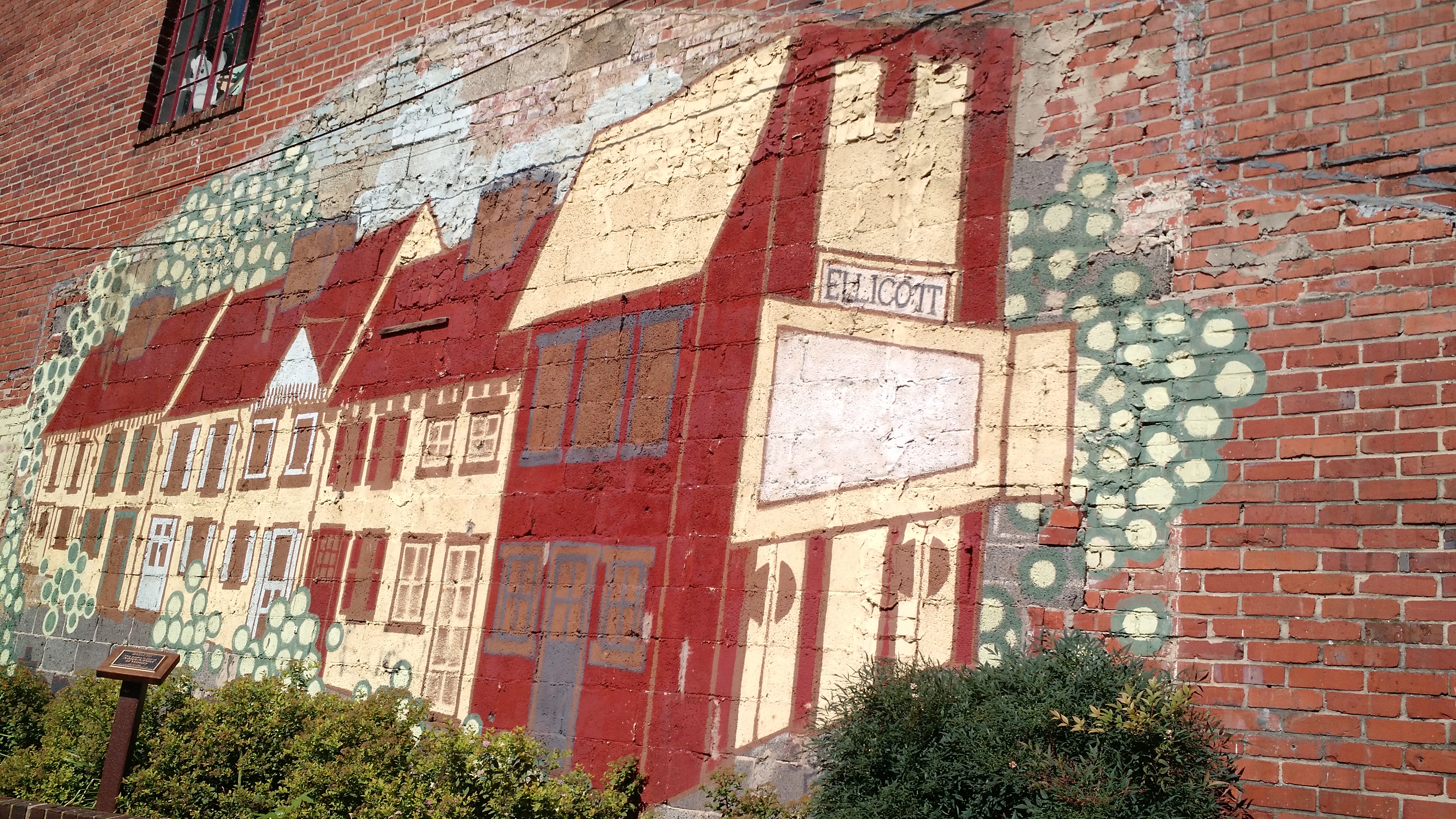
a mural at the intersection of Old Columbia Pike and Main Street in Old Ellicott City, Maryland
As I browsed those “pre-owned” books, I got to thinking about the material-life of books. Some used books are filled with marginalia, folds, and even small tears that show wear. Some suffer from cracked spines. Others are pristine – as if they were never used – perhaps very gently and carefully read but not used. A musty smell is activated when you open an old book – the pages so old and dry, yellowed brown, that when you turn them, they “crack.” You wonder about the last time someone had touched this book. It’s an experience that engages all of your senses and sparks your imagination.
All of this made me go home to revisit my bookshelves and open up my old books.

If you have an interesting edition of Roxana, I’m interested.
When I look at my three copies of Defoe’s Roxana I notice three different books. The first copy is a large, beautiful hardcover edition by The Heritage Club purchased by Miss Lee Baack – when I purchased the book at a used bookstore, it included the receipt and the publisher’s brochure. The second is a regular old Oxford World’s Classics copy that I used to study the novel for my thesis (notice all the post-it papers sticking out of the pages). The third is an early or mid 20th century sensationalized pocketbook edition. Although all three tell exactly the same story , the cover design and the physical appearance of the book beckon different kinds of readers as well as varying reading-purposes.

one of my prized possessions – 1896 edition of Robinson Crusoe with beautiful illustrations
Inside my 1896 copy of Robinson Crusoe – of course, also by Defoe – there is an inscription: “R. Stacey Christmas 1903”. The “£2” written next to the name reminded me that I had bought this book during my year abroad in England.
They do that, you know. Old books – they remind me of specific times, events, people, and even feelings. My broken and tattered copy of Macbeth will always remind me of my awesome, wonderful high school English teacher who was also a real-life hippy who rode the motorcycle to school wearing his Grateful Dead t-shirt. Memories. Inside the pages of that book, I keep a photo of the Lady Macbeth statue that I took in Stratford-upon-Avon.
Each book – not the story, not the literary, artistic work that’s in it, but the physical book – has a life. Our reading habits, what we do to our books end up shaping how we communicate with the future readers (our future selves or other people). Our reading habits change the thing of the book. What we do to our books pass from one reading circumstance to the next not only the writer’s art but also the experience of its being read – through various creases and folds, underlines, markings, and writings.
In “A Year in Marginalia: Sam Anderson,” Sam Anderson shares images of marginalia he made in 12 different books in 2010. He writes, “The writing I enjoy doing most, every year, is marginalia: spontaneous bursts of pure, private response to whatever book happens to be in front of me. It’s the most intimate, complete, and honest form of criticism possible — not the big wide-angle aerial shot you get from an official review essay, but a moment-by-moment record of what a book actually feels like to the actively reading brain.” In another article, Anderson says this about his practice of marginalia: “I basically destroyed my favorite books with the pure logorrheic force of my excitement, spraying them so densely with scribbled insight that the markings almost ceased to have meaning.”

“Borrowers: please don’t confuse me by adding further notes to mine.”
Excitement is not exactly what I found in the marginalia of my Reconstructing Aphra: A Social Biography of Aphra Behn. Inside the cover I found this: “A.J. De Armond 1980- review copy”. Then a note to the future readers of this book from A.J.: “Borrowers: please don’t confuse me by adding further notes to mine.” I’m trying to hear the tone of this message – is it a polite plea or a bossy command?
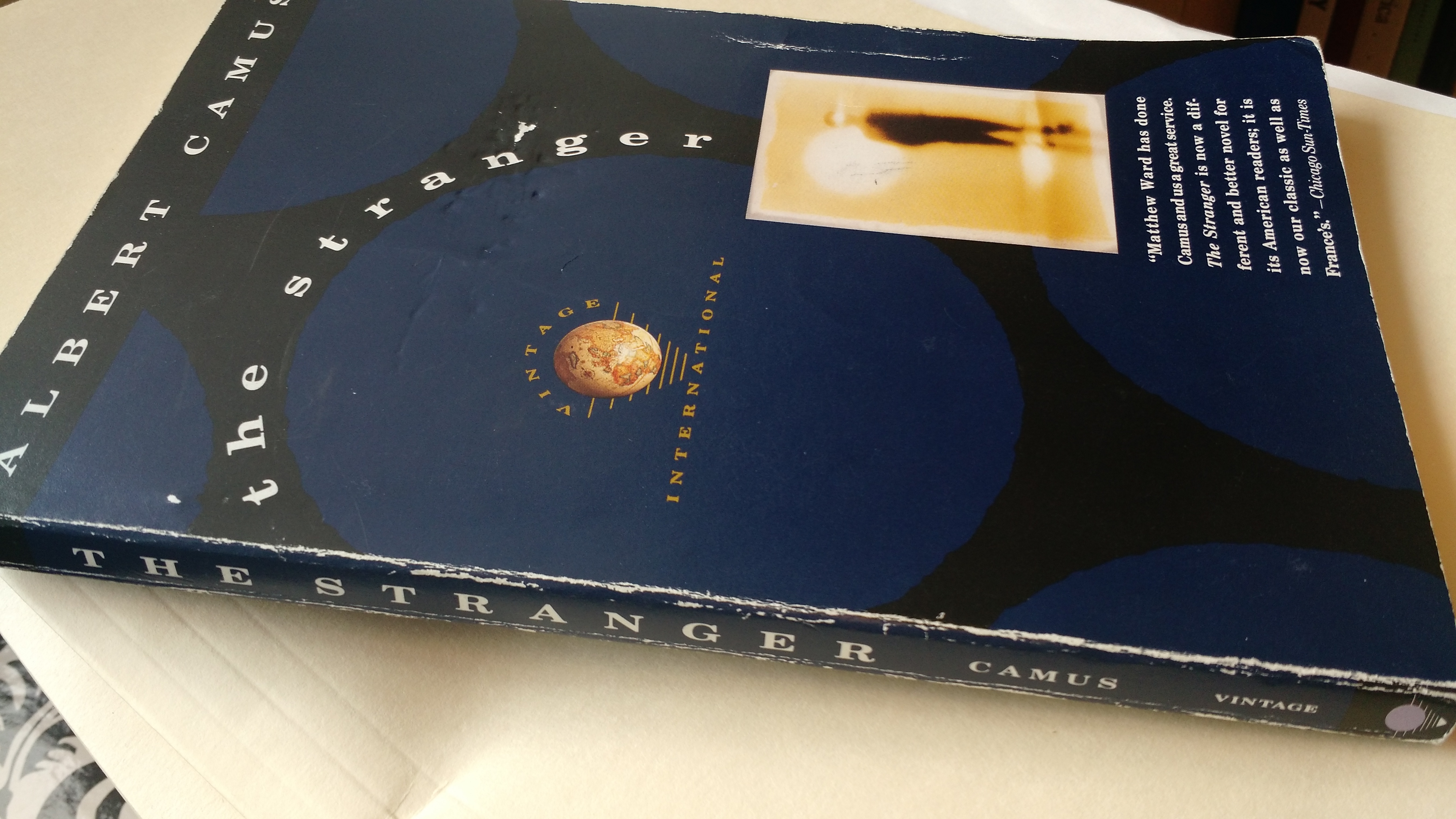
all along I thought my brother had borrowed my book for school — turns out I had borrowed his copy and never returned it
Speaking of marginalia-over-marginalia, the copy of The Stranger on my shelf, it turns out, is not my own copy. It’s my brother’s – he says the book was new when he read it for school. In it, I see marginalia in my brother’s handwriting with only a few notes in my hand. I also found on the first page of Chapter 5 a message from his classmate named Saidat who apparently wanted credit for helping him study this novel. But when asked about it, my brother said, “Who the hell is Saidat?” Oh well.

“Nothing had changed but me. That was all that was needed to change everything 8.26.1998”
I can’t help but smile when I read inside the cover of my Crime and Punishment a penciled writing by 19-year old me: “Nothing had changed but me. That was all that was needed to change everything 8.26.1998.”
Dear readers, I invite you to browse your own bookshelves and revisit your old books. I invite you to go to a used bookstore and rescue a book, take it home, see where it came from, and create a new life for that book with your own reading of it. The thing – not just the art – of the book has much to tell us.
On Reading: A Poem That Caught My Eye to Catch My Ear.

Tim Singleton, co-chair of the HoCoPoLitSo board, writes On Reading for the fourth week of each month.A Poem That Caught My Eye to Catch My Ear
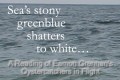
The other day a poem caught my eye because it wanted to catch my ear. I had spied or sort of spied Eamon Grennan’s “Oystercatchers in Flight” in my inbox, Poets.org’s Poem-A-Day offering.
Sea’s stony greenblue shatters to white…
 To be honest, most of the time, the Poem-A-Day missives fall by the wayside, especially if, at a glance, they look long – I save them for ‘later’ and off they disappear, most likely not to be looked at again. This time, the word ‘oystercatchers’ caught my eye and then the brevity of the poem. I could take a look.
With the next glance and I saw the words looked pure sound and begged to be read aloud. I did. One. Two. And three times. The sound was a pleasure. It took something to work the line rhythms into the air. It was a roil of words. Something was going on here. I liked the way the words abutted each other, almost fighting for space and identity amidst the rockiness of the lines. [Listen to a reading of this poem in the clip at the bottom of this post — you can tell I am still working out the rhythm, sound and breath in the recording. Click on the image at the right to read the text of the poem.]
Up till then, I had just been saying the sounds of the poem. I was almost at the point of saying, “What is going on here? What is the meaning?” and some distraction reclaimed me to the busy tasks of the workday; the poem went by the wayside.
Much later in the day, someone else mentioned the poem and we brought it up on the computer to read together, trying to get out something we both had glimpsed, but didn’t really pay attention to at the time. What was going on in that poem? It looked neat. It sounded neat. But what?
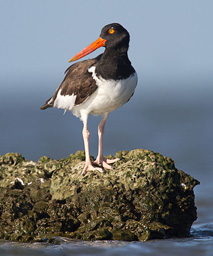
Oyster catcher by Dan Pancamo*
Early, in my inattentive glancing, I had assumed humans for oystercatchers. Seemed romantic, appropriate for a poem and I was working at meaning through that misconception, trying to figure out the bit about orange and black and what. Then, eureka, oystercatchers are birds! a fact which google not only confirmed but also displayed and we all started appreciating what the poem was obviously saying. The poem and its colors started to make beautiful sense. Sometimes we readers of poetry just try too hard.
There is a complexity to what could just be obvious in this poem, though, which makes it delight, but it wants a bit of trying to get at. The first line gets things going so quickly and particularly with sound that meaning might not deeply render on a quick read; its not conveying in the way of obvious and ordinary everyday language where words rest on the ear starting with meaning, rather by a pay-attention-example of solid words that jump right away into the next sound, almost leaving things behind. (All the punctuation in this poem but the last mark is of a push-forward kind: colons, hyphens, even that first apostrophe which launches a reader from the first word breathlessly into the second, even the parens, which add a hastened phrase on top of the forward push.)
Just where the poem ‘turns’ there is ‘veronica’ as a verb, kind of delicious, kind of awkward, a little odd to my ear and eye. The flower is not an everyday appearance in the geography of my mind, so I am not quite guided to instant image or meaning. Or is it a reference to a Christ-imaged cloth? Or the bullfighter’s move? Not sure. Can’t tell. But then I think it could be just the sound in the word that is describing what the birds are up to, how they hang and move in the windy air: slow-slow-fastoff: verrrr-onnnnn-ica. I am still a little uncertain about what it specifically conjures, but it slows down the rhythm for a moment before the ‘then away’. Nice. It is a great sound to say, a comfort after the hard Ss, Ts and Ks of the earlier lines.
The way sound and rhythm works through all the lines is thrilling, physically manipulating when you read it out loud (do!). It’s not just because of the punctuation lack. You can hear clapping here: “tribe of black till you clap and their risen black” in the repeated slap-like ‘ack… ap… ack’ sound. And you can sense the rhythm/wind hold-shift-hold for a moment in the poem, too:
…and their risen black
as they veronica on wind and
then away with them (shrill-pitched as frighted
plovers only harsher more excited)
and riding the stiff wind like eager lovers straining
into its every last whim: its pulsing steady
The parenthetical phrase full of energy that stifles and speeds into the steady pulsing surrounding it, “harsher more excited” sending the tongue off and into the ploddingly slower single syllable words of “and riding the stiff wind like…” Grennan makes the wind of the breath match the wind of the wind. ‘Lovers’ brings back the stalling hold-in-place of ‘veronica’ with its V sound and something of a parallel image of wind fight. Then the final, almost exhaustive:
its pulsing steady
heart-push in every flesh-startling open-eyed
long-extended deepening sea-breath.
which you don’t get to without having said the whole of the poem in one long exhale. Bravo. You are breathing like the sea.
On the first few glances at this Poem-A-Day email I missed some obvious things, a now super obvious one being Grennan’s comments on the piece I would have seen if I had scrolled down a single screen from the poem:
“This poem is a fairly straightforward visual report on its title, the birds being a common sight on the coastline I live beside in Connemara, Ireland. I sought a contrast between their ‘abiding’ and the speed and dash of their taking off, their going. The lovers’ metaphor intends, I guess, a broadening or deepening of the natural facts. The absence of punctuation is a strategy to suggest the long-breath continuity and interconnectedness of things.“
I had gone straight to the sound and was quite happy for it, even blew past the title and its clue. I wasn’t worried about meaning at that point, letting words be sound for the sake of hearing what the poet was up to. I was fortunate that the poem came back to me later, grateful the time spent listening through the sound to get to the meaning: it’s quite an enjoyable observation, quite a re-livable observation shared via Grennan’s skill with the rhythm and sound in words and groups of words. I love the way this poem uses breath and sound to portray what its words observe. You’ll be missing things if you don’t read it out loud yourself.
You can see that I am not the best at making the most out of the Poem-A-Day features as they visit my already overwhelmed emailbox. I pay attention only sometimes and then often just slightly. Still, I highly recommend signing up for the service and letting poems interject as they may. When they do, let them spend time with you. They have a way of making delightful your day.
- Click here to sign up to receive Poets.org’s Poem-A-Day in your own email.
- More on Eamon Grennan at The Poetry Foundation.
 HoCoPoLitSo
