



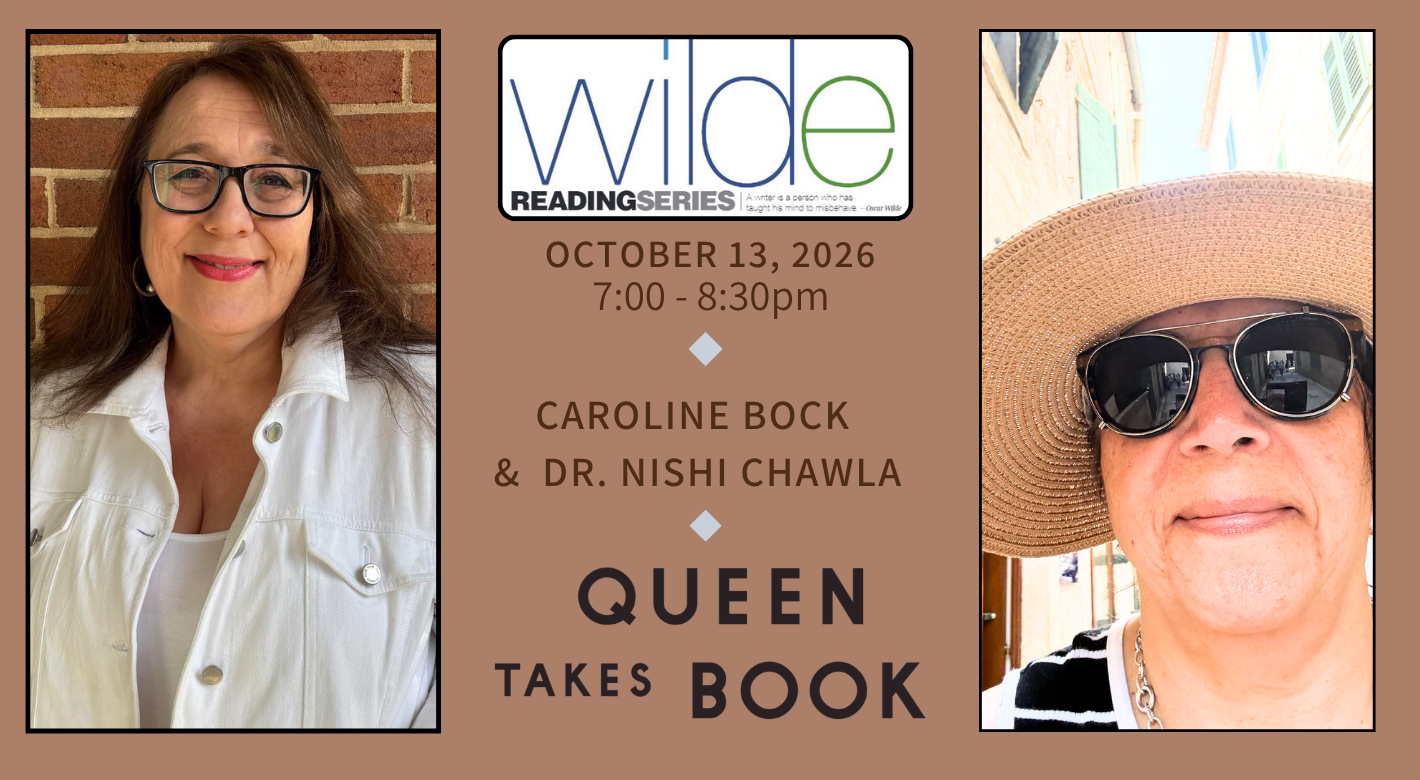
HoCoPoLitSo welcomes all to the October meeting of its Wilde Reading Series, proudly continuing its ongoing eleventh season of highlighting local authors in Howard County. This month’s reading features Caroline Bock and Dr. Nishi Chawla, hosted by Laura Shovan and Ricky Jones. Please join us at independent bookstore Queen Takes Book on Tuesday, October 13th at 7 p.m., at 6955 Oakland Mills Rd, Suite E, Columbia MD, 21045.
Our warm and welcoming open mic follows the featured authors and we hope you will let us hear from your stories, poems, or other piece. Please prepare no more than five minutes of performance time (about two poems) and sign up when you arrive. Books by the featured authors will be available for purchase.
In addition to our customary author’s Q&A below, we would like to invite you to read and subscribe to a new, monthly Wilde Readings Newsletter distributed on HoCoPoLitSo’s Substack and penned by Ricky Jones, who joined the team of series hosts this season after many prior months gifting us with insightful questions as an audience member. Each month, Ricky will share his thoughts on the upcoming authors, and how the topics and themes of their work resonated. This month: on procrastination, freedom of choice, and how to know the difference between obligation and responsibility.

Below, get to know Caroline and Nishi!
Who is the person in your life (past or present) that shows up most often in your writing?
Caroline: Pop. My father. He is a quirky ghost trailing my main character, television executive Amy Greene, in my new novel The Other Beautiful People. He is always here with me; may he rest in peace, may his memory be a blessing, and may he please let me write a story that doesn’t include him.
Nishi: The person who shows up most often in my writing is, perhaps surprisingly, myself—not as an autobiographical character, but as a presence. My experiences, questions, contradictions, loves, losses, migrations, and encounters with different cultures inevitably find their way into my work. Even when I write about people very different from me, some part of my own emotional and intellectual journey is there.
I think that is what happens when one writes across genres. The self keeps returning, sometimes disguised as a character, sometimes as a voice, sometimes as a question. I may be writing about Ayodhya, refugees, Indigenous communities, Gandhi and Tagore, or a family caught between cultures, but underneath those stories is the same person asking: How do we live with difference, memory, displacement, love, and the need to belong?
So perhaps the person who appears most often in my writing is not a particular person at all. It is the evolving self I have carried through all the places and lives I have encountered.
Where is your favorite place to write?
Caroline: My desk, which overlooks a public park, and two magnificent fir trees, and often there— a murder of crows watching for the next paragraph to be written.
Nishi: My favorite place to write is wherever I can be alone with my thoughts. I have written in my study, in hotel rooms, on airplanes, and even in cafés. But I especially love writing near a window— with the world moving outside while I remain completely absorbed in the world I am creating.
I don’t need silence as much as I need a sense of solitude. For me, the real writing space is an inner one: that moment when everything around me recedes and a character, a voice, or a sentence begins to take over.
Do you have any consistent pre-writing rituals?
Caroline: I select music to write with, an old-school CD. My current favorite is Anat Cohen, a jazz clarinetist.
Nishi: I don’t really have a rigid pre-writing ritual. What I need most is a certain inward quiet— a feeling that I can enter the world of the work without distraction. I often read over a few pages of what I have already written, let the language and characters come back to me, and then begin. Sometimes a cup of tea, music, or simply sitting quietly helps. The real ritual, however, is returning to the page every day and allowing the writing to take over.
Who always gets a first read?
Caroline: My husband, because he is not a writer (he’s a labor lawyer), and he will be both very kind and very honest.
Nishi: Usually, no one gets a first read while the work is still taking shape. I like to live with the writing myself first— to discover what it is trying to become before I expose it to another reader. Once I feel it has found its form, I have a very small circle of trusted readers whose responses I value, particularly when they can tell me where the work is alive and where it is not yet working.
What is a book you’ve read more than twice (and would read again)?
Caroline: Diane Seuss’s collection of American sonnets, frank: sonnets.
Nishi: There are books I have returned to more than once, but one that stays with me is The Magic Mountain by Thomas Mann. I found something different in it each time— the first reading drew me into its strange, suspended world, while the second made me more aware of its ideas about time, illness, society, and the human condition. I think some books ask to be reread because we are never quite the same reader twice.
What is the most memorable reading you have attended?
Caroline: At Syracuse University, I studied with the poet Jack Gilbert. I will never forget his mane of white hair against the snowy sky. He read his poetry and made me cry. He made everyone in the room cry. He wiped away tears. Snow fell. You can imagine snowflakes in the room, in our hair. It was a joy.
Nishi: One of the most memorable readings I attended was one where the boundary between the writer and the audience seemed to disappear. I remember the sense of intimacy— the room becoming completely still as the writer read, and everyone listening not simply to the words but to the life and experience behind them. Those are the readings I remember: not necessarily the grandest ones, but the ones where language creates a shared space between strangers.
• Caroline Bock is the author of The Other Beautiful People, a workplace love story, inspired by her two-decade career in cable television, notably at AMC, Bravo, and IFC. She is also the author of the young adult novels Lie and Before My Eyes, as well as the short story collection Carry Her Home. She is the co-president and prose editor at the Washington Writers’ Publishing House based in Washington, DC. The Other Beautiful People (Regal House Publishing, 2026) is her first novel for adults.
Caroline’s home page is www.carolinebockofficialauthor.site and she can be found on Facebook and Instagram as @CarolineBockAuthor.
• Dr. Nishi Chawla is an academic, a writer and a filmmaker. She has published eleven plays, three novels, and eight collections of poetry and written and directed four award-winning art house feature films. She co-edited two global anthologies of poetry Greening the Earth and Singing in the Dark. Dr. Chawla has taught English Literature for forty years at the University level. She is one of the few Indian playwrights to have two plays in Manhattan, NY and has appeared on the U.S. Library of Congress program “The Poet and the Poem.”
Find more at www.nishichawla.com.


