Home » Articles posted by hocopolitso (Page 7)
Author Archives: hocopolitso



Poetry, music, cocktails at HoCoPoLitSo’s 41st Irish Evening of Music and Poetry
 HoCoPoLitSo’s guest for its annual Irish Evening on February 8, 2019, is the award-winning poet Vona Groarke, recipient of the 2017 Hennessy Hall of Fame Award for Lifetime Achievement. Groarke’s reading will be followed by a concert of Irish music and championship step dancing. During intermission, complimentary snacks and non-alcoholic beverages will be available. Irish coffee, specialty cocktails, and Guinness will be offered for sale beginning at 7 p.m. and during intermission. The program begins at 7:30 p.m. in the Smith Theatre of the Horowitz Center for Visual and Performing Arts on the campus of Howard Community College. Tickets are available on-line (starting Nov. 23) https://www.brownpapertickets.com/event/3905864, by phone or mail. To purchase by phone, call 443-518-4568 or by mail, send a check and self-addressed envelope to HoCoPoLitSo, 10901 Little Patuxent Parkway, Horowitz Center 200, Columbia, MD 21044.
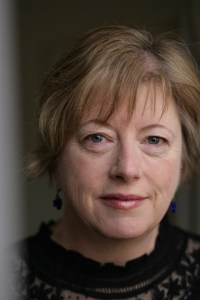 Vona Groarke’s most recent collection, Selected Poems, won the 2017 Pigott Prize for the best collection of poetry by an Irish poet. Noted as “brilliant and original” by the Irish Times, Groarke writes haunting and candidly sensual poems. At Irish Arts Center’s annual PoetryFest in New York, organizer and author Nick Laird extolled Groarke’s voice as “always modulated beautifully, assured and daring, often wry, (that) in the end keeps faith with the world.”
Groarke has published ten books, including a 2016 book-length personal essay, Four Sides Full and one translation, Lament of Art O’Leary (from an eighteenth-century Irish classic). A new collection of poems, Double Negative, is due in 2019. Her work has been recognized as one of Irish poetry’s “most consistently satisfying voices” (Agenda magazine) and “among the best Irish poets writing today” (Poetry Ireland Review). She has been the recipient of many prizes and grants, including the Brendan Behan Memorial Prize for her first collection, Shale (1994), the Michael Hartnett Award for Flight (2002), and is currently a Cullman Fellow at New York Public Library.
Groarke joins the long list of illustrious Irish authors HoCoPoLitSo has brought to Howard County audiences, including Frank McCourt, Colm Tóibín, Anne Enright, Colum McCann, and Emma Donoghue. For more than 40 years, HoCoPoLitSo’s Irish Evening has celebrated the substantial impact of Irish-born writers on the world of contemporary literature.
Performing traditional and original Irish music will be the Hedge Band: Laura Byrne on flute, Billy McComiskey on the box accordion, Donna Long on piano and Jim Eagan on fiddle, accompanied by dancers Maureen Berry, founder and Director of the Teelin School of Irish Dance, and Saoirse DeBoy, the 2016 World Solo Championship winner (girls age 16-17).


HoCoPoLitSo’s 45th Season Opens with Poetic Trio.
HoCoPoLitSo opens its literary season October 26 with “Ordinary Wonder: Three Poets on Writing and Reality,” featuring Michael Collier, Elizabeth Spires, and David Yezzi. The 2018 Lucille Clifton Reading Series highlights three Maryland poets with new, acclaimed collections. Collier, Spires and Yezzi will read and discuss their work beginning at 7:30 p.m. in the Monteabaro Recital Hall of the Horowitz Center for the Performing and Visual Arts on the campus of Howard Community College. Join us in celebration of HoCoPoLitSo’s forty-five years of literary programming at this year’s Lucille Clifton Reading Series. A book signing and wine and cheese reception will follow. The suggested donation for this event is $5.

Michael Collier, Elizabeth Spires, and David Yezzi
The three poets, in their own ways, hold up the ordinary world to the light of poetry and examine everyday mysteries, both beautiful and horrible.
Michael Collier’s most recent collection is My Bishop and Other Poems (2018). Poet and professor A. Van Jordan wrote, “My Bishop and Other Poems reminds us of the power of the observant in an age when, too often, we move too quickly to notice the world unfolding around us. These poems bring a passion, an empathy, and a way of seeing I had forgotten was possible.” Collier’s other collections include An Individual History, a finalist for the Poet’s Prize, and The Ledge, a finalist for the National Book Critics Circle Award and the Los Angeles Times Book Prize. He is the director of the Creative Writing Program at the University of Maryland, a director emeritus of the Bread Loaf Writers’ Conferences, and a former Maryland Poet Laureate.
Elizabeth Spires‘ most recent poetry collection, A Memory of The Future (2018), was influenced by Zen and Asian art. The New York Times wrote of the work, “In these lyrical verses, Spires questions the quotidian, elevating the everyday to a meditational art form.” Spires’ other collections include Worldling, Now the Green Blade Rises, and The Wave-Maker. The author of six books for children, Spires lives in Baltimore and is a professor of English at Goucher College.
David Yezzi’s newest collection of poems is Black Sea (2018). Other collections include Birds of the Air, Azores, and The Hidden Model. Reviewing Birds of the Air (2013), Farisa Khalid noted the poem Orts “does something that many poems strive for but don’t quite get at, and that’s conveying with clarity the otherness of our world—the strange beauty of what we experience and the mystery of what we can’t always understand.” Yezzi has contributed poems and criticism to The New York Times Book Review, The Times Literary Supplement, The Wall Street Journal, The Paris Review, The New Republic, Poetry, The Yale Review, Poetry Daily, and elsewhere. Yezzi, who lives in Baltimore, is the editor of The Hopkins Review and poetry editor of The New Criterion, and chair of the Writing Seminars at Johns Hopkins University.
Ordinary Wonder:
Three Poets On Writing and Reality
Michael Collier, Elizabeth Spires, and David Yezzi
Friday, October 26, 2018 – 7:30 p.m.
Monteabaro Recital Hall at the
Horowitz Center for the Performing Arts
Howard Community College
HoCoPoLitSo, a private, nonprofit literary organization, receives funding from the Maryland State Arts Council, an agency funded by the state of Maryland and the National Endowment for the Arts; Howard County Arts Council through a grant from Howard County government; The Columbia Film Society; Community Foundation of Howard County; and individual contributors.
“Up Close and Personal” at the Recent Blackbird Poetry Festival
 During Olympics’ coverage when I was a kid, ABC’s genial Jim McKay used to do interviews with athletes called “Up Close and Personal.” Sure, ice skating and swimming competitions were cool to watch, but “Up Close and Personal” was always my favorite because those talks felt intimate.
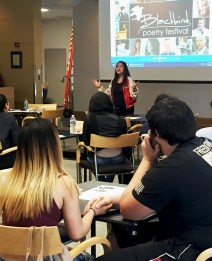
HoCoPoLitSo’s own versions of “Up Close and Personal” are the workshops that acclaimed writers offer aspiring writers. During the 2018 Blackbird Poetry Festival, featured poets Marilyn Chin and Joseph Ross read their work during the afternoon and evening. But on the morning of April 26, Ross and Chin offered forty students a close-up version of writing and reading poetry.
Students from Howard Community College’s creative writing and English courses were assigned some of Chin’s poetry to read, and she brought those poems to life, reciting and reading works like “How I Got That Name,” in which she explains how her father repurposed her Chinese name, Mei Ling, to become Marilyn. As a dark brown Chinese child, she wasn’t beautiful and wasn’t honored, Chin explained to the students.
 “I’m this little Chinese girl, born dark, underweight, a little weak. How shall I speak? I shall speak loudly,” Chin said. “I shall speak for that little brown girl who was unwanted.”
Chin and the students also talked about “loaded words,” like “slant” and “bitch,” and how Chin wants to repurpose those words and take the power away from the negativity that bigots have used.
“You can take the power back,” Chin promised.
When Joseph Ross claimed the microphone, he turned the tables and asked the students to write. “Every poem is political,” Ross said, because as Langston Hughes wrote, “Poets who write mostly about love, roses and moonlight, sunsets and snow, must lead a very quiet life.” Whether you choose to write about sunsets or sexual assault, snow or police brutality, those are political choices, he explained.

Then he asked students to write ten to fifteen-line poems including these phrases: line from a song, a phrase someone might hear on public transportation, words someone might speak in a kitchen, and title of a favorite book or poem or movie.
 Sofia Barrios, who also read a powerful political poem during the afternoon reading, wrote a poem that logically incorporated the line, “Next stop, Glenmont.”
The next assignment Ross suggested was to write an apology that the author wanted to hear. One student wrote the apology her father should give to her. Another wrote an apology to his inner self that included the sentiment that he was sorry he didn’t believe in himself more.
After the workshop, Chin listened to one student’s story. Chunlian Valchar told 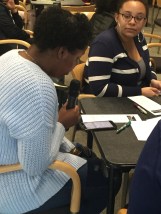 Chin that as a baby girl born with a birth defect in China, her birth parents left her by the side of the road near the market. Valchar’s adoptive family wanted her, though, so Valchar said her situation was slightly different from Chin’s, but she still identified strongly with Chin’s work.
Chin enfolded Valchar in a hug, they took a photo and Chin left her with a simple thought: “You’re loved and cherished.”
Afterward, Valchar explained that she’s not really angry at her birth parents, since she doesn’t really know what they were going through. But she liked Chin’s poetry.
“It’s interesting to see a poet on paper, and then to hear the background,” Valchar said. “It’s more impactful to hear the back story.”
Up close and personal indeed.
Susan Thornton Hobby
HoCoPoLitSo board member

A teeny bit of corporate evil cuts into the HoCoPoLitSo budget
Google started with a good motto: “Don’t be evil.”
A new policy on the Google-owned YouTube channel though, seems like a teeny bit of corporate evil to thousands of small, independent channels.
The new policy, announced this week, forbids smaller channels to monetize their videos – earning pennies per view – because they don’t have enough subscribers or time that viewers watch their videos.
YouTube sent HoCoPoLitSo an email Jan. 17 that read as follows:
Under the new eligibility requirements announced today, your YouTube channel, hocopolitso, is no longer eligible for monetization because it doesn’t meet the new threshold of 4,000 hours of watchtime within the past 12 months and 1,000 subscribers. As a result, your channel will lose access to all monetization tools and features associated with the YouTube Partner Program on February 20, 2018 unless you surpass this threshold in the next 30 days. Accordingly, this email serves as 30 days notice that your YouTube Partner Program terms are terminated.
Grammatical errors aside – and those truly bother us literary types – the announcement is another cut that the arts cannot afford.
HoCoPoLitSo uses its YouTube channel to show editions of its writer-to-writer talk show, The Writing Life, featuring conversations with Nobel and Pulitzer winners, with local poets made good, with beloved authors like Lucille Clifton and Frank McCourt and Amiri Baraka who have died. Often, we have the most extensive interviews with writers like Gwendolyn Brooks; that’s because HoCoPoLitSo’s founder Ellen Conroy Kennedy had the foresight to begin recording the show to preserve – in a kind of literary time capsule – the moments of writers talking about their craft. Here is a smallest sample, the wonderful Stanley Kunitz talking about the value of poetry:
In a little more than a month, HoCoPoLitSo will be removed from the possibility of making tiny amounts of money on these shows that help fund the taping of new shows, like the one just uploaded featuring Laurie Frankel, and the digitization of archived shows, such as the Michael Longley and Edna O’Brien vintage gems that hit YouTube this week. HoCoPoLitSo usually makes only a few pennies per view, but in this current climate of reduced funding for the arts, HoCoPoLitSo needs every penny. YouTube revenues added a few hundred dollars a year to the budget; that amount could fund a visit by HoCoPoLitSo’s writer-in-residence to a high school.
What can literary lovers do? It’s not too hard. Help us reach the goal of 1,000 subscribers – the channel has 890 now – and 4,000 hours of watch time in a year. Subscribe. Try one episode of The Writing Life while you’re folding laundry or doing your New Year’s resolution sit-ups; Frank McCourt will make you laugh with stories of his Irish childhood, Tyehimba Jess will cause a brain explosion explaining and reading his three-dimensional poetry from Olio, dear Lucille Clifton will warm your heart and put a fire in your gut on five different episodes. Think of the time as a creative respite from the chaos of business and politics. And, as always, donate to help our small nonprofit bring literature to this capitalistic world, which sorely needs it.
Susan Thornton Hobby
Recording secretary and
YouTube channel manager
To subscribe to HoCoPoLitSo’s YouTube channel, click here and then click on subscribe (it’s free).

Mike McCormack to read at HoCoPoLitSo’s 40th Irish Evening of Music and Poetry
HoCoPoLitSo’s guest for its 40th annual Irish Evening on February 9, 2018 is the award-winning novelist and short story writer Mike McCormack, whose latest novel is a tour-de-force in a single sentence. McCormack’s reading will be followed by new and traditional Irish music by Narrowbacks featuring Jesse and Terence Winch, with stepdancers from the Culkin School. Irish coffee, Guinness and other beverages and snacks will be offered for sale beginning at 7 p.m. and during intermission.
 Mike McCormack’s most recent novel, Solar Bones, won the 2016 Goldsmith’s prize, given to fiction with “qualities of creative daring,” and was longlisted for the 2017 Man Booker Prize. The book, which takes place in the mind of a middle-aged Irish civil engineer, has little punctuation and no chapter breaks, and Goldsmith’s chair of judges Blake Morrison said of the book, “its subject may be an ordinary working life but it is itself an extraordinary work.”
The Guardian subtitled their review “an extraordinary hymn to small-town Ireland.” The Times U.K. named Solar Bones one of the best fiction books of 2017 and noted that the novel, “follows meandering memories of his wife, his adult children and his work; these simple materials make for a beautiful and strangely compulsive read.” The Wall Street Journal also listed it as one of the best new books of 2017. Former Irish Evening guest novelist Colum McCann wrote, “With stylistic gusto, and in rare, spare, precise and poetic prose, Mike McCormack gets to the music of what is happening all around us.”
 In 1996, McCormack won the Rooney Prize for Irish Literature for his first collection of short stories, Getting It in the Head. His novel Notes from a Coma was shortlisted for the Irish Book of the Year Award in 2006; in 2010, John Waters of The Irish Times described it as “the greatest Irish novel of the decade just ended.” Val Nolan noted in an article in Ariel (April 2012) “McCormack’s fiction is cerebral and often surreal, depicting a west of Ireland that moves beyond narrow, realistic interpretations and into spaces that exist outside of government and history.” McCormack has also published the novel Crowe’s Requiem (2012) and a short story collection, Forensic Songs (2012).
McCormack joins the long list of illustrious Irish authors HoCoPoLitSo has brought to Howard County audiences, including Frank McCourt, Colm Tóibín, Anne Enright, Colum McCann, and Emma Donoghue. For 40 years, HoCoPoLitSo’s Irish Evening has celebrated the substantial impact of Irish-born writers on the world of contemporary literature. The evening program begins at 7:30 p.m. in the Smith Theatre of the Horowitz Center for Visual and Performing Arts on the campus of Howard Community College. General admission tickets are $35 each; available on-line at http://www.brownpapertickets.com/event/3099986 or by sending a check and self-addressed envelope to HoCoPoLitSo, 10901 Little Patuxent Parkway, Horowitz Center 200, Columbia, MD 21044. Each ticket purchased by January 15, 2018, includes a complimentary adult drink.
HoCoPoLitSo works to cultivate appreciation for contemporary poetry and literature and celebrate culturally diverse literary heritages. The society sponsors literary readings and writers-in-residence outreach programs, produces The Writing Life (a thirty-minute writer-to-writer talk show), and partners with the public schools and cultural organizations to support the arts in Howard County, Maryland. For more information, visit www.hocopolitso.org.
Click here to download a pdf of this press release.
Wrap-up your holiday shopping at smile.amazon.com/ch/52-1146948 and Amazon donates to Howard County Poetry & Literary Society.

Wilde Readings: A Great Place to Share Your Love of Literature

Ann Bracken
http://www.annbrackenauthor.com/
Wilde Readings, Columbia’s literary reading and open mic series, eagerly launches season two on September 12th at the Columbia Art Center. When poet and author Laura Shovan approached Linda Joy Burke and myself about starting a reading series in Columbia, we offered our full support. Because Wilde Readings is funded through private donations and a generous grant from HoCoPoLitSo and is housed in the Columbia Art Center in Long Reach, any concerns about funding and a venue disappeared. Before the three of us could begin the daunting yet exciting task of selecting authors for our first year’s lineup, we first solicited naming ideas from several of our friends in the writing community. While there were many names we liked, we selected Patricia VanAmburg’s suggestion to use Wilde Readings—a dual homage to Wilde Lake, Columbia’s first village, and Oscar Wilde, a writer known for both his wit and his bravery. His words, which appear as a tagline on our promotional materials, “A writer is a person who has taught his mind to misbehave,” capture the spirit of what we hope good writing encourages.

Mahitha Vijily
It was especially important to all of us that we present a variety of voices and styles, as well as represent the demographics of our area and balance male and female voices. With those parameters in mind, I hope you’ll agree that our 2016-2017 inaugural series fulfilled those goals and provided our audience with ten evenings of engaging, thoughtful, and provocative voices. Fiction was well represented when Jen Grow, Jan Bowman, Austin Camacho, and Susan Muaddi Daraj shared short stories and novel excerpts. Poetry and spoken word performances, both with political undertones, captured our audience’s attention when Michael Rothenberg, Ron Kipling Williams, Ken “Analysis” Brown, Maritza Rivera, and Shelly “Says So” Washington performed. Le Hinton had a most unusual approach to his rendition of poems from his “Cotton” collection—he passed around real cotton bolls for the audiences to feel both the velvet smoothness of the white fiber and the contrasting prickles of the supporting stamen and leaves. The remaining readings featured the impressive and highly regarded poetic voices of Grace Cavalieri, Merrill Leffler, Sally Rosen Kindred, Michael Ratcliffe, Nancy Naomi Carlson, Sue Ellen Thompson, Virginia Crawford, Sam Schmidt, and City Lit’s own Carla Dupree.
Wilde Readings’ lineup of literary artists for the fall of 2017 promises to be as engaging and diverse as our opening season. We kick off the series with Debbi Mack, New York Times best-selling author of the Sam McRae Mystery Series and Pat Valdata, whose most recent work, Where No Man Can Touch, is a book of persona poems in the voices of female aviation pioneers. In October, Michael Salcman, poet, physician, and art historian, will speak about his latest work, A Prague Spring, Before and After, along with his photographer, Lynn Silverman, a professor of photography at MICA. In November, we will feature the work of D.C. poet Henry Crawford reading from his inaugural collection, American Software, and Susan Sonde, author of several books and a two-time Pushcart Nominee and winner of numerous prizes and awards. We close out 2017 with Doritt Carroll, D.C. native and author of a new chapbook entitled Sorry You Are Not an Instant Winner and poet Alan King, Bowie, Maryland, resident and author of Point Blank and Drift.
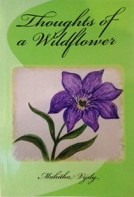 This year, in addition to lining up an exciting roster of literary guests for Wilde Readings, Laura, Linda Joy, and I plan to reach out to local teens who aspire to become writers. We’d love to put together a roster of interested writers to participate in a dedicated teen night as part of Wilde Readings. Last year, Mahitha Vijily, a teen writer from Marriotts Ridge High School, saw our event in the local papers and decided to bring her family and her book of poetry to the April Wilde Readings event. She blew us away with her provocative voice and skillful use of language and even sold a few copies of her book, Thoughts of a Wildflower. We hope to engage more voices in the coming year.
When we open the fall series on September 12, 2017, at the Columbia Art Center at 7pm, Laura, Linda Joy, and I will be there to welcome everyone, sign up open mic readers, and introduce our featured authors. We hope to see many attendees from last year and anticipate welcoming new folks as well.
By Ann Bracken

Of Stars and Hurricanes, Words and Moths
Like the moths that flit thickly around their outdoor lights in rural Virginia, the words must fly around Carrie Brown and John Gregory Brown’s house on the campus of Sweet Briar College. Because not only Carrie and John are writers, but so is their daughter Molly McCully Brown.
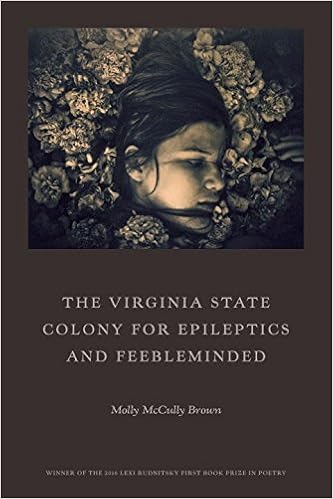 Family lore holds that a tiny Molly used to wake in the middle of the night and call for her mother or father because a poem was waiting and she couldn’t yet write well enough to capture it. And she had two parental examples of how to live an adult life: Catch those words swooping around and write them down.
Molly’s first book of poetry won the 2016 Lexi Rudnitsky Prize, and starting in September, she’ll work as the inaugural Jeff Baskins Fellow at the Oxford American magazine.
John Gregory and Carrie Brown are returning to Columbia, the town where their family story started, for a reading to celebrate the fiftieth anniversary of the founding of this town. The pair of novelists met while working at the storied Columbia Flier, and then began their family and their careers as authors.
They’ll read together at an event June 4 at Slayton House that HoCoPoLitSo is calling “Of Stars and Hurricanes: Two Columbia Novelists Return.” Carrie Brown’s newest novel, The Stargazer’s Sister, centers on the life of eighteenth-century astronomer Caroline Herschel, while John Gregory Brown’s 2016 book A Thousand Miles from Nowhere follows a man fleeing the wreckage of his life in New Orleans after Hurricane Katrina.
Both authors’ main characters, while living in different centuries and countries, seek redemption, for a way to save themselves.
 In her opening chapter, Carrie Brown writes that Caroline thinks “a girl was not taught anything that could save her in the larger world.” Desperate to escape an abusive mother and repressive poverty, Caroline is rescued by her elder brother, William Herschel, an astronomer who, with Caroline’s help, discovers Uranus and myriad comets. Carrie explains that the relationship of the siblings – in which Caroline so closely cares for her brother that she sometimes feeds him bits of bread and cheese while he keeps both hands and his eyes on the telescopes he manufactures – was “fertile material” for a novel.
The Boston Globe writes, “Carrie Brown takes up the real life saga of the Herschels and breathes fresh life into it in her lyrical and riveting new novel … .”
“Historical fiction fills in the spaces where history is silent,” Carrie explained at a recent reading in Baltimore. Carrie tells the Herschels’ story, massaging it into the arc of fiction, to “tell the other truth of their story.”
 John Gregory Brown’s fiction is based in history – the horrible story of Hurricane Katrina – but is invented whole cloth. A former New Orleans professor loses his way, buys a store that becomes a gathering spot and exchange depot, then flees north ahead of the hurricane winds. “I am a wrecked ship,” the protagonist says in the novel. He winds up at a rural Virginia hotel owned by an East Indian widow, then discovers a community willing to lend him aid and an epic poem that might save his soul. The Boston Globe calls his book “…a tale of redemption that is both believably prosaic and incredibly, quietly moving … .”
The two novelists will read together and answer questions at this event, which also honors Ellen Conroy Kennedy, the founder and longtime executive director of HoCoPoLitSo, and her husband and longtime supporter and board member of HoCoPoLitSo, for their decades of contributions to Columbia’s cultural life.
For tickets, visit http://www.brownpapertickets.com/event/2725249.
For more information about Carrie Brown, visit http://authorcarriebrown.com/
For more information about John Gregory Brown, visit http://jgb.blog.sbc.edu/about/
For more information about Molly McCully Brown, visit https://mollymccullybrown.com/
— Susan Thornton Hobby
Recording secretary


March for Science, Literarily
Science people and literature people don’t usually mix. We use different languages – dew and anguish for the lit types, water vapor and comorbid anxiety disorder for the science folks.
But there is a kinship.
 Environmental activist and poet Jane Hirshfield, who knocked out crowds at a 2007 reading for HoCoPoLitSo at the Howard County Conservancy, showed that science and poetry should march hand in hand more often.
On April 22, Earth Day, at the rain-soaked March for Science in D.C. to support the scientific community, Hirshfield read a poem from the main stage (photo). Cheers and whoops broke from the crowd of hundreds of thousands who crammed the park below the Washington Monument and spilled over into Constitution Avenue.
She prefaced her poem with this statement: “On Jan. 25, when the federal scientists were told to be silent, this march was first conceived. By the afternoon, I began writing the poem I’m about to read you.”
“On the Fifth Day” begins:
“On the fifth day
the scientists who studied the rivers
were forbidden to speak
or to study the rivers.”
(Click here for the full text of poem.)
A few hundred yards from the main stage, through the crowds with their creative signs (Got Smallpox? Me neither! Thanks, science!), the March for Science community had set up tents to hold science teach-ins. Marchers crammed into sessions about the benefit of preserving nature in cities, about efforts to save the bees and manage stormwater. In a tent sponsored by #Poets for Science – a popular place on the rainy day – people popped in to write poems. The tent was surrounded by a collection of eight-foot-tall signs printed with verse by writers such as W.S. Merwin and Linda Pastan, each poem chosen by Hirshfield.
The activities inside the tent were directed by Kent State University’s Wick Poetry Center and its Traveling Stanzas program. As the rain pattered on the tent’s ceiling, hundreds of people created “emerge” poems, striking out some words in long paragraphs of scientific language. Copies of the speeches given on the stage that day were handed to anyone who came in – from four-year-olds to gray beards. Using markers, the authors crossed out blocks of words, leaving poems to emerge from the blackness.
One read:
Eye witnessed
a law
The intrinsic value
of diverse and abundant plant and animal species
That value has been shared
forever.
The Wick Poetry Center site features more photos and emerge poems.
 In Washington last Saturday, the crowd was exposed to the connections between poetry and science, demonstrating the ideas that many activist poets are trying to express — that art and science are not expendable, they are intrinsic to survival in the world.
As many signs read: “There is no Planet B.”
Hirshfield explains in her statement on the #Poets for Science site:
“Poetry and science are allies, not opposites. … Observation and imagination, the microscope and the metaphor, the sense of amazement— you need all of them to take the measure of a moment, of a life. Poetry and science each seek to ground our lives in both what exists and the sense of the large, of mystery and awe. Every scientist I know is grounded in curiosity, wonder, the spirit of exploration, the spirit of service. As is every poet.”
Many signs at the march were lettered with the March for Science’s slogan: “Science, not silence.” I would add, though the rhythm isn’t quite as sublime, “Poetry and science, not silence.”
Susan Thornton Hobby
Recording secretary


Tyehimba Jess to read at HoCoPoLitSo’s 9th Annual Blackbird Poetry Festival
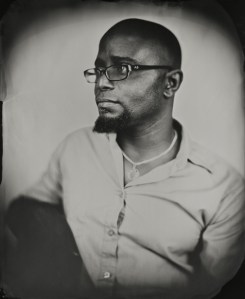 HoCoPoLitSo’s guest for its ninth annual Blackbird Poetry Festival is award winning writer and slam poet Tyehimba Jess. The Blackbird Poetry Festival, to be held April 27, 2017, on the campus of Howard Community College, is a day devoted to verse, with student workshops, book sales, readings and patrols by the poetry police. The Sunbird poetry reading, featuring Mr. Jess, as well as Washington, D.C., writer and literary activist E. Ethelbert Miller and Howard Community College students, will start at 2:30 p.m. Mr. Jess will read from and discuss his most recent work, Olio, as well as leadbelly, winner of the 2004 National Poetry Series, during the Nightbird Poetry Reading, starting at 7:30 p.m. in the Smith Theatre of the Horowitz Center for Visual and Performing Arts. Nightbird admission tickets are $15 each (students and seniors are $10) available on-line at http://www.brownpapertickets.com/event/2551545 or by sending a self-addressed envelope and check payable to HoCoPoLitSo, 10901 Little Patuxent Parkway, Horowitz Center 200, Columbia, MD 21044.
Tyehimba Jess, Associate Professor of English at College of Staten Island, a Cave Canem and NYU alumnus, received a 2004 Literature Fellowship from the National Endowment for the Arts and a 2006 Whiting Fellowship. He is also a veteran of the 2000 and 2001 Green Mill Poetry Slam Team. With rare skill, Jess welds the immediacy of slam poetry with the craft of poetry on the page.
Jess is the author of two poetry collections: leadbelly (2004), a biography in poems of the legendary blues musician Huddie “Lead Belly” Ledbetter, and Olio (2016), about African American performers from before the Civil War up to World War I. About Olio, 2011 National Book award winner Nikky Finney said: “Tyehimba Jess is inventive, prophetic, wondrous. He writes unflinchingly into the historical clefs of blackface, black sound, human sensibility.” Jess’ fiction and poetry have appeared in many journals and anthologies including Angles of Ascent: A Norton Anthology of Contemporary African American Poetry, Beyond The Frontier: African American Poetry for the Twenty-First Century, Slam: The Art of Performance Poetry, American Poetry Review, and Ploughshares.
Ethelbert Miller, editor of poetry anthologies, author of two memoirs and numerous books of poetry, including his latest, The Collected Poems of E. Ethelbert Miller (2016), will read and offer workshops.
Free Screening (tomorrow): Robert Bly: A Thousand Years of Joy
Thursday, March 9, 2017 –
from 7-8:30 pm
Miller Branch of the Howard County Library
Let us know you are coming: register through the Howard County Library or call 410-313-1950.
Robert Bly: A Thousand Years of Joy – Official Trailer (2014) from Haydn Reiss on Vimeo.
Join the Howard County Library and HoCoPoLitSo for a special screening of the documentary filmA Thousand Years of Joy, which charts the path of revolutionary poet Robert Bly from Minnesota farmer’s son to radical anti-Vietnam War activist to wild man of the 1990’s men’s movement. Best known as the author of the bestseller Iron John, which launched a million men drumming in the woods, Bly has been both celebrated and vilified, but above all has persisted in championing the power and importance of poetry in today’s America.
Robert Bly was a guest of the Howard County Poetry and Literature Society in June of 1997. During his visit, co-sponsored by the Columbia Festival of the Arts, he led a workshop at Howard Community College, presented a reading in the Smith Theatre and taped an edition of The Writing Life with Cornelius Eady.
 HoCoPoLitSo