Home » Education (Page 2)
Category Archives: Education



HoCoPoLitSo Recognizes Howard County Students for Literary Achievement
For thirty-five years the HOward COunty POetry and LITerature SOciety (HoCoPoLitSo) has awarded book prizes to the winners of its All County Writing Contest, and recognized students nominated by their teachers for Promise and Achievement in Language Arts. To foster lifelong reading and a love of literature, HoCoPoLitSo presents book awards with personalized bookplates. The tradition continued this year as HoCoPoLitSo board members made presentations at all Howard County public high school senior award assemblies and the Homewood Center.
Books were presented to eleven creative writing winners: Nadine Eloseily (Centennial), Angelina Zater (Howard), and Kasmita Mirani (Glenelg) in the personal essay category; Christian Salazar (Oakland Mills) Ben Yodzis (Hammond), Alexa Marquis (River Hill), Erin Hill (River Hill) and Lawrence Qiu (River Hill) in the short story category; and Xin He (River Hill), Kasmita Mirani (Glenelg) and Kiara Bell (Oakland Mills) in the poetry category. This year’s judges were Sama Bellomo, rehabilitation technologist; Joelle Biele, poet and editor, Patricia Van Amburg, poet and professor, Howard Community College; and Nsikan Akpan, HoCoPoLitSo board member and Former Promise and Achievement in Language Arts Award Winner.
In addition, twenty-four students were chosen by their English Departments to receive HoCoPoLitSo’s Promise and Achievement Award in Language Arts. The honorees were: Amanda Etcheberrigaray, Connor Gallant (Atholton), Jessie Kwon, Teresa Whittemore (Centennial), Tiffany Nguyen, Zoe Read (Glenelg), Emily Carter, Matthew Sinnott (Hammond), Mia Dubin, Emilee Melton (Homewood Center), Hunter Hensley, Rachel Walter (Howard), Naomi Yang, Theo Yang (Long Reach), Devon Carberry, Grace Yi (Marriotts Ridge), Casey Kindall, Cory Weller (Mt. Hebron), Kiara Bell (Oakland Mills), Joseph Smith, Marya Topina (Reservoir), Alexa Marquis (River Hill), Yazunat Guta, and Sara Shemali, (Wilde Lake).
Thirty-one students in all received books by such outstanding poets and writers as Lucille Clifton, Sandra Beasley, Michael Collier, Billy Collins, Emma Donoghue, Rita Dove, Eamon Grennan, Josephine Hart, Robert Hass, Colum McCann, and Richard Wilbur. HoCoPoLitSo is dedicated to enlarging the audience for contemporary poetry and literature through public readings, special events, writer-in-residence visits, and The Writing Life, a cable television series produced at Howard Community College, now available on YouTube, for more than 40 years.
Poet Ann Bracken’s Visit to Patuxent Institution
Quality Poems: Offering a Window and a Voice
by Ann Bracken

Ann Bracken
So few of us ever visit a prison, yet many of us already have a vision of what it’s like, thanks to TV shows, such as the popular Orange is the New Black. On November 10, 2015, sponsored by the Howard County Poetry and Literary Society, I visited the Patuxent Institution to offer a writing and poetry workshop to some of the incarcerated men in the youth program. Pseudonyms have been used to protect the men’s identities.
The day was rainy and cool, and the gray skies nearly matched the gray walls and somber mood of the prison. Because I have worked with another writing group at the prison complexes in Jessup, I knew all I could take in were my art supplies, papers, and a book, in addition to my car keys and my license. The screening procedures are very much like going through the check-points of airport security, except that you must be patted down each time you enter the prison. I was not allowed to bring in my tote bag for the class supplies—instead, I was given a clear plastic bag.
Once I made it through security, Hillary Battle, a social worker who works with the youth program, escorted me to the education wing of the prison. I was curious about the designation of “youth program” because I knew the approximate ages of the men were between 25 and 35 years old. Ms. Battle explained the disconnect, “In order to be eligible for the Youth Program, the men must be sentenced under the age of 21. We could receive them at any time during their incarceration because the program distinction is based on when they were sentenced for their crimes.”
I’ve walked those long halls to the classrooms several times now, but I still shudder a little when I get on an elevator and the barred doors clank shut behind me. As Ms. Battle and I walk towards the classroom, many thoughts run through my head. Will the activity be beneficial for the men? What will they be like? Will they write and share? Do I have enough time for all I want to offer?
After discussing the men’s needs with Ms. Battle a few weeks earlier, we had both decided that my activity using J. Ruth Gendler’s book Quality Poems would provide a familiar starting point for the men to explore poetry. In her series of prose poems, Gendler personifies 100 character traits and invites us into their world—a world where “Commitment has kind eyes,” “Forgiveness is a strong woman,” and “Courage has roots.”
Dr. Cynthia Carter, the team leader for the youth program, greeted me with a warm smile and thanked me for coming when I arrived in the classroom. The men sat at their desks, quietly waiting for the lesson to start. As I surveyed the room, I noticed the standard furnishings: a large blackboard, several file cabinets, a few TVs, and about five computers. Nine men sat at desks arranged in rows. Because I’ve been a teacher for my whole career, the classroom felt familiar—even down to the four men who chose to sit in the back row. “We just feel safer here,” they told me and smiled. After I put my supplies on the desk, I walked up to each man, shook hands, and introduced myself. They smiled at me and thanked me for coming. In that moment I prayed that things would go well and that what I had planned would speak to their needs.
I began by reading the poem “Courage.” After a few moments of reflection, Claudio said, “Courage is quiet. He keeps to himself.” The other men chimed in, feeling more confident now that one of their friends had spoken. “Is Courage ever afraid?” Tony asked. My take? Yes, Courage is often fearful, but chooses to move ahead despite the fear. Tony shared his thoughts and said, “I like the line in the poem that goes, ‘Courage is not afraid to pray.’” I read another poem about “Forgiveness” and the men were visibly moved. As I read, they were nodding their heads. I knew they were ready to write when I heard Julio say, “Forgiveness is a gift you give yourself.”
All told, the men wrote two poems—one on a positive character trait they possessed and one on a trait they wanted to improve or change. When it was time to share their work, I invited all of them to form a circle with their desks so that we could all see and hear each other better. Here is a sample of the traits they wrote about and some lines from their poems; I found their words both powerful and beautiful.
Danny spoke up from the back row and offered to share first. He wrote about “Distrust” as if the character were a woman. “She lives within herself … I stood at the door of her heart … to let her know I understood, I called her by her name, Distrust.” For his other characteristic, Danny chose “Uncertainty”: “ … harsh forms like factory smoke … moist, unanswered questions.”
Claudio, with short-cropped hair, offered to share next. I had met Claudio during another visit, and I knew him to be a fine painter. He wrote these lines about intuition: “Like vapor in gulfless canyons, travels like a gadfly. Intuition chooses friends like a coal miner searches for diamonds.” As I listened to Claudio’s poem, I was struck by how he seemed to literally paint with words.
Armando, sitting in the front row, offered to read next. “Confidence is not arrogant. He takes responsibility. Confidence is a good trick to have.” All of us loved that last line—a real surprise.
Bernardo sat in the corner and raised his hand to share after his friends had read. He had this to say about creativity: “Creativity comes in every size. He recites rhymes for fun and lives in the forefront of my mind. Creativity has a humble hobby.”
The men’s poems were full of rhythm and memorable phrases. Even though I wanted copies of their work to share with HoCoPoLitSo, I didn’t feel right asking the men to give me the poems they had written that day. I encouraged them to keep writing more about the qualities they had chosen. I did ask them for permission to use some of their work and they all agreed, as long as I used pseudonyms to preserve their anonymity. Dr. Carter, Ms. Battle, and all of the men told me I was welcome to come again any time.
Once again, I could see that poetry had offered people two vital elements: a unique expression of their voices and a safe place to explore their lives.
Poet, certified poetry therapist, teacher
Creative Writing 101 with Tara Hart
Writing is a discipline and it takes discipline to write.
So how does one learn and practice to become a writer? What’s more, how does one teach others to become writers?
In the next few months, you will hear from those who teach creative writing. Consider this your mini, free Creative Writing 101.

Tara Hart, Co-Chair of HoCoPoLitSo Board of Directors and Professor of English at Howard Community College
We kick off this series with Dr. Tara. Hart. Tara is one of two Co-Chairs of HoCoPoLitSo. In addition to being a community advocate for poetry and literature, she is a scholar, a poet, and a teacher. Listen to Tara read her poem “Pine” published in TriQuarterly. She teaches poetry and creative writing at Howard Community College. Here’s what she had to share with us.
LY: How would you describe – to someone brand new to teaching creative writing – your approach to teaching creative writing?
TH: I’ve realized over the years that the greatest challenges students face in their creative writing are getting it done on time and overcoming a sense of vulnerability, and that realization has significantly impacted my course design. I set up the grade distribution to reflect the fact that in the professional world of creative writing, you might have tremendous freedom in your assignments but you must hit your marks. Students might struggle to produce creative work by a certain deadline because they haven’t consciously made time or created the right environment for their creative process and habits, or because they fear the judgment that follows sharing their work, which can be very personal. So one of our first assignments is to create an action plan that anticipates difficulties, and every assignment they do receives full credit/points if it meets the required length and deadline and is on topic; I don’t “grade” individual pieces of creative work a la A, B, C, D, F.
This design motivates them to meet their deadlines and push forward even when it’s not perfect or even close. Their final portfolio of work, containing their best pieces and a reflective essay on their own strengths and goals for improvement, is graded at the end of the semester, but it’s now a much lower percentage of their overall grade, and it’s quite remarkable how the “best” writers very often do end up with the highest grades, even though the vast majority of the final grade is really about completing work on time. It affirms my idea that strengthening the habit of writing consistently and pushing through fear to meet the challenges of writing in unfamiliar genres and on a variety of topics produces, ultimately, better quality writing.
I heard a “Moth” storyteller on NPR say that a turning point in her life when she decided to “stop being a writer” and decided to “actually write.” I think my class, with its emphasis on production and feedback, distinguishes those students who are compelled to write and to develop the habits and discipline of a writer, from those who just like the idea of writing and might otherwise use the excuse that the instructor doesn’t “like” their writing – if they don’t do well in the class, it’s because they simply didn’t produce and engage.
LY: What is the most challenging thing to teach in creative writing?
TH: I have struggled most and improved most in the area of designing valuable peer review experiences in which students consistently give, receive and respond to each other’s feedback. Peer review skills are important in composition as well, but it’s harder, in a different way, for students to critique someone’s personal memoir than an expository essay. When I gave creative writing students choices in terms of whom to review, the same strong writers would get the most feedback and others would be neglected. Now I deliver the course most often as a hybrid, so that the Canvas learning platform becomes the “workshopping” portion of the course, and I use its automatic peer review feature to make sure everyone receives equal amounts of attention.
I’ve also worked hard to teach them how to work effectively within a writing community. I give very specific guidance and requirements about how to review each other’s work, using the model of What Works? What Doesn’t Work? and What If? , and as they explicitly improve in the quality of their feedback they implicitly improve their own writing because their self-editing skills are inevitably sharpened. I have learned to come in with my comments at the end of a unit, such as writing to them about patterns and possibilities I see in their fiction or in their poetry after they’ve worked a while with that genre – this gets them in the habit of listening to each other first and for quite a while without waiting for or deferring to the “real” critique from the professor.
Students might say that the most challenging/scary part of the course is reading their work aloud, which I’ve required to greater degrees over the years. I want them to learn more about the rhythm and music of their words. Also, the literary readings we do together, in which each student gets on the stage of Monteabaro Hall and reads for two minutes, make the students feel closer to each other, often increase their self-confidence in their writing, and illustrate the power of a supportive writing community.
LY: You are a poet. What’s the best suggestion/tip/teaching that you received from your own creative writing teachers?
TH: I didn’t study towards an MFA but trained in criticism, so my best creative writing teachers have been the master poets and writers I’m fortunate to read and meet and listen to as they are interviewed about their process for The Writing Life or present in venues here on campus or at the Dodge Poetry Festival every other year. I tell and require my students to READ, and to “read like writers,” which an astonishing number do not do extensively or widely. I ask those who do not read often, “Who, then, do you think is going to read your work?”
Billy Collins has had the greatest impact on my own writing when he teaches that readers don’t really want to hear about the writer’s thoughts and feelings but are looking to find themselves in what they read; that readers need to be oriented in concrete, specific ways before you launch them into abstraction or profundity; and that as writers we need to stop hiding behind vagary or ego. I’m better at spotting the difference between self-indulgent “bravery” (in which facts and feelings are wielded as weapons) and the tender commitment to offering truth.
LY: What is the most common advice/suggestion/tip you find yourself giving to your students?
TH: Show, don’t tell! Let the reader “be there” through the use of sensory details, rather than summarizing or explaining the experience for them. I’m also (in)famous for crossing out lots of text. I can do lots of slashing because I’ve already given them full credit for doing their work – I’m free to tell them how unnecessary lots of it is. Student writers tend to over-explain and interrupt their own compelling action or images with redundant “telling” of what we’re already inferring and feeling.
HoCoPoLitSo names author Laura Shovan as poet-in-residence
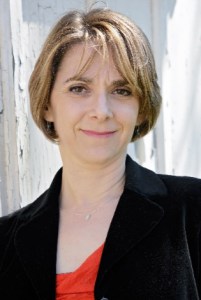
Laura Shovan
The Howard County Poetry & Literature Society (HoCoPoLitSo) has chosen Laura Shovan, winner of the 2009 Harriss Poetry Prize and author of an upcoming novel-in-verse for young readers, as its 24th poet-in-residence. Shovan will visit county high schools, the alternative school and Howard Community College classes to read her work and guide the students’ writing.
Using portraits and news headlines as triggers for poetry, Shovan will lead the students in writing their own verse. Shovan also plans to start a public reading series with student participation. A Maryland State Arts Council artist-in-residence since 1999, Shovan is the poetry editor of the Little Patuxent Review. Shovan’s book, The Last Fifth Grade of Emerson Elementary, comes out in April 2016 from Wendy Lamb Books, an imprint of Random House. Her poetry chapbook, Mountain, Log, Salt and Stone, won the Harriss prize, and she has edited two poetry anthologies. Shovan graduated from NYU’s dramatic writing program, taught high school and worked for the Dodge Poetry Festival.
For 24 years, HoCoPoLitSo has brought contemporary writers to the students of Howard County to encourage the love of literature and writing. Atholton High School teacher Jennifer Timmel, whose class wrote with last year’s poet-in-residence Joseph Ross, said about the experience: “I think the poet-in-residence program is brilliant. The students were all very moved by (Ross’s) poetry; many of them are writers and poets themselves, so to be able to speak with someone who writes for a living was very inspirational to them. They found his work interesting and inspiring. Mr. Ross is … an incredible combination of encouraging teacher and good poet.”
Shovan follows in the footsteps of illustrious writers, including Lucille Clifton, Li-Young Lee, Michael Glaser and Grace Cavalieri. Last year’s poet-in-residence, Joseph Ross, wrote, “For high school students, I’m convinced poetry can help them discover who they are. It helps them know they’re not alone. Poetry has healing properties, it connects us to everyone else.”
Nsikan’s Young Life with Poetry
In the last few months, we heard from Katy Day and Faheem Dyer about what poetry means to them. Today, in the last part of our series on young people on poetry and literature, we hear from Nsikan-Abasi Akpan. She is a student at Howard Community College and an aspiring writer.

Nsikan reading her poem to Taylor Mali
What do you get out of literary events like Taylor Mali’s reading at Blackbird Poetry Festival?
I recently met slam Poet Taylor Mali. He is a fire that enhances the light in others. It was nice spending time with him and the HoCoPoLitSo team and seeing that he doesn’t do what he does just for the stage – it’s inside of him. Poetry is inside of me and meeting him has encouraged me to not force my way into it, but rather to allow it to come naturally, perhaps when I least expect it to.
As a student and as a citizen of this world, what benefits do you see in reading and studying literature (especially poetry)?
The benefits of studying literature is growth. I spend many days cooped up in my room like a hermit, watching documentaries of great writers like Jack Kerouac and George Eliot, but it doesn’t mean I’m up to no good. It sounds silly, but when I get anxious (mostly due to my fear of not making it as a writer), I remember the struggles of J.D. Salinger and how he had to try many times before The New Yorker accepted his work; when I feel misunderstood, I think about Virginia Woolf and how she never truly fit in; an most importantly, when I find myself almost giving into anger and sin, I think of God and how He has given me poetry. Then I recite a poem in my head and end with “Amen” – and all is well again.
What’s your favorite piece of literature (a particular poem, poet, or novel maybe)?
“You might as well have asked, “What’s your favorite grain of sand?” Am I allowed to have a favorite? It’s just too much, but I’ll tell you this: In Stephen Chbosky’s book “The Perks of Being a Wallflower,” the main character, Charlie, is asked what his favorite book is. His answer: “The one I just read,” or something like that. I just read “Catholicism,” a poem by Billy Collins, so for this moment, that is my favorite poem.
Do you have any thoughts on what literary organizations like HoCoPoLitSo might do to encourage more young people to read, study, and encounter poetry?
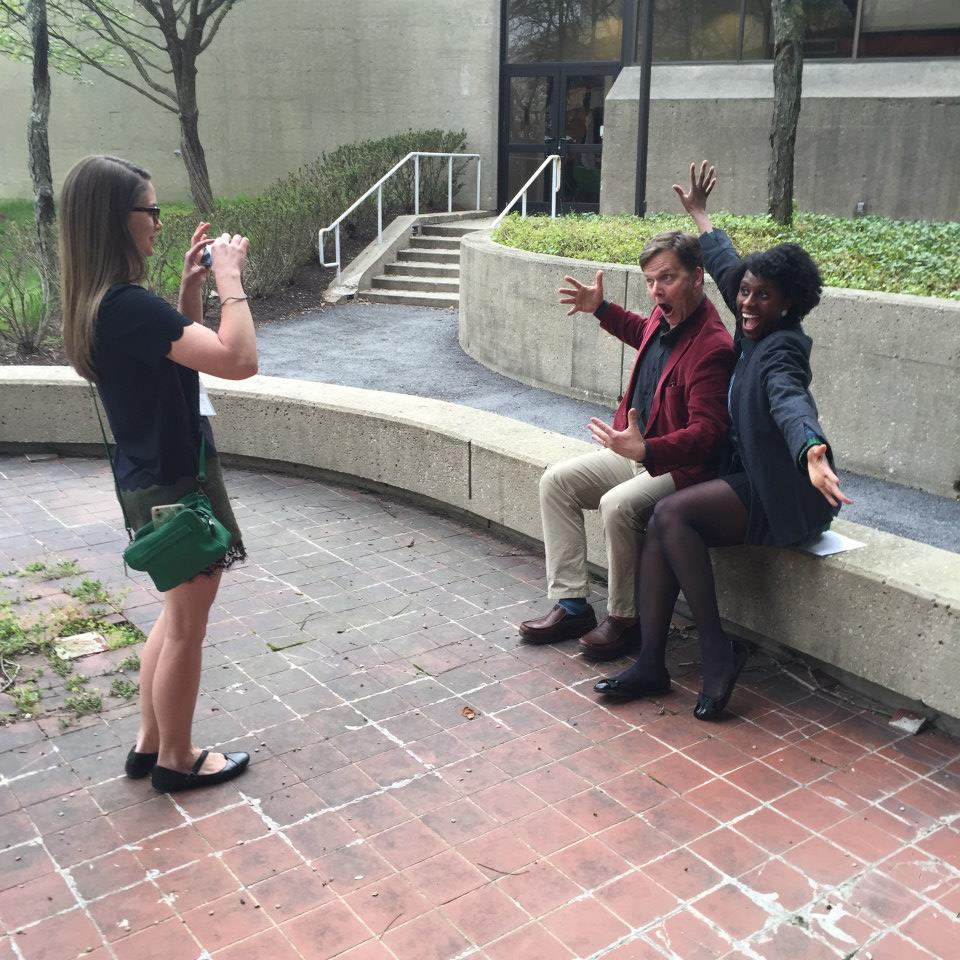
Who says poets aren’t silly? Katy and Nsikan share a moment with Taylor Mali
To some crazy people out there, poetry is no longer important. I once heard someone say “Poetry is dead.” Of course that person only said so because they were feeling bitter about failing the poetry unit in English class, but still we live in a world where such statements seem almost true. HoCoPoLitSo reminds us, though, that people who love poetry still exist, that poetry lives. It was through HoCoPoLitSo that I met Billy Collins and was able to recite my poem, “Frank,” right in front of him. HoCoPoLitSo is energetic and on the ball of everything literary, and young people need that. By providing the opportunity to not only read poetry , but also to meet the poets and share our own works, HoCoPoLitSo encourages us to stay involved and to stay in touch with literature. There are also local sources, like HCC’s literary magazine, The Muse, which bring us closer to literature. Young people are willing when it comes to being a part of the poetry world. It’s absolutely magical.
Rest assured, poetry lovers everywhere, that young people like Katy, Faheem, and Nsikan will become stewards of all that is beautiful and magical in the world of language and literature. But you and I have to support them, so that they can continue to spark and renew their energy.
And I promise you this – your support of HoCoPoLitSo will continue to foster their love of poetry and literature. Katy, Faheem, and Nsikan are the reason that HoCoPoLitSo does what it does.
– Laura Yoo
Member, HoCoPoLitSo Board of Directors
Next Up – Faheem Dyer on Poetry
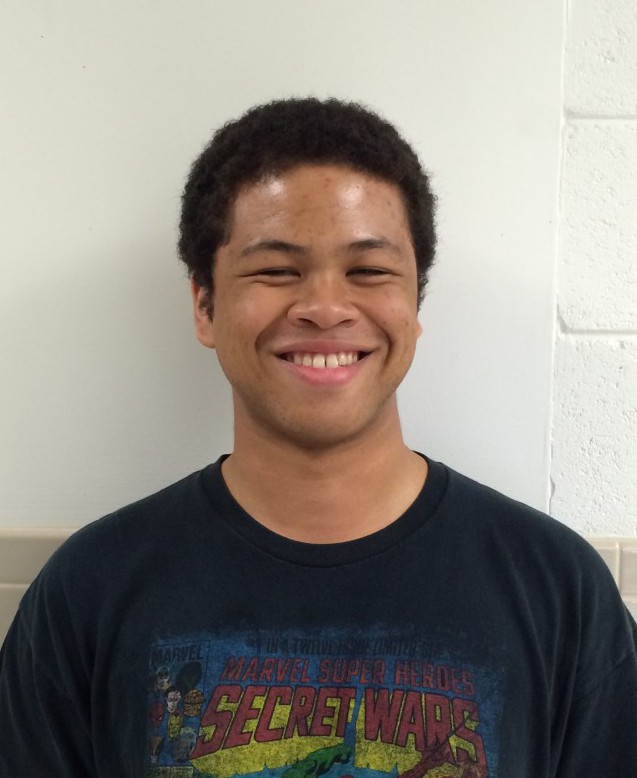 In this mini-series on young people in/of poetry, I have made my own observations about the importance of poetry in the lives of young people and I have interviewed HoCoPoLitSo’s Student on Board, Katy Day about poetry in her life. Next up is HoCoPoLitSo’s student intern, Faheem Dyer.
Faheem is a senior at Atholton High School. He has been pursuing his interest in poetry since middle school, and some of his favorites are Whitman, the Beats, and the Romantics. At Atholton, he is the president of the Poetry Club, and he serves his school’s student newspaper, Raider Review, as the Opinions Editor and the Online Editor. When he graduates this summer, he hopes to attend college in the fall to study creative writing or comparative literature. He says, “I believe that a deep engagement with the written word is essential to the intellectual growth and a healthy understanding of the world, both on a personal, and social level.”
Here’s what he had to say.
What do you get out of attending poetry and literary events, such as the Rita Dove and Joshua Coyne event last year?
I think the most profound thing I gained was the direct exposure to talent and experience of Ms. Dove’s and Mr. Coyne’s caliber. More than that, though, I think the chance to see these two people share their insights and ideas on their crafts with an attentive, engaged audience helped deepen my understanding of those art forms, both as a consumer and aspiring creator.
As a student and as a citizen of this world, what benefits do you see in reading and studying literature (especially poetry)?
I believe that being well-read in literature is the most important part of being a well-educated and informed individual. Whether it’s lofty philosophical theory, or raw poetic passion, all human knowledge and experience is cataloged with language; writing is one of the most important vessels of thought, and to make oneself a student of that is to put oneself at the heart of it. That is invaluable in growing as a person, and it is absolutely essential to a robust education.
What’s your favorite work of literature (a particular poem, poet, or novel maybe)?
I personally never get tired of Leaves of Grass by Walt Whitman, specifically “Song of Myself.” The wild, loving, and almost holy way Whitman addresses the nature of the world around him is beautiful and altogether profound and spiritual on a deeper one.
Do you have any thoughts on what literary organizations like HoCoPoLitSo can do to engage young people?
I may not be able to speak for all young people, but I know that if I were not already interested, simply being shown poetry in ways that demonstrate its continued relevance could easily engage me. Also, in introducing poetry to others, I would keep in mind what priorities and temperaments I’m trying to appeal to, because there is something for any young person of any mindset to gain from poetry, but the ways to make it appealing differ greatly from circle to circle.
You can read Faheen’s review of HoCoPoLitSo’s 2014 Lucille Clifton Poetry Series event when Rita Dove and Joshua Coyne read and performed together on stage at Howard Community College.
As a teacher, I am envious of teachers who get to teach students like Faheem. His commitment to poetry signifies more than his interest or even “skills” in language and literature – for me, it signifies the potential for a deep and wide understanding of the world that I believe literature students like Faheem can cultivate.
Poetry and other forms of literary arts ask us to look outward – at the world, at people, at history, at cultures, at empowering ideas as well as dangerous ideas. At the same time, they ask us to look inward, too – to think, to feel, to ask questions of ourselves, to imagine, and to nurture our interior lives.
Yes, poetry can do that. And Faheem knows it.
– Laura Yoo
Member, HoCoPoLitSo Board of Directors
This Time, “The Young” Speak – Katy Day
In my previous post, “Poetry for the Young (and the Young-Hearted)”, I promised you voices of our young poetry lovers.
First up is HoCoPoLitSo’s Student on Board Member, Katy Day. Katy is a student at University of Maryland, College Park who is studying English and Psychology. She has been a friend of HoCoPoLitSo’s since 2013. She made her Blackbird Poetry Festival debut in 2013. Billy Collins, who came to HCC to read at the 2014 Blackbird Poetry Festival, is an admirer of Katy’s poetry (as evidenced by the photo below). She is currently studying poetry with Stanley Plumly at College Park.
-

- Student Katy Day taking a selfie with Billy Collins at Blackbird Poetry Festival 2014.
I asked Katy some questions to get her take on encountering poetry.
What do you get out of attending poetry and literary events?
All of my time studying literature and poetry hasn’t prepared me to fully articulate the degree to which attending poetry readings and other literary events have influenced my life. The first poetry reading I ever attended was the Blackbird Poetry Festival in 2013. I knew that I had discovered something great when I attended Blackbird that year. I felt like I belonged there and like I had finally found something that I really felt passionately about.
As a student and as a citizen of this world, what benefits do you see in reading and studying literature (especially poetry)?
Studying literature and poetry has expanded my mind. It has allowed me to discover who I am as a person by changing and building upon my thoughts and beliefs about the world.
What’s your favorite work of literature (a particular poem, poet, or novel maybe)?
I can’t choose a single favorite. I love poetry and literature for several different reasons and I think that different works of poetry and literature have enriched my life in different ways. I can read David Sedaris over and over again and still laugh until I’m crying and marvel over his perfected comedic timing. The more I learn about poetry and literature, the more particular my interests become also. I read Olive Schreiner’s Story of an African Farm and was blown away by not only the anticipation of modernist literature in the experimental style of her writing, but also by her progressiveness, which I think even surpasses many of our contemporary thinkers. Oscar Wilde has also greatly influenced the way in which I consciously navigate and perceive the world.
Do you have any thoughts on what literary organizations like HoCoPoLitSo can do to engage young people?
This is a tough question. It’s hard to get people of any age interested in poetry. Billy Collins says that high school gives people “anti-poetry deflector shields.” Any time poetry is encountered, the automatic response is to avoid it. Becoming interested in poetry is like opening a set of nesting dolls. You have to begin with poems that speak to non-poetry adherents. Then, like the nesting dolls that become smaller and smaller, your interests become more and more refined as you explore various kinds of poetry. I think these anti-poetry deflector shields come from teachers who forgo the big nesting dolls and instead present their students with poems that require the refined interest that comes with exposure and extensive study. I gained this perspective through my experiences at Howard Community College and through attending HoCoPoLitSo events. HoCoPoLitSo has done an exceptional job in the past few years bringing poets to Howard County who excite young people and act as gateways into poetry.
Here’s at least one awesome young person in whose hands we can trust the future of poetry in Howard County and beyond.
-Laura Yoo
Member, HoCoPoLitSo Board of Directors
“Why poetry?”: Steven Leyva wins teachers’ hearts and minds

Steven Leyva
The Friday Professional Development Day for Howard County’s English and language arts middle and high school teachers was cold and damp, there was a car fire on Route 29 that jammed traffic for an hour, and teachers were rushing in late and texting their supervisors.
Steven Leyva had one hour to convince those teachers that poetry was worth teaching.
Leyva faced the auditorium of 220 educators and cleared his throat.
The power point he had prepared flashed the question: “Why Poetry?”
Leyva, sponsored by HoCoPoLitSo to give the teachers a poetry pep talk, passed around two sheets of paper, asking the teachers to write two collective poems. The first lines? “I know that poetry is not” and “Poetry has power.”
At first, some of the teachers were imitating their students — coughing, checking their phones, shuffling papers. But as Leyva explained that he edited the Little Patuxent Review, taught in the Baltimore City schools for years (a round of applause for that one), and was now a professor at the University of Baltimore, they quieted down.
Then a quote from Richard Howard appeared on the screen: “Verse reverses, prose proceeds.” Leyva started to talk about the “magical” things poetry can do: act as a force for healing, open up a student who is closed down, make connections between people, create empathy.
But everyone has to start as a novice, he says, even teachers.
“This is vital when we’re trying to engage students who may not be interested or receptive to poetry,” Leyva said. “It’s OK to be a beginner. You’re don’t have to be good at this right away.”
He read Mary Oliver’s “Wild Geese,” and talked about letting the language wash over you as you read, about how meeting a poem is like meeting a new person because it’s both intimidating and exciting.
“It’s demanding, it’s hard, but that’s the beauty of it,” he said. “Some of them may have past negative experiences with poetry, they may have anxiety over misinterpreting.”
Too many classrooms treat poetry as a riddle to be solved, he said, “it must be an experience,” and then quoted one of his professors, “Art doesn’t need our judgment, it needs our attention.”
He asked for volunteers, and four teachers trooped up to the stage to read “Memory from Childhood” by Antonio Machado. The first teacher read the words of the poem. The second vocalized each piece of punctuation, “Comma!” or “Colon,” he boomed. The third said “line break” at each line break, and the fourth said “stanza break,” when the poem reached that point. If they messed up, as they did several times, they had to start again at the beginning, which drew hoots and laughter from their fellow teachers. The audience, he explained, had to recite the title and be the silence in the poem. That exercise, Leyva said, showed students that everything in the poem, even its white space, is put there on purpose, and needs a reader’s attention. “Everything matters,” he said.
By the time he had the teachers yelling out each personal pronoun (“Me!” and “My,” they chorused) in Lucille Clifton’s “Won’t You Celebrate with Me,” they were leaning forward in their chairs, more than interested.
And when a YouTube clip of “Direct Orders” by Anis Majgani wasn’t loud enough because of a sound system glitch, someone called out, “Read one of your poems!” Leyva did, reciting a poem about New Orleans, his hometown.
He went on to talk about form, rhyming (“you’re saying these two things belong together — “there’s a reason why wife, life and knife all rhyme,” he said), resources, and the skills that reading poetry can develop (qualitative judgment, empathy and imagination).
Teachers asked him about web sites and Split This Rock, stayed after to talk to him about submitting poetry to the Little Patuxent Review, and wrote down the TED talks and books he suggested. And a few gave him a standing ovation.
Jocelyn Hieatzman, a teacher at Oakland Mills High School, wrote afterward about the program, “I spend the next hour listening, and interacting, and awkwardly jumping onto the stage, and feeling chills and tears and ideas flow through me. I shout ‘N’Awleans’ and listen to spoken word from the Seattle Grand Slam poetry championship; I listen to Stephen Leyva recite his own poetry from memory like his life depended on it; I read through poems that touch on complex ideas and sadness and culture and race and identity and beauty. Suddenly, everything is important, everything has weight. I think of our students and their big emotions and secrets and ideas and gifts.
 “There’s still a car fire snarling traffic on Rt. 29, and we are are still distracted and cold and worried about all the the things that middle and high school teachers worry about. But ‘we’ have become a ‘we’ and share a collective experience, and we dig deep, and we remember why we love to teach what we teach, and we carry this on. And we carry this on. And suddenly … everything is important, everything has weight.”
And those community poems? The ones Leyva asked the teachers to write, with each contributing a line? The paper filled up fast. The writing is tough to read, but the poems are published here, and like most poems, they’re worth reading.
— Susan Thornton Hobby
HoCoPoLitSo recording secretary

Joseph Ross is HoCoPoLitSo’s 2014/15 Writer-In-Residence
 For twenty-three years, HoCoPoLitSo has brought a writer into the Howard County high schools to read and talk with students for a few hours. The teenagers meet a live writer, not someone sifted into the dust of textbooks.
Authors of all stripes have worked with Howard County students: slam poets, memoir writers, Native American poets, Bulgarian poets, African-American poets, journalists, poets with National Book Awards, fiction writers, poets with a clutch of photocopied poems that were printed in literary journals. What all of these writers have in common is a love of words, and of the capability to spark and fan the flame of conversation about literature in English classes and poetry clubs.
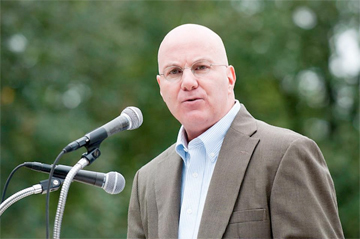
Joseph Ross, a D.C. poet, teacher and activist, is the next in HoCoPoLitSo’s line of illustrious writers-in-residence, which have included Lucille Clifton, Jean Nordhaus, Michael Dirda, Roland Flint and Michael Glaser.
Ross, the author of Meeting Bone Man (2012) and Gospel of Dust (2013), won the 2012 Pratt Library and Little Patuxent Review poetry contest with his poem, “If Mamie Till Was the Mother of God.”
That winning poem touches on a theme that runs through Ross’s poetry — personalizing injustice. Many of Ross’s poems give a name and face to outrages like Darfur genocide, Civil Rights outrages, Gettysburg body counts, political kidnappings in Brazil. Ross also writes about Tupac Shakur, Cool Disco Dan (the graffiti artist who sprinkled D.C.’s walls in audacious letters), his veteran father and even Buddha.
“What makes Ross stand out is (more…)
From Banned Books to All Time Faves, What Teachers are Teaching This Year:
It’s a new school year, and we asked teachers around Howard County and professors at Howard Community College what they are most looking forward to teaching and why. Here is what they said:
Catherine M. Mundy (Lime Kiln Middle) says,  I am looking forward to teaching House of the Scorpion with my 8th graders […] because it is a perfect example of “science fiction” becoming “fact”. I love reading literature that is NOW – that students can relate to. […] Another novel I am looking forward to teaching is The Giver. While most teachers cover it in our science fiction unit, I am choosing to teach it during our Freedom Unit as an extension of the concept of freedom. The issues of social control and mind control are so pertinent in our world today – especially as you look at countries that face dictatorial control. It is a great novel to discuss the importance of being educated and having an education and not always accepting what is told or taught to you at face value. This compelling story shows that knowledge can be difficult, but “ignorance is bliss” is truly not the way to go. Living and learning through experience, regardless of how difficult, is what life is. Those experiences that individuals in a free society are allowed to have are what make us human. I guess I would be remiss in not mentioning studying Shakespeare’s Romeo and Juliet. I love showing my students that the human condition and human issues, emotions, and struggles haven’t changed much over hundreds of years.
Laarni C. Lucero (Long Reach High) says, I can’t wait to teach Fahrenheit 451. I love to see my students turn a critical eye on the media environment they’re immersed in.
Rita Guida (Howard Community College) says, I have two books that I really look forward to teaching. I teach A Thousand Splendid Suns by Khaled Hosseini in Ethics in Literature, and I have been delighted with students’ reactions. Because it takes place in Afghanistan, it works to humanize people that we frequently see only as enemies. It provides an opportunity to introduce the sad history of the country and their own oppression. Hosseini’s use of female bonding reminds readers of the sacredness of family in every culture, and he has included heroic male characters as well as female characters. The other book that I love is the Poisonwood Bible by Barbara Kingsolver. I use this in By and About Women, and like A Thousand Splendid Suns, it educates students on life in a country often in the news: the Congo. It also provides an opportunity to explore the oppression of the region, and the five, distinct female narrators show varying reactions to the events that occur as the Congo seeks to become independent.
Stacy Korbelak (Howard Community College) says, I’m looking forward to teaching the play Ruined by Lynn Nottage which highlights human rights issues in the Democratic Republic of Congo. I’m excited that it will be coming to the stage at the Everyman Theatre in the spring, too.
Rick Leith (Howard Community College) says, Fahrenheit 451 because it’s still so timely; Bradbury said this book is about television taking over our culture, not censorship, and this is something the students can relate to and discuss especially considering that television is only one of many distractions driving students away from reading in today’s world. Censorship remains a valid theme, however, so I’m also using the novel as an introduction to our Banned Books Week observance.
Bradbury’s best-known work, Fahrenheit 451, published in 1953, became an instant classic in the era of McCarthyism for its exploration of themes of censorship and conformity. In 2007, Bradbury himself disputed that censorship was the main theme of Fahrenheit 451, instead explaining the book as a story about how television drives away interest in reading: “Television gives you the dates of Napoleon, but not who he was.” (www.biography.com)
Ryna May (Howard Community College) says, I am most looking forward to teaching Hamlet this fall. I love this play because I hope that students will come to see Hamlet as someone similar to themselves: a college student, a son, a friend, etc. He has powerful influences all around him demanding that he do certain things and act certain ways, but in the end, he realizes that he, and only he, is responsible for the choices in his life. And for better or worse, he embraces that. I also love Hamlet because I feel like I am still a student of this play, and even though I’ve read it many times, my students always help me see something new.
Elisa Roberson (Howard Community College) says, I enjoy teaching Antigone by Sophocles to the Ethics in Lit class because of the 180 degree change I get from students’ initial reaction and their reaction after reading the play. At the beginning of the semester I hold up the book during our discussion of course materials and I always get a response of rolled eyes or looks of disinterest. When I ask students if anyone has read anything written by Sophocles the response is this…cricket, cricket, cricket. When I ask if anyone knows who he was I get half-hearted replies involving the words “Greek, dead, and philosophy.” By the end of the play, the students are excited about the characters, defend the choices of different characters, and identify with character motivations. Once they’ve learned about the backstory of Antigone and the rest of the cast, the students cannot get enough. I’ve had more than one student say, “This play is better than anything on reality TV. It’s got love, death, betrayal…”
What are you teaching?
We’d love to hear in the comments below….
 HoCoPoLitSo