Home » Guest post » Mana’s Musings (Page 2)
Category Archives: Mana’s Musings


mana’s musings: celebrating marilyn chin on international women’s day
a blog post by Laura Yoo
It was my very first visit to the famous Dodge Poetry Festival. It was Saturday, October 22nd in 2016, right around 7:15 in the evening. There stood on this enormous stage at the New Jersey Performing Arts Center a petite Asian woman, speaking with a slight accent and a lot of voice. She read her poem, “One Child Has Brown Eyes.” First I googled “vacuity.” Then, I was mesmerized. Also on stage were poets like Martin Espada, Robert Haas, Claudia Rankine, and Jane Hirshfield, but it was Marilyn Chin who spoke to me that night. She was smart, powerful, and funny – and she looked like me.
Ever since getting a serious high on Macbeth in high school, I’ve been studying and loving English literature. In college, I chose all of my electives to be in English literature, and I studied abroad in England to nerd it up with Shakespeare and Jane Austen – and to drink a lot of beer. My area of study was eighteenth-century British literature (which even other English majors didn’t want to touch) so I can say for sure there were no likes of Marilyn Chin in my curriculum. In the last 10 years, thanks to HoCoPoLitSo, I’ve met many wonderful writers and poets, and among them a few Asian American writers, too. But the poet embodied and represented by Marilyn Chin was something new for me.
See, I always wanted to be like Sandra Oh’s character in Grey’s Anatomy, someone who wasn’t on the show to play Asian. She was just another doctor, who happened to be Asian. Her name wasn’t Johnson or Smith. Her name was Cristina Yang, best friend to the main character, but the “Yang” part did not define her character. Sandra Oh, who is Korean-Canadian, plays this “best friend” role also in Sideways and Under the Tuscan Sun. In both of these movies, she is just the best friend, not the Asian best friend. I applauded these characters. Yes! Finally! Asian people are just people! In retrospect, however, I am seeing that in some ways this is denial, a kind of self-imposed erasure. Yes, it hurts to be locked inside the limits of stereotypes, but it also hurts to deny my self from myself in an apparent fight against such stereotypes. At this point, I can hear a frustrated voice saying to me, “What do you want, then? You want Cristina Yang to be Korean or not?” Well, I think I want Cristina Yang to be her self, all of the things that she is.
Recently a Korean-American writer, Mary H.K. Choi, posted this:
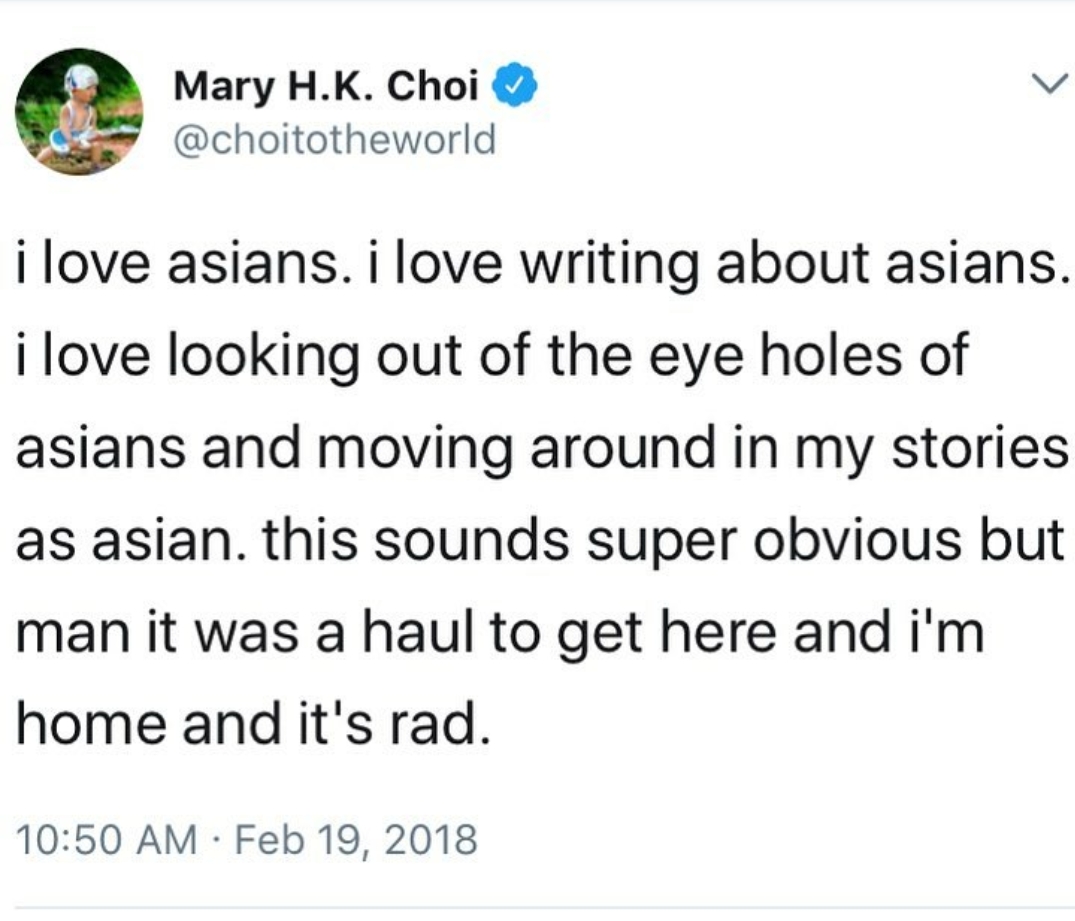
From this post, I suspect that, like me, Ms. Choi has been struggling – maybe unbeknownst to her – with her relationship to the Korean part of her “Korean-American” identity. So, I have been thinking about my own going home (or coming home) and how art helps me on that journey. A great example of such art is Ms. Chin’s novel, Revenge of the Mooncake Vixen, which Sandra Cisneros called “bad ass,” Maxine Hong Kingston “What fun!” and Gish Jen “Deeply provocative and deeply Chinese.” The story of two Chinese girls growing up in California focuses very much on their grandmother’s voice and legacy, weaving 41 separate stories together into what Ms. Chin calls a “manifesto.” The story is magical, mythical, and yet so very painfully and beautifully real. The opening story is heartbreaking, shocking, and ultimately triumphant.
Ms. Chin’s poem, “How I Got My Name: An Essay on Assimilation,” is another good example. It starts like this:
I am Marilyn Mei Ling Chin
Oh, how I love the resoluteness
of that first person singular
followed by that stalwart indicative
of “be,” without the uncertain i-n-g
of “becoming.” Of course,
the name had been changed
somewhere between Angel Island and the sea,
when my father the paperson
in the late 1950s
obsessed with a bombshell blond
transliterated “Mei Ling” to “Marilyn.”
And nobody dared question
his initial impulse—for we all know
lust drove men to greatness,
not goodness, not decency.
And there I was, a wayward pink baby,
named after some tragic white woman
swollen with gin and Nembutal.
My mother couldn’t pronounce the “r.”
The assimilation happens with the choosing of an “American name.” I am also named after a white woman, Laura Ingalls Wilder, but more accurately the character Laura Ingalls on Little House on the Prairie the TV show. My mom had watched this show in Korea and loved the character. This custom is seen as practical as it is difficult for Americans to pronounce Korean names. Luckily, my family – like most Korean people – also could not pronounce the “r” and has always called me Yoonji, by my real name. Now, my little sons hear my mom calling me Yoonji and once in awhile, very quietly, they test it out in a kind of whisper “Yoonji” and then giggle. It’s like they’re wondering, “Who is this Yoonji? She’s like a whole another person from my mom who is Laura.” Maybe so. Maybe not. All of this, of course, is not to deny the name Laura, which my mom gave me and therefore an important part of my identity. Besides, it’s a beautiful name. But it’s complicated, you see.
I know it sounds cliche to say this, but Ms. Chin’s poetry, novel, and her performances have raised my awareness. No, it did not happen like a bolt of lightning or anything that dramatic, but rather like a gradual stewing and simmering in this idea about who I am and what I am. So, on this International Women’s Day, I want to thank her for being on that stage on that day at Dodge Poetry Festival to help me widen the way I might think about my cultural identities.
I am ecstatic that I will have another chance to meet Ms. Chin and maybe – if I have the guts – thank her in person on April 26th when she reads at the Blackbird Poetry Festival at Howard Community College. Read more about Marilyn Chin’s visit here.

Laura Yoo
HoCoPoLitSo Board member and Professor of English at Howard Community College.
mana’s musings: Step Aside, Ambien! Here comes Dr. Seuss’s Sleep Book!
Laura Yoo
HoCoPoLitSo Board member and Professor of English at Howard Community College.
A blog post by Laura Yoo
I did not grow up with Dr. Seuss because by the time I came to the United States from Korea, I was already 10 years old and my parents certainly didn’t know who Dr. Seuss was. That’s right. I had a Seuss-less childhood.
It was when I was in high school and doing a lot of babysitting that I came across Dr. Seuss. The children just loved his books, almost as much as they enjoyed watching Disney movies. I learned quickly that Cat in the Hat and Green Eggs and Ham were some of the kids’ favorites. As a 15 year old, I didn’t see the real value of these books, of course. They were just fun.
Now as a mom to young children, a teacher of writing, and a human fascinated by language and literature, I have a whole new appreciation for Dr. Seuss. Hop on Pop, The Lorax, The Cat in the Hat, and Green Eggs and Ham are probably some of the most popular of Dr. Seuss’s books. My own two boys say Fox in Socks and One Fish Two Fish Red Fish Blue Fish are their two favorites.
While all these are wonderful stories, my personal favorite is Dr. Seuss’s Sleep Book. This is the book that truly showcases Dr. Seuss’s genius.
Oh boy, does it work. Try to stifle the yawn while you read it. You can’t do it. At least half way through, someone – you or one of the little listeners – will yawn. And once that first yawn comes out, there’s no stopping the flood of yawns to come. As Dr. Seuss says: “A yawn is quite catching, you see. Like a cough.” Turns out – just reading the word “yawn” or seeing illustrations of creatures yawning will make you yawn. That’s how powerful a yawn is.
So, by the time you reach the end of the book to read “When you put out your light, / Then the number will be / Ninety-nine zillion / Nine trillion and three” I swear the little ones look sleepy – and I am also sleepy.
And this is one of the many magical powers of Dr. Seuss. Yes, the silly names, the nonsense words, and the insane rhymes are so fun to read. Yes, the books have valuable life lessons. In addition to all that, it will help your kids go to sleep. Now, if he had just written a book called Dr. Seuss’s Clean Up Your Room Book…
Happy Dr. Seuss Day!

what are libraries for?
Laura Yoo
HoCoPoLitSo Board member and Associate Professor of English at Howard Community College.
Many, many things.
This past week, we celebrated the National Friends of Libraries Week and these wonderful folks shared their memories of libraries and what the library means to them. Thanks to Tara, Darby, Sandra, Susan, Jocelyn, Sharon, Kristine, Ale, Liz, Annette, Trudie, Kaitlyn, and Lorraine for sharing your memories with all of us. In these stories, we see that the library is a place that offered solace, growth, independence, and of course knowledge for many.
My parents, immigrants from Korea, also found comfort at the Central Library in Columbia because they could borrow Korean books there. For them, borrowing these books allowed them to remember and connect with their homeland. For me, it was a place where I could continue my journey to becoming proficient in English. I devoured the Nancy Drew books, the Hardy Boys books, The Babysitters’ Club, and the Boxcar Children. I also borrowed many cassette tapes and later CDs of Debbie Gibson, Tiffany, Sheena Easton, and the New Kids on the Block. We borrowed movies. The library granted access to these materials – books, CDs, and movies – that were otherwise not available to me.
But it’s not just these things that the library gives us. It’s also the space it provides. When the time came for me to study for the SATs, I went to the Central Library to study. When I needed a computer, I went to the library. Many years later, when I had to study for the GREs, I went there to study in one of the study carrels on the second floor of the Central Library. Now, I take my own children there to borrow books, trying to hunt down the elusive and long-awaited copy of a Diary of a Wimpy Kid, and to sign up for summer reading programs. When we are about to go on a long road trip, we go there to borrow DVDs.
The library may have changed over the years to keep up with the changing times, especially with the changes in technology. Still, the library continues to provide space and access that many of us need and crave.
Read on to see what the library has meant for so many of us.
I have vivid memories of my small hometown library in the 1970s and can recall every section, specific places where favorite books lived, the smells of leather and hot mimeographed paper, even the words on the tiny bathroom wall.
– Tara
My love of books was born when I was a child, and to me, going into a library conjures up memories of me, twelve years old, digging through bookshelves for something new to feed my imagination. I remember the somehow comforting strain of trying to get my arms around a large stack of books, and the feeling of resting my chin on top of the stack as I hauled it to the front desk. Even today as a college student, I feel peaceful in a library, and standing between shelves, surrounded by old books, is something wonderful to me.
– Darby J.
In fifth grade summer, shortly after we immigrated to the States in the early 90s, my parents decided this summer break thing, unheard of in South Korea, was ridiculous. They dropped my younger sister and me off at the White Oak library in the morning and picked us up close to dinner time every single working days of the week for a while (around the third day or so, they decided we should have lunch and packed us something to eat). We did EVERYTHING in that children’s section in the library from eating, napping, getting to know the two very lazy hamsters we saw for the first time in our life, learning checkers from strangers to list a few. We didn’t speak or read much English at all, so when we discovered comic books, it was as if we had uncovered hidden treasures. There were two kinds, Garfield and Calvin and Hobbes. Naturally, we went with shorter plots, bigger letters, and easier expressions to guess (his eyes said it all): Garfield. I hadn’t realized then, but I was living a dream. As an English professor now, how I wish I could just roll around on the library floor without a care, rummaging through shelves after shelves and chatting away with my sister as if we were the only two in the world.
– Sandra Lee
I would visit our community public library everyday because it was the midpoint between my junior high school and my sister’s elementary school. We spent hours reading in the quiet corners of the library! I believe that my love for reading was fostered by my parents and the wonderful librarians.
– Susan Y. Williams
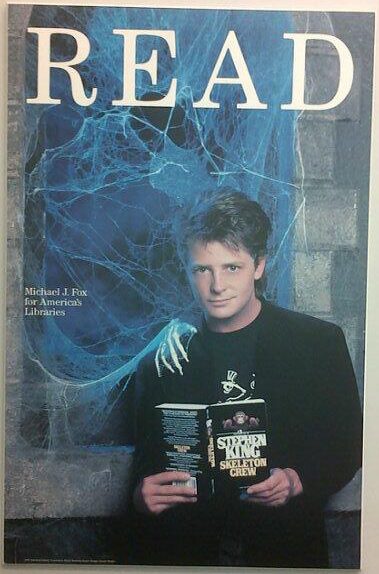 There was this feeling of a borderland for me as a young teenager in the library. I was able to be older, to be smarter somehow among the stacks. A Stephen King READ poster, a microfiche machine, a wide staircase, and low windows brushed with leaves. In the library, I was studious in wooden study carols, while the names of the Grateful Dead danced in my sight line, etched in pen years ago. In the library, I did my research with the help of those titans of knowledge behind the tall desks, their faces blooming with joy at my questions. In the library, I saw homeless men sit and read the newspapers with dignity. In the library, I saw my life stretch out before me, echoed over time, echoed under the hanging lights, layers of books and memories forever in the same borderlands of my old heart today.
– Jocelyn Hieatzman
1. My childhood library was a big stone building with stone lions guarding the front door. It made the institution impressive and important . As a child, we couldn’t borrow “adult” books, and it seemed like they must hold some secret knowledge. 2. The bookmobile came to our neighborhood every Monday afternoon. We were allowed to take 7 books, and it was air-conditioned. It was the 1960’s.
– Sharon O’Neill
I love the library. It’s a quiet place to work or explore new authors! I love the creativity with displays.
– Kristine
I moved to the United States when I was 13 years old. In Mexico libraries were not an everyday thing for me. If we went, they were usually surrounded by homeless people or too far from our home. However, once I moved to the U.S, libraries became my escape from a place I did not understand. At first I hated the library. Mostly because of my limited English and low reading level. I felt embarrassed when my teacher told me all I could read were elementary level books. It wasn’t until a lunch monitor saw me with one these books, The Ugly Duckling, that I learned the value of reading. She told me that the fastest and best way to improve my pronunciation and understanding was by reading out-loud to myself. After that day, I visited the public library and read as much as I could. I read through all the R.L Stine, Goosebumps, romances, mysteries, and many others until I was finally able to challenge myself and read the Harry Potter series. Thanks to the welcoming environment of my public and school libraries, I went from reading picture books at the age of 13 to 1000 pg Stephen King books by the time I was 16.
– Ale M.
I grew up in Ellicott City, MD, so I went to the (old) Miller Branch library when I was young quite often. My first memories are borrowing toys from the kids’ section, which was directly to your right when you entered the library. My mom loved that she could borrow toys for my sister and me since kids can be so fickle; I’m sure my family saved a lot of money by not having to buy us as many toys! In elementary school, I remember creating my own fantasy story about the small enclosed garden area directly across from the circulation desk (although I don’t remember what the story was now). In middle school, R.L. Stine novels engrossed me. I remember spending many weekends searching through the R.L. Stine books directly to the left when you entered the library, at the back. I also bought some of his books from the area to the left of the circulation desk at something like 25 or 50 cents per book. I loved that I had enough money to buy my own books! I didn’t care that they had clearly been read many times before. Finally, I remember doing a couple of research projects at Miller Branch and Central Branch. Unfortunately, I moved to another state before high school started and didn’t have such a fabulous library nearby anymore. I’m so glad to be back in Howard County with a renovated Miller Branch and an almost-ready renovated Elkridge branch within walking distance of my new house!
– Liz Campbell

the old Miller Branch library in Ellicott City, MD
Every Saturday when I was growing up, my dad and I would drop my mother off at the grocery store and walk over to the Randallstown Branch of BCPL which was in the same parking lot. While she shopped, my father and I would return the books we signed out the week before and take out new ones. We would walk back to the store and find my mom in one of the aisles and help her finish up. This is one of the fondest memories of my childhood and I remember many wonderful chats with my dad before curling up in an easy chair to read my newest treasures!
– Annette Kuperman
When I was a little girl, I lived in a small blue collar town just north (on the mainland) of Galveston, Texas. Hitchcock had a grocery store, a small bank, a doughnut shop, Mr. Charburger, a drug store and some other small local businesses! We also had a book mobile every three weeks or so, that parked in the bank’s parking lot. A large trailer with books, books and more books! I didn’t even know “libraries” existed, until one day Mother took all of us four little girls to Galveston Island to THE library. It was beautiful; with what I remember to be massive, dark-stained, ornate rails leading up the many steps to the magnificent entryway of the building. And books! Who knew there were that many books in the world? What pure, giddy joy I felt that day.
– Trudie Myers
When I was in late elementary school, I loved going to the Central Library with my mom. I loved the weird shape of the building and the nooks and crannies of the library. The library was also the first space I was allowed to be “alone” in a public space. I would look for my books while my mom would look for hers. We would meet at the check out line, her with her reasonable amount of books and me struggling to balance a stack that piled to my nose.
– Kaitlyn Curtis
I remember the Book Mobile routinely coming through our military Navy Housing in Bremerton, WA when I was in 6th grade. My two younger brothers and I so looked forward to the Book Mobile! It was such a different experience to walk-in to a library on wheels. It was a pleasurable experience I will not forget.
– Lorraine
mana’s musings: national read a book day 2017

Laura Yoo
HoCoPoLitSo Board member and Professor of English at Howard Community College.
Today – September 6th – is National Read a Book Day. And on this occasion, I’m sharing with you 30 books that changed me.
These are the books that exposed me to new things (like about racial passing in Nella Larsen’s Passing), changed the way I felt about a subject or what I knew about the subject (like about death and dying in Ann Lamott’s Hard Laughter), or seemed to push the conventions of literature (like the way Laurence Stern’s Tristram Shandy experiments with structure and narrative voice). These are the books that made me say, “What? A book a can do THAT?!?!”
For most of these works, though, I don’t remember the exact plot or the details that made them so impressive. For some of these books, I bet the timing was what mattered. When I read Crime and Punishment, for example, it was right after high school. And I read it for fun. I think I was pretty proud of myself for reading a Dostoevsky for leisure. That made me an official adult.
Though I don’t remember the details, I remember the sensation. I remember the sense of awe inspired by Waiting for Godot and The Unbearable Lightness of Being. These books blew me away with their deep investigations of humans – about who we are, what we want, what we believe, what we lack, and what we could be (both beautiful and hideous).
I remember feeling very grown up after reading books like The Laramie Project and Middlesex. These books introduced me to the things that happen in the world to real people that I might otherwise have been shielded from.
I remember feeling envious when reading works like Playing in the Dark and Between the World and Me. These are the books that showed me what a human mind can think through and what a human mind can then articulate into language. The envy comes from recognizing these writers’ genius as well as the fact that I will never achieve that.
I remember the labor that went into studying Paradise Lost and Macbeth. So much to excavate and discover – again and again – in pouring over works like those. And the sense of accomplishment that comes from cracking the code in some small way to understand the text.
I also remember specific lines from these books that stay with me. Like “There is no story that is not true” from Thing Fall Apart. Like “A true war story, if truly told, makes the stomach believe” from The Things They Carried. And these unforgettable words: “Let me imagine … what would have happened had Shakespeare had a wonderfully gifted sister, called Judith, let us say” from A Room of One’s Own – and I never forgot about Judith Shakespeare.
Oh, and of course – I remember the laughing and the crying. Really laughing out loud while reading Me Talk Pretty One Day. And really sobbing while reading The Kite Runner.
My literature students are writing this week about why we read and study literature. As for me, I read because I want to be changed. Even in some small way. By the time I read the last page of the book I want to feel a little different and be a little better than when I started the book.
Why do you read?
black nature – a reading for earth day and national poetry month
By Laura Yoo
April is National Poetry Month, and Saturday, April 22nd is Earth Day. And I have a book recommendation that can help celebrate both: Black Nature: Four Centuries of African American Nature edited by Camille T. Dungy.

Black Nature edited by Camille T. Dungy is edited by .
Black Nature offers a different perspective through which we might read, understand, and talk about the 93 black poets and their 180 poems included in this anthology. Dungy writes a compelling introduction in which she describes the noticeable absence of black writers from anthologies and discussions in ecocriticism and ecopoetics. She reminds us of the complex and unique connection that African Americans have to “land, animal, and vegetation in American culture”.
Despite all these connections to America’s soil, we don’t see much African American poetry in nature-related anthologies because, regardless of their presence, blacks have not been recognized in their poetic attempts to affix themselves to the landscape. They haven’t been seen, or when they have it is not as people who are rightful stewards of the land. They are accidentally or invisibly or dangerously or temporarily or inappropriately on/in the landscape. The majority of the works in this collection incorporate treatments of the natural world that are historicized or politicized and are expressed through the African American perspective, which inclines readers to consider these texts as political poems, historical poems, protest poems, socioeconomic commentary, anything but nature poems.
I want to test this new perspective, and with this in mind I turn to the poetry of Tyehimba Jess, the newly minted 2017 Pulitzer Prize in Poetry winner, who is coming to headline HoCoPoLitSo and Howard Community College’s annual Blackbird Poetry Festival on Thursday, April 27th. He will be reading and speaking with E. Ethelbert Miller during the Sunbird Reading. Notably, Miller’s “I am Black and the Trees are Green” is included in Dungy’s anthology.
Much of Jess’s acclaimed body of work illuminates on the African American experience. About Olio, Wave Books says, “Part fact, part fiction, Jess’s much anticipated second book weaves sonnet, song, and narrative to examine the lives of mostly unrecorded African American performers directly before and after the Civil War up to World War I.”
In an interview with LitHub about Olio, Jess spoke about the power and the politics of song: “To be able to sing under that kind of oppression I think, in a lot of ways, is the very essence of survival, of a people, of the ability to have to the hope to make something beautiful amongst so much wretchedness. That’s critical to the concept of human survival. And in this particular context, of African Americans working through slavery… that’s what we had.”
But in the context of Dungy’s Black Nature, I turn to Jess’s leadbelly with a different ear.
In “john wesley ledbetter,” Jess writes,
singing a crusade of axe and machete i take virgin texas territory by force, clear it of timber and trouble. each eastern twilight, i till top soil ’til sun plants itself back into that western horizon. i keep struggling against a brooding moon’s skyline until dark sleep is my friend again, a place where i can dream drought into rain, pray storm could out of spotless sky.
The poem goes on with, “there’s only one way out of slave time dues: hump this land down till it shrieks up a crop of cancelled debt into your wagon.” In this poem, we see an illustration of what Dungy describes as African Americans’ “complex relationship to land, animals, and vegetation.” She says, “African Americans are tied up in the toil and soil involved in working the land into the country we know today,” and she reminds us how they were “viewed once as chattel, part of a farm’s livestock or asset in a bank’s ledger.”
In “leadbelly: runagate,” Jess writes,
where water and land meet is shore, and on shore is iron in fists of jailers in sun of texas swamp. i wade into bubble and blue ink of red river, my head is shaven, bobbing, brown island of shine. […]
i want to let the water take me, i want to surrender to this river’s rock and swirl, come up clean and white as death itself, but the black in me breaks into blues, and i feel the coffle of their claws. i am stepping toward dry land, the dance of ankle chains, where i scream history into song that works itself into blood, sweat, memory.
The water in this poem reminds me of Dungy’s description of the “river” in Rita Dove’s “Three Days of forest, a River, Free”: it is “more than a moving body of water. It is a biblical allusion, a historical reality, a geographical boundary, a legal boundary, a decoy, the center of emotional and personal change, an aspiration, a metaphor: all these things at once.”

Tyehimba Jess’s leadbelly
As I re-see the poems in leadbelly with a different framework, I am reminded how the way we group, categorize, thematically arrange, and shelf literature can limit or expand our experiences of literature. We put the poems under one category or another, and it’s hard to imagine what else it can be.
Dungy’s Black Nature is important, because it acknowledges the African American perspective these 93 poets highlight while introducing what else their work is – and how that “what else” amplifies our understanding of their works. As Dungy says, Black Nature “encourage[s] readers to divert their gaze into new directions, demanding they notice new aspects of the world and accept alternative modes of description.”
To put it another way, a book like Black Nature is like a hearing aid. It can give us that extra power to hear poetry in an even more powerful way. It can help us turn up the volume on that work – perhaps turn up the bass or the treble and experience the poem in a myriad of ways.
Laura Yoo
HoCoPoLitSo Board member and Associate Professor of English at Howard Community College.
mana’s musings: poetry-binge at dodge poetry festival 2016
Laura Yoo
HoCoPoLitSo Board member and Associate Professor of English at Howard Community College.
It was my first time. I was nervous. I was excited. I felt better that a friend was going to be there with me the whole time, a friend who had done it before.
My first Dodge Poetry Festival.
I had two goals and I had 24 hours (if I didn’t sleep) to achieve them. First, hear Claudia Rankine, my new literary hero whose formidable poetic and intellectual power show us what a real-life super hero looks like. Move over, Captain America! Second, discover one new poet – someone I’ve never read or heard
The first event I attended was called “American Poetries” with Brenda Hillman, Khaled Mattawa, Claudia Rankine, and Anne Waldman – all Chancellors of Academy of American Poets. While I would have loved to hear these poets read from their own impressive repertoire of works, it was also wonderful to hear the poems they’re reading and who they recommend for us to discover.
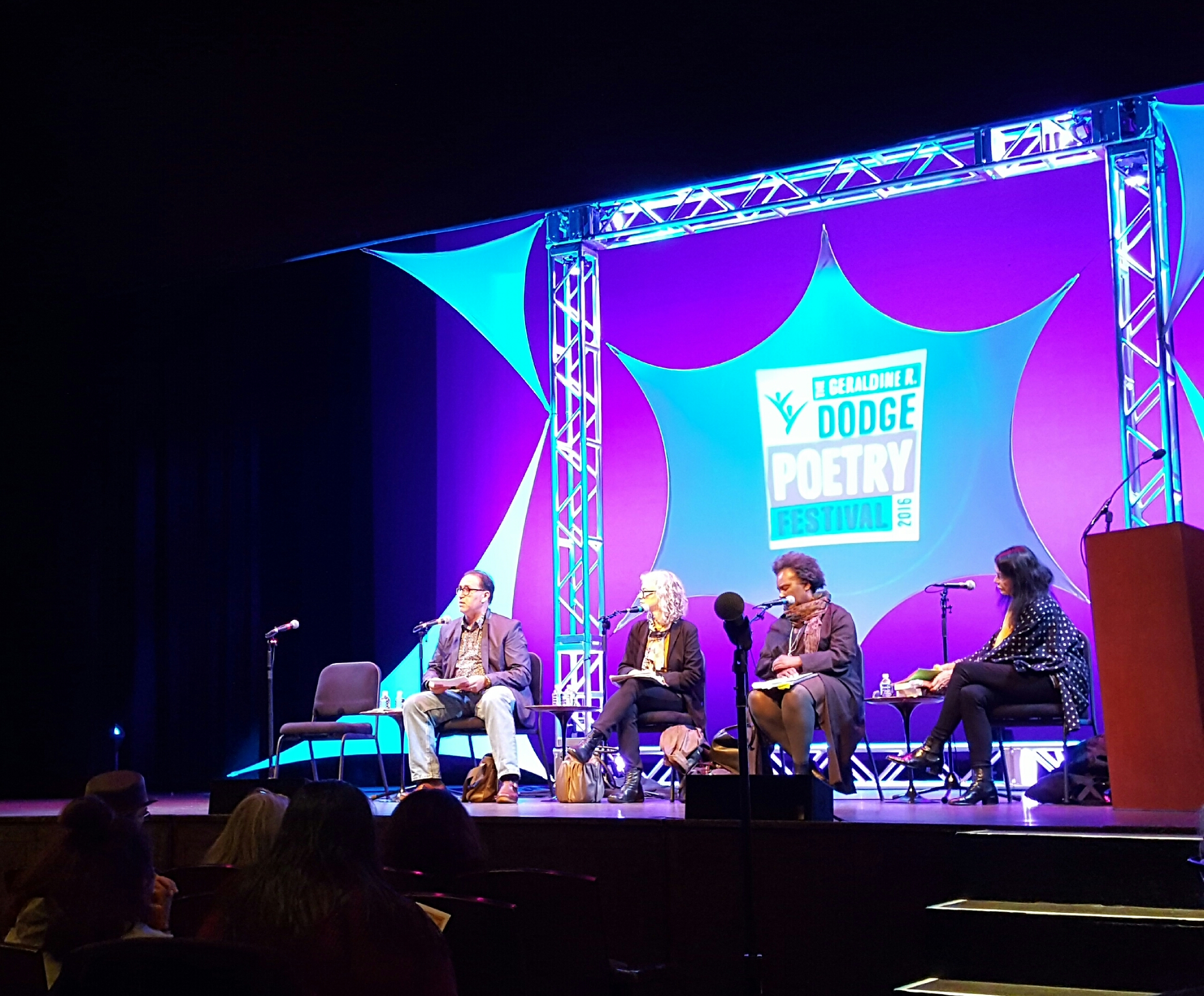
from the left – Khaled Mattawa, Brenda Hillman, Claudia Rankine, Anne Waldman
Khaled Mattawa read a poem by Hayan Charara called “Animals,” a haunting story about the violence we commit against each other. The poem, Mattawa reminded us, exposes the horrors that we’re not allowed to speak of. I immediately ordered a copy of Charara’s book, Something Sinister.
Claudia Rankine told us about a poet named Mark Nowak and his book, Shut Up Shut Down. In referring to Nowak, Rankine brought to the foreground a voice that is sometimes ignored in our discussions about race – the working white class. This voice is essential to Rankine’s new project of studying whiteness.
Much of this forum’s discussion on “America’s Poetries” highlighted the diversity of voices, experiences, and perspectives. The takeaway for me was that poets feel a deep sense of responsibility in their roles not only as artists but also as people who speak for, about, and on behalf of American lives. Their poetry gives us language with which we can speak of our world in ways that are creative and enlightening.
That evening, I experienced one of the most special poetry performances I’ve ever attended at “Poetry like Bread – Poems of Social and Political Consciousness.” The lineup included Marilyn Chin, Robert Hass, Martín Espada, Juan Felipe Herrera, Brenda Hillman, Claudia Rankine, Vijay Seshadri, and Gary Snyder. I know, right? Yes, let that list sink in.
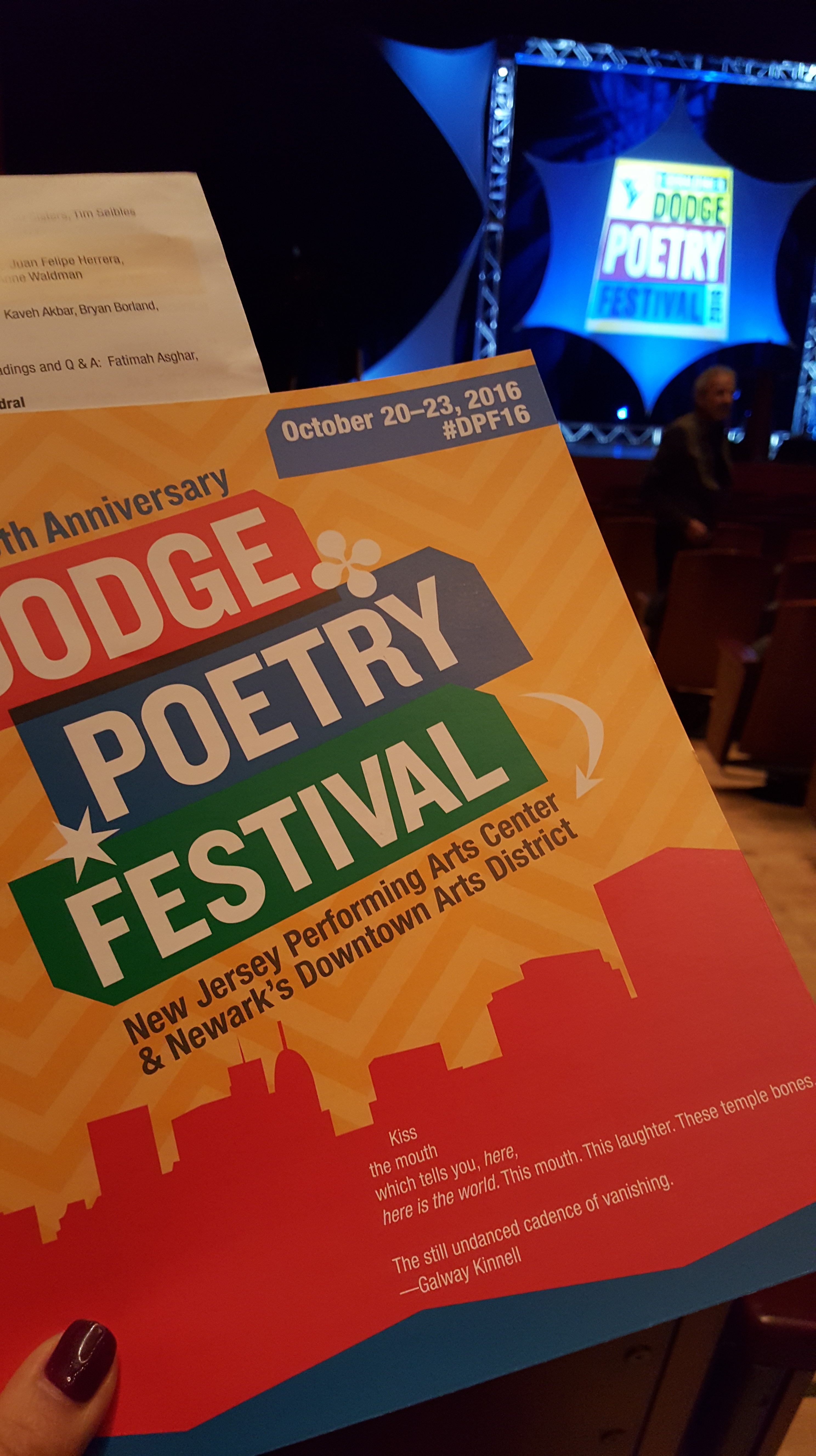 I rediscovered Robert Hass. Though I had read his works and studied them in school, experiencing his poetry live on stage sparked a new interest. His reading of what can only be called an epic poem titled “Dancing” – about human history of violence and weapons – brought people to a standing ovation.
That same evening, I discovered Marilyn Chin. I don’t know many poets who look like me – an Asian American woman. And there is something powerful about seeing someone who looks like you speaking of an experience, a perspective, a history, a family, or a value that you are personally familiar with. She is a cool performer with a bit of an attitude and spunk. I like that.
So within hours of arriving at the festival, I met both of my goals.
But it’s not just the poets and the poetry that made this overnight trip to Newark deeply moving. Conversations with my friend about language, education, art, race, politics – those conversations had me doing mental gymnastics. My ideas were both validated and challenged. My mind stretched.
I learned that the community of poets and poetry is a thing of beauty and power. Dodge got me hooked. I can’t wait to go back in two years.
mana’s musing: where the wilde things are
Laura Yoo is a HoCoPoLitSo Board member and Associate Professor of English at Howard Community College.
This is a story of a prodigal daughter.
At the beginning of the summer, I made big plans. A long list of books I wanted to read. Big goals. Ambitious. I would read, read, and read some more. I had books to read. And I had the time to read them.
Instead, all through July and August, I watched TV. A lot of it. Game of Thrones, Orange is the New Black, Stranger Things, Master Chef, and endless episodes of Chopped. And all these hours that were committed to watching means I haven’t been reading. There is the still-not-finished Fates and Furies on my night stand. I’m about 50 pages into Wilde Lake by Laura Lippman. Though Pride and Prejudice and Zombies intrigued me at the bookstore, I haven’t even opened it yet. Though I made good progress on Claudia Rankin’s Citizen: An American Lyric, it is not finished. (Though, you might argue, one simply does not plow through a work like Citizen.)
This summer, the room we call the “reading room” in my house was used to get away from the children to watch stuff on Netflix on my tablet with earphones shoved into my ears.
I am ashamed. Fail. Major fail.
So, clearly, I needed help.
And help came on September 13th in the form of a very wild Wilde Reading. Organized by Laura Shovan, Ann Bracken, and LindaJoy Burke, Wilde Readings launched its first open mic night with featured readers Jen Grow and Le Hinton. An audience of about 30 gathered in one of the art studio spaces at the Columbia Art Center, the same space where my son had art summer camp. It was comfortable, friendly, and intimate.
As Laura told us, though there are many wonderful literary organizations, publications, and events in Howard County, a place for writers to come together and share freely and informally had been lacking for many years. And Wilde Reading’s inaugural event demonstrated the very reason such gatherings are needed: it created a collage of unique, diverse literary voices. Each time a reader went up to the podium, you just didn’t know what you were gonna get.
Jen Grow’s short story about a daughter and her dying mother just about killed me. Before she read, Jen promised to go for the jugular – her words – and she didn’t miss. I was relieved and astonished at the same time when Jen ended by reassuring us that her mother is still living, that the story is indeed fictional. I thought, how can one create a story like that – so moving, so real, and so visceral – without actually having lived it? Even if one had experienced it, telling it in such a powerful way would be a difficult task. I suppose that’s why poets are artists, creators.
Le Hinton’s reading was enhanced by a tactile experience he created for the audience. He passed around cotton blooms for us to feel between our fingers while he read his poems on the motif of cotton. When he read an autobiographical poem about doing math lessons with his father, he passed around Tootsie Rolls for us to enjoy. The taste of chocolate in our mouths transported us to that room with that little boy, his father, math lessons, and Tootsie Rolls for reward.
The open mic readers included Jan Bowman and Michael Ratcliffe, two writers who will be featured in future Wilde Reading events. The open mic evening ended with a powerful performance by Analysis the Poet.
While the voices of the evening were divergent and their subject matter so varied, together these writer-performers created a one-of-kind literary sound. And that sound, that experience can never be recreated again. I feel lucky to have been there to witness it.
This Wilde Reading invited me back to the written word. It pushed me around a bit – from one emotion to another and yet another – and left me wanting more. And more I shall get – on October 4th with Jan Bowman and Derrick Weston Brown as featured readers at the second Wilde Reading.
Inspired by this Wilde Reading, I did something different today. During my son’s 45-minute swim practice, instead of browsing my Facebook page or taking quizzes on Buzzfeed, I opened a book: Roxanne Gay’s Bad Feminist. And I’m in love with the written word again.
Thank you, Wilde, for welcoming back this prodigal daughter.
mana’s musing: unfolding the mystery with Jean Sonntag
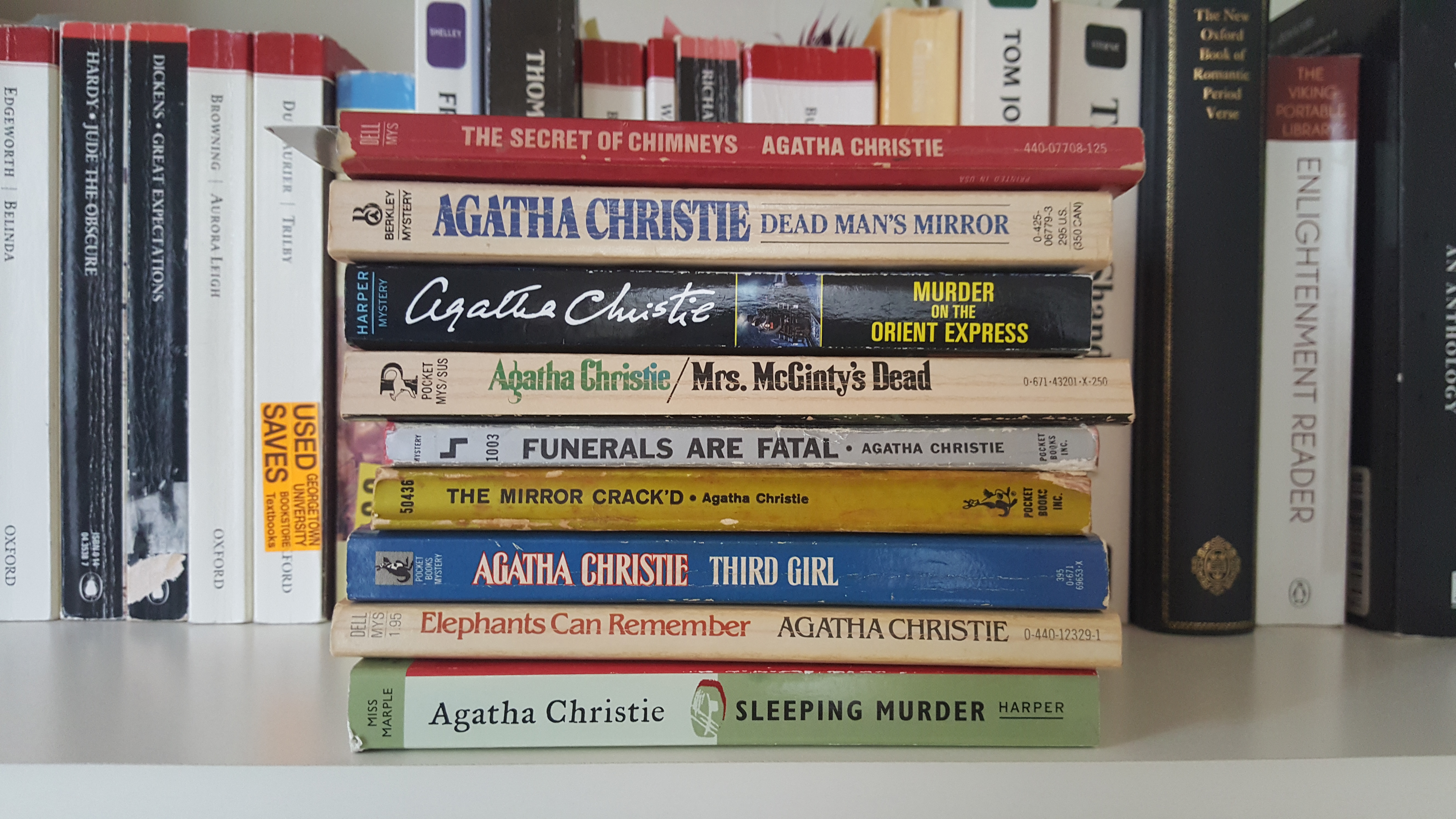 During my last visit to Antique Depot in Old Ellicott City (if you’ve been reading this blog, you know I LOVE this place), I picked up several paperback copies of Agatha Christie’s mysteries.
My memories of reading Agatha Christie are also memories of growing up. On my parents’ bookshelves, I found Korean novels, histories, and poetry. But also there were the classics like Dostoevsky and Don Quixote as well as detective novels by Agatha Christie and thrillers by Sidney Sheldon. All in Korean. In middle school, I read my first Christie, And Then There Were None, in Korean.
So it was with a bit of nostalgia that I began reading The Secret of Chimneys, one of my finds at Antique Depot. Right away I noticed in her writing something dramatically different from the mystery novels of today. Novels like Girl on the Train and Gone Girl which were wildly popular recently (and made into movies) have character development (some better than others) and complicated plot twists, a mix of whodunit and exploration of various themes. Compared to these, Christie’s mystery seemed rather… plain. Instead of sex, drugs, infidelity, violence, and blood, we find witty dialogue and a slow building of a puzzle.
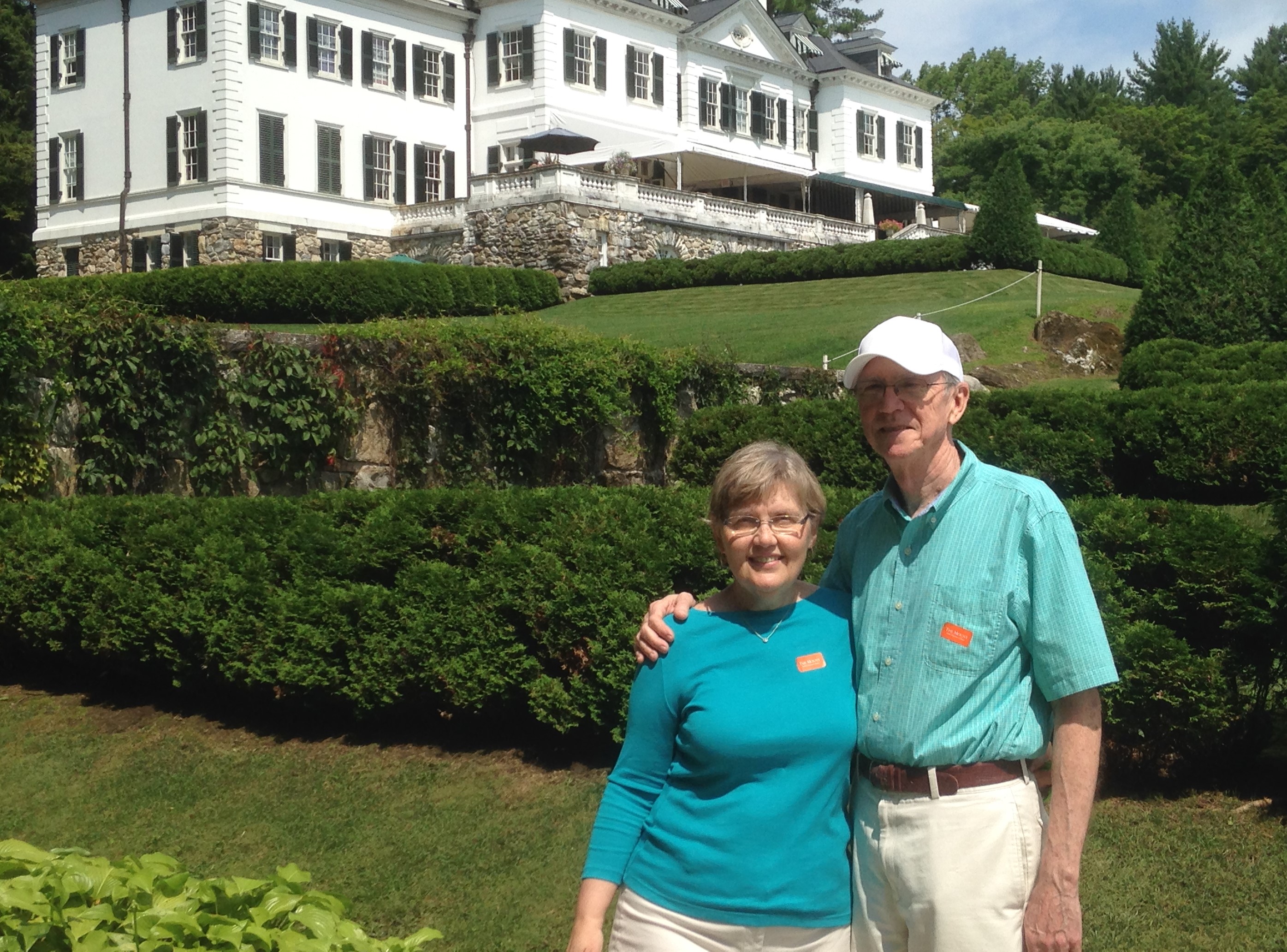
Jean Sonntag with her husband Bill at Edith Wharton’s home, The Mount, in the Berkshires.
This re-introduction to Christie made me want to learn more about the mystery genre, so I turned to my friend Jean Sonntag with some questions. Jean is an adjunct instructor of English at Howard Community College as well as a mystery enthusiast. Here’s what she had to say about Christie and the development of the mystery genre.
Laura: How would you describe Christie’s kind of mystery-telling and our contemporary mystery-telling?
Jean: There is a huge difference. The key thing is the emphasis in Christie on solving a puzzle to the subordination of characterization, psychological analysis, or any larger themes. Christie was part of a group called The Detection Club who had a quite elaborate set of rules for writers of detective stories in the 30’s. In short, everything should be there so the reader could solve the puzzle. Writers, of course, violated these rules at times. The tradition of ratiocination (Poe’s word) and very often an eccentric detective were part of the development of this 30’s Golden Age and Christie fits this tradition, particularly with Hercule Poirot.
Today’s detective story leaves room for more in-depth characterization and is minus the formulaic considerations of the detective stories of Christie’s era. Thus, someone like Elizabeth George’s Inspector Thomas Lynley and P.D. James’ Adam Dalgleish have a history that unfolds throughout the works while they are solving crimes committed by complex characters in complex situations. The modern detective story tends to be longer, more in depth, with more sophisticated style in many cases. And some have themes; P.D. James has pointed out that she sets out to write a detective story as any one would a novel, where the plot is a natural outgrowth of plot and setting.
Laura: Beyond the experience of thrill or curiosity, what do you think draws people to mysteries like Christie’s?
Jean: Reading Christie is a thinking (not feeling) exercise. Her works are not exceptionally long and her style is relatively simple, with pretty good dialogue. Those attracted to puzzle solving or who are reading strictly for entertainment love her. All of us have times we’d like to read like that – consider that layover in an airport or the need for pure escape. Interestingly enough, many of my friends who are Christie fans cut their teeth on her as middle or high schoolers. I came to Christie late, so the meatier mystery appeals more to me unless I need that strictly lighter entertainment option.
In addition, Christie and the other Golden Age writers got their start between the two world wars. I think this really supported their popularity as it was a time when readers badly needed stories where everything was tied up neatly at the end. Even today, one school of thought says we read mysteries because we like to have that sense of closure. More modern detective or crime novels sometimes leave us with more modern senses of ambiguity or disquiet, but I still think the solving of the crime still meets that need today.
Laura: What are your thoughts on Agatha Christie? How would you describe her influence in the mystery genre?
Jean: Although Christie is part of that rational puzzle approach to the mystery, she has had incredible success for a variety of reasons. One is the sheer number of works she produced – over 80 detective (or thriller) novels, and over 90 novels total over a 50-year career. The second is the fact that she escapes a bit of the label of formula fiction because of the variety of her detectives, the ingeniousness of her puzzles and the variety in settings. The relative simplicity of her style also made it easier to translate her works into other languages. At one point, she was second to the Bible in the number of languages in which her books have appeared.
Laura: Is there a writer writing now (or recently) that you’d compare to Christie?
Jean: Someone more expert than I might have a candidate for this comparison. I don’t think there is anyone who compares because the nature of the detective story has changed so much, and because I doubt anyone will come close to her huge output.
I do see influences, however. One is what we now call the “cozy mystery” – a set of writers who minimize the goriness of the crime and focus more heavily on solving the mystery but also provide more character development. Someone once said that in Agatha Christie, the representation of the crime itself is nothing more than a bloodstain left on the floor, so the cozies are in this tradition.
The other influence is the tradition brought to perfection in Miss Marple, a detective whom no one suspects of being involved and therefore one who can pick up clues where others couldn’t. This sort of detective, always an amateur, is also usually a feature of the cozy mystery. One of my favorites that fits this bill is Alan Bradley’s series (The Sweetness at the Bottom of the Pie is the first one) with a precocious child detective Flavia de Luce. No one suspects her as she solves crimes.
Jean calls herself an enthusiast rather than an expert, but certainly I learned a great deal from this crash course in mystery. I think my reading of Christie and other detective novels, crime novels, mysteries, and thrillers will be a bit richer for it. Jean is hoping to teach a continuing education course on the topic sometime in the near future, and I bet the mystery enthusiasts of Howard County will thoroughly enjoy it.
Laura Yoo
HoCoPoLitSo Board member and Associate Professor of English at Howard Community College.
mana’s musing: experimenting with book spine poetry
Books aren’t for just reading. They’re for taking off the shelf, stacking, rearranging, and creating. (Click on the photo for a clearer and prettier view.)
*****

back when we were grown ups
we stood on such a full sea
to count the waves
blessing the boats
daring greatly
and we journeyed to the center of the universe
to find a room of one’s own
under the tuscan sun
or where the sidewalk ends
*****

under the unbearable lightness of being
things fall apart
for everything that rises must converge
but the spirit catches you and you fall down
into quicksand
passing
into paradise
with your crooked little heart
*****

the things they carried
under the warmth of other suns:
home
despair
earthly possessions
hard laughter
immortality
slowness
laughable loves
and
the secret history
of fates and furies –
and so now you know when the men are gone
*****
Now, your turn.
Laura Yoo HoCoPoLitSo Board member and Associate Professor of English at Howard Community College.
mana’s musing: what do poets do all day?
Yes, I know. Poets write. But surely they don’t write all day, every day. They do other stuff.
As a HoCoPoLitSo board member and Howard Community College’s faculty, sometimes I get to see (somewhat) up close what writers do when they’re working away from their desks. On April 28th, HCC and HoCoPoLitSo celebrated Blackbird Poetry Festival with poets Marie Howe and Sandra Beasley, and I got to see Ms. Howe and Sandra at work.
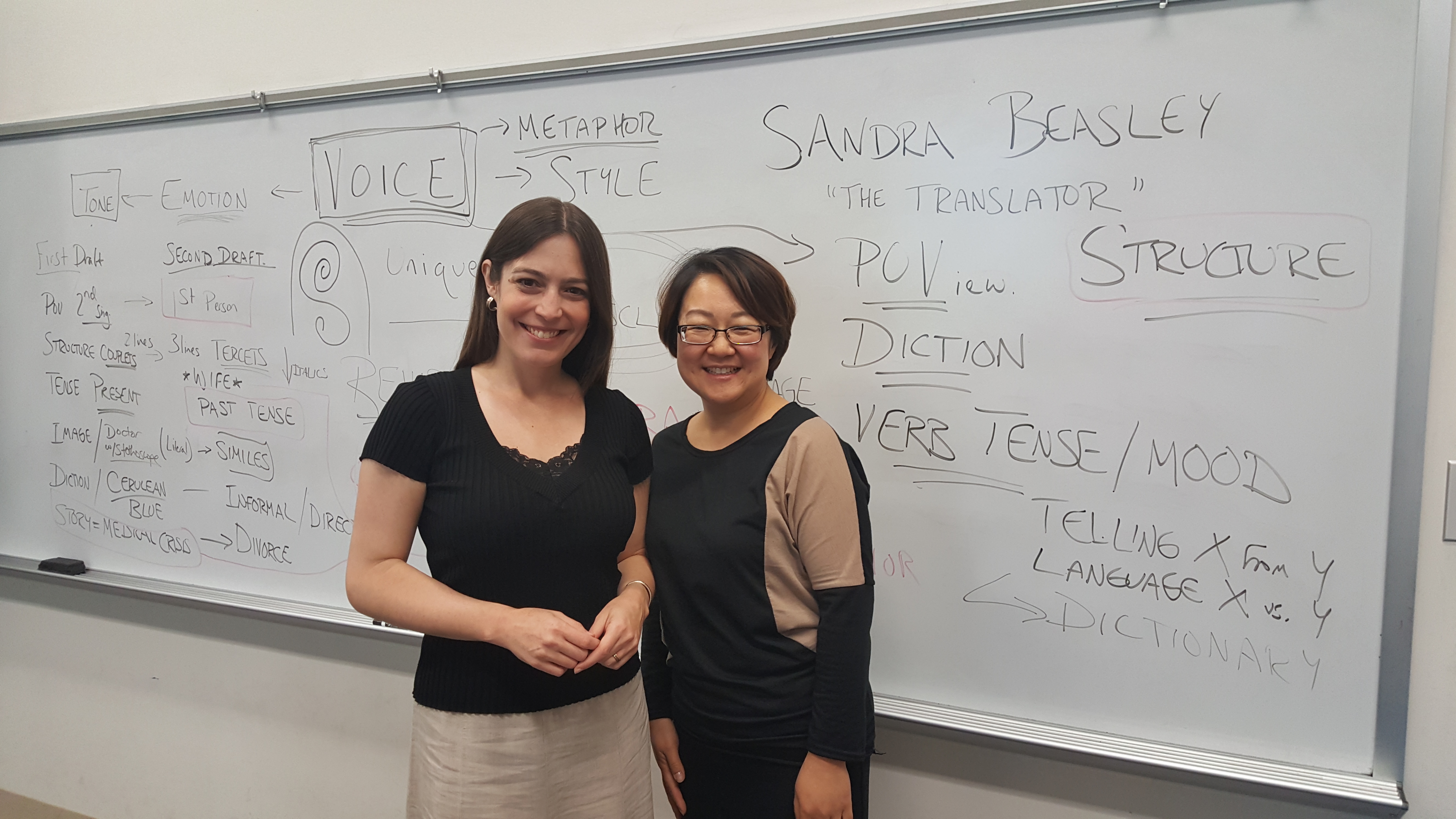
Sandra Beasley visited my composition class on April 28th
The poets came to HCC campus for morning workshops with students. While Ms. Howe visited a literature class, Sandra came to my 11 am composition class to talk about voice and revision. The talk was spot on. She was enthusiastic and attentive to the students. She worked hard during those 80 minutes.
After the morning workshops, the poets attended an informal lunch with some friends of poetry. In the mid-afternoon, from 2:30 to 4:30, they were the feature poets at the Blackbird Poetry Festival’s day reading where they shared the stage with Maryland Poetry Out Loud winners and other student- and faculty-poets. Both Ms. Howe and Sandra went on stage two different times and read several works each. They engaged with the student poets, coached them, and talked to them about the work of poetry and the performance of poetry. When the afternoon reading ended, the poets went to tape The Writing Life interview, where Sandra interviewed Ms. Howe.
At 7:30 pm, our evening event, Nightbird, began. Ms. Howe gave another beautiful reading and Sandra was in the front row listening with the rest of us. And after the reading, Ms. Howe signed books. At this point, it was almost 9 pm. Nonetheless, when I went up to Ms. Howe with a book, she engaged me in a conversation about my own work at HCC. She did the same with the others who approached with books clutched to their chests. She was kind, thoughtful, and engaged with her fans. So gracious. Sandra, too, stayed to chat with the audience in the lobby, and I couldn’t help but smile when I saw her get in line to get Ms. Howe’s book signed.
Poets work hard. I know that much.
I suppose some work harder than others. And I imagine there are writing divas (and divos?) out there who demand only green M&Ms in their “dressing rooms,” but most of the writers that I have met through events like the Blackbird Poetry Festival work hard from morning til late into the evening to read, talk, meet, greet, and shake hands. They take photos, they answer questions, they sign books with personal messages, they ask questions of their fans, they tell stories, and they joke. Most importantly, they connect. They connect themselves to the readers, the poetry to the poet, and poetry to life. Real life.
They say writing is a lonely task, much of it done in solitude. The labor of writing takes discipline, craft, and hard work. But then there is the work that many poets do away from their desks and sometimes very far from home. Sandra Beasley, for example, was off to Massachusetts the day after her performance at Blackbird. Sometimes HoCoPoLitSo’s Irish Evening writers fly in from Ireland just for a few days for a reading or two. So, it seems to me, that so much of the writer’s work is also the people-work.
At readings, I see them scribbling, flipping through their works, and making changes to their reading list. I see them taking notes, listening to the others, and observing what is going on in the room and who showed up. The best poet-performers listen and watch. They don’t stand up and read the words on the page in a vacuum. Never. These poets – the good ones, anyway – make the reading unique to that moment for that group of people. And what they create during that reading cannot be recreated.
They interview each other like they do for HoCoPoLitSo’s The Writing Life series: E. Ethelbert Miller interviewing Amiri Baraka, Roland Flint interviewing Lucille Clifton, or Naomi Ayala interviewing Martin Espada. And they also collaborate with other artists like when Steven Levya performed his poetry with Josh Soto on drums, when Rita Dove shared the stage with violinist Joshua Coyne, and when Patricia Smith performed her poetry with a string quartet.
So, I think that the work of the poet is not so isolated or so esoteric. As Susan Hobby wrote about Ms. Smith’s performance, “An artist works alone in a garret, her solitary room the site of revelation. Or not.”
And if you care to read/see more: Just for fun – here’s a catalog of some of what I have witnessed writers doing (with photos):
- In college, I went to a Maya Angelou reading and she came onto the stage singing. So, sometimes they sing.
- When I met Grace Paley she sat in a circle with 15 college students to read and talk about her stories. And changed lives.
- Derek Walcott had dinner with English graduate students and entertained their very silly questions.
- Lucille Clifton attended HoCoPoLitSPo board meetings on Saturdays.
- Julie Otsuka had lunch with students and told stories about her craft. And later, after her reading, she spoke with community members about her book, When the Emperor was Divine.
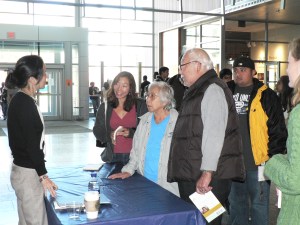
Julie Otsuka’s HCC visit 2009
- I’ve seen David Mura stand on stage and inspire HCC faculty and staff with his talk on the Hero’s Journey.
- I saw E. Ethelbert Miller stand at a podium in the lobby of Columbia Art Center and command a crowd on a cold, snowy February night.
- Emma Donoghue wrote the screenplay for novel-turned-movie Room and got nominated for an Oscar. But, more importantly, she came to Columbia for an Irish Evening reading in 2015.
- I’ve seen Martin Espada, a former tenant lawyer, make small talk about the weather in the car ride between the hotel and HCC, then getting on stage to deliver “Imagine the Angels of Bread” and send goosebumps on the arms of the many in the audience, including me.
- Joseph Ross is a high school teacher, and I’ve read his wonderful blogs capturing his experience of teaching as a Poet-in-Residence for HoCoPoLitSo. Here’s one about River Hill High School.
- Ann Bracken facilitated poetry workshops for prisoners at a correctional facility in Jessup, Maryland.

Special Delivery! Home No Home by Naoko Fujimoto (and tea!)
- Laura Shovan, Sandra Beasley, and Derrick Weston Brown also worked as Poet-in-Residence for HoCoPoLitSo and worked with Howard County high school students.
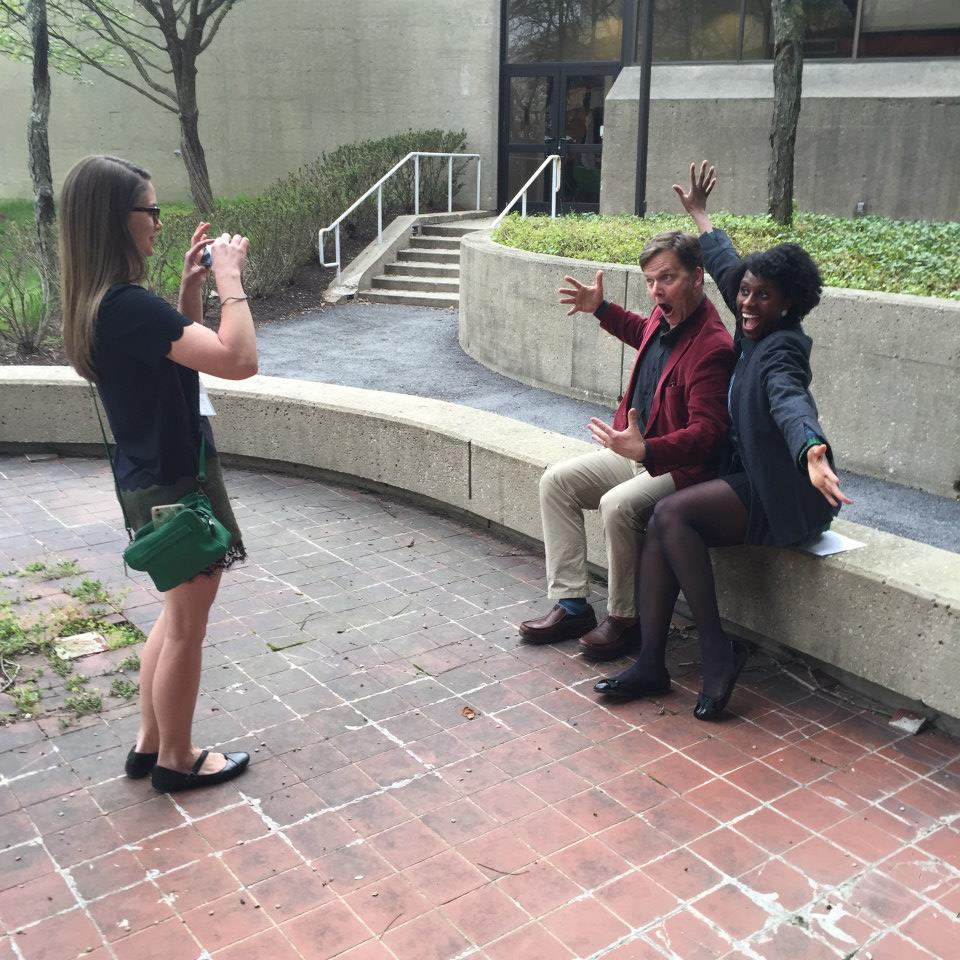
- Taylor Mali speaks about and for the teachers and advocates for the profession of teaching – and he poses for silly photos with students (see below). I’ve seen him speak to community college English professors. I’ve also seen him coach a Poetry Out Loud competitor on how to improve his performance.
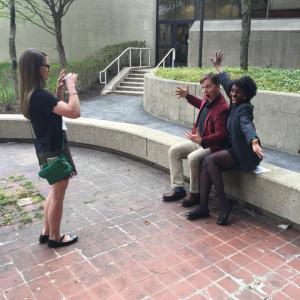
Who says poets can’t be silly? In 2015, Taylor Mali poses with Nsikan Akpan
- When Eamon Grennan came to read for Irish Evening this year, he fought a terrible cold and probably exhaustion from traveling to not disappoint his fans. And indeed we were not disappointed.
- Steven Leyva is the editor of The Little Patuxent Review and teaches at the University of Baltimore. He also did professional development workshops for Howard County Schools teachers and gave us a little taste of New Orleans in the coolest poetry reading with a drummer.
- Naoko Fujimoto, a poet I mentioned in my last blog, included a personal note with my book order (and special tea).
-

Student Katy Day taking a selfie with Billy Collins at Blackbird Poetry Festival 2014.
Billy Collins does really cool stuff like creating animation for his poetry and reading at Blackbird Poetry Festival – and he poses for silly photos with students.
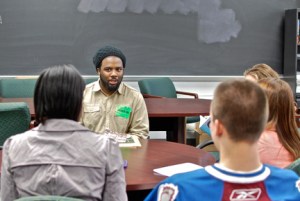
Poet Derrick Weston Brown speaks with students at Atholton High School. (Photo by Paige Feilhauer)




 HoCoPoLitSo