



Read Our Annual Report
six questions with Kenneth Carroll and Marlena Chertock

Kenneth Carroll and Marlena Chertock are the feature writers at the December Wilde Readings, a monthly community open mic supported by HoCoPoLitSo. Join Kenneth and Marlena as well as other open mic readers for a free reading on Zoom (and Facebook Live) on Tuesday, December 14 at 7 p.m. Click here to register for the free event. Click here for more details about the event.
We asked Kenneth and Marlena our favorite six questions about their reading and writing, and here’s what they had to say.
Who is the person in your life (past or present) that shows up most often in your writing?
Kenneth: My mother.
Marlena: I often write autobiographical poetry, so I guess I show up most in those pieces. My short stories focus on science fiction about climate change. I’m drawn to writing about astronauts, especially unlikely ones — the astronauts I’ve written about are disabled, mentally ill, young, or stuck on Earth due to too much space trash.
Where is your favorite place to write?
Kenneth: Any place where I’m supposed to doing something else.
Marlena: I tend to write on my computer because I have terrible handwriting and am a fast typist. But if I’m spending time outside on a nice day, I sometimes remember to bring a journal. Writing under trees is especially inspiring and calming.
Do you have any consistent pre-writing rituals?
Kenneth: Review my notes.
Marlena: Not really. I tend to write when the inspiration strikes, which is always at random times. Often when I should be sleeping.
Who always gets a first read?
Kenneth: The ancestors.
Marlena: I share pretty much every single poem and shitty first draft with my friend Codi, who was in the Jiménez-Porter Writers’ House with me at the University of Maryland. It’s nice to stay in the habit of sharing writing, which can be so isolated. But I’ve been grateful to have found such a welcoming writing community in the Washington, D.C. area.
What is a book you’ve read more than twice (and would read again)?
Kenneth: August Wilson, Two Trains Running
Marlena: Fahrenheit 451 by Ray Bradbury and Her Body and Other Parties by Carmen Maria Machado.
What is the most memorable reading you have attended?
Kenneth: Lucille Clifton at St. Mary’s College.
Marlena: I was so lucky that Patricia Smith visited my class at the Jiménez-Porter Writers’ House when I was a junior. She was such a gracious visitor, taking all our questions and reading some of our baby poems. When she took the stage for her reading that night, her whole presence shifted. Her voice, her cadence, her power — it was palpable!
Kenneth Carroll is a native Washingtonian whose poetry has appeared in Icarus, In Search of Color Everywhere, Potomac Review, Worcester Review, Obsidian, Words & Images Journal, Indiana Review, American Poetry: The Next Generation, Beyond the Frontier, Gargoyle, Spirit & Flame, and Penguin Academics Anthology of African American Poetry. His book of poetry is entitled So What: for the White Dude Who Said This Ain’t Poetry, published by Grace Cavalieri. He is former director of DC WritersCorps and the African American Writers Guild and a former Pushcart nominee. He is married and the proud father of a daughter and two sons.
Marlena Chertock has two books of poetry, Crumb-sized: Poems (Unnamed Press) and On that one-way trip to Mars (Bottlecap Press). She uses her skeletal dysplasia as a bridge to scientific poetry. She is queer, disabled, and a 2020 Pushcart Prize nominee. Marlena serves as Co-Chair of OutWrite, Washington, D.C.’s annual LGBTQ literary festival, and on the Board of Split This Rock, a nonprofit that cultivates poetry that bears witness to injustice and provokes social change. Her poetry and prose has appeared in AWP’s The Writer’s Notebook, Breath & Shadow, The Deaf Poets Society, Lambda Literary Review, Little Patuxent Review, Noble/Gas Quarterly, Paper Darts, Paranoid Tree, Plants & Poetry, Washington Independent Review of Books, WMN Zine, Wordgathering, and more. Find her at marlenachertock.com and @mchertock.
Climate change is scary, and cli-fi short stories are here to help
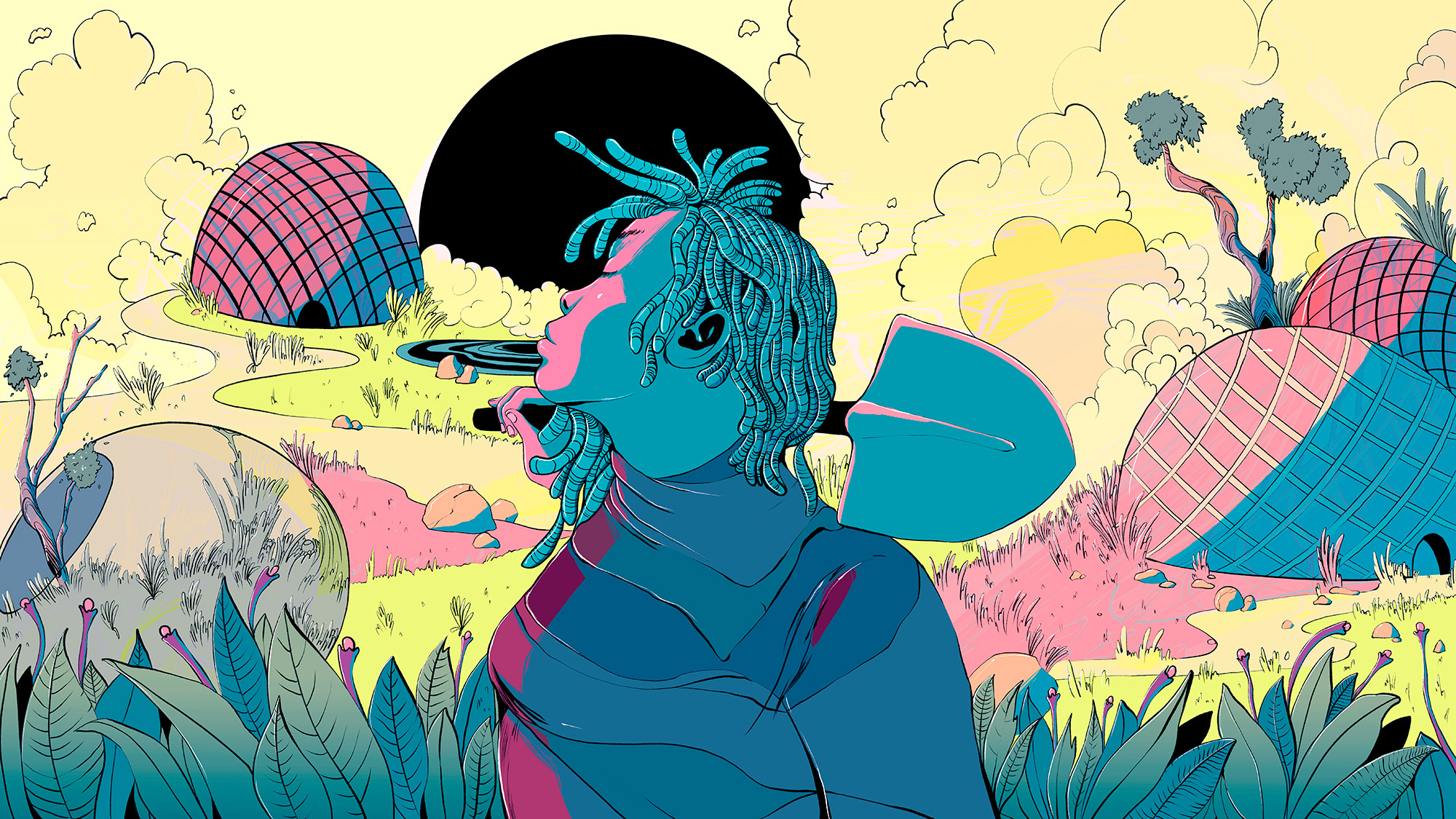
“Right here, right now is where we draw the line. The world is waking up. And change is coming whether you like it or not.” — Swedish climate activist Greta Thunberg, age 18
Change is coming, both in the climate, and with luck, in human behavior. Reading about climate change is frightening, and sometimes shuts people down. But as many climate activists have explained, there is hope.
Environmental and animal activist Jane Goodall said it well: “I do have reasons for hope: our clever brains, the resilience of nature, the indomitable human spirit, and above all, the commitment of young people when they’re empowered to take action.”
But reading alarmist nonfiction doesn’t always reach the heart. Story, however, seems to sneak through our defenses and climb straight into our souls. Climate fiction, a genre of literature sometimes shortened to “cli-fi,” pioneered with J. G. Ballard’s novels of climate change (especially the 1962 classic The Drowned World) and Frank Herbert’s 1965 novel Dune.
Since March 2019, HoCoPoLitSo and climate educator Julie Dunlap have led a climate fiction book club through the Howard County Library. Attenders are interested in literature that explores the facts and mysteries of Earth’s changing climate, and have read and discussed eight incredible novels over two years.
We’re mixing things up in January, and have chosen to read the award winners of a climate fiction short story contest sponsored by Grist Magazine’s Fix Solutions Lab. Organizers of the contest, Imagine 2200: Climate Fiction for Future Ancestors, urged writers to envision the next 180 years of equitable climate progress.
Sponsored by the National Resources Defense Council, the contest is “an uprising of imagination,” as Fix describes it. The winning stories, a collection of a dozen short pieces of fiction by authors including Black, Indigenous, disabled, and queer authors, conjure hope, anger, frustration, joy, and contemplation about the future of our planet in the impending climate crisis.
“Whether built on abundance or adaptation, reform or a new understanding of survival, these stories provide flickers of hope, even joy, and serve as a springboard for exploring how fiction can help create a better reality,” writes Tory Stephens, who works at Fix and spearheaded the contest.
Join us in reading a dozen of these stories and discussing them on Jan. 6, 7 to 8 p.m., at the Miller Branch Library. Register here. The stories, and a terrific glossary of cli-fi terms, including afrofuturism (looking at you Octavia Butler), solar punk and ecotopia, are available here.
blog post by Susan Thornton Hobby, HoCoPoLitSo recording secretary and a leader of the Inconvenient Book Club
Six Questions with Kristin Kowalski Ferragut and Lucinda Marshall

Kristin Kowalski Ferragut and Lucinda Marshall are the feature writers at the November Wilde Readings, a monthly community open mic supported by HoCoPoLitSo. Join Kristin and Lucinda as well as other open mic readers for a free reading at the Columbia Art Center (and virtual) on Tuesday, November 9th at 7 pm. See details about the event below.
We asked Kristin and Lucinda our favorite six questions about their reading and writing, and here’s what they had to say.
Who is the person in your life (past or present) that shows up most often in your writing?
Kristin: Notably my children, my dad, me or previous me(s) from different days, men I love(d), and friends who have died show up often in my writing. It’s not usually what it seems at face value. For instance, I may be writing “you” in a poem exploring love or estrangement, but the “you” might be pieces of me and a composite of others real and maybe more fictional characteristics that represent wishes, fears, or possibilities.
Lucinda: I have a number of first person poems, so I think I would have to say that I am that person. My work covers a broad range of topics, and even when the poem isn’t personal, my point of view is reflected in virtually everything I write.
Where is your favorite place to write?
Kristin: I could stare out on nature maybe forever, at least longer than I’ve ever tried. It puts me in a meditative, often melancholy state from where I’m better able to access images. I write mostly in my Nook in my room looking out on our trees, squirrels, birds. I love getting away to look out other windows on woods and sky. Sometimes I write outside. When it’s cold I have a little portable writer’s fort I like to go out in, especially in the snow. (Here’s the story on that: https://www.kristinskiferragut.com/post/writing-fort)
Lucinda: Where I am. I don’t have a specific writing place. I’ve written in the shower, on planes, in doctors’ offices, standing in the checkout at the grocery store, under the covers with a flashlight. And I’m not picky about what I write on. I have a lot of blank notebooks that are never in the right place at the right time. One of the poems in my book, “Serenity Prayer For Singular Existence” was written on my forearm when I couldn’t find any paper.
Do you have any consistent pre-writing rituals?
Kristin: I prefer writing in the morning and usually jump in pretty quickly. I tend to grab coffee, sometimes tea, and seltzer water, light a candle, and start the writing/window staring. I do have a writing mix on Spotify, the songs are instrumental or in other languages, sometimes I play it. When I’m outside, well, there’s not much better than musing to the tune of a moving river or calling birds.
Lucinda: I don’t. The best way for me to get writing is to be in the middle of something else that has an imminent deadline or otherwise deters me from having writing time. Those are usually the times I am suddenly struck with inspiration.
Who always gets a first read?
Kristin: There’s no one person that consistently reads my work first. It’s kind of a lovely dream to imagine one. I belong to three writer’s groups — DiVerse workshop, La Mads, who used to meet out of La Madeleine’s in Bethesda, and Gaithersburg Writers. I do as little Zoom as possible so my attendance to these groups has been spotty for the past year and a half, but I trust them with new and fragile work. I have a few friends who will also sometimes read early work and offer feedback, for which I’m grateful.
Lucinda: There is no one specific person.
What is a book you’ve read more than twice (and would read again)?
Kristin: I got the poetry collection “And Her Soul Out of Nothing” by Olena Kalytiak Davis around ’97/’98. Since, I’ve shared it with many people and often reread before sharing, wondering, is it really as good as I remembered? And always come back to Yes, it is. Another one I give away a lot, and thus revisit a lot is Sam Shepard’s short stories, “Cruising Paradise.”
Lucinda: There are so many, among them Kristin Kowalski Ferragut’s “Escape Velocity”, truly a stunning collection and I’m thrilled to be reading at Wilde with her.
What is the most memorable reading you have attended?
Kristin: I believe it was May 2019, the last live Gaithersburg Book Festival. Lucinda organized the poetry that year and it was awesome! I sat under a tent all day while incredible poets spoke before me — Grace Cavalieri, Reuben Jackson, Ethelbert Miller, Katherine Young, Rose Solari, Alan King… And while I listened my son drifted about the festival collecting hugs. Beautiful day!
Lucinda: Oh Goodness–all of them. I don’t think I’ve ever gone to a reading where there was not something memorable. When I was mentoring the Gaithersburg Teen Writing Club we held a few readings for parents and hearing the kids get up and read the work that we had been workshopping was really a thrill.
About November Wilde Reading
Register for our event at: WildeReadingsHoCo@gmail.com
You can sign up for the open Mic either by sending an email to: WildeReadingsHoCo@gmail.com
Registration for the in person event will be limited. All attendees must follow Columbia Art Center Covid protocols.
We encourage attendees to participate in the open mic. Please prepare up to five minutes of performance time/two poems. Sign up when you arrive.
About Our Guests Kristin and Lucinda
Kristin Kowalski Ferragut teaches, plays guitar, hikes, and supports her children in becoming who they are meant to be. She is author of the full-length poetry collection Escape Velocity (Kelsay Books, 2021) and the children’s book Becoming the Enchantress (Loving Healing Press, 2021). Her poetry has appeared in Beltway Quarterly, Nightingale and Sparrow, Bourgeon, Mojave He[Art] Review, Anti-Heroin Chic, Fledgling Rag, and Little Patuxent Review among others. For more information see her website: https://www.kristinskiferragut.com/
Lucinda Marshall is the author of Inheritance Of Aging Self (Finishing Line Press, 2021). She lives in Gaithersburg, MD where she is the Founder of DiVerse Gaithersburg Poetry Reading, and helped create the Local Poets collection at Quince Orchard Library. Lucinda is also an accomplished mixed media and fabric artist.

We’re Cooking Up a Feast of Words
It’s a poetry potluck with Sandra Beasley, Steven Leyva, Alan King, and Naomi Ayala in a virtual poetry reading from their own kitchens!
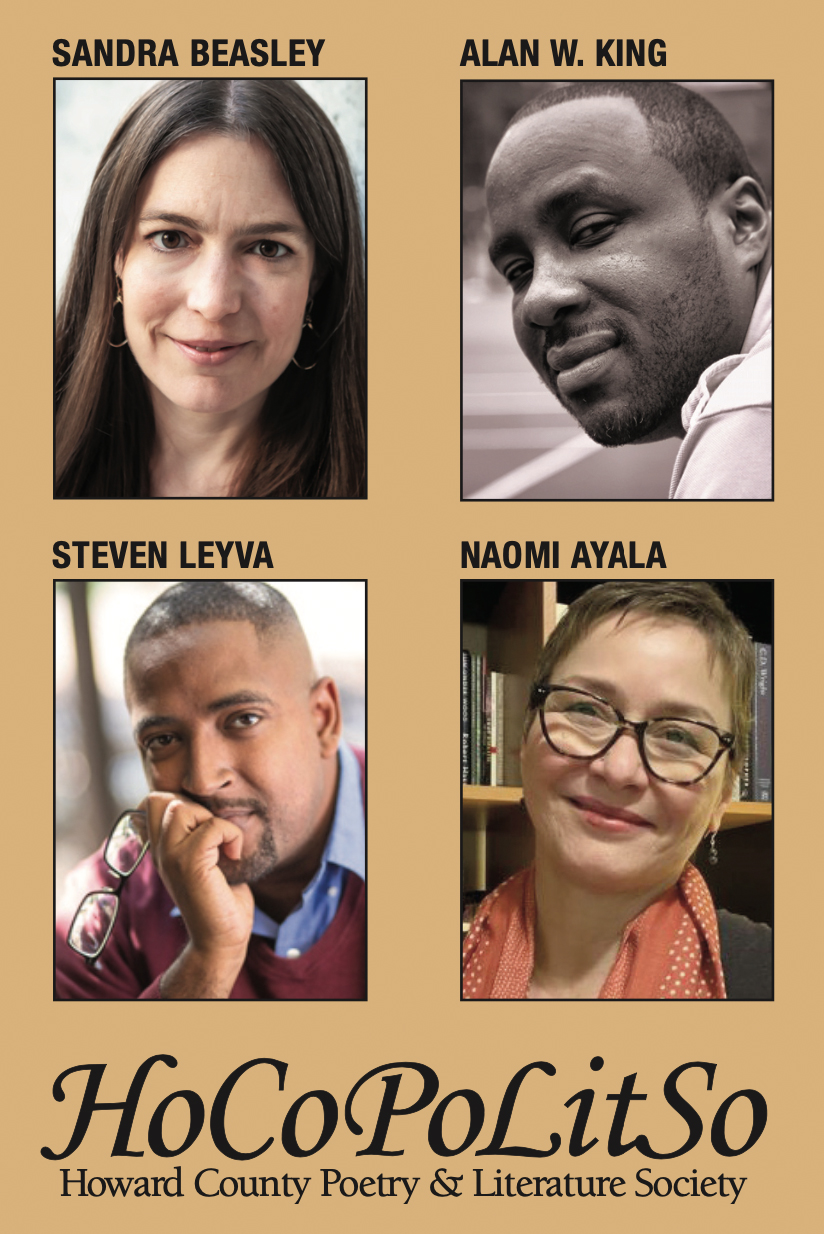
HoCoPoLitSo opens its 47th literary on Friday, November 5 at 7 p.m. with a virtual Poetry Potluck. Join Sandra Beasley, Alan King, Steven Leyva and Naomi Ayala, each live from their own kitchen, as they read and discuss a feast of food-inspired poetry, and maybe even share a favorite recipe.
As the 2021 Lucille Clifton Reading Series event, Poetry Potluck celebrates the beloved Lucille Clifton, HoCoPoLitSo’s longtime artistic director and first writer-in-residence in the Howard County School System. With technical and artistic support by Howard Community College’s Arts Collective, this year’s program features four writers who have also served as HoCoPoLitSo’s literary ambassadors in the school system.
The program honors 30 years of providing a writer-in-residence to the Howard County public high schools. The evening will also honor Howard County teachers with FREE admission* and a special message from poet Taylor Mali, author of “What Teachers Make: In Praise of the Greatest Job in the World.” (See video clip below for a little teaser.)
Poetry Potluck – Verse in Good Taste
Friday, November 5th at 7 p.m.
An Online Reading live-streamed from kitchens of poets and former writers-in-residence Sandra Beasley, Steven Leyva, Alan King, and this year’s poet Naomi Ayala.
10 general admission*
Reservations required via HCC Box Office
Click here to make your reservation: https://ci.ovationtix.com/32275/production/1080760
*Howard County teachers with a valid @hcpss.org email can request a complimentary ticket by emailing BoxOffice@howardcc.edu
wilde readings feature authors Nishi Chawla and Kathleen Hellen
Nishi Chawla and Kathleen Hellen are the feature writers at the October Wilde Readings, a monthly community open mic supported by HoCoPoLitSo. Join Nishi and Kathleen as well as other open mic readers for a free, virtual reading on October 12, 2021 from 7 pm to 8:30 pm. See details about the event below.

We asked Nishi and Kathleen our favorite six questions about their reading and writing, and here’s what they had to share.
Who is the person in your life (past or present) that shows up most often in your writing?
Nishi: There is no specific person whose image gets repeated in my writings. I would suggest that the theme of what I write is what ‘shows up most often in my writing.’ The theme assumes a persona, a kind of living personality. This is often a ‘recollection’ kind of figure as it holds together moments and memories, important aspects of personality along with other parts, like traits of temperament, goals and objectives. This thematic persona assumes the shape of a recent history. It gets wrapped in the web of some urgent questions of the present and future that I try to focus on.
Kathleen: My mother, and more recently my son
Where is your favorite place to write?
Nishi: The solarium is my favorite place to write as the morning rays plunge the room with its unique and faultless solar energy. “Drought became us / Turned us into grains of sand / The blithe breeze that poets sung of / Weren’t that kind to us / When they were done caressing their faces / And having their way with the locks of women’s hair, / They turned a new leaf for a new story” – A A Surin
Kathleen: Anywhere–in the car I write on backs of envelopes, receipts, any available scrap of paper, on walks, in parking lots, on the La-Z-Boy beside the statue of Lord Shiva, on the couch with a legal pad and staring out the window, in bed on unlined tablets beside the pile of books, at the computer in the morning, at the computer at night, in front of the tv on yellow Post-It notes, on beaches with my pocket-sized spiral notebook, in hotel rooms on guest notepads, on planes and waiting at the airport …
Do you have any consistent pre-writing rituals?
Nishi: My writing process is like an implosion within me. I wrap my mind around an idea that bursts into me and sometimes, surprises me to my own inner self. I do not often see clearly where I should go with it. When the way forward seems nebulous, ideas creep around me from behind me, almost my stealth, and crowd my other thoughts out. Sometimes, the outburst seems too condensed and waits to be fleshed out. The flow of words gets blocked, and the dialogues come out broken and need some agility. The sounds and rhythms, the breaks in logic, any unnecessary verbiage, the indiscriminate voices of the individual characters, the hunger in my belly for the right word, the right way to convey my message or project my vision, are all important rituals of my pre-writing process.
Nishi: As soon as I wake up, I put on coffee, stretch, write my dream thoughts in the black-and-white marble composition notebook, then I get to work.
Who gets the first read?
Nishi: My own lonely self. “I saw an otter lying dead at the edge of the creek, / body flaccid, scaled like that of a bird’s. / That was also the time we swung our palms loose, / heading down February over a speed bump, and our mothers- / calling us out, yet the distance too large and the gravity too strong / for us to hear their voices. / It was the way we slid over frozen ice – the carelessness, / the tangling of bones, that reminds me of how / this time and that time was all but a series of endings.” – S Verma
Kathleen: Usually, it’s just me.
What is a book you’ve read more than twice (and would read again)?
Nishi: I have read many books multiple times. I have found Gandhi’s My Experiments with Truth quite mesmerizing even as I try to understand the flawed human being behind the mask of a great and flawless human. “everything comes around from water / to dust, betrayal to trust / you have to recognize the small alphabet a and distinguish it / from the capital A observing the pressure on the fingers that write / trace you must contours on the bark you lean on to / and it will all come to you / Do not look for us when we are not around for we are the moon quivering / upon the night’s lake and the puppet shadows appearing disappearing / beyond us / we are the trees that long for the roots as much yearn the high sky.” – Shelley Bhoil.
Kathleen: Thich Nhat Hanh’s No Death, No Fear
What is the most memorable reading you have attended?
Nishi: A striking and indelible reading that I attended was at Politics and Prose. Amitava Ghosh read from his novel, A Sea of Poppies. Ghosh’s ibis trilogy blew my mind at the level of in depth research he has done. And what a contrast to “Sea Poppies” by H.D.: “Amber husk / fluted with gold, / fruit on the sand / marked with a rich grain, / treasure / spilled near the shrub-pines / to bleach on the boulders: / your stalk has caught root / among wet pebbles / and drift flung by the sea / and grated shells / and split conch-shells. / Beautiful, wide-spread, / fire upon leaf, / what meadow yields / so fragrant a leaf / as your bright leaf?”
Kathleen: Most recently, Tin House’s online reading and interview with Arthur Sze

The First Annual Ellen Conroy Kennedy Poetry Prize.
Deadline extended, prizes, publication.

The new annual Ellen Conroy Kennedy Poetry Prize honors our dear co-founder (1932-2020) and supports HoCoPoLitSo’s live literary programs.
The winning poet will be awarded a cash prize of $500, provided by the Friends of HoCoPoLitSo. The winning poem will be published in The Little Patuxent Review and HoCoPoLitSo’s website. Additionally, the winning poet will be celebrated with a press release, on social media, in a blog interview, and in the annual report. A second prize winner will also be selected and awarded $100.
Eligibility: We welcome submissions from poets all ages and in all styles, including experimental, traditional, and short narrative poems. Each poet may submit one or more previously unpublished, original poems to total no more than 60 lines or three pages. HoCoPoLitSo-appointed judges will consider each poem separately and without identifying author information to select one winning poem of exceptional quality. HoCoPoLitSo Board Members and staff are not eligible to submit.
Evaluation: Each poem will be judged separately and read anonymously.
Reading Fee: $10
Submission Deadline: October 15, 2021 [EXTENDED]
The winner will be notified by November 15, 2021.
Click here to submit your work.
wilde readings feature authors gabor gyukics and sami miranda
Gabor Gyukics and Sami Miranda are the feature writers at the September Wilde Readings, a monthly community open mic supported by HoCoPoLitSo. Join Gabor and Sami as well as other open mic readers for a free, virtual reading on Tuesday, September 14th at 7:00 pm at the Columbia Arts Center. The event will be livestreamed as well. See details about the event below.

We asked Gabor and Sami a few of our favorite questions and there’s what they had to share!
Who is the person in your life (past or present) that shows up most often in your writing?
Gabor: imaginary people from reality
Sami: My Grandfather, and the bass player I perform with Pepe Gonzalez. People I know make up the greater part of my body of work. My work comes from conversations and listening to the stories people have to tell.
Where is your favorite place to write?
Gabor: I can write anywhere
Do you have any consistent pre-writing rituals?
Gabor: Don’t have one. When word hits me I take a note. Weeks or/and months later, I take these notes out and write them down to create poems.
Sami: Conversations with people, other artists, my students
Who always gets a first read?
Gabor: no one
What is a book you’ve read more than twice (and would read again)?
Gabor: Pynchon’s V
Sami: Short History of Monsters by Jose Padua
What is the most memorable reading you have attended?
Gabor: The one with Ira Cohen in NYC and the one with Jack Hirschman in SF, so that’s two – sorry.
Sami: Aracelis Girmay and Ross Gay read together and it was a reading that stuck in my head because of its tenderness and power.
Gabor G. Gyukics, Budapest born Hungarian-American poet, translator, author of 11 books of poetry in five languages, 1 book of prose and 17 books of translations including A Transparent Lion, selected poetry of Attila József in English published in 2006 by Green Integer, an anthology of North American Indigenous poets in Hungarian published in 2015, a brand new Contemporary Hungarian Poetry Anthology in English titled They’ll be Good for Seed published by White Pine Press in 2021. He was honored with the Hungarian Beat Poet Laureate Lifetime award in September 2020 by the National Beat Poetry Foundation, Inc. based in Connecticut.
Sami Miranda is a poet, teacher and visual artist. Originally from the South Bronx, he has made his home in Washington, DC. He is the author of We Is, published by Zozobra Publishing, and Departure published by Central Square Press.
Registration for the in person event will be limited. To register for in-person attendance, email us at WildeReadingsHoCo@gmail.com.
All attendees must follow Columbia Art Center COVID protocols. We encourage attendees to participate in the open mic. Please prepare up to five minutes of performance time/two poems. Sign up when you arrive. Books by featured authors and open mic readers will be available for sale in person and via buying links posted online.
HoCoPoLitSo Announces Inaugural Ellen Conroy Kennedy Poetry Prize

HoCoPoLitSo has created a poetry prize in honor of co-founder Ellen Conroy Kennedy (1932-2020). The winner’s poem will be published on HoCoPoLitSo’s website and the winning poet celebrated with a press release, on social media, in a blog interview, and featured in our annual report.
We welcome submissions from poets of all ages and in all styles, including experimental, traditional, and short narrative poems. Each poet may submit one to three previously unpublished, original poems to total no more than 60 lines or three pages. HoCoPoLitSo-appointed judges will consider each poem separately and without identifying author information to select one winning poem of exceptional quality.
Entries must be submitted September 30, 2021. Each poem will be judged separately and read anonymously. The reading fee is $10. The winner will be notified by November 15, 2021. HoCoPoLitSo Board Members and staff are not eligible. Click here for the submission link.
Kennedy, a National Book Award finalist, co-founded the Howard County Poetry and Literature Society in 1974 and served as chief executive officer until 2005, bringing literary luminaries including Saul Bellow, Edward Albee, Isaac Bashevis Singer, W.S. Merwin, Henry Taylor, Lucille Clifton, Amiri Baraka, Gwendolyn Brooks, Stanley Kunitz, Derek Walcott, Allen Ginsberg and more to Howard County.
“Ellen’s brilliant, discerning love of literature, especially contemporary poetry, inspired the creation of this annual contest in her name. She delighted in nurturing and showcasing new voices who can move, inform, and connect our community through verse,” says Tara Hart, HoCoPoLitSo Co-Chair.
Proceeds will support HoCoPoLitSo’s live literary programs. HoCoPoLitSo’s mission is to cultivate appreciation for contemporary poetry and literature, to celebrate a culturally diverse literary heritage and to broaden exposure to the literary arts. The Writing Life, HoCoPoLitSo’s award winning writer to writer interview show, available on YouTube, has been viewed worldwide over 666,000 times. HoCoPoLitSo is supported in part by the Howard County Arts Council through a grant from Howard County Government, the Community Foundation of Howard County, the Maryland State Arts Council, the Columbia Film Society, Dr. Lillian Bauder, and individual donors.
writers who dare to be Asian
a blog post by Laura Yoo
When I was growing up or even when I went to college and graduate school to study literature, I did not have exposure or access to Asian or Asian-American writers, thinkers, or scholars. My literary repertoire was almost exclusively white British and American writers. My area of focus was the 18th century British novel.
In graduate school, I started taking courses in African-American literature, so my education in race came through writers like Toni Morrison, Alice Walker, and James Baldwin. Later, I turned to contemporary writers like Tyehimba Jess, Claudia Rankine, and Ta-Nehisi Coates. These powerful voices of African-American writers were my introduction to thinking through my own racial identity, about being a person of color in America.
Maybe it was the getting-older and becoming more aware of my identity and my place in the world, but I realized that I wanted a more focused, specialized language to think about being Asian in America – our history, culture, and language. Of course there is diversity in Asianness, for “Asian” is not homogeneous. And so my reading list has been drilling down to more specific voices: from Asian-American, to Korean-American, to Korean-American women. I am craving voices that sound as much like me as possible.
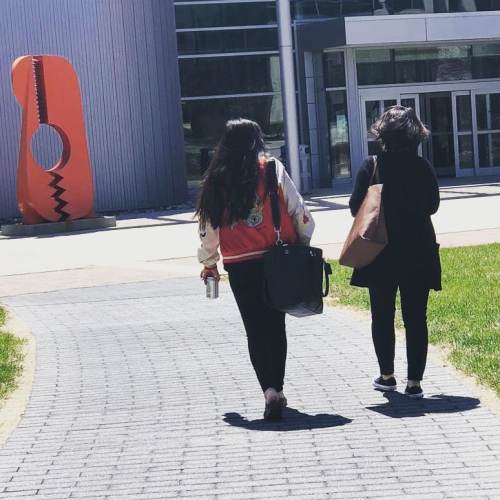
Laura (right) walking with Marilyn Chin (left) between sessions at the 2018 Blackbird Poetry Festival at Howard Community College
Meeting poet Marilyn Chin changed everything for me. I saw her read on that big NJPAC stage at the Dodge Poetry Festival in 2017 and met her at the Blackbird Poetry Festival at Howard Community College in 2018. Her poetry and my conversations with her (yes, I had conversations with her – that’s right – and she called me “my sister!” and hugged me) opened my ears to that Asian-American literary voice that I didn’t know I craved. I said to my friend after meeting Chin: “She’s so brazenly Asian-American.” I had never read literature like Ms. Chin’s Revenge of the Mooncake Vixen. Like, what? Who gave you permission to write like this? She did, of course. She gave herself permission and she did it. And her poetry dared me to be Asian too.
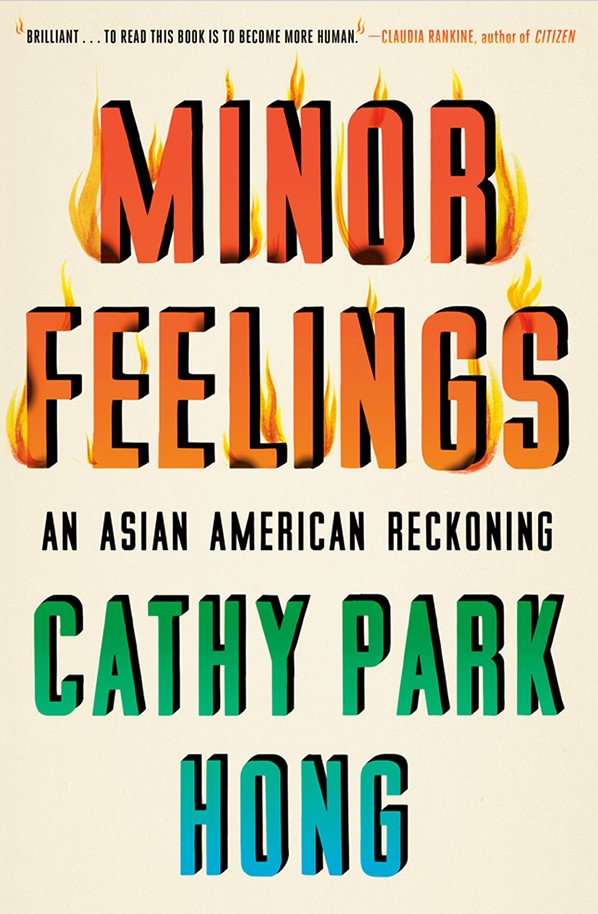
More recently, I came across another writer who is brazenly Asian in her writing: Cathy Park Hong. Her book, Minor Feelings: An Asian American Reckoning, is like nothing I have ever read. In this book, she covers a lot of different topics from history, art, cultural commentary, gender, language, poetry, friendship, family, and love – all through a perspective and voice that are brazenly Asian. Some of it so Korean. It seems like the book is written for me and to me. Hong’s book explains to me why I’m drawn to African American literature, why I feel so hyper-visible and invisible at the same time, why I’m connected to Korea though I haven’t set foot in that country since 1989, and why I feel the way I do toward my mother. As Hong asks, “Does an Asian American narrative always have to return to the mother?” Apparently so.
Hong says, at the end of Minor Feelings, “I want to destroy the universal. I want to rip it down.” And this explains why I want to read books about my people. I’m now reading to learn about myself, not just about how other people live or what other people think. I want to read writers who know me, my family, my language, and my experiences as a Korean and an Asian-American. I want to read works that reflect back to me who I am. I want to read books that explain to me things that happened to me and are happening to me. Specifically.
six questions with Ned Balbo and Jane Satterfield
Ned Balbo and Jane Satterfield are the feature writers at the May Wilde Readings, a monthly community open mic supported by HoCoPoLitSo. Join Ned and Jane as well as other open mic readers for a free, virtual reading on Tuesday, May 11th at 7:00 pm. Register here. Get to know Ned and Jane with our Six Questions.

JANE SATTERFIELD 
NED BALBO
Q: Who is the person in your life (past or present) that shows up most often in your writing?
Ned: I haven’t counted, but Betty & Carmine, my adoptive parents, have racked up quite a few appearances… as have my birth parents, Elaine (Betty’s much-younger sister) & her belated husband Don.
Jane: It would be interesting to take an inventory… my parents (and their parents) show up in my recent book, Apocalypse Mix, in the context of poems about war’s generational impact on soldiers and civilians, and I’m pretty sure that the presence of other women writers and artists—present and past—is strong.
Q: Where is your favorite place to write?
Ned: My home office where files, books, knick-knacks, Golden Guides, drafts & memorabilia are all in easy reach & my lap is available to Wyatt, our affectionate polydactyl cat.
Jane: My second-floor study has plenty of books within reach; I work near a window that offers the welcome distractions of suburban wildlife—the crows, foxes, squirrels, and assorted birds that sometimes make their way into poems.
Q: Do you have consistent pre-writing rituals?
Ned: Nothing consistent. Sometimes I wander the Internet: musing on pop culture trivia that’s crossed my path while thinking about the poem I’m working on, or gathering background information in PDF form for research purposes. Lately, if I’m in the mood for music, I’ll call up Eno via iTunes (Ambient 1, Harold Budd collaborations, Thursday Afternoon, Neroli, Compact Forest Proposal), Sufjan Stevens’ Planetarium, or maybe Andrew Bird’s Echolocations.
Jane: Music and meditation are often helpful, but I don’t have any consistent pre-writing routines. I am, however, a notebook fanatic—I like to collect images, ideas, research notes, opening lines so I never have to face a blank page.
Q: Who always gets the first read?
Ned: Jane. She has a way of just asking questions gently that point me in the right direction if a poem isn’t quite right. I also listen for the degree of enthusiasm she conveys in her always supportive way. If it’s less than I’d like, I know I have more work to do.
Jane: Ned. He has a perfect ear for the soundscape of a poem and asks all the right questions that encourage me to return to the page. I’m lucky beyond belief that his listening also turns my attention to subjects I’ve overlooked, written off, or avoided…
Q: What is a book you’ve read twice and would read again?
Ned: Prose – Jane Austen, Mansfield Park; Zora Neale Hurston, Their Eyes Were Watching God. Poetry – Denis Johnson, The Incognito Lounge; Elizabeth Spires, Globe; Andrew Hudgins, Saints & Strangers; Tracy K. Smith, Life on Mars.
Jane: I’ve cracked the spine of copies of Plath’s Ariel, Shapcott’s Her Book, and Levis’ Winter Stars. I’ll probably do the same with recent favorites like Erika Meitner’s Holy Moly Carry Me and Aimee Nezhukumatathil’s Oceanic. I’ve revisited Michael Ondaatje’s The English Patient and Virginia Woolf’s Mrs. Dalloway more summers than I can count.
Q: What is the most memorable reading you’ve attended?
Ned: A.E. Stallings at Loyola University Maryland in 2019: not only was she gracious & her poems brilliant but she shared extensive footage, photos & anecdotes on her work in support of Syrian refugee families who’ve fled to Athens, Greece (where Stallings lives) – their children especially, whose poems & artwork reflect both hardship & hope.
Jane: I attended a Simon Armitage reading in a pub in Huddersfield back in 1994 that had all the fabulous energy of a football match — Armitage recited his poems and, since Huddersfield is his hometown, there was a palpable sense of poetry’s connection to the community. Several years ago, I hosted Paisley Rekdal in Loyola’s Modern Masters Series the day Guggenheim winners were announced. Paisley read a sequence of Mae West poems that would later appear in Imaginary Vessels — an amazing mini-seminar in the sonnet.
 HoCoPoLitSo